
Clyde Vernon Cessna was born in Iowa on December 5th, 1879. His family moved to Kansas when he was two years old, and he grew up on a farm and began helping out as soon as he was able. Clyde had a natural mechanical ability and loved to take equipment apart and reassemble it. Even from an early age, he used his self-taught skills and a natural aptitude to both improve the efficiency of farm equipment and develop better methods of farming. Eventually, Clyde’s love for the mechanical spread to cars, and he became a successful car dealer in Enid, Oklahoma.
Clyde Cessna built his first aircraft at Enid, Oklahoma, in the spring of 1911. Built and flew several more before moving to Wichita, Kansas, in 1917. Founded Travel Air Manufacturing Company with Walter Beech and Lloyd Stearman on February 5,1925. The Travel Air Manufacturing Company was in es¬sence Waiter Beech, Lloyd Stearman and Clyde Cessna, all backed by Walter P. Innes. In 1926, Stearman quit to go it alone. Cessna followed a year later. Cessna’s bone of contention was that he thought the monoplane was the way to go, while Walter Beech felt there was life left yet in the biplane.
In 1910, Clyde witnessed an aerial exhibition that would dramatically change the course of his life. He was amazed by what he saw at the exhibition and decided to learn everything he could about flying and aviation. Moving to New York, he worked at the Queen Aeroplane Company for a short time, experiencing hangar life and learning how aircraft were constructed. Though Clyde wasn’t there long, he soaked up all the information he could and would use that knowledge to create his first monoplane.
In 1911, finding inspiration from the American version of the Bleriot XI, Clyde created his first monoplane using linen and spruce. This initial creation was known as the “Silverwing,” and was powered by an Elbridge 4 cylinder motorboat motor with 40 hp.
Between 1912 and 1915, he created a number of monoplane designs, all powered by an Anzani 6-cylinder engine, providing between 40 and 60 hp. During this time, he also took to the skies flying for holiday events and county fairs, something which proved surprisingly lucrative. This also earned Clyde Cessna the distinction of being the only man to construct and fly an aircraft between the rugged Rocky Mountains and the great Mississippi River.
In 1916, Clyde acquired a vacant building where he planned to build aircraft for the upcoming 1917 aviation exhibition season. Seeing the demand for aviation growing, he also opened a flight school that ran out of his new factory, quickly enrolling five students. Unfortunately, after the US entered World War 1 in 1917, the exhibition flying market came to a halt, putting a damper on Clyde’s primary source of income. And so he relocated back to his family farm in Kansas and resumed a farming lifestyle.
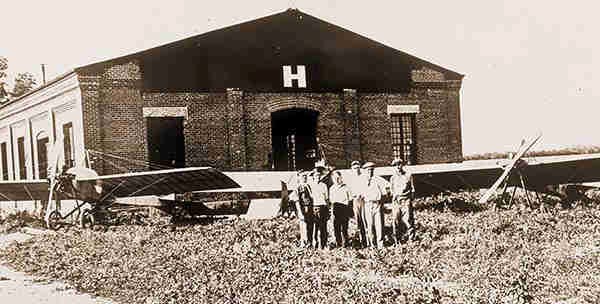
After WWI ended, there was a huge push for new aircraft and private flying, so in 1925, Clyde Cessna partnered with Lloyd Stearman and Walter Beech to create the Travel Air Manufacturing Company in Wichita, Kansas. Clyde served as the company’s president, and it soon became one of the leading US aircraft manufacturers. This was due in large part to Clyde’s advanced design ideas and the attention brought to their aircraft as the aircraft were used to set a variety of distance and speed records.
Clyde remained with Travel Air Manufacturing Company for 2 years but found his own interests gravitating toward monoplane designs while his partners were more interested in biplane designs. When he proposed a monoplane design without wing struts, his Travel Air associates dismissed the idea, claiming it was folly. This prompted Clyde to resign from the company and build a fully cantilevered wing monoplane on his own. This aircraft, known as the Comet, inspired him to start a new business focused on monoplanes.
Clyde Cessna started the Cessna Aircraft Company on 22 December 1927 in Wichita, Kansas, delivering his self-financed first aircraft on 28 February 1928 to a Pittsburgh customer for $6500. The aircraft was a Series monoplane, which developed into Airmaster and Model 195 series of four-seat cantilever high-wing cabin monoplanes.
Clyde V. Cessna and Victor H. Roos formed a partnership leading to the formation of the Cessna-Roos Aircraft Company on September 8,1927. Roos backed out, on December 22 the secretary of state approved a name change to Cessna Aircraft Company, and on December 31 the Cessna company was incorporated.

In September 1927, Clyde partnered up with aviation entrepreneur Victor Roos to create Cessna-Roos Aircraft. This partnership turned out to be very short-lived and only one month in, Roos chose to resign and sell back his interest in the company to Clyde. Finally in December that year, Clyde was able to drop Roos from the name and the Cessna Aircraft Company was born.
Clyde continued to perfect his monoplane design which included enclosing the cockpit. In late 1927, the company released the AW model, followed by the CW-6 which flew in 1928, and the DC-6 in 1929.
Production of “A” series (again with cantilever wings) began 1928, as did BW three-seater. Built DC-6 prototype 1929, followed by four-seat DC-6A and 6B.
Cessna tried to keep factory functioning during the Depression, producing 300 CG-2 primary gliders, but finally had to close in 1931.
In 1929, Clyde began collaborating with his son Eldon on the CR series of racing aircraft. However, the Great Depression hit and even though the company was able to keep its doors open longer than most, the Cessna Aircraft Company eventually declared bankruptcy and closed its doors in 1931.
Though they closed the company, Clyde and Eldon started a new business building custom racing aircraft for few years.
In 1934, Clyde’s nephew’s, Dwane and Dwight Wallace approached him with a plan and persuaded him to reopen the company and take control once more. The pair contacted all of the Cessna Aircraft Company stockholders and let them know that if they allowed Clyde to come back as president and resume construction of aircraft, then they and Clyde would all work for free until the company began to show a profit. After being forced out of the company in 1931, Clyde is re-instated as president January 17, 1934. Clyde returned to his role as president, with Dwane Wallace serving as the general manager at the young age of 23.
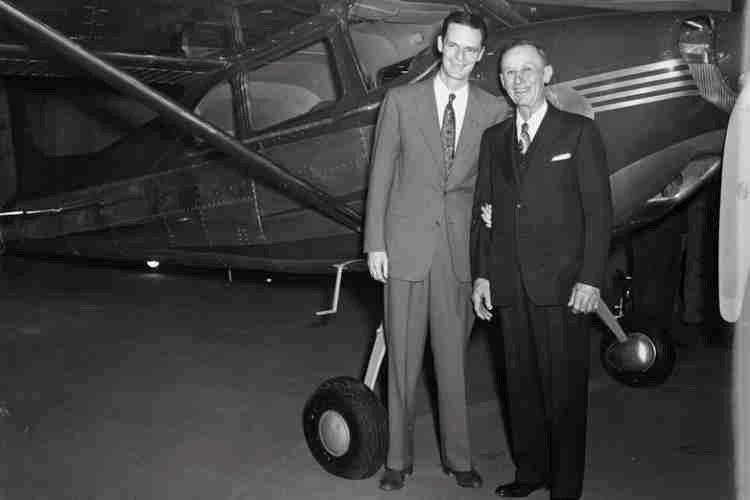
It’s not known exactly why, but whether because of a family dispute, a lack of interest in working for free or some other reason, Eldon did not rejoin the company and instead moved to California where he began working as a design engineer for first the Douglas Aircraft Company, then North American Aviation, and finally Rockwell International. During this period, he helped with the designs for both the P-51 Mustang and the F-86 Fighter Jet.
Finally, in 1936, Clyde Cessna retired from the aviation business, selling his interests to his nephews and returning to a life of farming. During his two-year return from 1934-36, it is said that Clyde had served more in a ceremonial capacity and stayed out of the day to day functioning of the company.
Factory reopened 1934, but Clyde sold his interests and company continued to be run by his son, a nephew, and T. Salter. Went on to develop highly successful Airmaster series and in 1939 the first Cessna twin, the T-50 five-seat cabin monoplane. Latter built in large numbers including nearly 1,200 Crane trainer versions for the RCAF. Adopted also by USAAF, U.S. Army and Navy, and over 5,000 produced during Second World War, serving in all theaters.
After the war Cessna began building light aircraft for private and business use. The most successful early models were Models 140 and 170, plus later Models 172, 305,180, and others which became world renowned. Model 305 used widely for liaison duties during Korean War and later as L-19/OE-1 Bird Dog (over 3,500 built).
In 1952 Cessna acquired the Seibel Helicopter Company and the CH-1 four-seat helicopter was developed and built in small numbers.
1958 Cessna production included (from top to bottom) Model 310B, Skylane, Model 182, and Model 172.

In 1960 Cessna affiliates itself with Reims Aviation, S.A., Reims, France, and acquires McCauley, a manufacturer of propellers and other aircraft components.
In 1978, Clyde Cessna was posthumously inducted into the National Aviation Hall of Fame, and Flying Magazine placed him at number 27 on their list of “51 Heroes in Aviation.”
In 1972 Cessna became the world’s first company to have produced 100,000 aircraft. Production has included nearly 2,000 twin-engined jet trainers and A-37 strike aircraft for the U.S.A.F. and U.S. Military Assistance Program. Company’s Pawnee and Wallace divisions taken into Aircraft division in 1984, but company sold to General Dynamics in 1985 and then to Textron Inc in 1992.
In July 1996 Cessna Single Engine Piston Facility opened in Independence, Kansas, to reintroduce production of single-engined light aircraft to Cessna range. Available Cessna aircraft were Cessna 172R and 172SP Skyhawk four-seat lightplanes as much refined versions of previous Skyhawk, four-seat 182S Skylane as refinement of previous Skylane versions, six-seat 206H Stationair and T206H Turbo Stationair as refinements of previous versions, 208 Caravan (first flown 1982) as single-turboprop commuter, business and cargo aircraft (among other uses) offered in four civil versions plus as U-27A for U.S. foreign military sales, and a range of business jets as six/seven-seat Model 525 CitationJet (first flown April 1991), nine/12-seat Model 550 Citation Bravo (first flown April 1995), nine/ten-seat Model 560 Citation Ultra and latest Ultra Encore (latter first flown July 1998), eight/ten-seat Model 560-XL Citation Excel (first flown February 1996), 15-seat Model 650 Citation VII (first flown February 1991), ten-seat Model 680 Citation Sovereign (for certification in year 2002), 11/14-seat Model 750 Citation X (first flown December 1993), CJ1 (for delivery from year 2000 as successor to CitationJet), and eight-seat CJ2 (to fly 1999).
On 27 November 2007, Cessna purchased Columbia Aircraft from bankruptcy for US$26.4M including its Columbia 350 and 400 line



 All Aero