The company Direct Fly s.r.o. was founded in 2006. The main subject of enterprise of the company is batch production of the ultralight sport aircraft ALTO. The aircraft factory is situated near Uherské Hradiště – Kunovice, in region with 70 years tradition of aircraft production.
2000->
Diamond DART-750
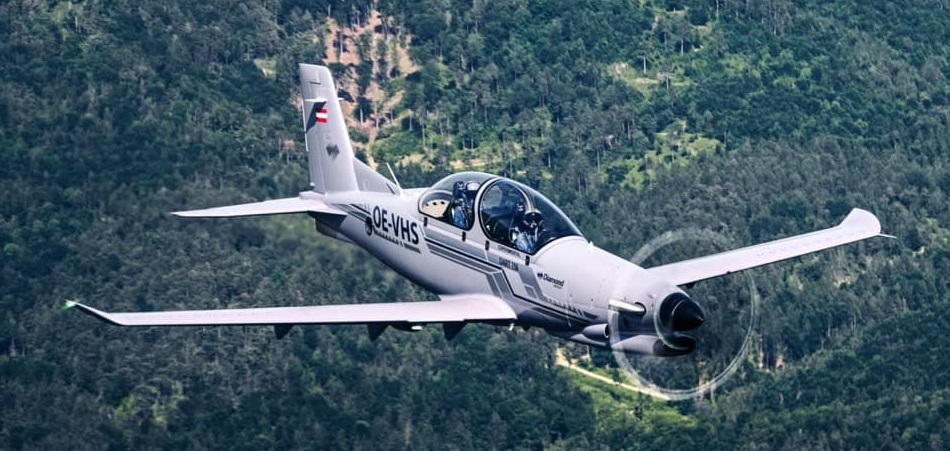
The DART-750 will be a certified all composite aerobatic turboprop trainer in tandem seat configuration, equipped with Garmin G3000 avionics and the 750 shp Pratt & Whitney Canada.PT6A-25C turboprop engine.
The first flight of Diamond Aircraft‘s DART-750 aerobatic trainer took place June 12, 2023, at the company’s headquarters in Wiener Neustadt in Austria.
Piloted by Diamond’s Head of Flight Test Sören Pedersen and Senior Test Pilot Niko Daroussis, the maiden flight lasted 30 minutes and covered all basic maneuvers, including performance and handling checks.
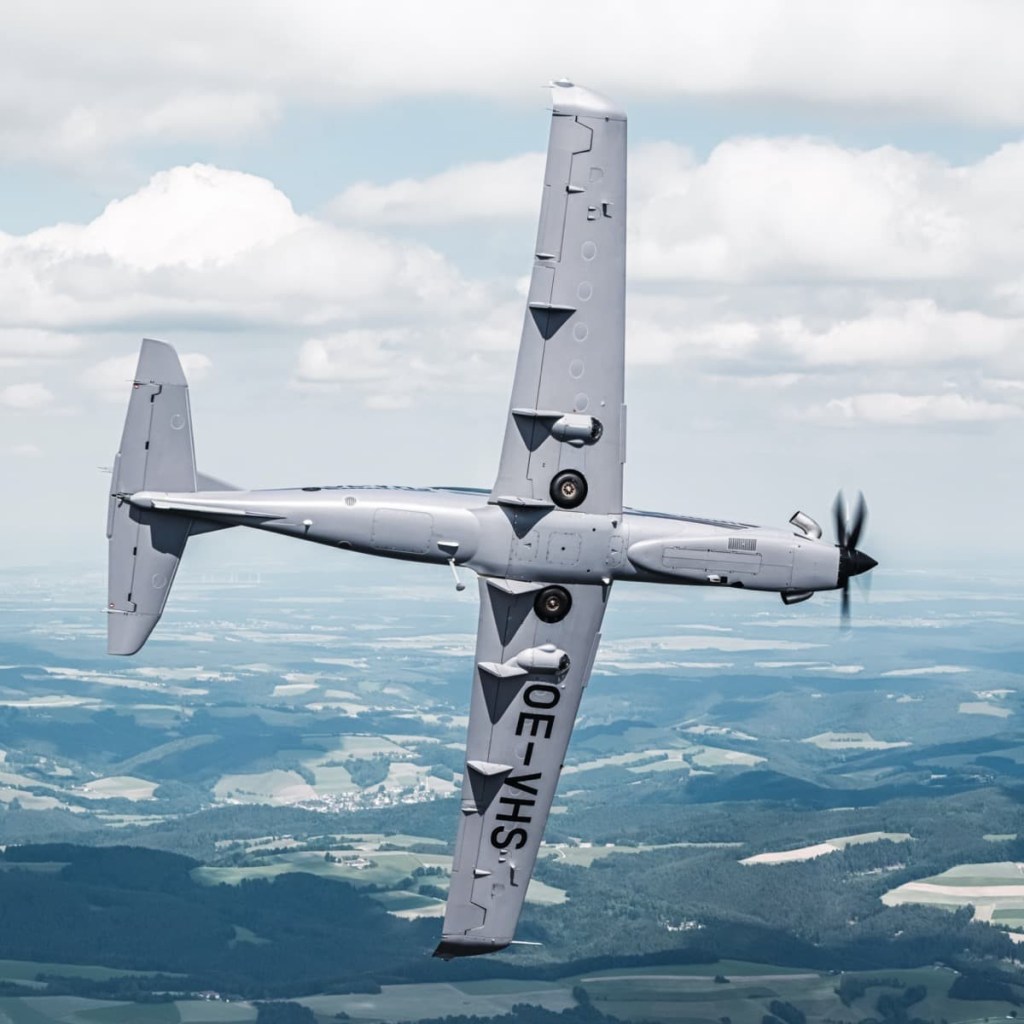
“The aircraft and all tested parameters did meet or exceed all expectations,” company officials said in a press release.
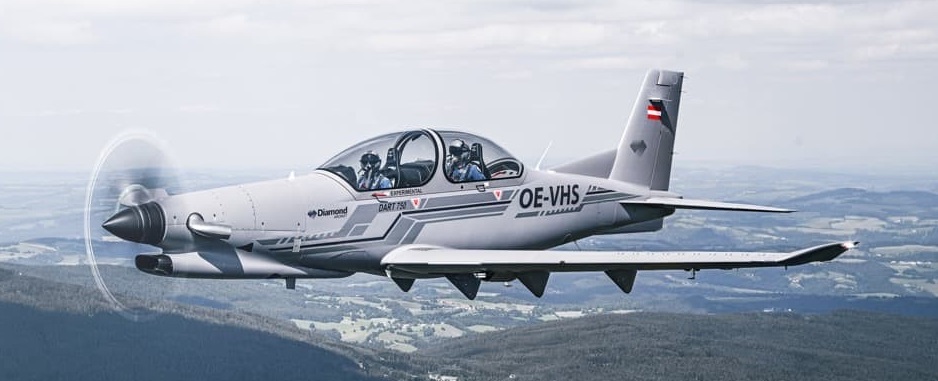
The aircraft was expected to be certified by EASA in 2024, with FAA certification soon after.
Diamond DA62
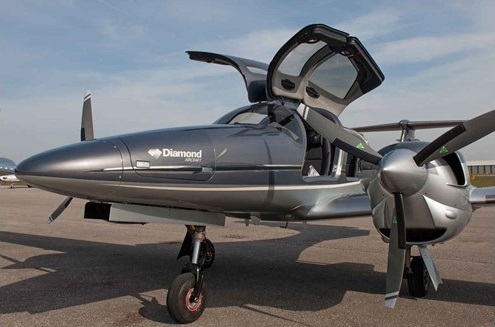
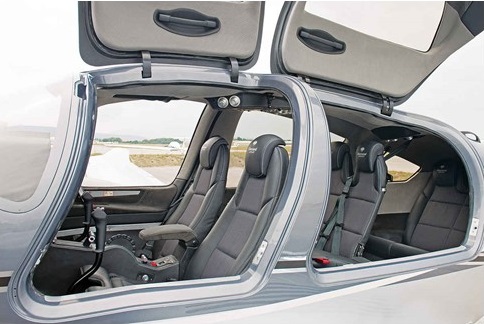
In developing this airplane, Diamond Aircraft founder and CEO Christian Dries challenged his team to create a simple-to-operate, fuel-efficient twin and wrap it around a passenger compartment mimicking the latest luxury SUVs. With its third-row seating option, oversize doors and seats that fold flat to accommodate bulky items, the DA62 is a utility vehicle.
The DA62s twin 180-horsepower Austro AE330 diesel engines burn less than 10 USgallons per hour per side at maximum continuous power, propelling the airplane to a top speed of around 200 knots. At 75 percent power and the speed is 187 ktas, but fuel burn drops to 7.4 gph per side.
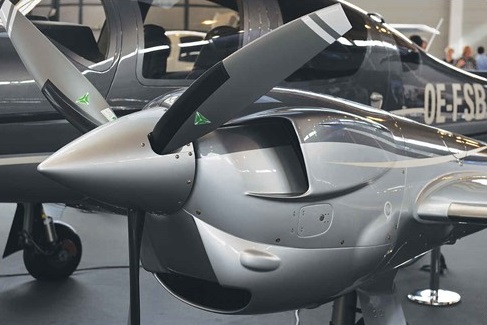
The DA62’s diesel engines are encased in cowlings that seem oddly misshapen, a result of packaging Mercedes-Benz diesel car engines on an airplane.
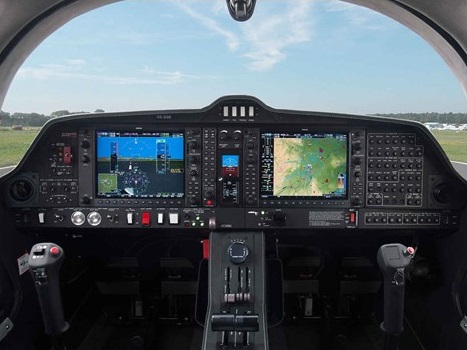
The DA62 has the same center control stick, throttle placement and cockpit display layout as the Diamond DA40 and DA42. Round-dial backup instruments have been replaced with an electronic standby instrument with emergency battery. The seats are leather with seatback adjustments, but they don’t move fore and aft. Instead, the rudder pedals can be adjusted forward and back to accommodate a variety of pilots. An armrest is in the center of the cockpit between the pilots.
The DA62’s three large gull-wing doors and the forward-folding seats, plus smart placement of handholds, make entry and exit from the DA62 easy. There are cup holders for the front-seat occupants and a variety of LED interior lighting options throughout the cabin. Options include air conditioning, a 36-gallon aux fuel tank, Garmin weather radar and satellite data receiver, and Avidyne TAS600 traffic advisory system. New for the DA62 is an upgraded metallic paint option that lets buyers choose colors other than the standard white found on many carbon-composite aircraft.
It features aluminum fuel tanks sandwiched between the carbon-fiber main wing spars for crashworthiness, and incorporates Diamond’s trademark high-impact fixed seats that are attached to strategically located crush points in the floor. The composite monocoque cabin design was borrowed from the Formula 1 racing world. The airplane has undergone crashworthiness testing similar to what is -performed in the auto industry. The DA62 also offers full icing protection with its TKS weeping wing option.
The U.S. spec version offers a 5,071-pound gross weight (versus 4,400 pounds for the European version to avoid the ATC fees levied on heavier airplanes) and a 1,300-nautical-mile range with a full-fuel payload of over 1,000 pounds. Its 2.0-liter Austro compression ignition engines, meanwhile, sip jet-A fuel and a 13,000-foot single-engine service ceiling (at max gross weight) and turbocharged power. There are two baggage compartments in the nose that can accommodate full-size suitcases, golf bags and more. The DA62’s useful load in the international spec version is 1,609 pounds.
At $1.08 million (2016) for the U.S. model before typical options, the DA62 compares well with the competition. The short engine overhaul interval is 1,000 hours at the moment for the new Austro AE330s. Based on the Mercedes-Benz diesels in B-class automobiles, the engine is a proven design, and the 1,000-hour limitation is projected to be short-lived as Diamond gains experience with the aero engine. The company hopes to increase TBO to as high as 2,400 hours eventually. Other required engine maintenance, meanwhile, includes inspection of the generators at 300 hours, and replacement of the high-pressure fuel pump and inspection of the two-mass flywheel at 600 hours.
The Diamond DA62 options include third-row seating accommodating seven people, increased 5,071-pound maximum takeoff weight, built-in oxygen, air conditioning, TKS icing protection, Garmin GWX 70 weather radar and GSR 56 satellite data receiver, Avidyne TAS600 traffic advisory system, 36-gallon auxiliary fuel tank, metallic paint and more.
The DA62 earned its type certification in Europe in April 2015.
The airplane is simple to operate. The engine start procedure involves hitting the master switch, flipping the engine master on, waiting a moment to ensure the glow plug annunciation is out and then pushing the engine start button. That’s it. The Austro diesels come to life in an instant as the dual-channel full authority digital engine controls (fadec) manage rpm and continuously check for faults while the only other job is to glance at the oil pressure indication. As long as the gauges are in the green, it’s good to go.
The before-takeoff run-up procedure is stress free. It involves setting the parking brake, manually selecting the A and B channels of the electronic engine control units (EECU) to ensure both are online, and then pushing and holding the engine run-up buttons. The AE330’s fadec computers automatically increase power to 1,950 rpm and perform a number of health checks, including cycling the props. The throttles never physically move and there aren’t any prop levers to move in the first place. If no fault messages appear on the Garmin G1000 primary flight display when the test sequence is completed, you’re ready for departure.
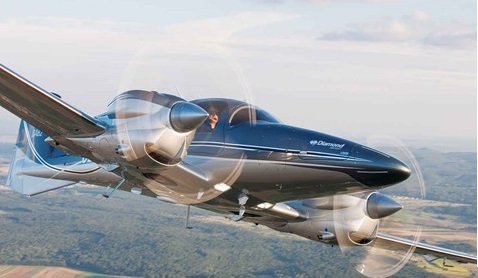
Rotation is at 80 knots, climb is at 110 kias, and the DA62 cruise climb speed is 128 kias. The left is the critical engine in the DA62 and the ¬propeller automatically feathers. The single-engine best rate-of-climb airspeed is 87-knot (blue line).
Max continuous power of 95 percent at 14,000 feet gives around 195 ktas with the twin AE330s burning 18.6 gph. 60 percent power shows 170 ktas and 11.8 gph fuel consumption. With one engine-out, at 100 knots in level flight, fuel burn is 3.6 gph. Even with less than half fuel on board, at this rate the flight endurance would still be more than 11 hours.
By design, pilot workload is low in all flight regimes. Fitted with the latest generation of Garmin G1000 avionics with synthetic-vision technology (SVT) and electronic stability and protection (ESP), plus a three-axis Garmin GFC 700 autopilot and GWX 70 weather radar, there’s an argument to be made that the DA62 is the among the most capable and easiest-to-fly piston airplanes ever produced.
Landing targets 90 knots on final with full flaps selected. Max demonstrated crosswind component with full flaps in the DA62 is 25 knots, slightly better than in the DA42, even with its slender wing spanning nearly 48 feet.

2016 Diamond DA62
Standard price: $1.08 million
Engines: 2 x Austro Engines AE330, 180 hp
Props: MT 3-blade 76 inches)
Wingspan: 47 feet 10 inches
Wing area: 184.1 square feet
Length: 30 feet 1 inch
Height: 9 feet 3 inches
Wing loading: 27.54 lb/sq.ft
Power loading: 14.08 lb/hp
Max takeoff weight: 5,071 lb
Standard empty weight: 3,461 lb
Max useful load: 1,609 lb
Payload with full fuel: 1,021 lb
Max usable fuel: 86.4 USgallons (with aux tanks)
Max rate of climb: 1,346 fpm
Single-engine rate of climb: 288 fpm
Service ceiling: 20,000 ft
Max speed: 204 kias
Cruise speed: (14,000 feet, max cont. power) 193 kias
Max range: 1,275 nm
Stall speed (clean): 70 kias
Stall speed (full flaps): 64 kias
Takeoff distance: 1,265 ft
Takeoff distance over 50 ft: 2,097 ft
Landing distance: 1,259 ft
Diamond D-Jet
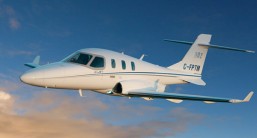
Engine Williams FJ33-4A-19 turbofan
Length 35 ft 1 in
Height 11 ft 7 in
Wing Span 37 ft 6 in
Cabin seating 2 + 3
Pressurization 5.5 psi
Cabin altitude 8,000 ft @ FL250
Maximum ramp weight 5,690 lbs
Useful load 2,240 lbs
Maximum fuel 1,740 lbs
Maximum cruise speed 315 ktas
Certified ceiling 25,000 ft
Time to climb to 25,000 feet 15 min
Long range cruise speed 240 ktas
Maximum range 1,350 nm
Diamond DA50
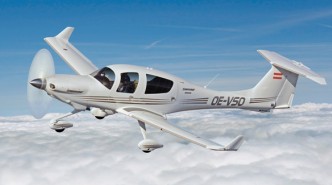
Austria-based Diamond Aircraft announced a change in direction for its DA50 aircraft program, which Diamond introduced in 2017 with five-, six-, and seven-seat variants. Diamond says after spending 2018 re-evaluating all its ongoing projects, it decided to change the DA50’s “engine concept.” As such, Diamond was partnering with Continental Aerospace Technologies to equip the DA50 with Continental’s 300-horsepower CD-300 Jet-A1 engine. Initial ground tests of the DA50 with the new engine occurred 15 March 2019, and the first flight with the new engine happened March 22, marking the official start of the aircraft’s flight test program with the CD-300.
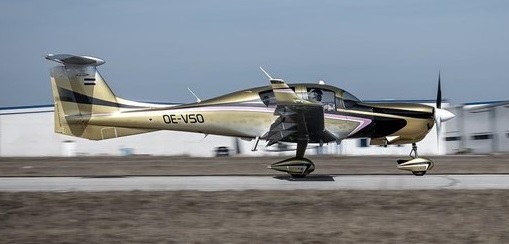
Diamond Aircraft determined that the CD-300 engine aligned with Diamond’s jet fuel philosophy and that it is a suitable solution for the DA50. Certified in December 2017, the CD-300 is the third platform in Continental’s Jet-A fuelled piston engine line up.
In 2020 Diamond Aircraft offered the DA50 RG. The first production aircraft to be fitted with a CD-300 powerplant. The DA50 RG is powered by a 300hp turbocharged Continental CD-300 V6 diesel.
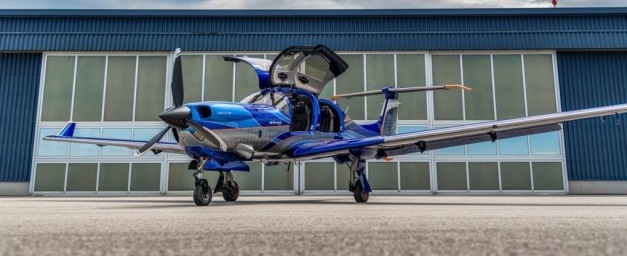
In the design phase, close attention was paid to drag reduction, and the aircraft features a retractable undercarriage.
Hinged, double slotted flaps provide high lift and excellent slow speed behaviour. The aeroplane has five seats, including a 60/40 folding back seat with a separate cargo bay hatch. Entry and exit are through big gull-wing doors.
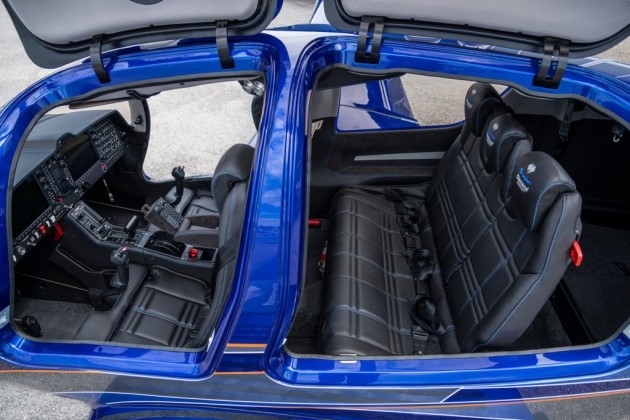
The aircraft’s avionics include Garmin’s G1000 NXi flight deck with the GFC700 Automated Flight Control System.
Options include a removable right-hand control stick, oxygen system, electric air conditioning, TKS de-icing system, Garmin GCU 476 keypad and a built-in tablet mount.
The aircraft is currently undergoing type certification with EASA, with approval anticipated by late summer of 2020. FAA certification is expected by the end of 2021.
DA50 Magnum
Engine Austro Engine AE 300 2.0 l turbo-diesel,170 hp
Fuel Jet A1
Propeller MT 3-blade Constant Speed
Cruise speed 150+ kts
Fuel consumption 9 USgph max power
Fuel consumption 6-7 gph cruise
Certified altitude 18,000 ft
Maximum takeoff weight (MTOW) 3,262 lbs
Seating 4
Cabin width 52 inches
Doors 3
DA50 SuperStar
Engine Teledyne Continental TSIOF-550J
Fuel AVGAS 100LL
Propeller 3 or 4 – blade constant speed
Cruise speed 200+ kts
Fuel consumption 16-20 gph at cruise
Maximum takeoff weight (MTOW) 3,560 lbs
Seating 2 + 3
Cabin width 52 inches
Doors 3 + baggage door
Pressurization: Yes
Diamond DA42 / Twin Star
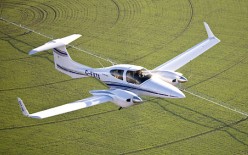
Diamond’s DA42 Twin Star (now referred to only as the DA42 because of a lawsuit by Aérospatiale) is an all-composite four-seater with twin turbocharged diesel engines that can operate on automotive diesel or Jet A1 fuel. At takeoff the engines develop full power at a quiet 2,300 rpm, and feature automatic prop (FADEC) control and autofeather. The Twin Star was designed to incorporate the Garmin G1000 all class cockpit from the beginning, and trailing landing gear give the twin a smooth transition to landing and taxi. Optional equipment available for the DA42 include oxygen, anti/de-ice and air conditioning.
The first flew on 9 December 2002.
2007 Diamond DA42 Twin Star
Engines: Thielert TAE Centurion 1.7, 135 hp@SL to 10,000 feet
TBO hrs.: 1000/2400
Fuel type: Diesel/Jet A1
Propeller type: MT 3-blade
Landing gear type: Tri./Retr.
Max ramp weight (lbs.): 3935
Gross weight (lbs.): 3935
Landing weight (lbs.): 3935
Empty weight, std. (lbs.): 2761
Useful load, std. (lbs.): 1174
Payload, full std. fuel (lbs.): 839
Useful fuel (gals.): 50
Oil capacity (qts.): 8
Wingspan: 44 ft.
Overall length: 28 ft. 1 in.
Height: 8 ft. 2 in.
Wing area (sq. ft.):177.2
Wing loading (lbs./sq. ft.): 22.2
Power loading (lbs./hp.): 14.6
Seating capacity: 4
Cabin doors: 2
Cabin width (in.): 46
Cabin height (in.): 50
Cruise speed (kts.): 80% power: 172
Max range (w/ reserve) (nm): 60% power: 1129
Fuel consumption (USgph): 80% power: 12.5
Turbo critical altitude (ft.): 8000
Vso (kts.): 56
Best rate of climb, SL (fpm): 1280
Service ceiling (ft.): 18,000
Takeoff ground roll (ft.): 1130
Takeoff over 50-ft. obstacle (ft.): 1730
Landing ground roll (ft.): 1069
Landing over 50-ft. obstacle (ft.): 1877
DA42-L360
Engine 2x Lycoming I0-360 counter rotating, 180 hp
Propellers 2x MT 3-blade constant speed full-feathering propeller (counter-rotating)
Airworthiness category Normal
Length 28 ft 1 in
Height 8 ft 2 in
Wing span 44 ft
Maximum take-off weight 3,935 lbs
Useful load 1,180
Fuel capacity, total / usable 79 gal / 76 gal
Fuel 100 LL Avgas
Take-off distance, 50-foot obstacle 1,500 ft
Landing distance, 50-foot obstacle 1,877 ft
Rate of climb, sea level 2,000 fpm
Maximum demonstrated operating altitude: 18,000 ft
Maximum single-engine ceiling (standard day): 7,500 ft +
Maximum cruise speed: 180+ ktas
Economy cruise speed at 55% power: 140 ktas
Maximum landing gear extension speed: 195 kias
Maximum demonstrated crosswind: 20 kts
Range, 55% power (30 min reserve): 700 nm
DA42-NG
Engine 2x Austro Engine AE 300 turbocharged, common-rail injected 2.0 liter diesel engine with EECDU single-lever control
Horsepower 170 hp
Propellers 2x MT MTV-6-R-C-F / CF187-129 3-blade Constant Speed
Airworthiness category Normal
Length 28 ft 1 in
Height 8 ft 2in
Wing span 44 ft
Wing area 175.3 sq ft
Seats 4
Empty weight 3,119 lbs
Maximum take-off weight (MTOW) 4,189 lbs
Useful load 1,070 lbs
Fuel capacity (standard / long range) 50 US gal / 76 US gal
Fuel grades Jet A1 / Diesel
Rate of climb, sea level MTOW: 1,150 fpm
Rate of climb, 10,000 ft MTOW: 1,020 fpm
Maximum operating altitude: 18,000 ft
Maximum air speed: 192 kts IAS
Cruise speed at 75% in 14,000 ft: 175 kts TAS
Cruise speed @ 60% in 14,000 ft: 152 kts TAS
Range, at 75%, standard / long range tank: 614 nm / 950 nm
Range, at 60%, standard / long rang tank: 707 nm / 1,180 nm
DA42 TDI
Engines: 2 x TAE Centurion 2.0 Turbo Diesel, 132 hp
Propellers: MT 3-blade composite constant speed, full-feathering
Airworthiness category: Normal
Length: 28 ft 1 in
Height: 8 ft 2in
Wing Span: 44 ft
Maximum takeoff weight: 3,935 lbs
Useful load: 1,174 lbs
Fuel capacity, usable standard: 50 US gal
Fuel capacity, usable extended: 72 US gal
Fuel: Jet A-1
Takeoff distance, ground roll: 1,130 ft
Takeoff distance, 50-foot obstacle: 1,730 ft
Landing distance, ground roll: 1,069 ft
Landing distance, 50-foot obstacle: 1,877 ft
Rate of climb, sea level: 1,280 ft/min
Maximum operating altitude: 18,000 ft
Maximum SE ceiling (standard day): 10,000 ft
Cruise speed at 80%: 168 kts/12.5 gal/hr total
Economy at 60%: 151 ktas/8.8 gal/hr total
Stall speed, full flaps gear down: 56 kias
Stall speed, clean: 62 kias
Maximum landing gear operating speed: 194 kts
Maximum demonstrated crosswind: 20 kts
Range, at 80% extended fuel: 917 nm
Range, at 60% extended fuel: 1,129 nm
Diamond DA40 / DV40 Diamond Star
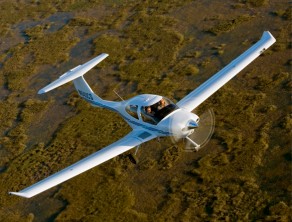
An all composite light aircraft. There is a display showing percentage power as well as engine RPM. Dual control sticks instead of wheels allow for better instrument placement on the panel. Control stick actuation is by push rods in¬stead of the more conventional cables and implies a lower maintenance cost. The panel itself is modular allowing for improved main¬tenance access
The DA-40 seats four people comfortably. A forward hinged canopy allows access for the pilot and front seat passenger, with a separate access for the rear passengers via a gull wing door in the left fuselage side The cabin struc¬ture contains a carbon fibre roll bar aft of the front seats for crash protection. There is plenty of headroom and legroom for all occupants. As in the Katanas the front seats are fixed in position, but don’t have quite the same reclined aspect as in the Katana. Rudder pedals can be easily adjusted.
At the 2004 Sun’n Fun Diamond showed the DA40-FP. A fixed pitch version of the DA40-180 DiamondStar, powered by a Lycoming O-360-A4D 180 hp, with a fixed pitch metal Sensenich prop.
In 2006 220 Diamond Star four-seaters were delivered.
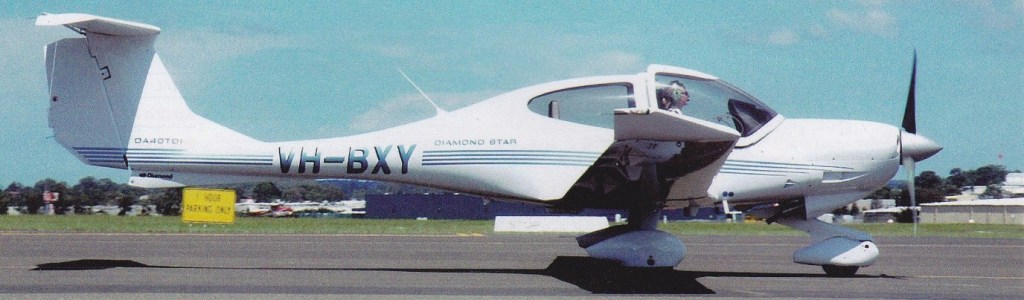
The DA40 DiamondStar is powered by a Lycoming IO-360-M1A 180 hp engine, with a hydraulic prop governor and a constant speed prop.
DV40-180
Engine: Lycoming IO-360, 180 hp.
Range @ cruise: 570 nm.
Fuel burn @ cruise: 35 lt/hr.
Seats: 4.
DA40-Tdi
Engine: Thielert TAE turbodiesel, 135 hp.
Cruise: 130 kt.
Fuel burn @ cruise: 18.5 lt/hr.
Range @ cruise: 750 nm.
Seats: 4.
DA40 CS
Engine: Lycoming IO-360-M1A, 180 hp
Propelller: Hartzell 2-blade aluminum constant-speed
Airworthiness category: Normal and utility
Length: 26 ft 5 in
Height: 6 ft 6 in
Wing Span: 39 ft 6 in
Maximum takeoff weight: 2,645 lbs
Useful load: 900 lbs (standard equipped airplane)
Fuel capacity, usable (standard/optional): 40 USgal / 50 USgal
Fuel: AVGAS 100LL
Takeoff distance, ground roll: 1,175 ft
Takeoff distance, 50-foot obstacle: 1,700 ft
Landing distance, ground roll: 1,155 ft
Landing distance, 50-foot obstacle: 2,093 ft
Rate of climb, sea level: 1,120 ft/min
2007 Diamond Star DA40 XL
Engine: Lycoming IO-360-M1A, 180 hp@SL
TBO (hrs.): 2000
Fuel type: 100/100LL
Propeller type: MT 3-blade CS
Landing gear type: Tri./Fixed
Max ramp weight (lbs): 2646
Gross weight (lbs.): 2646
Landing weight (lbs.) 2535
Empty weight, std. (lbs.): 1756
Useful load, std. (lbs.): 890
Useful fuel, ext. (gals.): 50
Payload, full std. fuel (lbs.): 602
Wingspan: 39 ft. 6 in.
Overall length: 26 ft. 5 in.
Height: 6 ft. 6 in.
Wing area (sq. ft.): 145
Wing loading (lbs./sq.ft.): 18.2
Power loading (lbs./hp): 14.7
Wheel size (in.): 6.00 x 6
Seating capacity: 4
Cabin doors: 3
Cabin width (in.): 47
Cabin height (in.): 44
Cruise speed (kts.): 75% power: 150
Fuel consumption (USgph.): 75% power: 10
Range (nm): 75% power: 720
Range (nm): 55% power: 785
Vso (kts.): 49
Best rate of climb, SL (fpm): 1120
Service ceiling (ft.): 16,400
Takeoff distance (ft.): 1027
Takeoff over 50 ft. obstacle (ft.): 1140
DA40 XLS
Engine: Lycoming IO-360-M1A, 180 hp
Propeller: MT 3-blade composite constant-speed
Airworthiness category: Normal and utility
Length: 26 ft 5 in
Height: 6 ft 6 in
Wing Span: 39 ft 6 in
Maximum takeoff weight: 2,645 lbs
Useful load: 860 lbs (standard equipped airplane)
Fuel capacity, usable: 50 gal
Fuel: AVGAS 100 LL
Takeoff distance, ground roll: 1,175 ft
Takeoff distance, 50-foot obstacle: 1,700 ft
Landing distance, ground roll: 1,155 ft
Landing distance, 50-foot obstacle: 2,093 ft
Rate of climb, sea level: 1,120 ft/min
2009 DIAMOND DA40 XLS
Price: $348,950
Engine: Lycoming IO-360-M1A, 180 hp@SL
Fuel type: 100/100LL
Propeller type: 3-blade, CS, composite MT
Landing gear type: Tri./Fixed
Max takeoff weight (lbs.): 2645
Useful load, std. (lbs.): 860
Usable fuel, std. (USgals.): 50
Baggage capacity (lbs.): 100
Wingspan: 39 ft. 6 in.
Overall length: 26 ft. 5 in.
Overall height: 6 ft. 6 in.
Seating capacity: 4
Cabin width (in.): 45.5
Vso (KIAS): 49
Cruise speed, 75% power (kts.): 150@10 gph
Range, 75% power (nm): 720
Range, 55% power (nm): 785
Max speed (KTAS): 157
Best rate of climb, SL (fpm): 1120
Service ceiling (ft.): 16,400
Takeoff ground roll (ft.): 1175
Takeoff over 50 ft. obstacle (ft.): 1700
Landing ground roll (ft.): 1155
Landing over 50 ft. obstacle (ft.): 2093
Max demonstrated crosswind (kts.): 20
Glide ratio: 10.3:1
Engine Lycoming IO-360-M1A,180 hp
Propeller MT 3-blade composite constant-speed
Airworthiness category Normal and utility
Length 26 ft 5 in
Height 6 ft 6 in
Wing Span 39 ft 6 in
Maximum takeoff weight 2,645 lbs
Useful load 860 lbs (standard equipped airplane)
Fuel capacity, usable US50 gal
Fuel AVGAS 100 LL
Takeoff distance, ground roll 1,175 ft
Takeoff distance, 50-foot obstacle 1,700 ft
Landing distance, ground roll 1,155 ft
Landing distance, 50-foot obstacle 2,093 ft
Rate of climb, sea level 1,120 ft/min
Diamond Aircraft Industries GmbH / Hoffman Aircraft / HOAC
Hoffmann Flugzeugbau-Friesach GesmbH
Wolf Hoffinann Flugzeugbau KG
Hoffmann Aircraft Ltd
HOAC AG
HOAC-Austria, Flugzeugwerk Wiener Neustadt Gesellschaft mbH
Dimona Aircraft
Diamond Aircraft Industries GmbH
Hoffmann Flugzeugbau-Friesach GesmbH was founded in Friesach, Austria, in 1981 to produce the newly certified H36 Dimona motorglider.
1983: Wolf Hoffinann Flugzeugbau KG, Sportflugplatz, D 8870 Gfinzburg; West Germany.
By 1985, Hoffmann Aircraft Ltd, was a 100% subsidiary of Simmering-Graz-Pauker AG, and in 1985 moved to Vienna and introduces the Dimona Mk II.
Production facilities are established at the Wiener Neustadt airport, just south of Vienna in 1987. The airport has a long history, dating back to before the first world war.
The Dries family acquired 100% control of the company, now named HOAC AG, in 1989, thereafter being known as HOAC-Austria, Flugzeugwerk Wiener Neustadt Gesellschaft mbH. Immediately, development of the HK36R Rotax 912 powered motorglider and its derivative, the DV20 “Katana”, were started.
With a view to supplying the US market with its new technology training aircraft, a full production facility was established in London, Ontario, Canada, in 1992. The company was named Dimona Aircraft.
The Austrian built DV 20 Katana is certified in 1993 and the first, DV20, OE-CPU went on a demo tour in the US and Canada.
The first Canadian built production DA20-A1 was delivered to Central Missouri State University in 1995 and serial production was ramped up. The DA20-A1 Katana receives the prestigous Flying Magazine Eagle Award, for best light aircraft.
Named Diamond Aircraft Industries GmbH since March 1996, Diamond Aircraft Industries Canada division produced the HK 36 Super Dimona motorglider in four versions, but stopped production of the DV 20 Katana two-seat lightplane in Austria (first flown March 1991 as the HOAC LF 2000, becoming LF2 before DV 20), which is now produced in Canada as the DA 20 Katana. Latest aircraft is the four-seat DA 40 Katana (first flown 1998). HOAC introduces 4 new versions of the HK36 motorglider: taildragger or tricycle gear, either with the Rotax 912 or turbo 914 engine.
The 4 seater DA40 program is announced in 1997 at the AERO EXPO in Friedrichshafen. The first experimental aircraft are powered by Rotax 914 and TCM IO-240 engines. The Lycoming IO360 is selected for the production version.
The Rotax powered Katana, after production of 500 units, is replaced with the all new TCM IO240 powered DA20-C1, featuring improved performance, useful load and comfort.
Diamond opens its new Diamond Flight Center, including training facilities and the Katana Kafé restaurant, at the London Airport.
HOAC is renamed Diamond Aircraft GmbH, to align with the North American operation, and Diamond Austria acqired the Wiener Neustadt – East Airport (LOAN). In 1998 Diamond Aircraft maintained two research and de¬velopment centres, located in London, Ontario, Canada, and Weiner Neustadt, Austria. Diamond’s primary manufacturing facilities are located at their Canadian base, where the Con¬tinental powered Katana C1 is produced. The new Diamond DA40, four-place aircraft was also to be manufactured in this facility. Production of Diamond’s Katana Xtreme, high performance motor glider/glider tug aircraft takes place at the company’s Austrian facilities.
By 1999 over 1250 Diamond aircraft were flying worldwide. The Wiener Neustadt airport and company facilities undergo significant expansion, with the addition of new taxiways, runway lighting, NDB approach, construction of a new administration building, pilot shop, restaurant, and maintenance facilities.
The DA20-100, a factory refurbished and re-engined (Rotax 912S-100hp) Katana, is introduced and proves very popular, particularly in Europe.
Diamond opens a factory sales, service and flight training center in Egelsbach (Frankfurt).
The DA20-C1 Eclipse, an improved and enhanced version of the DA20-C1, enters production.
The IFR DA40-180 Diamond Star is certified in 2000 and enters production. The HK36TTC-ECO, a specialized aerial camera platform also enters service.
The DA40-180 receives FAA type certification and production for the North American market starts in London, Ontario in 2001.
Diamond Austria flies the world’s first modern production GA diesel powered aircraft, the DA40-TDI, in 2001.
The DA20-C1 was selected for the USAF Introductory Flight Training Program in 2002. The DA42-TDI project is announced at the Berlin International Airshow in May 02. Company CEO, Christian Dries makes the first test flight on December 9th. The DA40-TDI turbo diesel powered Diamond Star receives European certification.
In 2004 the DA42, equipped with the Garmin G1000, receives European certification and serial production is started. The company’s DA42 demonstrator crosses the Atlantic nonstop, direct from St. John’s, Newfoundland to Porto, Portugal, with a total fuel burn of only 72 gallons of jet fuel. DA20 and DA40 receive Chinese CAAC certification and first G1000 equipped DA40’s are delivered to PanAm Beijing.
The DA40 FP, a carburated fixed pitch version of the DA40 was certified in 2005. Diamond announces a Chinese joint venture to produce the DA40 Diamond Star for the Chinese market. The DA42 receives FAA certification and first US delivery is made.
In 2006 the DA20-C1 was selected for new USAF training program, D-JET completes first flights, the first Diamond Brilliance Center opens in Naples, FL, and DA40 XL introduced.
The DA50 Super Star made its first flight in 2007 and the DA40 XLS/CS Launch at AOPA Expo.
2008: 1560 Crumlin Sideroad, London N5V 1S2, Ontario, Canada.
Diamond DA42 is certified for Known Icing in 2008 and in 2009 the Turbo diesel Austro Engine AE 300 is certified.
It was in 2017 that China-based Wanfeng Aviation Industry acquired full ownership of the Austria-based Diamond Aircraft Group, founded in 1981 and maker of single- and twin-engine piston aircraft, including the four-seat DA40, four-seat DA42, and seven-seat DA62 models. Wanfeng’s acquisition also included Diamond’s sister company and diesel aerospace engine maker Austro Engine.
DFS Hol’s der Teufel
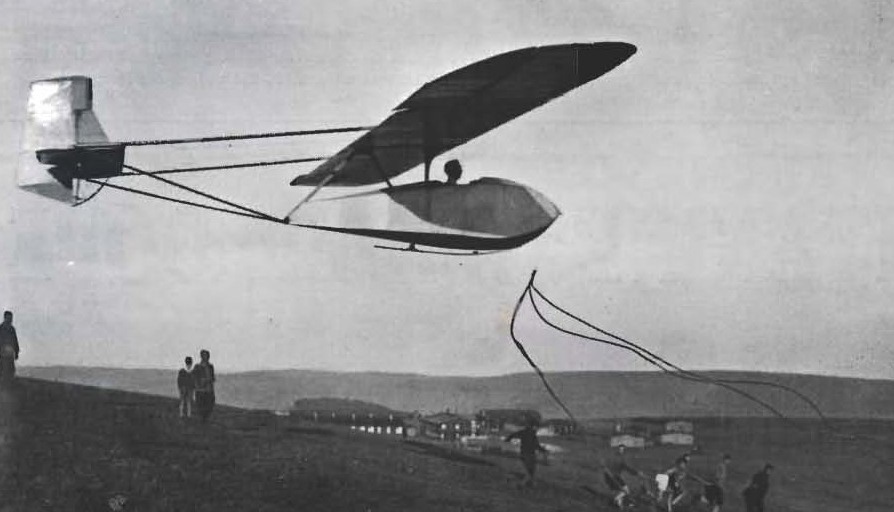
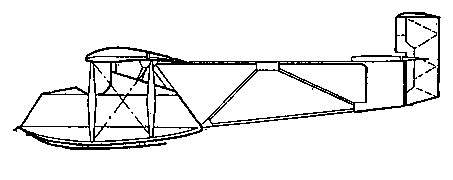
The history of this type, whose Czech name is “Take the devil”, begins in 1923 and is associated with the German designer Alexander Lipisch.
This was a simple 1933 glider for basic flight instruction. It was designed for being launched by rubber ropes. It was single seat – so there was no room for a flight instructor.
In 1927, this type was slightly modified and several pieces were produced by the beginning German company Alexander Schleicher.
This glider was used for basic training of sailors in gliding groups, where many dozens of pieces were produced by amateurs not only in Germany but also in the Czech Republic. According to surviving reports from the 1930s, this glider sailed in Bohemia, Olomouc, Konice na Moravě, Zlín, Valašské Meziříčí, Moravská Ostrava, 3 examples in Přerov and Jindřichův Hradec.
In the autumn of 2002, the German brothers Achim and Gerhnard Maleschka joined forces with veterans Jiří Leník and Jan Krejčí, and with the help of other fans of historical gliding, parts were created in Germany and the Czech Republic and assembled in the workshops of Aeroclub Raná during the second half of the year.
On Sunday, May 2, 2004, Jiří Leník from Aeroclub Raná ceremoniously flew the replica of the German historical glider “Hols der Teufel” from 1927 at the Rana airport.
In the future, it will be operated alternately in the Czech Republic (Na Rané) and in Germany by its German co-owners.
Wing span: 41.667 ft / 12.7 m
Length: 21.161 ft / 6.45 m
Height: 7.054 ft / 2.15 m
Crew: 1
Destiny 2000
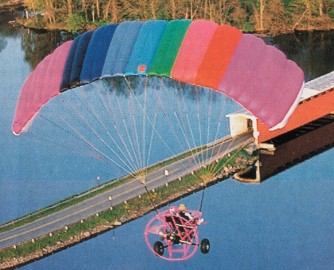
The Destiny 2000 features bucket seats equipped with a standard 5 point harnes. Landings are controlled both by power and flare. The chassis absorbing landings. Gear legs have built in suspension with fibreglass rods and 22-in tundra tires. With a frame built around such large tires, gives a 4-inch-higher clearance.
Destiny Powered Parachutes’ Destiny 2000 first flew in November 1999.
The Destiny 2000 has no cargo area, but comes with saddle bags. The Destiny 2000 has individual bucket seats in tandem and a 5-point restraint harnesses.
Destiny offered three different canopies. They have 500- and 550-square-foot square canopy models supplied both by Apco and Elan as well as a newer Chiron elliptical canopy. The Chiron (pronounced sha-RONE) canopy is made in Israel by Sycon Aircraft. After being sewn and tested in Israel, the canopies are again tested in Austria, which Brown feels provides extra assurance to buyers. Aluminum airframe, 4130 chromoly steel. Nylon canopy with Dacron suspension lines. The carriage made in the USA.
The instructor works the throttle from the rear, all the student does initially is steer the nosewheel with the hand control on the left. Since it operates fore and aft to steer left and right, it may take some time to acquire comfort with this system.
In light or no winds, the controlling foot bar will be held to a minimum but the instructor can always aid control by hand pulling the canopy’s lines at either side. Pulling in toward you by hand is similar to pushing with your legs in physical exertion and an experienced instructor can stay on top of the controls in this manner.
Despite a 20% increase in glide angle and some boost in handling qualities, most buyers don’t request the Chiron canopy. The added $900 expense no doubt accounts for some of this hesitancy, and the Chiron is somewhat more temperamental in the launch phase. If the lines are sufficiently entangled the canopy won’t inflate. The reliable square canopy rarely has this problem.
The Chiron canopy on the Destiny proved diving turns to 45 mph are possible with the Chiron’s wider speed range. The throttle at each seat is close and convenient; throttle also moves conventionally (i.e., lever forward is more power).
There is no rear steering system; at least other than an instructor tugging on lines by hand. Controls seem counterintuitive for 3-axis pilots: no flying is done by hand (though general aviation pilots all use rudders, which aren’t so different from powered parachute steering bars); and nosewheel steering is non-intuitive until you acquire some experience with it. The higher aspect ratio Chiron canopy brings glide improvement – around 5:1 versus about 4:1. The Chiron is also capable of faster gliding turns. The speed barely passes 40 mph even in a descending diving turn.
The Rotax 503 was standard at $13,800. Standard Features were Digital Engine Information System (EIS), spun aluminum wheels, strobe, adjustable front seat, 5-point seat belts, and side stash pouches. Options were a 66-hp Rotax 582, electric start, and brake. Destiny later added a small roll bar to better protect occupants, especially the rear person.
Destiny Powered Parachutes specialised in delivering a fully ready-to-fly powered parachute with many features built into the base price.
Destiny 2000
Span: 38 ft
Length: 10 ft
Width: 6.7 ft
Wing area: 500 or 550 sq.ft
Empty weight: 370 lb
Gross weight: 850 lb
Top speed: 30 mph
Cruise: 26 mph
Fuel capacity: 10 USG
Rate of Climb: 700 fpm
Take off roll: 150 ft
Landing roll: 150 ft
Destiny 2000 Chiron canopy
Engine: Rotax 503, 50 hp at 6,250 rpm
Canopy Area: 340 square feet
Empty weight: 365 pounds
Gross weight: 850 pounds
Fuel capacity: 10 US gallon
Cruise speed: 29 mph
Rate of climb at gross: 700 fpm
Takeoff distance at gross: 100-150 feet
Landing distance at gross: 100-150 feet
Canopy Loading: 2.5 pounds/square foot
Power loading: 17.0 pounds per hp
Seating: 2-seat, tandem
 All Aero