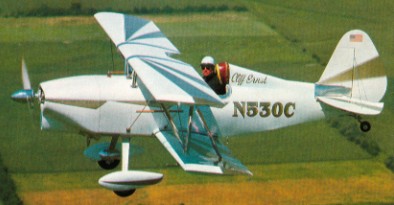
In 1955, the EAA decided to develop a single-seat sport biplane as a service to its members. The prototype was built as a classroom project by students of St.Rita’s High School in Chicago. It flew for the first time on 10 June 1960. The E.A.A. Biplane was designed in response to many requests from members of the American Experimental Aircraft Association for a single seater sports biplane of simple yet rugged construction. The fuselage consists of a welded chrome-moly steel tube frame, to which are fitted plywood formers and wooden stringers, the whole being fabric covered apart from the aluminium coaming panels. Both upper and lower wings have solid spruce spars and built-up wooden ribs, and are internally and externally wire braced. The leading edge to the front spar is aluminium covered, the remainder being fabric covered. Interplane and centre section struts are made of streamline steel tube. A 9.5 Imp. gallon fuel tank is fitted behind the firewall. The empennage, like the fuselage, is built up of welded steel tube and is fabric covered and externally braced. The ailerons which are installed on the lower wing only, are operated by means of push rods, while the elevator and rudder are cable operated. The main undercarriage is built up of steel tube with bungee cords for shock absorption.
Engine: Continental C-85, 85 hp. Wing span: 20 ft 0 in (6.1 m). Wing Area: 108 sq. ft. Wing Loading: 9.4 lb./sq.ft. Length: 17 ft 0 in (5.18 m). Height: 6 ft 0 in (1.83 m). Max TO wt: 1150 lb (522 kg). Empty Wt. 640 lb. Fuel capacity 12 USG. Max level speed: 125 mph (201 kph). Stall mph 55. Climb rate 800fpm. Takeoff run 500 ft. Landing roll 550 ft. Range 200 sm.
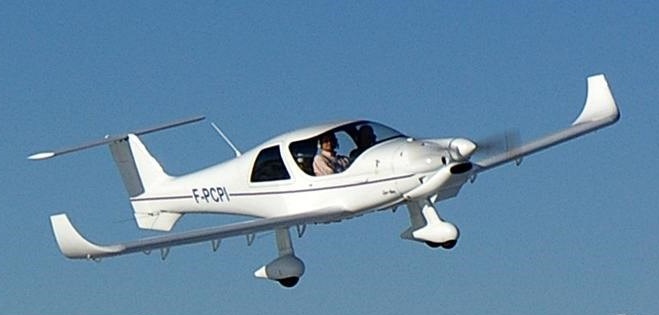
The Limousine S-LSA has elements of the MCR-4S and the Twin-R, designed to fit the LSA category. The airframe is based on the MCR-4S. The cabin is finished with the interior developed for the Twin engine “Twin-R”. It includes the new memory foam seats for comfort. The Limousine S-LSA bascally the MCR-4S certified under the S-LSA category. A two seater factory built in compliance with ASTM standards, with options and the interior designed for the Twin-R. It is a MCR-4S factory built and limited to 2 occupants whereas the 4S comes as a kit.
For its launch, the Limousine S-LSA was offered at 127,728 Euros +GST/VAT ex factory until 31 December 2010.
Engine: Rotax 912S, 100 hp Propeller: 2 blade fix pitch Wing span: 8.72 m / 28 ft 5 in Length: 6.72 m / 22 ft 5 in Height: 1.95 m / 6 ft 4 in Wing area: 8,30 m / 87.7 sq ft Aspect ratio: 9,20 Empty Weight fully equiped: 280 Kg / 616 lbs Structural MTOW: 750 Kg / 1650 lbs Useful load at 600Kg: 320 Kg / 704 lbs Fuel tanks: 2 x 100L=200L Total / 52 US Gal Wing loading: 77 kg/m / 18.8 lb/sq ft Speed at 75% Cruise, FL 0: 128 Kts (240 Km/h) Speed at 75% Cruise , FL80: 139 Kts (257 Km/h) Consumption at 75%: 20.7 L/h / 5.5 US Gal Range standard tanks at 75%: 1342 Nm (2486Km) Speed at 65% & FL110: 132 Kts (245 Km/h) Consumption at 65%: 17.9 L/h / 5 US Gal Range standard tanks at 65%: 1477 Nm (2737Km) Take Off distance: 200 m / 656 ft Climb rate, FL 0: 700 ft/min G loading: +3.8 /-1.5 g Glide ratio: 16/1 Cabin Width: 1.17 m / 46 in
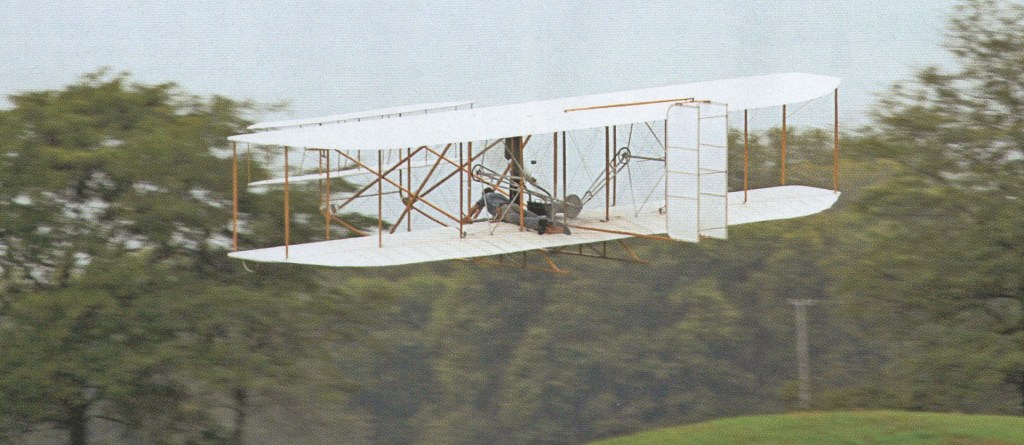
On October 3, 2007, at Huffman Prairie, Ohio, USA, Mark Dusenberry flew his Wright Flyer III reproduction for 2min 10sec around the oval course where Wilbur Wright proved the practicality of powered flight in 1905.
Dusenberry’s flight was the longest achieved by a Wright III reproduction. It came during rehearsals for a series of educational events on October 5 to celebrate the 102nd anniversary of Wilbur’s flight, during which the pioneer flew 29 laps of the course, covering 24 miles in 39min.
Construction took Dusenberry 10,000hr over a 10yr period, using the same materials seen on the original, spruce and ash. He also built a reproduction 1905 engine, and carved the spruce propellers. The only departure from original construction was the polyester cloth covering.
The October 5 events were organised by the US National Parks Service, and 2,500 people assembled at the prairie to watch Dusenberry’s flight; it lasted only 40sec, ending when the starboard wingtip clipped the ground in a turn. Mark was unhurt in the impact, and said. “All I broke was a bunch of sticks, and put a few holes in the fabric. I will repair it, and should have it flying in about a year”
The Valkyrie was a sleek, speedy looking airplane on a computer screen. Dozens of DreamWings depositors made their decision to buy a plane while they were sitting at the controls of the prototype, a happy grin on their face. They had found the perfect plane.
One thing led to another–dreams were crushed, careers were ruined, no planes were ever delivered and in 2001 DreamWings ceased operations forever. When DreamWings closed its doors, it left 145 customers behind – customers who lost nearly $1.5 million in deposit money.
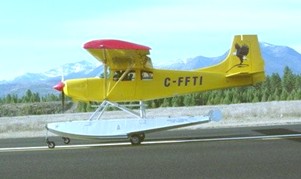
With more than 20 years expertise in manufacturing and with Yvan Desmarais’s flying experience on many different aircrafts, the construction of the first prototype began in 1998. The first flight was done at the Bromont airport on May 12th 2001 with great success. Following this first flight, many more are accomplished in the month and with the necessary flying hours accumulated by June 7th 2001, the special flying certificate can be delivered. On October 3rd 2001, the first flight on floats is accomplished, again with great success.
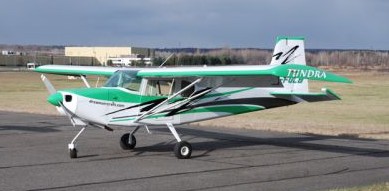
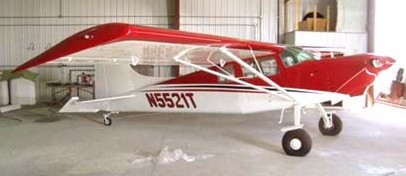
The TUNDRA is a four place kit plane in the STOL aircraft category (Short Takeoff and Landing) with a useful load comparable to bigger airplanes. This airplane will carry four adults, their luggage and enough fuel for a trip of several hours, even in floatplane configuration. This experimental aircraft is a true four place airplane. The TUNDRA is offered in either a tail dragger or a tricycle gear configuration. The TUNDRA structure is already built to attach a tail or nose wheel and even floats (all required parts are included).
The TUNDRA is an all metal plane with a useful load of more than 1100 pounds and 58 gallons of fuel (219.5 lt).
Tundra Engine: 200 hp Undercarriage: Wheels Max. take off weight: 2550 lbs Design load factor normal @ 2550 lbs: +3.8 -1.7G Maximum wing loading @ 2550 lbs: 13.90 lbs/sq ft Maximum flap extended speed: 90 mph (78 kts) Maximum cruise speed – Vc: 140 mph (122 kts) Never exceed speed (Vne): 160 mph (140 kts) Take-off roll: 400ft Cruise speed 75% power and 1500ft: 132 mph (115kts) Stall speed with extended flaps (Vso): 30 mph (26 kts) Stall speed (Vs): 42 mph (37 kts) Rate of climb: 1000 fpm Service ceiling: 14 000 ft Endurance: 5.2 hrs Range: 673 miles Length: 25 ft 6in Height: 7 ft Wheel span: 8 ft Wing span: 36ft Wing area: 183.6 sq ft Wing chord: 5ft 1in Horizontal tail span: 10ft 7in Horizontal tail area: 39 sq ft Empty weight: 1450 lbs Design gross weight: 2550 lbs Useful load: 1100 lbs Fuel capacity: 58 US gl Full fuel weight: 348 lbs Design payload: 722 lbs Wing loading: 13.90 lbs/sq ft Power loading: 13 lbs/bhp Cabin width: 44in Cabin length: 112in
Tundra Engine: 200 hp Undercarriage: Skis Max. take off weight: 2550 lbs Design load factor normal @ 2550 lbs: +3.8 -1.7G Maximum wing loading @ 2550 lbs: 13.90 lbs/sq ft Maximum flap extended speed: 90 mph (78 kts) Maximum cruise speed – Vc: 128 mph (112 kts) Never exceed speed (Vne): 160 mph (140 kts) Take-off roll: 650ft Cruise speed 75% power and 1500ft: 125 mph (110kts) Stall speed with extended flaps (Vso): 40 mph (35 kts) Stall speed (Vs): 45 mph (39 kts) Rate of climb: 800 fpm Service ceiling: 14 000 ft Endurance: 5.2 hrs Range: 660 miles Length: 25 ft 6in Height: 7 ft Wheel span: 9 ft Wing span: 36ft Wing area: 183.6 sq ft Wing chord: 5ft 1in Horizontal tail span: 10ft 7in Horizontal tail area: 39 sq ft Empty weight: 1604 lbs Design gross weight: 2550 lbs Useful load: 946 lbs Fuel capacity: 58 US gl Full fuel weight: 348 lbs Design payload: 598 lbs Wing loading: 13.90 lbs/sq ft Power loading: 12.78 lbs/bhp Cabin width: 44in Cabin length: 112in
Tundra Engine: 200 hp Undercarriage: Floats Max. take off weight: 2800 lbs Design load factor normal @ 2550 lbs: +3.8 -1.7G Maximum wing loading @ 2550 lbs: 15.25 lbs/sq ft Maximum flap extended speed: 90 mph (78 kts) Maximum cruise speed – Vc: 125 mph (110 kts) Never exceed speed (Vne): 140 mph (122 kts) Take-off roll: 1300ft Cruise speed 75% power and 1500ft: 118 mph (103 kts) Stall speed with extended flaps (Vso): 45 mph (39 kts) Stall speed (Vs): 52 mph (45 kts) Rate of climb: 600 fpm Service ceiling: 14 000 ft Endurance: 5.2 hrs Range: 613 miles Length: 25 ft 6in Height: 9 ft Wheel span: 9 ft Wing span: 36ft Wing area: 183.6 sq ft Wing chord: 5ft 1in Horizontal tail span: 10ft 7in Horizontal tail area: 39 sq ft Empty weight: 1692 lbs Design gross weight: 2800 lbs Useful load: 1108 lbs Fuel capacity: 58 US gl Full fuel weight: 348 lbs Design payload: 760 lbs Wing loading: 15.25 lbs/sq ft Power loading: 14.2 lbs/bhp Cabin width: 44in Cabin length: 112in
In 1979, Yvan and Yves Desmarais founded, with their cousin Serge Gagné and backed by their mother Gisèle, the company D & G Inc. The company is specialized in Welding and assembly. After some modest beginnings in their home garage, D & G Inc. gains a solid reputation based on its integrity and the quality of its workmanship. As the years pass, the company invests in new technology with the purchase of welding robots and in 1996, they move in a new 60,000 square feet plant. A couple of years later, the company invests again; this time, 1.5 million dollars is invested in the purchase of high technology machinery for sheet metal transformation.
Yvan Desmarais, the company’s vice-president, has always been fascinated by aviation. A pilot since he was 19 years old, he nurtured a dream which he transmitted to his business partners. His dream was of a highly secure plane; be it on wheels or on floats. A plane that would be solid, durable and easy to build.
With more than 20 years expertise in manufacturing and with Yvan Desmarais’s flying experience on many different aircrafts, the construction of the first prototype began in 1998. The first flight was done at the Bromont airport on May 12th 2001 with great success. Following this first flight, many more are accomplished in the month and with the necessary flying hours accumulated by June 7th 2001, the special flying certificate can be delivered. On October 3rd 2001, the first flight on floats is accomplished, again with great success.
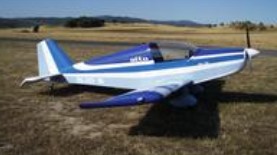
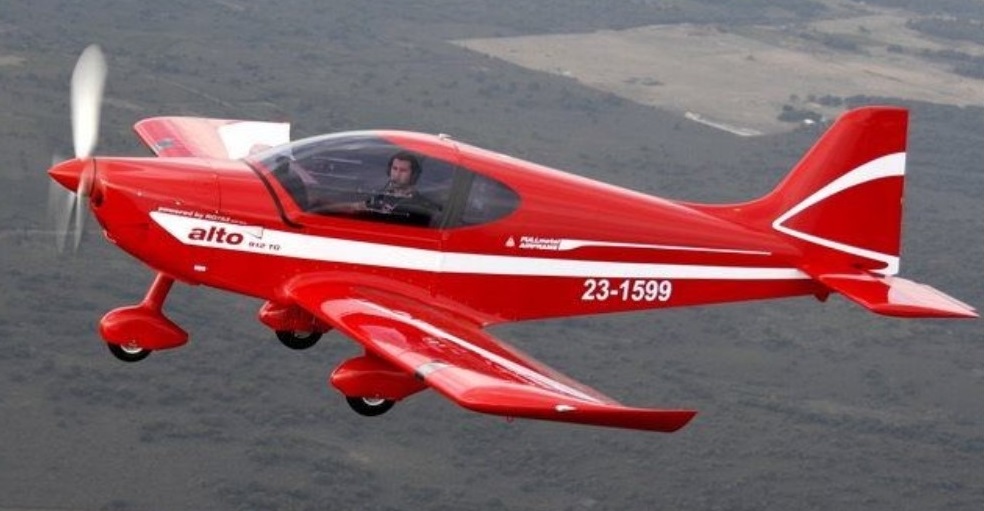
The Alto aircraft is an all-metal construction aircraft for amateur construction. The Alto aircraft meets both requirements to European category “ultralight aircraft” and “light sport aircraft” (LSA) category that has been defined in the U.S.A.
Different versions were offered. A basic version with the tricycle, nose type landing gear or optional with the tail landing gear with Rotax 912 ULS/UL as standard, but Jabiru on request, and wheel-type control or the stick control, standard is wheel control
Alto is single-engine, two-seat, low-wing, cantilever monoplane. The aircraft is all-metal riveted construction and may be equipped with rescue parachute system.
Alto 912 TG
The TG version (basic) is the tricycle, nose type with the nose landing gear steering. The main wheels are attached to the flexible all-composite legs. The main landing gear wheels brakes are operated by the hydraulic system, by means of break pedals (in the left side only) or with central brake with parking function. The TW version (optional) has the tail wheel landing gear.
The rectangular wing is a monospar construction with an auxiliary spar. The skin is made from duralumin sheet. The wing is equipped with ailerons, slotted flaps and integral fuel tanks with a total capacity of 105 l. All the parts are riveted together. The wing-body attachment forms a wing centre section, which is firmly placed into the fuselage. The wing main spar is connected to the wing centre section by bolts and the rear auxiliary spar is connected by a hinge.
The rectangular fuselage is of semimonocoque, riveted construction and has a bottom and the side walls reinforced by diagonal stiffeners. The dorsal is of oval cross section.
Alto 912 TG
The tail unit is of all-metal, riveted structure and has a standard configuration.
Aeroplane control consist of elevator, ailerons and rudder control surfaces. The manual control is of a wheel-type or a stick and deflections are transmitted by chains, push-pull tubes, and cables. The pedal control deflections are transmitted by cables to the rudder, and by push-pull tubes to the nose landing gear steering. The wing flaps and the elevator trim tabs are operated electrically. The main landing gear wheels brakes are independently operated by the hydraulic system, by means of break pedals on the pedal control.
The cockpit inner width is 106 cm and the wheel-type control and a forward sliding canopy make for easy boarding. The canopy is made from glass, and optionally may has light blue colour, and may be equipped with the wind-wings.
2009 Price: 44000 EURO
Alto TG 912 UL Engine: Rotax 912UL, 80 hp Length: 6,15 m / 20,18 ft Wing span: 8,20 m / 26,9 ft Wing area: 10,5 sq.m / 114 sq.ft Height: 2,25 m / 7,38 ft Cabin width: 1,10 m / 3,61 ft Seats: 2 Fuel: 118 lt / 31,2 US gal Take off run: 100 m / 328 ft Landing run: 150 m / 492 ft Empty weight: 280 kg / 618 lb MTOW – ULM: 472 kg / 1041 lb MTOW – LSA: 600 kg / 1320 lb Vne: 255 km/h / 158 mph Maximum speed: 230 km/h / 143 mph Cruising speed: 185 km/h / 115 mph Stall speed full flaps 450 kg: 65 km/h / 41 mph Stall speed no flaps 600 kg: 81 km/h / 51 mph G factor: +4 / -2 Climb rate 450 kg: 5,6 m/s / 1100 fpm Climb rate 600 kg: 4,5 m/s / 890 fpm
Alto TG 912 ULS Engine: Rotax 912ULS, 100 hp Length: 6,15 m / 20,18 ft Wing span: 8,20 m / 26,9 ft Wing area: 10,5 sq.m / 114 sq.ft Height: 2,25 m / 7,38 ft Cabin width: 1,10 m / 3,61 ft Seats: 2 Fuel: 118 lt / 31,2 US gal Take off run: 90 m / 295 ft Landing run: 150 m / 492 ft Empty weight: 285 kg / 628 lb MTOW – ULM: 472 kg / 1041 lb MTOW – LSA: 600 kg / 1320 lb Vne: 270 km/h / 168 mph Maximum speed: 250 km/h/ 155 mph Cruising speed: 200 km/h / 124 mph Stall speed full flaps 450 kg: 65 km/h / 41 mph Stall speed no flaps 600 kg: 81 km/h / 51 mph G factor: +4 / -2 Climb rate 450 kg: 6,3 m/s / 1250 fpm Climb rate 600 kg: 5,1 m/s / 1005 fpm Take-off distance (50ft obstacle): 440 ft / 135 m Landing distance (50ft obstacle): 490 ft / 150 m


 All Aero