2003: Based in Ascoli Piceno, Italy.
Jerry Yagen’s Flug Werk.
2010: FLUG WERK GmbH, Kothingried 4, 85408 Gammelsdorf, Germany.
In addition, Flug Werk was recognized for two years as subcontracting firm for the EADS and different components for the ME 262 reproduction of the Messerschmittstiftung manufacture. Among them is also new, “fin adjustment equipment specified in the RLM jargon “(= horizontal stabilizer trim). It is a quite complex construction unit, on which the working reliability of the entire aircraft hangs. A homogenous retrofit of the others “Swallows “of the American 262-Herstellers is available.
Flug Werk founder Claus Coiling says that the demand for the new-build FW 190s means that the original planned production of 12 airframes has been increased to 20 examples. After production of FW 190 parts has finished, the company will proceed with the manufacture of a North American P-51 Mustang Iookalike” airframe kit called the AP-51 Palomino.
2010: The workshop of Achim and Elmar Meiser at Bremgarten airfield, Germany, Flug Werke.
2000->
Flight Design Ghostbuster
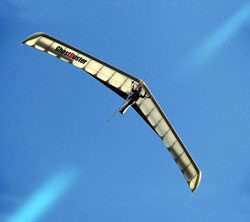
A 1999 hang glide for advanced pilots.
Wing area: 12.6 m²
Wing span: 13 m
Aspect ratio: 13.4
Hang glider weight: 35 kg
Minimum pilot weight: 90 kg
Maximum pilot weight: 150 kg
Minimum speed: 30 km/h
Maximum speed: 110 km/h
Max glide ratio (L/H): 17.60
Max glide ratio speed: 55 km/h
Minimum sink rate: 0.7 m/s
Packed length: 5.9 m
Nose angle: 150°
Flight Design Axxess / Fliegerböhm Axxess
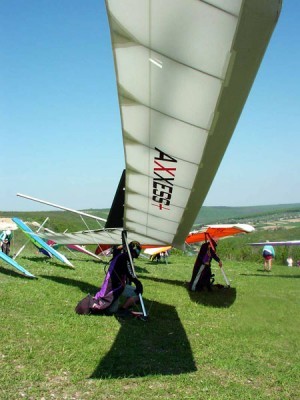
A 2002 rigid wing hang glider for advanced pilots.
The rigid AXXESS is super stable in flight (calm and turbulent) and has a formidable landing facility, with well dimensioned flaps. The assembly with integrated slats is easy. The decoupling of the wings facilitates the transport.
Flight Design no longer produces wings and rigid. But fliegerboehm continues the manufacture of rigid Axxess.
Axxess
Wing area: 13.5 m²
Wing span: 13.1 m
Aspect ratio: 12.7
Hang glider weight: 39 kg
Minimum pilot weight: 90 kg
Maximum pilot weight: 115 kg
Packed length: 6.3 m
Nose angle: 127°
Axxess +
Wing area: 12.6 m²
Wing span: 13.1 m
Aspect ratio: 13.6
Hang glider weight: 39 kg
Minimum pilot weight: 90 kg
Maximum pilot weight: 115 kg
Packed length: 6.3 m
Nose angle: 127°
Flight Design C4
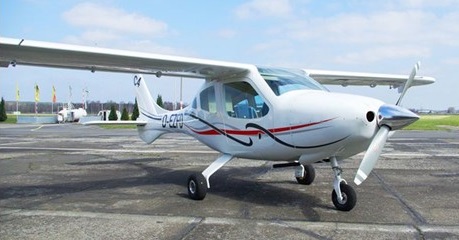
The company’s four-seat C4 project has slowed down its planned U.S. certification schedule to take advantage of anticipated streamlining of the Part 23 process by FAA, so deliveries could slide into 2015.
Flight Design entered receivership in 2016. Work on the C4 had come to a standstill after the company ran into financial difficulty. Production had also slowed to a trickle as the company workforce was trimmed to 10 people in Germany and around 60 in the Ukraine.
Flight Design completed the sale of all major company assets to the German investment group Lift Holding, allowing for the resumption of work on the C4, a Part 23-certified four-seater with a projected selling price of $250,000.
Flight Design MC
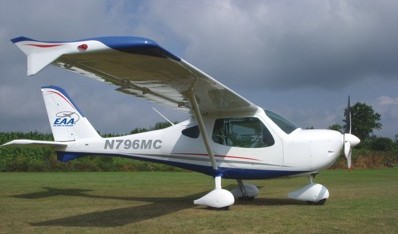
Created to complement the existing CTsw and CTLS, the MC offers utility and performance in a metal airframe. Constructed from Aluminum, steel and composites, the MC features a steel space frame, all aluminum flying surfaces and a composite cabin and cowling.
The focus with the MC was to provide more utility with a giant cabin and easy-to-maintain modular construction.
Designed with training and commercial fleet uses in mind, the MC visibility, baggage area and easy cabin entry are features.
The metal flying surfaces of the MC are buck riveted and corrosion proofed for maintenance free flying. The steel pilot cage is covered with easy to remove composite shells to allow quick access to the landing gear and controls for annual or 100 hour inspections. The main landing gear is the Flight Design nobounce composite gear introduced on the CTLS.
The cabin of the MC has a width of nearly 52 inches, 2-way adjustable seats and extra-wide cabin doors. The four-point safety harnesses, wing located fuel tanks and the BRS 1350 parachute system are standard.
Standard features include 2 blade composite propeller, conventional three-axis controls, electric pitch trim system, cabin door gas struts, two large capacity baggage compartments, two cockpit storage compartments, electric pre-selector flap system, one piece molded windshield, steerable nose wheel, hydraulic brakes, durable, two-part urethane paint.
2012 Price: US$114,627.
Flight Design CT
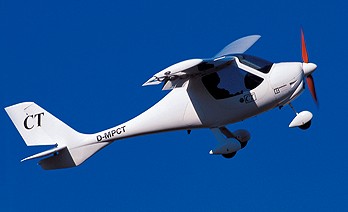
An ultralight composite aircraft, the Flight Design CT2K has been developed, and now has less weight, increased power and higher performance, with additional load-carrying capability.
The design of the wing and the aircraft structure has been tested for a take-off weight up to 600 kg, so the Flight Design CT2K can comply with different certification criteria in different countries. 2009 CT2K price: 55862 EURO
In spring 2003 CT2K was complimented with the CTSW (CTSW = CT Short Wing). Due to 80 cm shorter wings and increased ground effect CTSW has even greater aerodynamic stability and is easy to land. This aircraft had 5 km/h increased maximum level-flight speed while having slightly reduced climb speed.
Both CT2K and CTSW were also available as VLA versions.
2009 price for the CTSW was 60000 EURO.
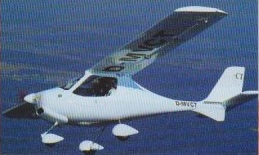
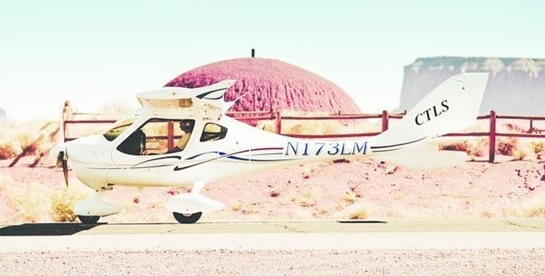
In 2012 Flight Design had 11 registrations in the US. CTLSi (with the fuel-injected Rotax 912iS engine) are selling well, and the CTLS, MC and CTLS-Club models continue in the popular lineup. 2012 Prices: US$156,500 (CTLSi); US$143,800 (CTLS); US$136,860 (CTLS-Club).
CT 180
Engine: Rotax 912, 80 hp
Wing span: 9.30 m
Wing area: 10.80 sq.m
MAUW: 450 kg
Empty weight: 275 kg
Fuel capacity: 100 lt
Max speed: 225 kph
Cruise speed: 210 kph
Minimum speed: 64.4 kph
Climb rate: 5 m/s
Certification: VZ
Seats: 2
Fuel consumption: 15 lt/hr
Price (1998): 60 000 DM
Flight Design CT
Engine: Rotax 912S, 100@SL
TBO: 1500 hrs.
Fuel type:100/100LL
Propeller: Neuform FP
Landing gear type: Tri./Fixed
Max ramp weight: 1320 lb
Gross weight: 1320 lb
Landing weight: 1320 lb
Empty weight, std: 646 lb
Useful load, std: 674 lb
Useful fuel, std: 34 USgals
Payload, full std. fuel: 470 lb
Wingspan: 28 ft
Overall length: 20 ft. 4 in
Height: 7 ft. 11 in
Wing area:107 sq. ft
Wing loading: 12.3 lbs./sq. ft
Power loading: 13.2 lbs./hp
Wheel size: 6.00 x 6 in
Seating capacity: 2
Cabin doors: 2
Cabin width: 49 in
Cruise speed 75% power: 112 kt
Max range (w/ reserve) 75% power: 600 nm
Fuel consumption 75% power: 4.5 USgph
Vso: 39 kt
Best rate of climb SL: 960 fpm
Service ceiling: 14,000 ft
Takeoff ground roll: 295 ft
Takeoff over 50-ft. obstacle: 525 ft
2006 price: US$92,900
CT2K
Stall: 33 kt / 39 mph / 62 kmh
Cruise: 127 kt / 146 mph / 235 kmh
VNE: 167 kt / 193 mph / 310 kmh
Empty Weight: 270 kg / 595 lbs
MTOW Weight: 450 kg / 992 lbs
Climb Ratio: 1000 ft/min / 5 m/s
Take-off distance (50ft obstacle): 520 ft / 160 m
CTSW
Engine: Rotax 912S, 100 hp
Propeller: Ground Adjustable Composite
Wing Span: 28 ft
Length: 20 ft, 4 in
Height: 7 ft 11 in
Wing Area: 107 sq.ft
Aspect Ratio: 7.29:1
Empty Weight: 649 lb
Gross Weight: 600 kg / 1,320 lb
Fuel Capacity: 34 USG
Fuel Economy: 4.5 USG/hr
Airfoil Type: C 180, 13.8% Thick
Cruise Speed (@ 75% power): 112 kts
Stall Speed (VS0): 39 kts
VNE: 145 kts
Climb Rate: 960 fpm
Max. Range; 34 Gal. no res: 1,080 miles
Takeoff Roll: 295 feet
Take-off distance (50ft obstacle): 660 ft / 200 m
Landing distance (50ft obstacle): 980 ft / 300 m
Glide Ratio: 14:1
CTLS
Engine: Rotax 912S, 100hp
Propeller: Ground Adjustable Composite
Wing Span: 28 ft, 2 in
Length: 21 ft, 8 in
Height: 7 ft, 8 in
Wing Area: 107 sq.ft
Aspect Ratio: 7.29:1
Empty Weight: 770 lb
Gross Weight: 1,320 lb
Fuel Capacity: 34 USG
Fuel Economy: 4.5 USG/hr
Airfoil Type: C 180, 13.8% Thick
Cruise Speed (@ 75% power): 112 kts
Stall Speed (VS0): 39 kts
VNE: 145 kts
Climb Rate: 805 fpm
Max. Range; 34 Gal. no res: 830 miles
Takeoff Roll: 800 ft
Glide Ratio: 14:1
Base price 2017: $147,900
Flight Design GmbH
Offered the CT two-seat very light composites cabin lightplane (first flown 1996 and produced in association with Albert Schulze-Oechterding from ASO Flugsport), hang gliders and paragliders.
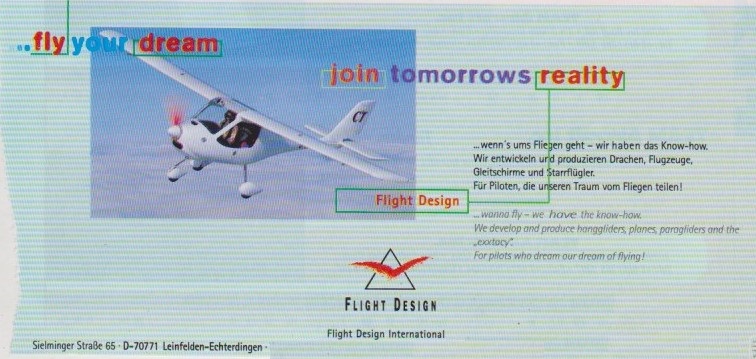
1998: Sielmingerstr.65, D-70771 Leinfelden-Echterdingen, Germany
Flight Design entered receivership in 2016. Work on the C4 had come to a standstill after the company ran into financial difficulty. Production had also slowed to a trickle as the company workforce was trimmed to 10 people in Germany and around 60 in the Ukraine.
German investment group Lift Holding purchased Flight Design in 2017, allowing for the resumption of production of the C4. Flight Design completed the sale of all major company assets to the German investment group Lift Holding, allowing for the resumption of work on the C4, a Part 23-certified four-seater with a projected selling price of $250,000.
The newly realigned company was to be based at a new facility near Eisenach in the Thuringia region of Germany. The company will now be called Flight Design General Aviation GmbH. Lift Holding will combine the technical expertise of Flight Design with its other recently acquired aviation asset, gyrocopter producer Rotorvox. Both companies were to be headquartered at the Kindel Airport near Eisenach.
Fläming FA 01 Smaragd / FA 02 / FA 04 Peregrine
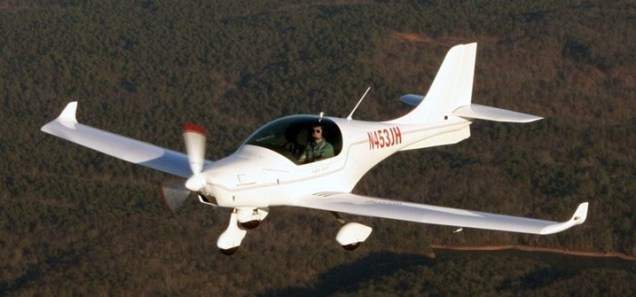
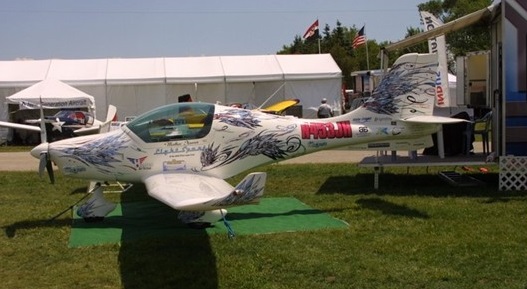
The Smaragd / Emerald is a conventional low-wing aircraft with classical tail unit and tricycle landing gear, built from glass and carbon fiber reinforced plastic. The seats are next to each other arranged and adjustable. Behind the seats are the very roomy baggage compartment and the evacuation equipment. The wing anchorage is solved over interlinking cross-beam roots and a main pin as with modern Seglern, which permits an extremely simple disassembly. The main landing gear consists of rocker with hydraulically braked wheels of GRP kevlar. The tanks are arranged in the wing; 55 and/or 110 litres were available.
The Smaragd had it’s maiden flight on March 22nd, 2003 and was licensed on December 29th, 2003.
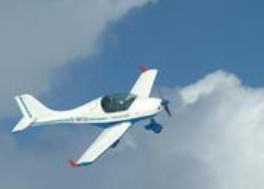
The aircraft was designed and produced by Flaeming Air of Zehlendorf, Brandenburg, to comply with the Fédération Aéronautique Internationale microlight rules and US light-sport aircraft rules, with different models for each category. It features a cantilever low-wing, a two-seats-in-side-by-side configuration enclosed cockpit under a bubble canopy, fixed tricycle landing gear, or optionally conventional landing gear and a single engine in tractor configuration.
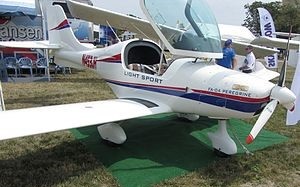
The aircraft is made from composites, with its fuselage, wing spars, flaps and rudder made from carbon fibre. Its 10.05 m (33.0 ft) span wing has an area of 9.27 m2 (99.8 sq ft). The standard engines available are the 100 hp (75 kW) Rotax 912ULS, 120 hp (89 kW) Jabiru 3300 and the 100 hp (75 kW) Continental O-200 powerplants.
The Peregrine is the LSA version of the Smaragd, allowing a 600 kg max take-off weight. The Peregrine is close to the VLA/experimental version, having different wings to fit into the LSA rule plus some small details to suit the US customer. The US-LSA certification has been granted. The Peregrine fits into the US rules ASTM 2245. The FA 04 Peregrine LSA features fixed gear and fixed pitch prop.
The FA 04 can be used for aero-towing gliders up to 700 lb (318 kg) gross weight. The Flaeming Air FA 04 Peregrine is supplied as a complete ready-to-fly-aircraft.
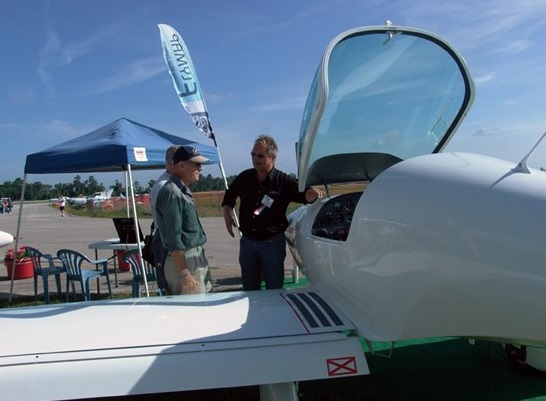
The FA-04 Peregrine factory-built Special Light Sport Aircraft (SLSA) is based on Flaeming Air’s FA-02 rugged VLA certified aircraft. The FA-04 can easily be configured from tricycle to tail wheel by a certified mechanic. The cockpit, 44 inch wide at the shoulders, has adjustable seats ergonomically designed, electric flaps, and hydraulic toe brakes with a hand brake option. A mechanical elevator trim or an optional electric trim is available.
Engine options for the SLSA are 80/100 hp Rotax 912 or 80 hp Jabiru 2200 and a 3-blade propeller, ground adjustable.
Variants:
FA 01 Smaragd (English: Emerald)
Initial model for the European FAI microlight class, with a gross weight of 472.5 lb (214 kg).
FA 02
Kit aircraft with a gross weight of 650 lb (295 kg).
FA 04 Peregrine
Light-sport model for the US market, with a gross weight of 600 lb (272 kg).
FA 04 SL
Super-light model with an empty weight of 270 lb (122 kg), including a ballistic parachute.
Specifications:
FA 01 Emerald
Stall: 35 kt / 40 mph / 65 kmh
Cruise: 119 kt / 137 mph / 220 kmh
VNE: 146 kt / 168 mph / 270 kmh
Empty Weight: 290 kg / 639 lbs
MTOW Weight: 472 kg / 1041 lbs
Climb Ratio: 1200 ft/min / 6 m/s
Fuel capacity: 55 and/or 110 lt
FA 04 Peregrine
Engine: 1 × Rotax 912ULS, 75 kW (100 hp)
Length: 6.15 m (20 ft 2 in)
Wingspan: 9.27 m (30 ft 5 in)
Wing area: 10.05 m2 (108.2 sq ft)
Empty weight: 278 kg (613 lb)
Gross weight: 472.5 kg (1,042 lb)
Fuel capacity: 120 litres (26 imp gal; 32 US gal)
Maximum speed: 230 km/h (143 mph; 124 kn)
Cruising speed: 220 km/h (137 mph; 119 kn)
Stall speed: 65 km/h (40 mph; 35 kn)
Never exceed speed: 270 km/h (168 mph; 146 kn)
Range: 1,148 km; 713 mi (620 nmi)
Rate of climb: 6 m/s (1,200 ft/min)
Crew: one
Capacity: one passenger
FA 04 Peregrine LSA
Engine: 80/100 hp Rotax 912 or 80 hp Jabiru 2200
Propeller: 3-blade, ground adjustable
MTOW: 600 kg
Stall: 45 kts
Cruise: 120 kts
Econ cruise: 100-110 kt
Max cruise: 117 kt
Price (assembled, 2011): €59,750
Fläming Air GmbH Oehna
Berlin, right after the re-unification, was the assigned German capital with an area of roughly 5 million people. Agricultural flying had been very popular in the GDR so there were a lot of adandoned airfields at that time.
Starting the organisation and finding the right spot to start was a challenging task. Even better, finding the right aircraft for training, getting all the licences and building the network of flight instructors, clients and maintenance facilities.
The property question was still a major obstacle as a lot of land had to be reassigned to old and new owners. Infrastructure of old adminstration had to be carried over to the new administration, validation of old licences, ald maintenance standards and while facing all that trouble, we opended our new company and found a spot to start Fläming Air.
Fläming, the name for an area south of Berlin, is flat land and called “Fläming” for about 900 years after some early settlements of the Flame tribes. In the early 90s, Fläming had their first airfield and fuel station. 40,000 flights from that field showed the importance of Fläming Air for the south Berlin flying community. By 1995 they had the first hard runway which was extended to 850 m in 1998. Another grass runway for gliders and tail dragger was added in 1998 as well as illumination for night VFR. 20-30 students filed their PPL at the facilities every year.
The repair and maintenance facility is certified to JAR 145 and a little later the JAR 21G Production certification for Rotax conversions of Cessna C150 was achieved. 1999 saw the first licence production of an ultralight aircraft made from GFR/CFR. In 2003 Fläming launched their own microlight/ultralight/experimental – the Smaragd, which had it’s maiden flight on March 22nd, 2003 and was licensed on December 29th, 2003.
FK-Lightplanes SW51 Mustang
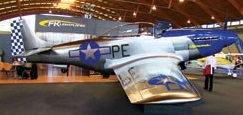
Designed by Peter Funk, the SW51 Mustang 70% scale version of the P-51, is a of all-composite carbon-fiber/honeycomb construction. The material is stained to look like aluminum.
The SW designation is due to FK-Lightplanes’ partnership with ScaleWings, which helped design the airplane. The SW51 took more than 40,000 man-hours to develop.
FK-Lightplanes can produce the airplane in one week and planned to certify the SW51 under the light sport aircraft category.
The European version has retractable gear and a 200 hp motor. The U.S. edition (either S-LSA or Experimental Amateur Built) has fixed gear and prop, and Rotax 912 or 914 power. Powered is by a 100-hp Rotax 912 ULS engine driving a fixed-pitch carbon fiber three-blade DUC propeller, expected cruise was around 150 knots. The airplane is able to withstand aerobatic maneuvers within +8 and -4 G.
The FK-Lightplanes SW51 took to the skies for the first time in late 2014, and serial number three, which was to be flying under an experimental exhibition airworthiness certificate, was expected to land in the U.S. by the year-end.
Price: $130,000 (2014 estimated).
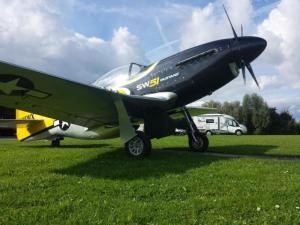
Engine: Rotax 100 hp – 200 hp V
Wingspan: 7.900 m
Length: 6.889 m
Height: 1.970 m
Empty weight 295 kg
MTOW: 600 kg
MTOW S-LSA: 472.5 kg
Ultimate load 600 kg: +8/ -4 G
Vne: 370 kph
Max speed: 280-350 kph
Seats: 2
Undercarriage: electro-hydraulic retractable
Fuel capacity: 116 lt (2 x 55 lt tanks)
 All Aero