Windward Performance Perlan II

Airbus Perlan 2

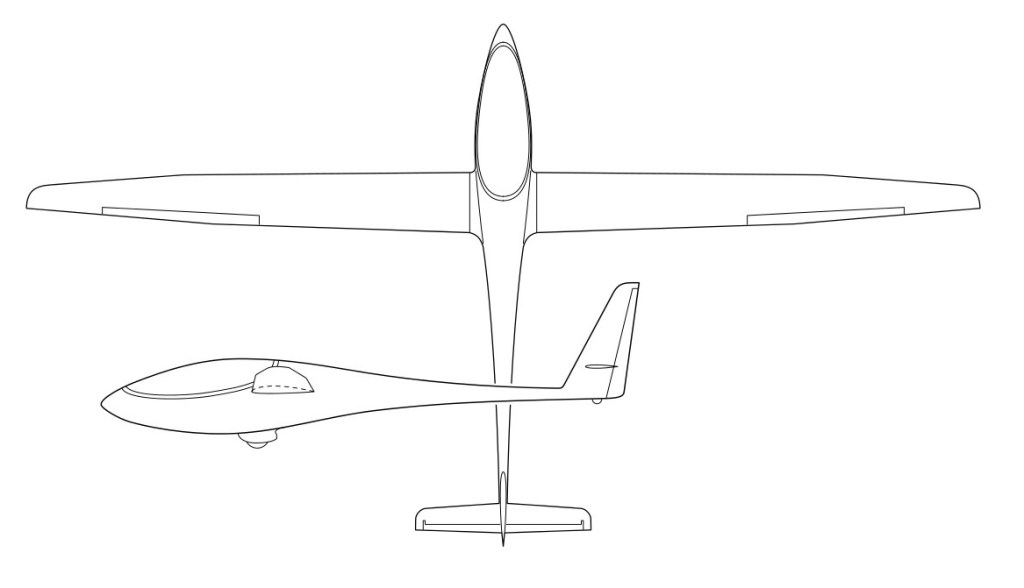
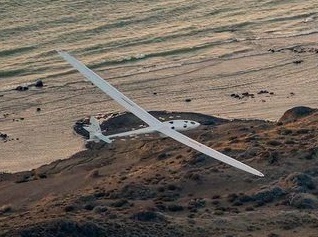
The Windward Performance Perlan 2 (English: Pearl) is an American mid-wing, two-seats-in-tandem, pressurized, experimental research glider that was designed by Greg Cole and built by Windward Performance for the Perlan Project.

The Perlan 2 is a follow-up design to the successful Perlan 1 and has as its design goal a flight exceeding 90,000 ft (27 km) in altitude. The aircraft will be used to study the northern polar vortex and its influence on global weather patterns. The program also hoped to beat the 85,069 ft altitude record set in 1975 by a SR-71.

The original funding for the Perlan Project was provided by Steve Fossett and he flew the Perlan 1, along with test pilot Einar Enevoldson to a glider altitude record of 50,761 ft (15 km) in the mountain waves of El Calafate, Argentina on 30 August 2006. Fossett was killed in a light aircraft crash a year later and the project floundered without funding. Since then, more than US$2.8M has been raised to build the Perlan 2, including a donation from Dennis Tito. In November 2013, a crowd-funding effort was undertaken. In August 2014 Airbus became a partner and major funder in the project.

The aircraft is made from composites. Its 83.83 ft (25.55 m) span wing has a high aspect ratio of 27:1 and is equipped with airbrakes. The pressurization system produces an 8.5 psi differential, and the two-person crew will not wear pressure suits. The landing gear is a non-retractable monowheel gear. Because the aircraft will operate at extreme altitudes, in only 3% of sea level atmospheric pressure, it will also be flying at true airspeeds in excess of 0.5 Mach. The aircraft was designed to minimize flutter and manage shock wave formation.

Perlan 2, benefitting from the lessons learned on Perlan 1’s ascent, incorporates a pressurized cabin to allow its pilots to enjoy unencumbered flight, with full control over stick and rudder, and many small switches. The cabin pressure of 8.5 pounds per square inch (psi) gives a cabin atmosphere equal to flight at about 14,000 feet. With an empty weight of 1,500 pounds, and a wing area of 262 square feet, the 84-foot span machine is amazingly light for the structural strength required for stratospheric flight.

With more wing area than a conventional sailplane, it would stay aloft, but never compete with such craft at lower altitudes. But in the thin air at 90,000 feet, with 98 percent of the earth’s atmosphere beneath it, it will be unrivalled. Because it carries two into a very hazardous realm, it is equipped with specialized equipment, including dual-redundant oxygen rebreathers, a drogue parachute to allow rapid descent in the unlikely emergency, and a ballistic chute for a lower-altitude emergency descent.
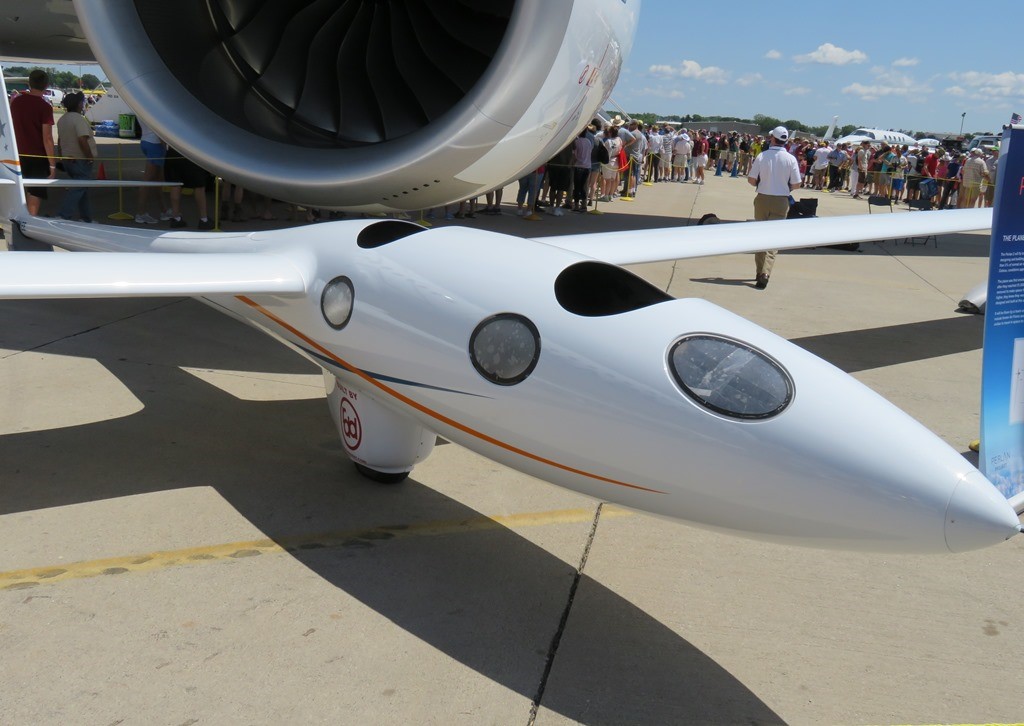
The aircraft first flew on 23 September 2015 at Redmond Municipal Airport, Oregon and started with flights in the U.S. Sierra Nevada mountain wave.

The record setting and research flights started in southern Argentina in 2016, by Einar Envoldson or Perrenod using rebreather oxygen systems. The aircraft was displayed at AirVenture in July 2015.

The first version of the Perlan reached 50,727 feet in 2006 with The Perlan Project’s founder Einar Enevoldson and lead project sponsor Steve Fossett at the controls setting a record.

The Airbus Perlan 2 reached new heights, flown by Jim Payne and Morgan Sandercock, breaking the world record for a glider flight as it soared to 52,172 feet on September 3 2017. An Aero Boero AB-180 tow plane pulled chief pilot Jim Payne and co-pilot Morgan Sandercock off the ground at Comandante Armando Tola International Airport, which sits at an elevation of 669 feet in El Calafate, Argentina.

The area around El Calafate is one of only a few places on Earth where mountain waves combine with a high altitude polar vortex; conditions critical to providing enough lift to bring a glider into the stratosphere.

Analyses by ground crews, which use data from weather balloons and meteorologists, did not indicate favorable conditions for a record flight. However, the pilots felt otherwise. They were right.

The glider was released at 10,500 feet and mountain waves carried the Perlan 2 to approximately 40,000 feet. There is generally a segment of altitude between the lifting layers where the glider can’t continue to gain altitude. An overlap is critical for bringing the glider into the stratosphere. And while the polar vortex did not quite overlap with the mountain waves, the glider was close enough that the pilots could redirect it to an area where they could continue to gain altitude.
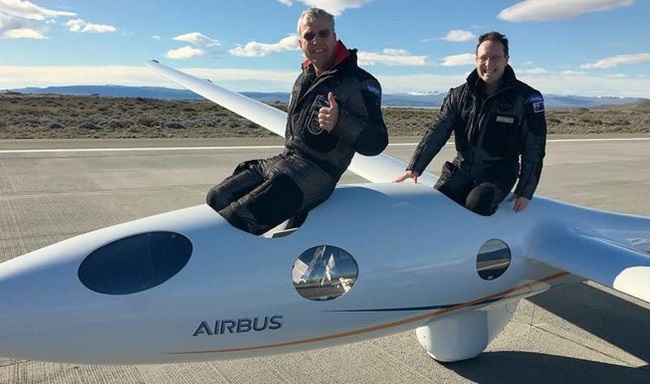
Perlan 2, flown by Jim Payne and Morgan Sandercock

The pilots said the climb rate was about 300 feet on average and the record flight lasted about 6.6 hours.

On 2 September 2018, Jim Payne and Tim Gardner reached an altitude of 76,124 ft (23,203 m), surpassing the 73,737 ft (22,475 m) attained by Jerry Hoyt on April 17, 1989 in a Lockheed U-2: the highest subsonic flight.

Perlan II
Wingspan: 83.83 ft (25.55 m)
Wing area: 263 sq ft (24.4 m2)
Aspect ratio: 27:1
Length: 33.33 ft (10.16 m)
Height: 7.25 ft (2.21 m)
Gross weight: 1,800 lb (816 kg)
Never exceed speed: 377 kn (434 mph, 698 km/h) true airspeed, 56kts indicated
Service ceiling: 90,000 ft (27,000 m)
g limits: +6/-4
Crew: two

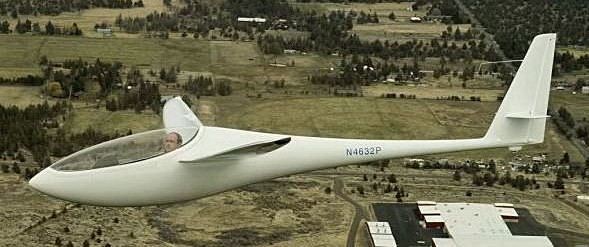
Windward Performance Perlan I

The glider, called the Perlan (Norwegian for “pearl”), is modified from a Glaser-Dirks DG-505M manufactured by DG Flugzeugbau in 1995. Its original self-launching Rotax 535C engine was replaced with oxygen tanks, scientific equipment, and non-rechargeable “primary” batteries, oxygen regulators and flight instruments. Because of this, the Perlan had to be towed into the air for release, and since the cockpit was unpressurized, pilots had to wear NASA spacesuits to combat the extreme altitude which presented difficulties in permitting full control movements.

To reach 50,000 feet while keeping the crew safe, the Perlan 1 was equipped with:
High altitude radar transponder by Sandia Aerospace
Instrumentation and lighting to fly at night by Whelen Engineering
Data loggers to validate world record, LX-9000
Scientific instrumentation
Cameras to record meteorological conditions
Lithium-ion rechargeable batteries
Telemetry to communicate with mission control on the ground

On August 29, 2006, Steve Fossett and Einar Enevoldson flew the modified glider to a record-setting altitude of 50,727 feet (15,445 m) over the Patagonia region of Argentina. By capitalizing on stratospheric “mountain waves” and the Polar Vortex that forms around Antarctica each winter, Fossett and Enevoldson were able beat the previous glider altitude record by over 1,500 feet. (The record was subsequently broken by the Airbus Perlan II, which reached 52,172 feet on September 3, 2017.)

The Museum of Flight acquired the aircraft from the late Mr. Fossett’s Marathon Racing Company in 2009.

Wingspan: 59 ft
Wing Area: 179 sq ft
Aspect Ratio: 19.52
Length: 28ft
Height: 6ft
Empty Weight: 860 lb
Gross Weight: 1389 lb
Wing Loading: 7.8 lb/sq ft
Maximum Speed: 168 mph
Service Ceiling: 62 000.00ft
Crew: 2

Windward Performance DuckHawk

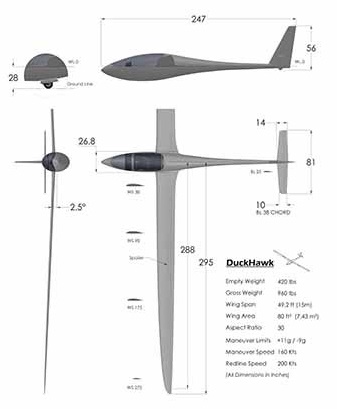
The DuckHawk is a development of the Windward Performance SparrowHawk and is intended as a higher performance glider than its predecessor, with very high structural limits and Vne. The DuckHawk has less than 10% parts commonality with the SparrowHawk. It features a cantilever wing, a single-seat enclosed cockpit under a bubble canopy and retractable monowheel gear.

Designed and produced by Windward Performance of Bend, Oregon, the aircraft is made from pre-impregnated carbon fiber. Its 15 m (49.2 ft) span wing employs a Greg Cole-designed airfoil, has an area of 80 sq ft (7.4 m2) and an aspect ratio of 30:1.

By December 2016 four examples had been registered in the United States with the Federal Aviation Administration, including three “V” models and one “E” model.

Since 2016 the aircraft has been no longer advertised as available by the manufacturer.

Variants:

DuckHawk E
Electric motorglider version, first example registered with the FAA in 2011.

DuckHawk V (Veloce)
Base model with an empty weight of 390 lb (180 kg), a maximum gross weight of 960 lb (440 kg) and load limits of +7/-5g. The first example was registered with the FAA in 2014 and three have been built.

DuckHawk SV (Super Veloce)
Proposed model with a 64% thicker spar, thicker fuselage, an empty weight of 435 lb (197 kg), a maximum gross weight of 960 lb (440 kg) and load limits of +11/-9g. None completed.

DuckHawk VNX
Proposed model with thicker wing skins, an empty weight of 455 lb (206 kg), a maximum gross weight of 1,150 lb (520 kg), maximum speed of 225 kn (417 km/h) and load limits of +11/-9g. None completed.

Specifications:

DuckHawk V
Wingspan: 49.2 ft (15.0 m)
Wing area: 80 sq ft (7.4 m2)
Aspect ratio: 30:1
Airfoil: Greg Cole-designed
Length: 20.6 ft (6.3 m)
Height: 3 ft 8 in (1.12 m)
Empty weight: 390 lb (177 kg)
Gross weight: 960 lb (435 kg)
Wing loading: 12 lb/sq ft (59 kg/m2)
Never exceed speed: 193 mph (311 km/h, 168 kn)
g limits: +7/-5g
Maximum glide ratio: 50:1
Crew: one

Windward Performance SparrowHawk

The SparrowHawk mid-wing, single-seat glider was designed to fit into the US FAR 103 Ultralight Vehicles category, including that category’s requirement that unpowered aircraft have a maximum empty weight of 155 lb (70 kg). The sailplane achieves this by utilizing a structure that is predominantly made from carbon-fiber-reinforced polymer.

The SparrowHawk’s multi-tapered, 36.1 ft (11.0 m) span wing employs five different airfoils and has an aspect ratio of 18.6:1. The wing features Schempp-Hirth style spoilers on the top surface. The cockpit can accommodate pilots who range in height from 63 to 75 in (160 to 191 cm). The landing gear is a fixed monowheel gear with an auxiliary tail wheel. The glider is finished with a two-part polyurethane paint. The aircraft can be launched by auto-tow, winch-launch, or aero-tow by both light aircraft and ultralight aircraft. Aerobatics are not recommended.

The SparrowHawk achieves a best glide ratio of 36:1 and a minimum sink rate of 119 ft/min (0.60 m/s).

Production ended after 35 were built. Since 2016 the aircraft has been no longer advertised as available by the manufacturer.

Wingspan: 36.1 ft (11.0 m)
Wing area: 70 sq ft (6.5 m2)
Aspect ratio: 18.6:1
Length: 20.6 ft (6.3 m)
Height: 4.5 ft (1.4 m)
Empty weight: 155 lb (70 kg)
Gross weight: 415 lb (188 kg)
Stall speed: 32 kn (37 mph, 59 km/h)
Never exceed speed: 123 kn (142 mph, 228 km/h)
g limits: +5.48/-4.0g
Maximum glide ratio: 36:1 at 50 kn (58 mph; 93 km/h)
Rate of sink: 119 ft/min (0.60 m/s) at 38 kn (44 mph; 70 km/h)
Wing loading: 5.93 lb/sq ft (29.0 kg/m2)
Crew: one

Wills Wings Talon / T2

Talon

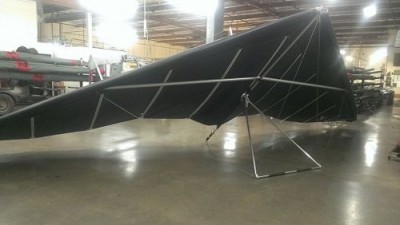
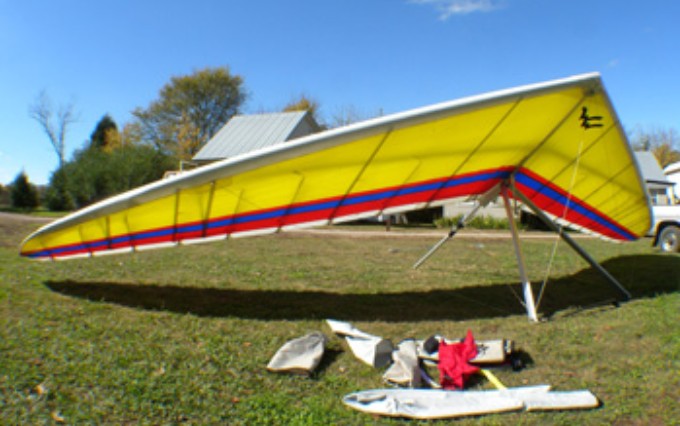
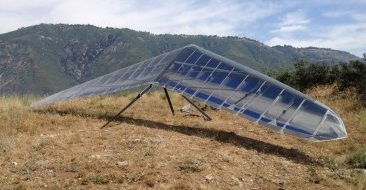
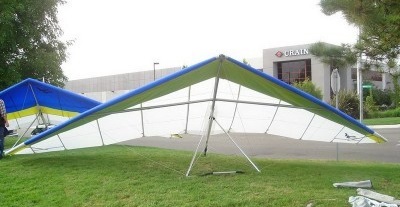
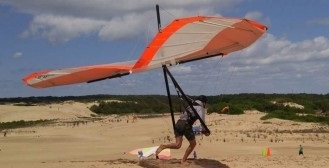
The original Talon for advanced pilots was a very good wing, solid, powerful and very easy to pose.

In 2005 Wills Wing developed the Talon 2 (T2) for advanced pilots.

T2

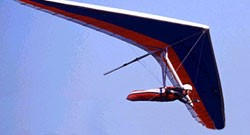
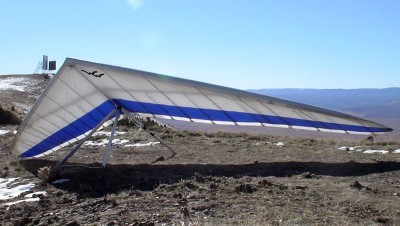
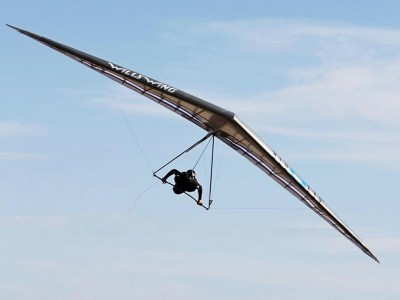
The T2 handling is light and predictable. In strong conditions it was a very physically demanding wing to fly, otherwise very nice glider in light conditions. Heavier pitch and a bit slower in roll – but so reassuringly stable and predictable. Launches with ease, but landing has been a chore due to the weight. For XC and aerobatics this glider is like cheating compared to other gliders but landing in no wind or high altitude can be a problem. 1/3 VG works best for those conditions. Bring it in fast and pop it. It tells you when it’s ready to stall.

T2

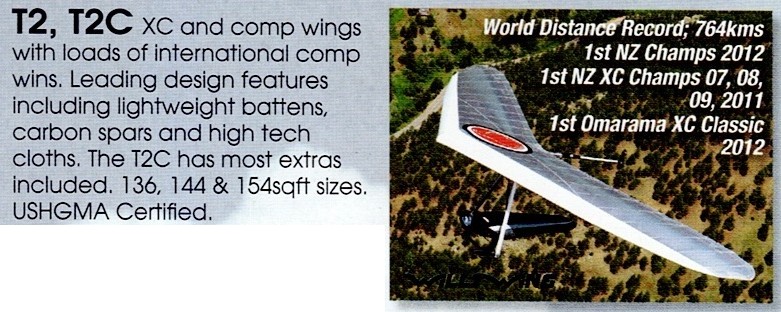
The T2C of 2008 displays an excellent maneuverability in all conditions. It is able to store a lot of energy to make loops or wings over very easy.

T2C

A light wing and well built with good materials. In flight, slightly unstable spiral, it reacts well to turning. It can be pushed in thermal and warns when going too far by a nice stall.

T2CS

The T2CS appeared in 2013.

Gallery

Talon 140
Wing area: 13 m²
Wing span: 9.8 m
Aspect ratio: 7.4
Hang glider weight: 34 kg
Minimum pilot weight: 63 kg
Maximum pilot weight: 77 kg
Maximum speed: 120 km/h
Nose angle: 127°

Talon 150
Wing area: 13.9 m²
Wing span: 10.2 m
Aspect ratio: 7.5
Hang glider weight: 35 kg
Minimum pilot weight: 77 kg
Maximum pilot weight: 91 kg
Maximum speed: 120 km/h
Nose angle: 127°

Talon 160
Sail Area: 160 sq. ft / 14.9 m²
Wing span: 10.4 m
Aspect ratio: 7.2
Glider Weight: 79 lb / 36 kg
Minimum pilot weight: 180 lb / 91 kg
Maximum pilot weight: 255 lb / 109 kg
Maximum speed: 120 km/h
Nose angle: 127°
Skill Level: Advanced
SS/DS: Double Surface
KP/TL: Topless
VG: Yes

T2 144
Wing area: 13.4 m²
Wing span: 9.8 m
Aspect ratio: 7.4
Hang glider weight: 32 kg
Minimum pilot weight: 63 kg
Maximum pilot weight: 82 kg
Packed length: 5 m
Packed length short: 3.9 m
Nose angle: 127°

T2 154
Wing area: 14.3 m² / 154 sq. ft
Wing span: 10.2 m
Aspect ratio: 7.5
Hang glider weight: 33 kg / 73 lbs
Minimum pilot weight: 82 kg / 175 lb
Maximum pilot weight: 91 kg / 255 lb
Packed length: 5.2 m
Packed length short: 4.1 m
Nose angle: 127°
Skill Level: Advanced
SS/DS: Double Surface
KP/TL: Topless
VG: Yes

T2C 136
Wing area: 12.6 m²
Wing span: 9.6 m
Aspect ratio: 7.3
Hang glider weight: 31 kg
Minimum pilot weight: 68 kg
Maximum pilot weight: 95 kg
Minimum speed: 34 km/h
Maximum speed: 85 km/h
Max glide ratio speed: 74 km/h
Packed length: 4.8 m
Packed length short: 3.7 m
Nose angle: 127°

T2C 144
Wing area: 13.4 m²
Wing span: 9.8 m
Aspect ratio: 7.3
Hang glider weight: 32 kg
Minimum pilot weight: 72 kg
Maximum pilot weight: 107 kg
Minimum speed: 34 km/h
Maximum speed: 85 km/h
Max glide ratio speed: 74 km/h
Packed length: 5 m
Packed length short: 3.9 m
Nose angle: 127-132°
USHPA Rating: 4
Vd: 120 (km/h
HGMA Cert. 5/22/2006
Sugg. Retail $6475.00

T2C 154
Wing area: 14.3 m²
Wing span: 10.2 m
Aspect ratio: 7.4
Hang glider weight: 33 kg
Minimum pilot weight: 84 kg
Maximum pilot weight: 129 kg
Minimum speed: 34 km/h
Maximum speed: 85 km/h
Max glide ratio speed: 74 km/h
Packed length: 5.2 m
Packed length short: 4.1 m
Nose angle: 127-132°
USHPA Rating: 4
Vd: 120 (km/h
HGMA Cert. 10/6/2006
Sugg. Retail $6475.00

Wills Wings Eagle

Wills Wing’s take on a novice-intermediate double surface glider, the Eagle was built 2000 to 2006.

Eagle 145
Wing area: 13.4 m²
Wing span: 9.2 m
Aspect ratio: 6.2
Hang glider weight: 25 kg
Minimum pilot weight: 57 kg
Maximum pilot weight: 68 kg
Maximum speed: 74 km/h

Eagle 164
Wing span: 9.7 m
Sail Area: 164 sq. ft / 15.2 m²
Aspect ratio: 6.2
Glider Weight: 58 lb / 26 kg
Pilot Weight: 150-250 / 68-113 kg
Maximum speed: 74 km/h
Skill Level: Novice
SS/DS: Double Surface
KP/TL: Kingpost
VG: No

Eagle 180
Wing area: 16.7 m²
Wing span: 10.1 m
Aspect ratio: 6.1
Hang glider weight: 28 kg
Pilot Weight: 175-275 lb / 80-125 kg
Maximum speed: 74 km/h

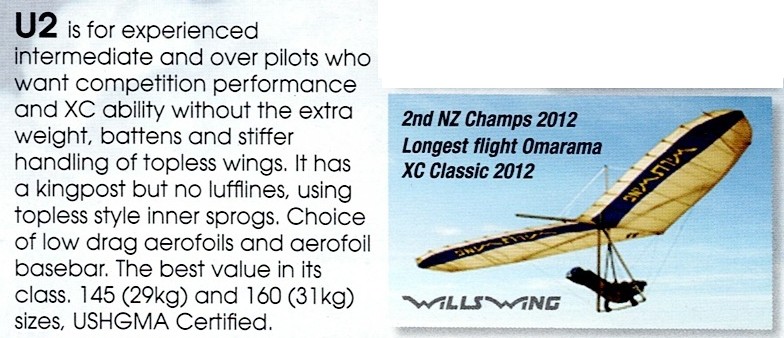
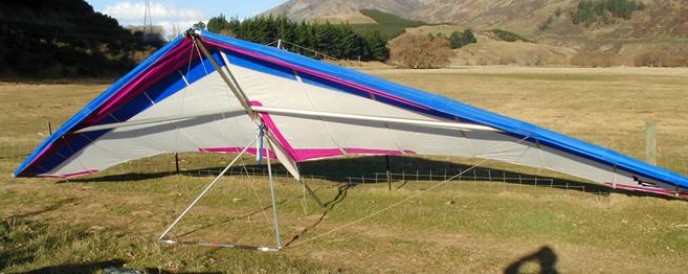
Wills Wings U2

The 2004 U2 for intermediate pilots is described as great stability, combined with easy roll response, and overall very easy handling, combined with good performance. On a U2 you can point your nose in any direction and the glider will follow. Easy to take off and set. In the air, it is very handy and actually goes where you want. Good plané all tense and still controllable.

U2 145
Wing area: 13.5 m² / 145 sq. ft
Wing span: 9.5 m
Aspect ratio: 6.8
Hang glider weight: 29 kg / 63 lb
Minimum pilot weight: 65 kg / 140 lb
Maximum pilot weight: 100 kg / 220 lb
Maximum speed: 85 km/h
Nose angle: 125°
Skill Level: Intermediate
SS/DS: Double Surface
KP/TL: Kingpost
VG: Yes

U2 160
Wing area: 14.9 m² / 160 sq. ft
Wing span: 10.1 m
Aspect ratio: 6.8
Hang glider weight: 31 kg / 68 lb
Minimum pilot weight: 72 kg / 160 lb
Maximum pilot weight: 117 kg / 255 lb
Maximum speed: 85 km/h
Nose angle: 125°
Skill Level: Intermediate
SS/DS: Double Surface
KP/TL: Kingpost
VG: Yes

Wills Wings Falcon

Falcon 225

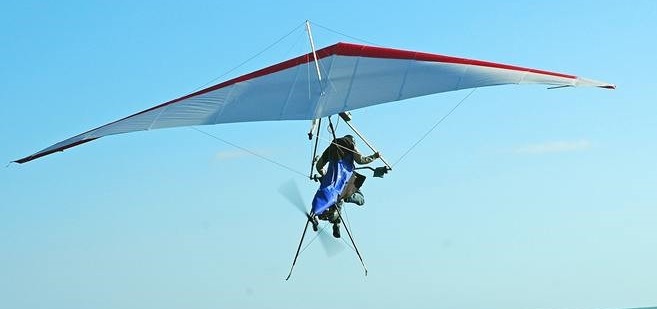
The Wills Wing Falcon has USHGMA certification, 7075 airframe for strength and light weight (19 23 kg). Fly prone or seated (with PG harness). The Falcon can be rigged both flat or on the A frame. Hang glider pilots are amazed at the manoeuvrability, superior climb and easy landings.

The Falcon 225 Tandem skyfloater can be used for tandems but is probably better suited for learner or solo pilot over 90kgs.

Shortening of the rear wires and keel suits motor harness.

One version of the Falcon primary single surface glider held the world record for cross country distance on a single surface glider at 205 miles (330 km).

The Falcon model line has gone through changes from the original Falcon, to the Falcon 2, to the Falcon 3. The Falcon 225 was rated for 185-440 pounds (meant to be tandem-capable), while the Falcon 2 225 was rated 185-300 pounds (meant for solo use). There is no Falcon 3 225 because the Falcon 3 195 is rated up to 275 pounds. The Falcon 3 Tandem was also approved for solo use by very large pilots.

The original 1995 Falcon for novice pilots is described as a breeze to land and handles superbly. It keeps at the top of the stack easily.

Falcon

The 2002 Falcon 2 has a cleaner leading edge and trailing edge (no bungees) than the Falcon 1, and carries more weight per size. Still for novice pilots, a great flier, and very light in weight. The only downside is that they don’t penetrate headwinds like a double-surface, so range is reduced.

The 170 Falcon 2, is 22kg single surface, low stall speed, simplicity, turns flat on narrow coastal soaring, easy landing but is a little bit tricky to start without assistance as the nose want to rise (no problem in weak winds).

The 195 Attack Falcon 2 with mylar sail and Slipstream control bar (airfoiled base bar) was a fine hang glider.

Falcon 2
Wills Wings Falcon 3 170

The Falcon 3 was a 2006 version. The Wills Wing Falcon 3 has improved handling and performance with full mylar leading edge inserts, and now short packs to approximately 2m. It was available in four sizes.

Falcon 3

The Falcon 4 was a 2013 version.

Falcon 4

Gallery

Falcon 140
Wing area: 13 sq.m
Certification: USHGA / DHV 1
Pilot weight: 45-75 kg
Wing span: 8.47 m
Nose Angle: 118 degrees
Aspect ratio: 5.5
Hang glider weight: 20 kg
Minimum speed: 24 km/h
Maximum speed: 85 km/h
Number of battens: 13
Price (1998) £ 2195

Falcon 145
Pilot weight: 50-64 kg / 110-140 lb

Falcon 170
Wing area: 15.8 sq.m
Certification: USHGA / DHV
Pilot weight: 65-100 kg
Wing span: 9.32 m
Nose Angle: 118 degrees
Aspect ratio: 5.5
Hang glider weight: 21 kg
Minimum speed: 28 km/h
Maximum speed: 85 km/h
Number of battens: 13
Price (1998) £ 2195

Falcon 195
Wing area: 18.2 sq.m
Certification: USHGA / DHV 1
Pilot weight: 70-125 kg
Wing span: 10.5 m
Hang glider weight: 23 kg
Nose Angle: 118 degrees
Aspect ratio: 5.6
Minimum speed: 24 km/h
Maximum speed: 85 km/h
Number of battens: 13
Price (1998) £ 2195

Falcon 225 Bi
Wing area: 20.9 sq.m
Certification: USHGA / DHV
Pilot weight: 80-200 kg
Wing span: 10.91 m
Hang glider weight: 27 kg
Nose Angle: 118 degrees
Aspect ratio: 5.7
Maximum speed: 85 km/h
Price (1998) £ 2650

Falcon 2 140
Wing area: 13 m²
Wing span: 8.2 m
Aspect ratio: 5.5
Hang glider weight: 20 kg
Minimum pilot weight: 50 kg
Maximum pilot weight: 64 kg
Maximum speed: 67 km/h

Falcon 2 170
Wing area: 15.8 m²
Wing span: 9.1 m
Aspect ratio: 5.5
Hang glider weight: 22 kg
Minimum pilot weight: 64 kg
Maximum speed: 67 km/h

Falcon 2 195
Wing area: 18.1 m²
Wing span: 10.1 m
Aspect ratio: 5.6
Hang glider weight: 24 kg
Minimum pilot weight: 77 kg
Maximum pilot weight: 100 kg
Maximum speed: 67 km/h

Falcon 2 225
Wing area: 20.9 m²
Wing span: 10.7 m
Aspect ratio: 5.7
Hang glider weight: 28 kg
Minimum pilot weight: 100 kg
Maximum pilot weight: 122 kg
Maximum speed: 67 km/h

Falcon 2 Tandem
Wing area: 20.9 m²
Wing span: 10.7 m
Aspect ratio: 5.7
Hang glider weight: 32 kg
Minimum pilot weight: 100 kg
Maximum pilot weight: 204 kg
Maximum speed: 67 km/h

Falcon 3 170
Wing area: 15.8 m²
Wing span: 9.1 m
Aspect ratio: 5.5
Hang glider weight: 22 kg
Minimum pilot weight: 64 kg
Maximum pilot weight: 77 kg
Minimum speed: 29 km/h
Maximum speed: 77 km/h
Packed length: 5.4 m
Packed length short: 1.8 m

Falcon 3 195
Wing area: 18.1 m²
Wing span: 10.1 m
Aspect ratio: 5.6
Hang glider weight: 24 kg
Minimum pilot weight: 77 kg
Maximum pilot weight: 100 kg
Minimum speed: 29 km/h
Maximum speed: 77 km/h
Packed length: 5.9 m
Packed length short: 2.1 m

Falcon 4