Was developing in mid-1980s the Lapwing low-cost two-seat lightplane.
1980->
SNECMA Turbomeca / Safran Aircraft Engines
The French made contact with Herman Oestrich, the chief designer of the German BMW factory, and smuggled him out of the American occupation zone into the French zone and then into France itself, giving him every technical support in return for his skills. By 1948 Oestrich had produced his first jet engine; the Atar
SNECMA / Société nationale d’étude et de construction de moteurs d’aviation
The high share price that G&R commanded prevented it from being nationalized before the war. However, this did come to pass after the Liberation. SNECMA, la Société nationale d’étude et de construction de moteurs d’aviation, was thus created on May 29, 1945. The company was an amalgamation of diverse design bureaus and workshops; it inherited a work force of 10,000 mostly part-time employees. Along with G&R, Snecma was given some of the factories of the Société des moteurs et automobiles Lorraine, formerly Lorraine-Dietrich, which had been nationalized as la Société nationale des moteurs and had been relegated to making parts for tanks. Some of Snecma’s other facilities had been devoted to the production of German Junkers engines by the thousands during the Nazi occupation. G&R also owned a factory of the Aéroplanes Voisin firm, which had gone bankrupt in 1938.
Unfortunately, the British government preferred to grant licenses for the newly acquired jet engine technology to rival Hispano-Suiza in the immediate postwar period. Snecma immediately after World War II suffered many of the same disadvantages as G&R had immediately after WWI. It was not until 1950, writes Chadeau, that budgetary crisis forced a restructuring that closed unproductive plants and re-equipped modern ones to give the firm some hope of a future.
The French made contact with Herman Oestrich, the chief designer of the German BMW factory, and smuggled him out of the American occupation zone into the French zone and then into France itself, giving him every technical support in return for his skills. By 1948 Oestrich had produced his first jet engine; the Atar
Given their already apparent importance in the future of military aviation, jet engines were the prime focus of Snecma’s development in the 1950s. However, the company did not abandon propeller-driven aircraft. In 1951, the firm acquired a license from the Bristol firm to produce the 2,080 h.p. Hercules engine for use in Noratlas military transports; nearly 1,400 of these were produced by 1964.
The creation of jet engines in the World War II propelled planes allowed a huge leap in aircraft performance. However, in the period immediately after the war, the devastated nations of Europe were unable to match American and Soviet research into jet engine design until the middle of the 1950s. A group of 120 former BMW engineers were assembled in the French controlled sector of Germany in 1946 and integrated into the Snecma team in France in 1950. From their efforts sprang the ATAR series of military engines, the first of which was created in 1948. Their first test of an engine equipped with afterburner came in 1953. The SO-4050 Vautour was the first plane powered by these engines; other better-known fighters such as the Mystère and Super-Mystère, and Mirage III, IV, and V. Planes powered by these engines set several speed records and enjoyed a lively export trade.
Meanwhile, Hispano-Suiza had been producing jet engines under license from Rolls-Royce, including the famous Tay engine, which it began building in 1954. The next year, it introduced its own turbojet, known as the Verdon, which was installed in Mystère IV aircraft.
Another French firm, Turboméca, was making quite low-powered jet engines, though in 1960 it began producing the Adour engine for the Jaguar fighter in cooperation with Rolls-Royce. Turboméca also produced engines for turboprops and, most notably turbine-driven helicopters, which it supplied to a variety of French and foreign firms. Yet another firm, Microtubo, was launched in 1961 to produce small turbojets.
While Hispano-Suiza and Turboméca were signing deals with Rolls-Royce, in November 1959 Snecma entered a contract to produce Pratt & Whitney’s popular JT8-D engine in France. The JT8-D powered several American military jets as well as the DC-8 and Boeing 707 airliners. Snecma signed an agreement with Bristol Engines in November 1962 to develop the Olympus engines for the Concorde supersonic transport.
In 1968, Snecma took control over Hispano-Suiza, which included the mechanical engineering firm Bugatti, the landing gear manufacturer Messier, and the engine maker Berthiez. All of these were at the edge of ruin.
Even though only a few examples of the Concorde would be produced, Snecma gained considerable experience and prestige through its participation. In 1969, the firm had begun development of its M56 engine, which would first appear on the market in 1976. An even more far-reaching program was launched in 1971 with General Electric, which was eager to break Pratt & Whitney’s domination of the U.S. market.
In this agreement, Snecma was to produce 20 percent of GE-s type CF6 engines (CF meaning “commercial fan”), which were destined for use in several Boeing airliners. In addition, they would also be used in the first planes made by Airbus Industrie, the new European consortium created to challenge U.S. control of the industry. A second contract provided for the joint production of the CFM 56 engine. The CFM International joint venture was formally created in 1974.
Snecma expanded its role in the CFM program after the CF6 engine was chosen for both the Airbus A310 and Boeing 767. In late 1980 Snecma and GE began planning a new $30 million plant in France to accommodate its production.
The French government mandated the merger of the Société Européenne de Propulsion (SEP) with Snecma in 1984. SEP produces rocket engines used in the Ariane space program and was merged with Snecma due to concerns it could not meet increasing production demands. By 1985, Snecma was taking a half share of CFM contracts, including a $2.7 billion order for 137 engines to re-equip the U.S. Air Force’s aerial refueling fleet.
The unprecedented airline industry downturn recession in the early 1990s resulted in consolidation among suppliers. In early 1994, Snecma merged its Messier-Bugatti landing gear subsidiary with Dowty, owned by the United Kingdom’s TI Group. Messier-Bugatti was effectively privatized for the merger. However, the two cultures of the merged parties clashed; TI Group exited the Messier-Dowty joint venture by the end of 1997.
In the mid-1990s, Snecma’s engine business was encountering its first civil market downturn ever, according to CEO Gerard Renon. It lost $100 million on sales of $1.8 billion in 1993. Workforce cuts and other measures were taken to increase productivity and shorten production cycles. Employment was reduced from 14,000 in late 1990 to 11,500 in December 1996.
A unique four-way alliance between Snecma, GE, Pratt & Whitney, and MTU to develop a small jet engine fell apart in September 1994. Meanwhile, CFM’s market share of engines for larger jets approached 70 percent.
When Jean-Paul Bechat became Snecma’s new head in the summer of 1996, following the brief reign of Bernard Dufour, he stated the company was close to bankruptcy and full of conflict. However, within a year things were closer to normal–operating profit rose 70 percent, to Ffr 440 million in 1996.
After losing Ffr 280 million in 1996, Snecma posted a net profit of Ffr 750 million ($122 million) for 1997. Exports accounted for about 70 percent of turnover, with more than three-quarters of these coming from the civil sector.
As the lifespan of jet engines increased, scheduled maintenance became a more important source of business. A new division, Snecma Services, was created in January 1997, which offered support services for landing systems and engines. By 1999, it had sales of $400 million and 2,000 employees. The Snecma group as a whole reported revenues of $5.3 billion for 1999. That year, CFM International celebrated the delivery of its 10,000th engine; the joint venture was widely held to be the most successful Europe-U.S. collaboration ever.
Snecma was converted into a holding company in January 2000. Snecma Moteurs was created to consolidate its air and space propulsion operations. Later in the year, Snecma acquired Labinal group for $1.1 billion but sold off its automotive businesses. Part of Labinal’s holdings included Turbomeca, which produced nearly $1 billion worth of turbine engines for helicopters and fixed-wing military planes. Snecma also acquired the British engine nacelle/thrust reverser manufacturer Hurel-Dubois in 2000, which it soon consolidated with Hispano-Suiza to form Hurel-Hispano.
Between 1995 and 2000, sales rose 100 percent, reaching FFr 36.9 billion (EUR 5.65 billion), mostly on the strength of acquisitions. Exports accounted for most of the increase, while rapidly growing commercial sales accounted for 84 percent of the total.
Plans to privatize Snecma were developed throughout 2001. A merger of Snecma’s ballistic propulsion activities with those of rocket engine and munitions manufacturer SNPE, was also under consideration. The French government planned to sell off a quarter of Snecma in an Initial Public Offering if market conditions were favorable, hoping to garner EUR 1.5 billion from the sale. These plans were put on hold after the September 11 terrorist attacks against the United States produced a downturn in the markets. The EUR 500 million SNPE merger, dubbed the Herakles project, had begun to fall apart over the question of leadership.
During the year, Snecma entered a joint venture with Rolls-Royce to produce engines for the next generation of European military aircraft. It had also tapped low-cost, quality Russian engineering talent from NPO Saturn to develop a new engine for regional jets. A collaboration between Snecma and FiatAvio (Italy), ITP (Spain), MTU Aero Engines (Germany), Rolls-Royce, and Techspace Aero (Belgium) was developing a turboprop engine for the Airbus A400M military transport. Meanwhile, Snecma Services entered a maintenance, repair, and overhaul venture with Sabena Technics.
Snecma was renamed Safran Aircraft Engines in 2016 as the main subsidiary of Safran. The Safran Aircraft Engines is headquartered in Courcouronnes, France. It has 15,700 employees working at 35 production sites, offices, and MRO facilities worldwide. It files an average of nearly 500 patents each year.
Smyth Sidewinder
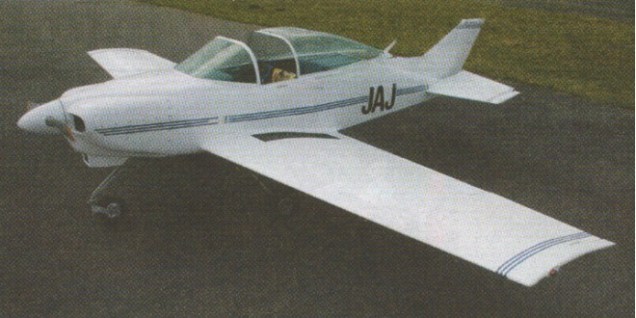
This side-by-side two-seater combines good looks and performance in an all-metal package that makes it more like a factory-built aircraft than a homebuilt. The design was started by former Navy pilot, Jerry Smyth in 1958, later modified by George Blair, and the prototype finally flew in February 1969. The design received the “Outstanding Design” award at the 1969 17th Sport Aviation Convention at Rockford, Illinois. Several have been built since then including some with fully-retractable undercarriage.
Fuselage is built around steel tubing for superior crash protection. Stabilizer is all-flying with an anti-servo tab to provide control fell and pitch trim. Airfoil is NACA 63-009. Alt control surfaces are mass-balanced. All three trike gear wheels wear pants. Provision is made for engines of 60 to 180 hp that weigh up to 310 lbs. A 125 hp unit giving a cruising speed of 255 km/h and a range of 685 km. It is a side-by-side two seater that uses a sliding canopy, tapered steel rod landing gear, stabilators and fiberglass cowling.
It is stressed to 9 g’s “ultimate”.
EU-Wish is the owner of the Smythe Sidewinder Design. The plans package contains 112 pages with many full size parts shown and all the necessary information to build the Sidewinder. Original copyright protected plans with official serial numbers were available from EU-WISH Aircraft.
Engine: Lycoming 125-hp 0-290
Wingspan 24’l0”
Wing area: 96 sq.ft
Length 19’4”
Height: 5ft 5.5in
Gross Wt. 1450 lb
Empty Wt. 867 lb
Fuel capaci¬ty: 17.5USG
Top 185 mph
Cruise (75 per¬cent) 160 mph
Stall 55 mph
Climb rate 900 fpm
Range 425 sm
Seats: 2
Engine: Lycoming O-320-E2A, 150hp
Prop: Hartzell CSU, 66in
Gross Wt. 1600 lb
Empty Wt. 1129 lb
Fuel capaci¬ty: 103 lt
Wingspan 24’l0”
Length 19’4”
Height: 5ft 5.5in
Wing area: 96 sq.ft
Seats: 2
EU-Wish Aircraft Sidewinder
Engine: 125 Hp
Wing Span: 24′ 10″
Wing Area: 96 sq. ft.
Fuel Capacity: 17.5 gal.
Baggage Weight: 60 lbs.
Gross Weight: 1450 lbs.
Empty Weight: 867 lbs.
Useful Load: 583 lbs.
Max. Speed: 175 mph
Cruise Speed: 160 mph
Stall Speed – No Flap: 55 mph
Rate Of Climb: 900-1500 fpm
EU-Wish Aircraft Sidewinder S&GA
Engine: Lycoming O-320, 160 hp
HP range: 90-180
Length: 19.3 ft
Wing span: 24.8 ft
Wing area: 96 sq.ft
Empty weight: 867 lb
Gross weight: 1550 lb
Fuel capacity: 17.5 USG
Cruise: 167 mph
Stall: 60 mph
Range: 490 sm
Rate of climb: 1200 fpm
Takeoff dist: 1200 ft
Landing dist: 900 ft
Seats: 2
Cockpit width: 38 in
Landing gear: nosewheel
Smyth / Sidewinder Corp
1980:
Jerry Smyth,
P.O. Box 308,
Huntington,
Indiana 46750,
U.S.A.
c.1980:
Sidewinder Corp
pres: George Blair
Temecula CA.
USA
Mike Smith Aero Prop-Jet XP-99
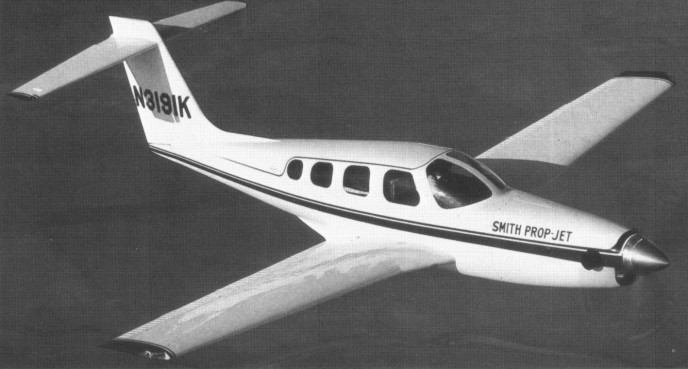
The 1982 Prop-Jet N3191K uses Beechcraft P-Baron wings and landing gear mated to a Smith T-tailed carbon fibre composite fuselage.
Engine: 850hp P&W-Canada PT6A-41 derated to 550hp
Useful load: 2000 lb
Max speed: 350 mph @ 31,000 ft
Seats: 6
Smith Der Cricket
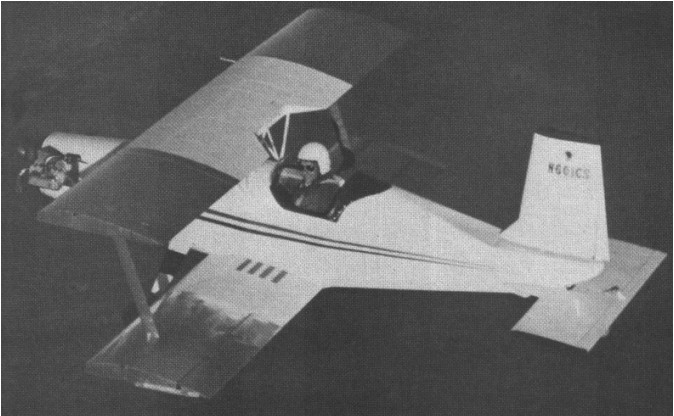
Der Kricket, an original bipe design by Cyril Smith, was built in 857 man hours, and finds that it flies fine from mile-high airports. The philosophy of design simplicity for Der Kricket began with selection of basic materials, and the construction concept developed requires only two sizes of 2024-13 aluminum angle. The spar for the horizontal stabilator is 2-inch square 6063 tubing, requiring a minimum of work. A 2-inch diameter 6063-15 tube spar for the rudder becomes self-hinging with two nylon, teflon or phenolic bushings. All ribs are constructed with a unique self-jigging tab to insure ac¬curate alignment dpring attachment to the various spars. Fuselage is semi-monocoque construction, built upside down on a flat surface, and tricks bor¬rowed from model-airplane building days are employed in assembling the fuselage. A 2 x 11-foot “pin board” on sawhorse supports is used for the fuselage layout. Longerons are tacked to the layout, then four bulkheads added to assure simple, accurate alignment. The “poor man’s deco,” (1/8th-inch soft aluminum pop rivets) are used when necessary for positioning, then are drilled out and replaced with monel or stainless steel pop rivets during final assembly. Full-flying tail surfaces, both vertical and horizontal, are easily constructed and attached, and provide effective control at low airspeeds, with ample rudder movement for takeoff and land¬ing rolls. A good-sized antiservo tab was chosen to provide ample control feel and reasonable sensitivity at cruise speeds. Smith elected to utilize as many pre¬fabricated items as possible in building Der Kricket – landing gear legs from the VP-1 Volksplane; aircraft-style Go Kart wheels and brakes; low-pressure aircraft tires for the mains; and a modified 5-inch caster for a tailwheel. The wing is a NACA 4412.
First flying on 19 September 1978, the prototype N501CS, flew for 25 years before Smith donated it to the Mid-America Air Museum.
Gross weight 750 lbs
Empty weight 500 lbs
Fuel capacity 8-10 Usgal
Wing¬span (biplane) 16’
Length 15’
Engine 1500cc-1835cc VW
Prop: 54 x 30
Vmax 138 mph
Cruise speed 90 mph
Climb rate 500 fpm
Range 200 nm
Wing loading: 7.3 lb/sq.ft
Pwr loading: 14 lb/hp
Smith, Cyril B.
1980: Cyril B. Smith, Flight Level Six-Zero, PO Box 9980, Colorado Springs, CO 80932, USA.
Built Der Cricket
Smith AJ-2
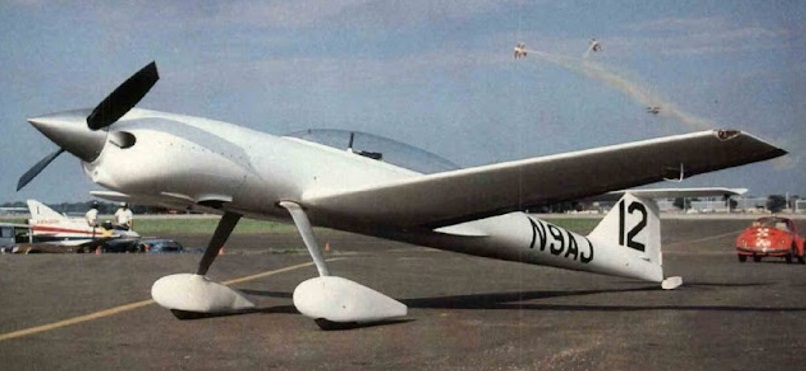
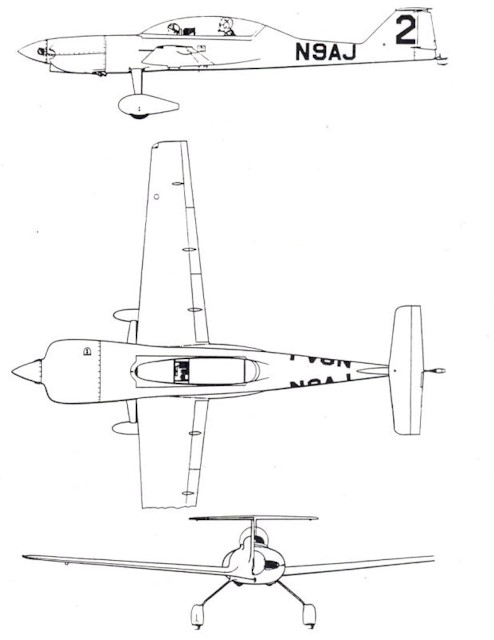
The AJ-2 was designed as a cross-country touring aircraft. It had two seats. The passenger seat was intended to serve as a baggage area when only the pilot was aboard. The engine is a Lycoming IO-360. It makes about 215 hp and has a custom, “one-off” McCauley constant-speed prop. Long-range cruise (55% power) reportedly resulted in 200 mph and 40 mpg. Normal cruise (75% power) was said to be 250-255 mph and about 23-24 mpg.
For the airframe, A.J. utilized techniques developed by the Germans in WWII. It consists of bulkheads spanned by balsa and foam. The wing is one piece, designed to be easily replaced with an updated version that contained retractable gear. The updated version was, to my knowledge, never manufactured or mounted. The wing pictured uses a NACA 64212 airfoil, 12% thick, with a constant section and a .5 taper ratio with no twist. The lack of twist produced undesirable stall characteristics, so A.J. added stall strips and rigged the ailerons up a quarter of an inch, providing an effective twist.
The airplane has a T-tail that also uses NACA sections – 9% for the horizontal, and 12% for the vertical. The tailwheel is a Henry Haigh locking version mounted on a Wittman-type tapered rod spring.
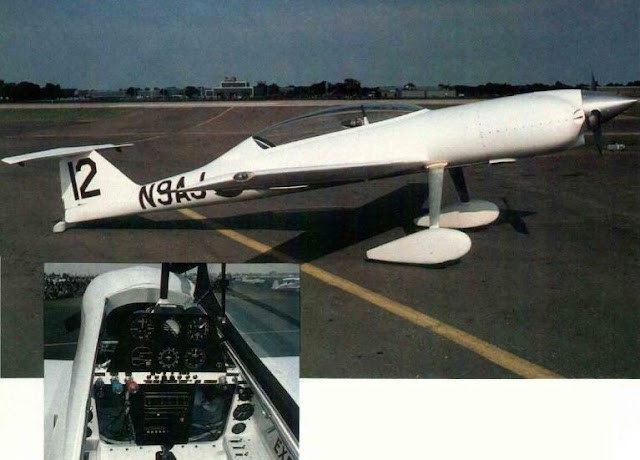
Andrew’s experience with gliders clearly translated into the exquisitely efficient design of the AJ-2. Indeed, according to Mike, Andrew once claimed that the total drag of the airplane was approximately equivalent to a 12″x12″ square piece of plywood being pushed through the air.
This paid off in cross-country competition. First flown on 15 July 1981 registered N9AJ, Andrew and the AJ-2 won a cross-country race that emphasized efficiency known as the Oshkosh 500. The airplane, AJ-2, was designed to compete in a new EAA sponsored efficiency race, the Oshkosh 500. AJ competed successfully, winning seven years in a row. He won the race with an average speed of just under 218mph while burning only 19.2 gallons to cover the 500 mile long course. On August 6, 1982 he flew the AJ-2 to a 500 km closed course speed record – 253.3 mph (407.7 km).

Andrew apparently was interested in donating the AJ-2 to a museum, but ultimately ended up selling it before passing away in 2004. It was then stored in a hangar at a nearby airport in rural Wisconsin.
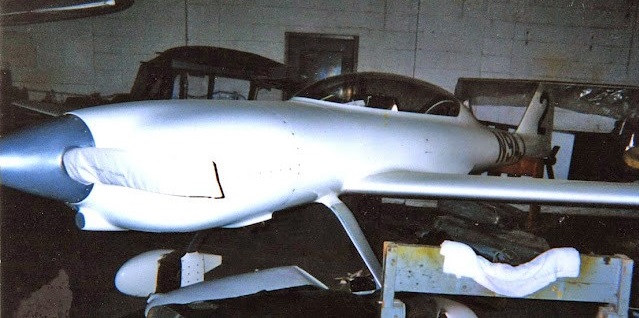
In addition to the aircraft itself, there was a vast quantity of plans, diagrams, and three-ring binders of handwritten calculations and data that AJ used to design it.
After purchasing the AJ-2 back in the early 2000s, the new owner still has yet to fly it. But he thought it will likely happen later when he completes the removal of a wing modification. This project should return the AJ-2 to its standard/original configuration.
Engine: 215hp Avco Lycoming IO-360-A1B6
Wingspan: 24’0″
Length: 22’0″
Useful load: 600 lb
Max speed: 298 mph
Cruise: 255 mph
Stall: 68 mph
Seats: 2
Smith, A J
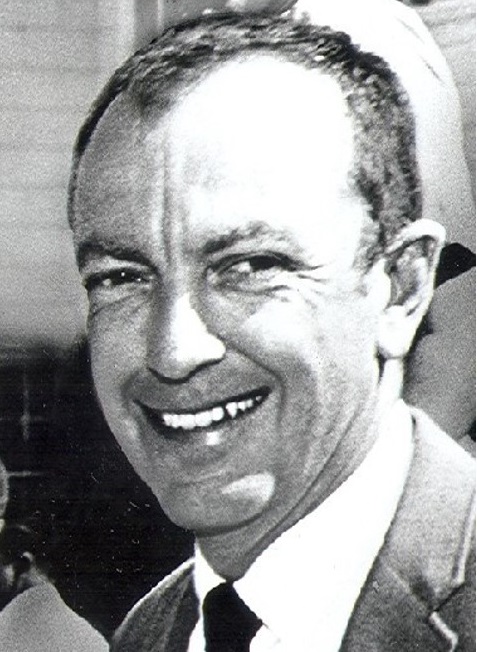
AJ Smith (Andrew James Smith) grew up in Tecumseh, Michigan graduating from Tecumseh High School in 1942. After high school, he worked for NACA (now NASA) at Langley Field, Virginia. He then served in the Navy during WW II flying Corsairs off aircraft carriers for two years in the Atlantic Theater of Operations. He attended the University of Michigan from 1946 to 1951 earning a degree in architectural engineering.
AJ Smith (Andrew James Smith) began soaring in the 1950s with his friend Dick Schreder in the Adrian, Michigan and Toledo, Ohio area. He quickly focused on competition soaring and proceeded to modify each of his sailplanes for enhanced performance, beginning with the LO-150 and continuing through the Sisu 1A, ASW 12 and Glasfluegel 604.
He won the Open Class Nationals flying these sailplanes in 1961, 1967, 1971 and 1978. AJ represented the USA on four international teams: England 1965, Poland 1968, Marfa, Texas 1970 and Yugoslavia in 1972. In the 1968 contest in Poland (flying a borrowed Elfe S-3 in the Standard Class), AJ became only the second American to win a World Gliding Championship.
AJ was a very successful architect in the Detroit area, owning his own major firm (Smith and Gardner) that designed many award-winning structures from airport terminals to major office complexes across the United States.
AJ’s artistic flare from his architecture background, combined with his engineering knowledge of aerodynamics, enabled him to design an extremely efficient racing airplane in the early 1980s which rocked the racing world of the Experimental Aircraft Association. The airplane, AJ-2, was designed to compete in a new EAA sponsored efficiency race, the Oshkosh 500. AJ competed successfully, winning seven years in a row. On August 6, 1982 he flew the AJ-2 to a 500 km closed course speed record – 253.3 mph (407.7 km).
AJ’s intense competition personality made him a controversial figure dominated by an intensity and extreme will to win.
AJ served the soaring community as an SSA Director and an NSM Trustee. Not only did he fly National and World Competitions, he was also a Smirnoff Derby competitor. He won the FAI Challenge Cup in 1968 and was awarded the Louis Bleriot Medal in 1982. He received the SSA Exceptional Achievement Award in 1970 and gave the Barnaby Lecture in 1975. He won the du Pont Trophy in 1961, 1967, 1971, 1978 and the Stroukoff Trophy in 1967, 1971, 1976, 1978. He earned Silver #283 (1957), Gold #140 (1962) and Diamond #446, Intl #2688 (1979).
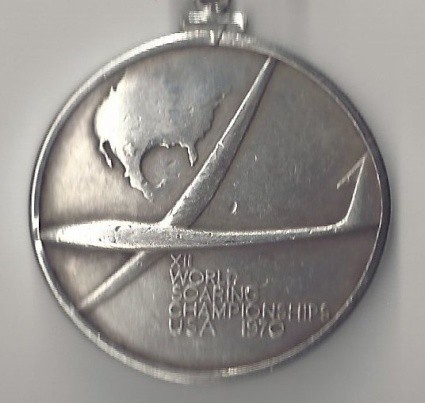
AJ used his artistic talent to design the medallion for the 1970 World Contest in Marfa, Texas. Which was made in both silver and bronze and two sizes. He told a long time wearer of this medallion that he was pleased with the weathering effect due to time and usage.
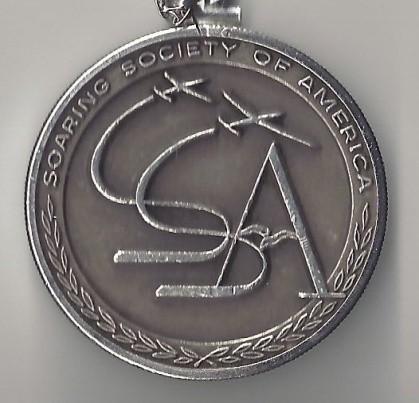
Andrew Smith passed away in 2004.

