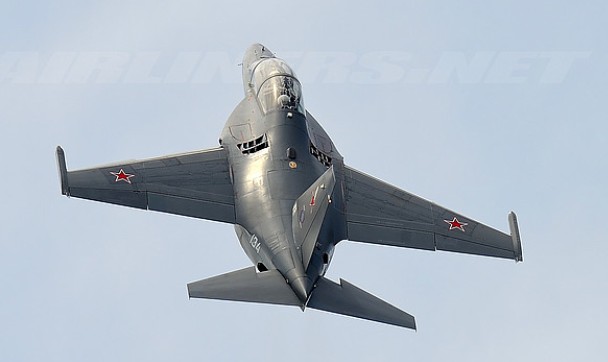
Through a joint programme with Yakolev of Russia, Aermacchi is assisting in developing the Yak/AEM-130 to meet the Russian Air Force’s requirement to replace the L-29 and L-39. The aircraft is equipped with a quadruplex fly-by-wire flight control system and will be required to fulfil a broad range of tasks: from basic flying training to weapons training and aircraft carrier deck training. The aircraft are equipped with wingtip- and pylon mounted AAMs with a roulette and sensor pod also fitted.
The joint Italian/Russian Yak 130 technology development programme ran from April 1996 to December 1999, accumulating some 300hr flying. The two seat Yak-130 fighter/trainer was exported as the AEM-130.
The Yak-130 became all Italian in 1998 and served as a basis for the Aermacchi M-346.
Engine: 2 x Klimov RD-35, 22kN Max take-off weight: 5400-6200 kg / 11905 – 13669 lb Wingspan: 10.6 m / 35 ft 9 in Length: 11.3 m / 37 ft 1 in Height: 4.8 m / 16 ft 9 in Wing area: 17.6 sq.m / 189.44 sq ft Max. speed: 1000 km/h / 621 mph Ceiling: 12500 m / 41000 ft Range: 1850 km / 1150 miles Crew: 2
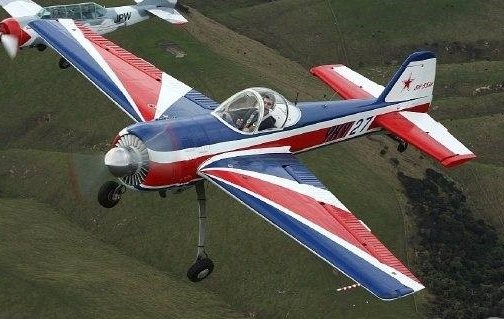
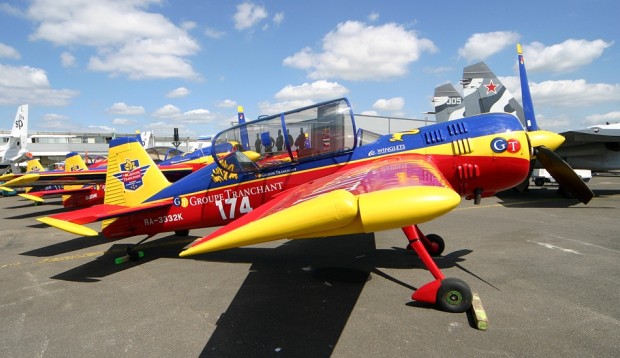
A single-seat aerobatic aircraft (first flown 1989).
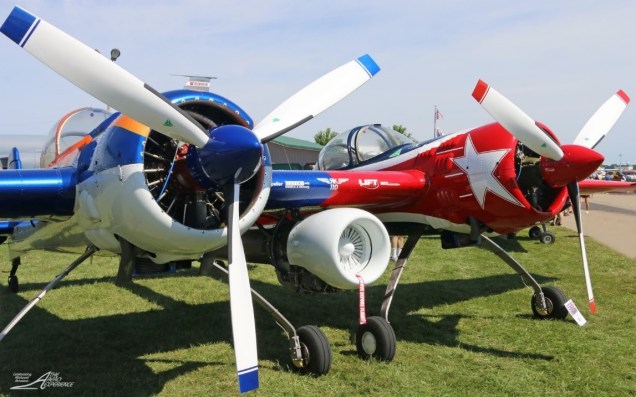
A team from Arizona led by mechanic and restorer Dall Koller and aerobatic flight champion Jeff Buerbon built two Yak-55M as Siamese twins.
As well as two M-14P engines of 360 hp, a TRD GE J-85 (in the variant GE CJ610) was installed.
For the first time it took to the air in June 2018, still without a jet, and flew normally. By October it flew with three engines. It flew and flew well.
The Yak-54 was designed in the 1990s as an improved two seat version of the Yak-55. Featuring a new landing gear that is raked forward, three blade propeller, and larger tail surfaces, the Yak-54 was first flown in December 1993. The airframe is built to 7G.
Publicy introduced at the 1994 Paris Air Show, manufacture came to a stop, after one production aircraft, in 1998, pending certification. Some modifications were made to improve stability, aerodynamics and aerobatic performance, plus the M-14 engine was not certified.
The production aircraft was purchased by Jim Bourke and after two years of inactivity was restored to flight in 1996.
The Yak-54 did eventually receive full certification and a series of five was under construction.
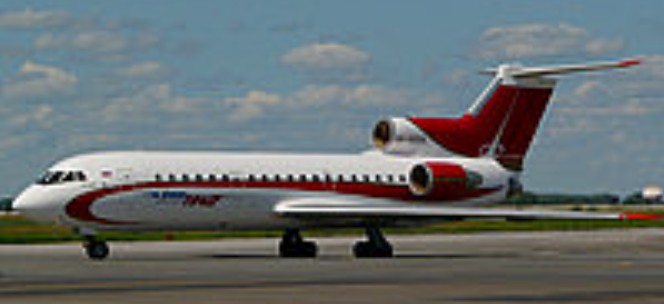
In the Soviet Union the prototype (SSSR 1974) of a new short range civil transport accommodating a maximum 120 passengers, the Yakolev Yak 42, made its maiden flight on 7 March 1975. This was powered by three Lotarev D 36 turbofans, in a similar rear engine layout to the Yak 40. Three prototypes ordered initially; first prototype (SSSR-1974) flew 7 March 1975, with 11 degree wing sweepback and furnished in 100-seat local service form, with carry-on baggage and coat stowage fore and aft of cabin; second prototype (SSSR-1975, later SSSR-42304) had 23 degree sweepback and more cabin windows, representative of 120-seat version with three more rows of seats and no carry-on baggage areas; third prototype (SSSR-1976, later SSSR-42303) introduced small refinements; flight testing proved a 23 degree wing superior.
The second Yak-42 flew in April 1976 and the third, which was exhibited at the Paris Air Show earlier this year and is representative of the production version, flew in February 1977. By May, these three aircraft had totalled some 320 hrs of testing.
The Yak-42 is designed to have a fatigue life of at least 30,000 hrs and 30,000 landings, and the life of the turbofans that power the new aircraft is said to be 18,000 hrs, subject to major overhaul and revision at 6,000 and 12,000 hrs. Glassfibre and carbon fibre composites are used to a considerable degree in the construction of the Yak-42, and it is claimed that the noise levels meet the newest requirements.
The maximum take off weight of the Yak 42 was increased in 1981 to 117,945 lb (53 500 kg), maximum and normal useful loads remaining unchanged. Cruising speeds have been reduced marginally to 466 503 mph (750-810 km/h), and range with max payload has been reduced to 559 mls (900 km) at 478 mph (770 km/h) at 29,530 ft (9000 m). Ranges with 23,148 lb/10500 kg and 14,330 lb/6500 kg payloads are quoted as 1,243 mls (2000 km) and 1,864 mls (3000 km) respectively. The practical life of the Yak 42 is claimed to be 30,000 hours or 30,000 flight cycles over a 15 year period and the service life of its Lotarev D 36 turbofan is 18,000 hours with two major overhauls.
The first series of production aircraft, built to replace some Aeroflot Tu-134, generally similar to SSSR-42303 as exhibited 1977 Paris Air Show. Changes for production included substitution of four-wheel main landing gear bogies for twin-wheel units on prototypes.
The Yak-42 and Il-86 entered regular service with Aeroflot at the end of 1980, after production examples had made proving flights on typical routes from Moscow. The 120 seat Yak-42 operated on the Moscow-Krasnodar route.
An accident in June 1982 caused the type to be grounded until October 1984, the aircraft being drastically redesigned during its temporary withdrawal from service. In 1990 the Yak-42D was introduced, this version having been stretched to include seating for 120 passengers. First exports of the Yak-42 were achieved in 1990, aircraft being sold to Cubana and CAAC.
Yak-42D introduced from second quarter of 1989 and manufactured by Saratov Aviation Plant (SAZ). The Yak-142 transport is a new variant of Yak-42D, featuring mostly US digital avionics and other improvements. Yak-42A and other versions have been produced in small numbers or been proposed.
Power Plant: Three Lotarev D-36 turbofans, 14,320 lb st (6500 kgp) for take-off, with a nominal static rating of 11,015 lb (5000 kg) and a thrust of 3,525 lb (1 600 kg) cruising at Mach 0.75 at 26,245 ft (8000 m) Max fuel load, 27,090 lb (12 300 kg). Max. speed: 870 km/h / 541 mph Typical cruising speed, 510 mph (820 km/h) at 25,000 ft (7600 m) Take-off distance, 4,920 ft (1 500 m) at ISA and 5,900 ft (1 800 m) at ISA plus 15 deg C Landing distance r, 5,900 ft (1 800 m) Range with max fuel, 1,520 mls (2450 km) Range with max payload, 620 mls (1000 km) Range with 26,430-lb (12 000-kg) payload, 1,150 mls (1 850 km). Typical empty weight, 63,788 lb (28 960 kg) Max payload, 31,938 lb (14500 kg) Max fuel, 27,090 lb (12 300 kg) Max take-off, 114,540 lb (52000 kg) Wing span, 112 ft 2.5 in (34,20 m) Length, 119 ft 4 in (36,38 m) Height, 32 ft 3 in (9,83 m) Wing area, 1,615 sq ft (150 sq.m) Undercarriage track, 18 ft 6 in (5,63 m) Wheelbase, 48 ft 5.5 in (14.776 m) Accommodation: max high density, 120 six abreast at 32-in (81-cm) seat pitch. Crew: 2-4
The Yak-38 was followed by a new VTOL prototype known as the Yak-41 (first flown March 1987) which was subsequently abandoned, as was the projected next-generation STOVL Yak-43 and the Yak- 44 shipborne AEW&C aircraft.
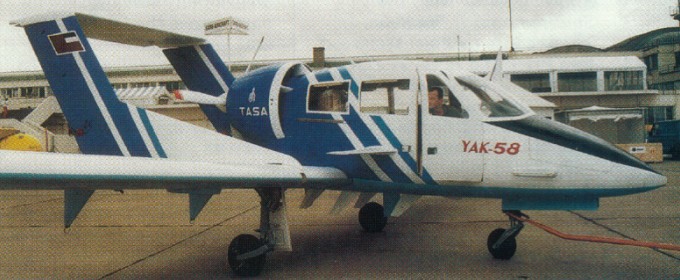
While working as a mechanic at Khodynka airfield, Yakolev had access to an aircraft graveyard in a ravine next to the flight area. In the course of a dozen years it was filled with wrecked airframes from all over the world, and Alexandre Sergeevich fully used his chance to study variety of construction methods, examine the nature of breakdowns and to discover the weak points in damaged parts. Aieksandr Sergievich Yakolev won a design competition for lightplanes even before entering an engineering academy in 1927. His design bureau was established 1935, and first military design was the Yak-4 twin-engined fighter, completed 1939. The Yak-1/3/9 series of single-seat fighters served the Soviet Union well in combat during Second World War and were built in larger numbers than any other Soviet wartime fighter. A Yak-3 airframe was modified to produce the Yak-15 jet fighter in 1945, developed subsequently as the Yak-17. The Yak-23 of 1947 was a complete redesign, resembling the earlier fighters only in fuselage configuration. Other post-war Yakolev designs included the Yak-12 high-wing utility aircraft, produced also in Poland and China, Yak-11 and Yak-18 trainers, Yak-28 twin-jet bomber and reconnaissance aircraft (production began 1960) and related Yak-28P radar-equipped all-weather interceptor (first flown 1960), and Yak-40 (first flown October 1966) and Yak-42 (first flown March 1975 and still in production) short-range transports. The important Yak-38 operational VTOL combat aircraft (first flown January 1971 for Russian naval use) was followed by a new VTOL prototype known as the Yak-41 (first flown March 1987) which was subsequently abandoned, as was the projected next-generation STOVLYak-43 and the Yak- 44 shipborne AEW&C aircraft. The Yak-142 transport is a new variant of Yak-42D, featuring mostly US digital avionics and other improvements. Projected airliners include the short-range twin-turbofan Yak-46-1 for 126 passengers, short-range Yak-46-2 with propfan engines, and Yak- 242138-180 passenger short-range airliner. In the field of general aviation, Yakolev developed the Yak-18T 4-seat multipurpose lightplane development of Yak-18 (first flown 1967 and still available), Yak-50 aerobatic sporting aircraft (first flown 1972), Yak-52 tandem two-seat piston trainer (first flown 1974 and still built in Romania), Yak-54 two-seat aerobatic trainer (first flown December 1993), Yak-55M single-seat aerobatic aircraft (first flown 1989), Yak-58 six-seat business transport with a pusher piston engine (first flown April 1994), and Yak- 112 four-seat light aircraft (first flown October 1992). General aviation projects include Yak-48, thought to be derived from the Israeli-designed Galaxy, Yak-56 piston-engined primary trainer and Yak-57 single-seat aerobatic competition aircraft. Yakolev is also a partner with Aermacchi of Italy in the Yak/Aem-130 and Yak-131 jet trainer and light combat aircraft program. In total, Yakolev has produced over 70,000 aircraft of more than 100 types since 1927, and the present Design Bureau is joined by the Saratov and Smolensk manufacturing facilities under Yak Aircraft Corporation.
On 22 August 1989, Alexander Yakovlev died at age 83.
Top L Paraglider circa 1998. Wing area: 28.1 sq.m Certification: Afnor Pilot weight: 70-100 kg No. of cells: 68 Wing span: 13.2 m Aspect ratio: 6.2 Min sink: 0.9 m/s Max speed: 57 kph Price (1998) 4940 SF
Top XL Paraglider circa 1998. Wing area: 32 sq.m Certification: Afnor Pilot weight: 85-125 kg No. of cells: 68 Wing span: 14.1 m Aspect ratio: 6.2 Min sink: 0.9 m/s Max speed: 57 kph Price (1998) 4990 SF
Inter 1.2 M Paraglider circa 1998. Wing area: 24.3 sq.m Certification: Afnor Pilot weight: 65-85 kg No. of cells: 41 Wing span: 11.1 m Aspect ratio: 4.7 Min sink: 1.1 m/s Max speed: 46 kph Price (1998) $ 3000
Inter 1.2 XL Paraglider circa 1998. Wing area: 30.5 sq.m Certification: Afnor Pilot weight: 100-130 kg No. of cells: 41 Wing span: 12.7 m Aspect ratio: 4.7 Min sink: 1.1 m/s Max speed: 47 kph Price (1998) $ 3200
Inter 1.2 L Paraglider circa 1998. Wing area: 27.6 sq.m Certification: Afnor Pilot weight: 80-104 kg No. of cells: 41 Wing span: 11.9 m Aspect ratio: 4.7 Min sink: 1.1 m/s Max speed: 48 kph Price (1998) $ 3100
Inter 1.2 XXL Paraglider circa 1998. Wing area: 34.4 sq.m Certification: Afnor Pilot weight: 115-159 kg No. of cells: 41 Price (1998) $ 3300








 All Aero