Zenair

Formed 1974 and currently producing the Zenith CH 2000 certificated two-seat Iightpiane (first flown June 1993 and delivered in assembled form from 1994). Also markets the Zenith CH-100 single-seater, Aero CH-150 and CH-180 (aerobatic variants of CH-200), Zenith CH-200 two-seat Iightpiane and Zenith CH-250 long-range version, and Zenith CH-300 (Tri-Z) three/four-seat Iightpiane (as variant of CH 2000), all built from plans and/or kits.

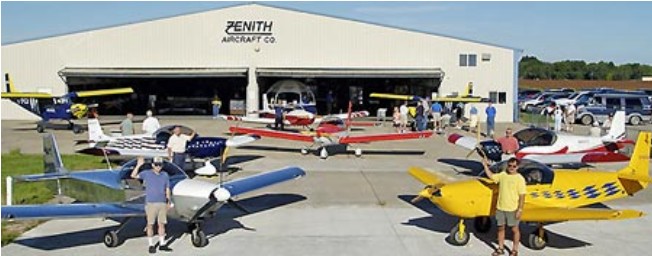
Zenith Aircraft Company is in the exclusive business of designing, developing and manufacturing kit aircraft. The independent, privately-owned company was formed in 1992 in Mexico, Missouri, centrally located in the United States, and is based in leased 20,000+ sq.ft. production facilities at Mexico Memorial Airport. Zenith Aircraft Company has acquired the exclusive rights to manufacture and market Zenair kit aircraft designs from designer Chris Heintz.

Chris Heintz

An aeronautical engineer, Chris Heintz is a graduate of the E.T.H Institute in Switzerland. After serving in the Air Force, Heintz worked for Aerospatiale on the supersonic Concorde jetliner, and later became chief engineer at Avions Robin (France) where he designed several fully-certified two and four seat all-metal production aircraft.
In his spare time, Heintz began to design and build his own aircraft, which he named the ZENITH, anagram of Heintz. His all-metal homebuilt aircraft incorporated simple construction methods throughout and after a little more than a year’s work, the two-place low-wing Zenith was rolled out and successfully flown in 1969. Soon after, detailed blueprints and construction manuals of the aircraft were drawn up and offered to the growing number of interested builders and flyers.
In 1973, Chris Heintz, his family and the Zenith moved to North America, where Heintz worked for de Havilland (in Toronto) as a stress engineer on the Dash 7 commuter. Chris decided to form his own aircraft company in 1974, and under the name of Zenair Ltd. started to manufacture Zenith kits himself from his two-car garage. Through the company, Heintz has introduced more than twelve successful kit aircraft designs over the years. In 1992, Heintz licensed the kit manufacturing and marketing rights to Zenith Aircraft Company for the STOL CH 701 and the ZODIAC CH 601 designs, and has developed the new STOL CH 801 and the new ZODIAC XL for Zenith Aircraft Company.
While Heintz officially retired in 2003, he is still very active as a designer, engineer and consultant.

1996: Huronia Airport, Midland, Ontario L4R 4K8, Canada.
PO Box 650, Mexico Memorial Airport, Mexico, MO 65265-0650.

By 1996, Zenair had a production facility in Mexico, Missouri, USA, headed by Sebastion Heintz (son of the designer, Chris Heintz)

Zdarsky Trike

Zdarsky in Austria

Czechoslovakian engineering student Ivo Zdarsky escaped into Austria in a homemade ‘ultralight’ aircraft powered by a 2-cylinder car engine.

In 1984 the plane was confiscated by police but he bribed the police and got it back.

The student, wearing a bright yellow crash helmet, flew the craft only about 100 to 200 yards above the ground for the entire trip. He parked his homemade, 3-wheeled craft with a basket-like seat outside an Austrian Airlines hangar used for DC-9 jets and sat there until airport employees spotted him.

Police said the man took off from the town of Lozorno, about 6 miles inside Czechoslovakia, at 3 a.m. and landed at Vienna’s Schwechat airport about 4:45 a.m., a 25-mile trip. Police said the student told them he had planned his escape for a year, making secret test flights of the ultralight aircraft.

A witness said the student’s plane was powered by a 600-cubic centimeter, 2-cylinder engine and had a fuel tank taken from a Czechoslovak-made Java motorcycle. Ultralights are prohibited in Austria because of noise and environmental regulations.

The 24-year-old Ivo Zdarsky spoke fluent English and asked for political asylum and wanted to emigrate to the United States or Australia, police said.

Zdarsky was able to sell his plane to Checkpoint Charlie German museum that housed escape vehicles. Afterwards he moved to Los Angeles where he started his own company, called Ivoprop, which produced propellers of his own design.

Zdarsky, Ivo

After being denied an exit visa, Zdarsky decided to take matters into his own hands and build his own plane; a hang glider with a 2-cylinder engine. In August of 1984, he set off at 3 a.m. and made his escape to Vienna where he requested political asylum.

Zdarsky was able to sell his plane to a German museum that housed escape vehicles. Afterwards he moved to Los Angeles where he started his own company, called Ivoprop, which produced propellers of his own design. Ivoprop Corporation, founded in 1984 by Ivo Zdarsky, is an American manufacturer of composite propellers for homebuilt and ultralight aircraft, as well as airboats. The company’s headquarters are in Long Beach, California.

Zdarsky started the company after carving his own propeller for a homebuilt ultralight trike that he flew from Cold War Czechoslovakia, over the Iron Curtain to Vienna in 1984. Ivoprop has sold more than 20,000 propellers since then.

The company’s propellers are built from carbon-fiber-reinforced polymer and feature a stainless steel leading edge.

In 1997 Zdarsky decided to move somewhere close to a runway where he could develop his design for an aircraft that could function as both helicopter and airplane. He came across 400 acres in the Utah desert and purchased it for just $99,000.

Zanzottera MZ 301

The MZ301i has electronic fuel injection, twin electronic ignition, and electric start.

MZ 301
Cycle: 2 stroke
No cylinders: 1
Bore: 76 mm
Stroke: 69 mm
Compression: 9.3
Displacement: 939 cc
Cooling: Air
Ignition: DCDI
Reduction: Mechanical Integral damper 2.18:1 to 3.66:1
Dimension: 200 x 400 x 500 mm
Weight: 39 kg
Max pwr: 85 hp at 6500 rpm

Zanzottera MZ 201 / MZ 202 / Compact Radial Engines MZ 201 / MZ 202

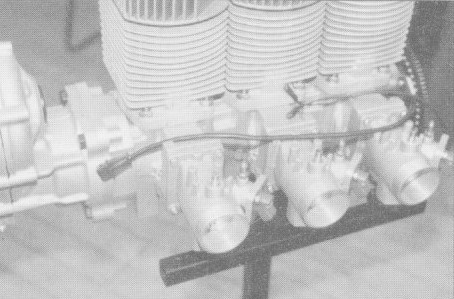
The Zanzottera MZ 201 and MZ 202 are a family of twin-cylinder, in-line two-stroke, dual ignition aircraft engines designed for ultralight aircraft and motor gliders. The engine was originally designed and produced by Zanzottera Technologies of Italy, but the design was sold, along with the rest of the company’s two-stroke ultralight aircraft engine line, to Compact Radial Engines of Surrey, British Columbia, Canada.

The MZ 202 was developed first as a 60 hp (45 kW) lightweight competitor to the liquid-cooled 64 hp (48 kW) Rotax 582. Later the MZ 201 was developed from the MZ 202 as a de-rated 45 hp (34 kW) version intended for motorgliders and single place ultralights that needed more power than the single-cylinder MZ 34.

The MZ 201 and 202 both have a cylinder barrels that are Nikasil-coated. The bore and stroke are the same as the single-cylinder MZ 34 engine. The MZ 201 features an optional recoil starter or electric starting, while the MZ 202 has electric starting only. The MZ 201 has a choice of a reduction drive belt or gearbox, while the MZ 202 offers just the gearbox with reduction ratios of 2.18, 2.55, 2.88, 3.11 or 3.66 to 1.

The unit cost for the MZ 201 in 2009 was US$4440, and the MZ 202 US$5560.

The owners manual acknowledges the limitations inherent in the design of the engine, stating:
This is not an aeronautic approved engine.
This engine has not been subjected to durability and safety tests in compliance with aeronautical standards and is not a certified engine. It is designed to be used in ULM or aeroplanes where engine failure will not produce serious consequences. The user must assume responsibility for all risks deriving from the use of this engine and must understand that this engine is subject to sudden failure. Engine failure may result in an emergency landing. Such accidents may cause serious material damage, injury and/or death. Never use an aircraft fitted with this engine in areas, conditions and altitudes that may cause problems if forced to land as a result of sudden engine failure.

Variants:
MZ 201
Twin-cylinder, air-cooled, two-stroke dual ignition 45 hp (34 kW) aircraft engine optimized for motorgliders and single place ultralights. Equipped with a single Tillotson carburetor.

MZ 202
Twin-cylinder, air-cooled, two-stroke dual ignition 60 hp (45 kW) aircraft engine. Equipped with dual Bing carburetors.

MZ 202i
Twin-cylinder, air-cooled, two-stroke dual ignition 67 hp (50 kW) aircraft engine. Equipped with electronic fuel injection, controlled by a computerized engine management system. No longer in production

Applications:

MZ 201
Belite Aircraft Superlite
SlipStream Scepter
Spacek SD-1 Minisport
Star Bee Light
Taggart GyroBee
Wings of Freedom Flitplane

MZ 202
ASAP Beaver Plus 2
Apex Cross 5
Mosquito Aviation XE
Sabre Wildcat
Star Bee Total Bee

Specifications:
MZ 202
Type: Twin-cylinder, two-stroke aircraft engine
Bore: 76 mm (2.99 in)
Stroke: 69 mm (2.72 in)
Displacement: 626 cc (38.20 cu in)
Length: 313.5 mm (12.34 in)
Width: 299.4 mm (11.79 in)
Height: 331.1 mm (13.04 in)
Dry weight: 38 kg (84 lb) with starter motor, two carburettors, fuel pump, cooling system and exhaust system.
Valvetrain: Reed valve induction
Fuel type: Premium auto fuel
Oil system: 50:1 oil to fuel, premixed
Cooling system: air-cooled
Reduction gear: RZ 2 gearbox with reduction ratios of 2.18, 2.55, 2.88, 3.11 or 3.66 to 1
Power output: 63 hp (47 kW) at 6250 rpm
Compression ratio: 9.1:1
Ignition: DCDI
Price 1998: 17530 Fttc

Zanzottera MZ 34 / MZ 35 / Compact Radial Engines MZ 34 / MZ 35

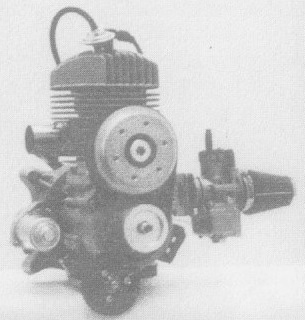
The Zanzottera MZ 34 and MZ 35 are a family of single-cylinder, two-stroke, single ignition aircraft engines designed for powered paragliders, one and two place powered parachutes, single place ultralight trikes, light single place ultralight aircraft and motor gliders.

The engine was originally designed and produced by Zanzottera Technologies of Italy, but the design was sold, along with the rest of the company’s two-stroke ultralight aircraft engine line to Compact Radial Engines of Surrey, British Columbia, Canada.

The MZ 34 and 35 both have a cylinder barrel that is Nikasil-coated. The engine features a decompression channel to allow easier recoil starting, a tuned exhaust system and a belt-type reduction drive. Starting options include a recoil or electric starter.

Earlier versions produced 26 hp (19 kW) at 6250 rpm or 38 hp (28 kW) with a tuned exhaust at 6450 rpm. The current production engine is rated at 27.5 hp (21 kW) at 6250 rpm. Reduction ratios available are 1.84, 2.05, 2.14, 2.24 and 2.34 to 1.

The unit cost for the MZ 34 in 2009 was US$2840, and the MZ 35 US$3120.

The owners manual acknowledges the limitations inherent in the design of the engine, stating:
This is not an aeronautics approved engine.
This engine has not been subjected to durability and safety tests in compliance with aeronautical standards. It is designed to be used in paramotors and ULM or aeroplanes where engine failure will not produce serious consequences. The user must assume responsibility for all risks deriving from the use of this engine and must understand that this engine is subject to sudden failure. Engine failure may result in an emergency landing. Such accidents may cause serious material damage and injuries. Never use an aircraft fitted with this engine in areas or at conditions and altitudes which may cause problems if forced to land as a result of sudden engine failure.

Variants:

MZ 34
Single cylinder, two stroke single ignition aircraft engine optimized for powered paragliders, one and two place powered parachutes, single place ultralight trikes, light single place ultralight aircraft

MZ 35
Single cylinder, two stroke single ignition aircraft engine with a narrower profile, optimized for motor-gliders

Applications:
Aviastroitel AC-5M
Belite Aircraft Superlite
The Butterfly Super Sky Cycle
Earthstar Thunder Gull
Fly Products Power
North Wing ATF
Paramotor Inc FX5
Spartan DFS Trike

Specifications:
MZ 34
Type: Single cylinder, two-stroke aircraft engine
Bore: 76 mm (2.99 in)
Stroke: 69 mm (2.72 in)
Displacement: 313 cc (19.10 cu in)
Length: 296 mm (11.65 in)
Height: 410 mm (16.14 in)
Dry weight: 17 kg (37 lb) with engine mount and silent-block mountings, starter motor, manual starter, reduction drive and muffler
Valvetrain: Reed valve induction
Oil system: 50:1 oil to fuel, premixed
Cooling system: air cooled
Ignition: Electronic
Reduction gear: Poly-V Belt drive with optional ratios of 1.84, 2.05, 2.14, 2.24 or 2.34 to 1
Power output: 27.5 hp (21 kW) at 6250 rpm
Max torque: 35 hp at 4100 rpm
Compression ratio: 9.6:1
Price 1998: 149 00 Fttc

Yvon Perret Sock

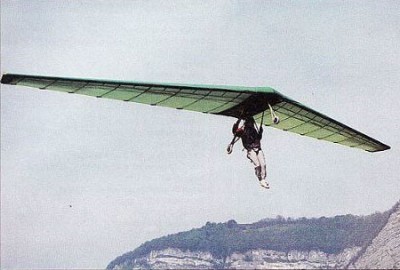
The Yvon Perret Sock hang glider appeared in 1985.

The Sock 3 was for advanced pilots.

Sock 2 – pilot Alain Jacques

The manufacturer and pilot tester of the Sock 2 is Alain Jacques. After a few tests on the slope school, he had taken off directly from the north hill in St Hil.

Sock 2
Wing area: 15.21 m²
Wing span: 11.6 m
Aspect ratio: 8.8
Hang glider weight: 36 kg
Packed length: 3 m
Nose angle: 138°