Striplin FLAC / Super FLAC

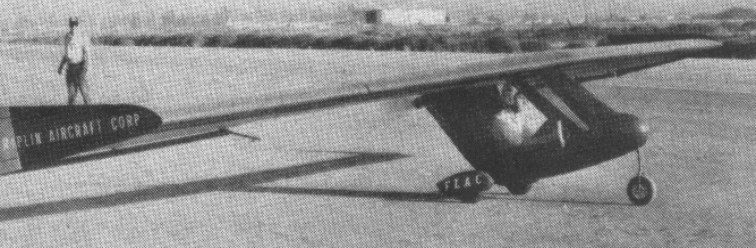
Single seat twin engined high wing mono¬plane with conventional three axis control. Wing has swept back leading edge, and tapering chord; no tail. Pitch/roll control by stabilator; yaw control by tip rudders; control inputs through stick for pitch/roll and pedals for yaw. Cantilever wing; wing profile Worthmann FX 126; double surface. Undercarriage has three wheels in tricycle formation; nosewheel retractable; suspension NC on nosewheel and glass fibre suspension on main wheels. Push right go right nosewheel steering connected to yaw control (Flac). No ground steering (Super Flac). Brakes Nod. Glass fibre/foam fuselage, totally enclosed. Engines driving pusher propeller.

Designed in June 1977, the prototype Flac (Foot Launch Air Cycle) made its first flight on the 24 October 1978 and despite its name was fitted with an auxiliary undercarriage to help the legs of its occupant. A tail less aircraft with a cantilever high wing set at 3 deg incidence with 8 deg of leading edge sweep back, even the earliest Flacs had a closed cabin of glass fibre and polyurethane foam, mounted under the wing. The wing tips were furnished with fins carrying rudders, while the stabilators at the trailing edge acted as elevators when used together or as ailerons when used differentially. The wing structure was glassfibre and epoxy on a foam base, fabric covered between spar and trailing edge. The main undercarriage was mounted on glassfibre legs, while the steerable nosewheel was manually retractable into the fuselage nose.
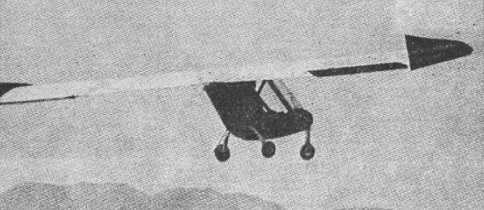
With two Chrysler Westbend motors giving 9hp each, the Flac cruised at 65mph (105kph) with a Vne of 80mph (129kph), a stall around 20 mph (32 kph) and a climb rate of 1630 ft/min (8.3 m/s). Add in weights of 156 I.P (71 kg) empty and 386 lb (175 kg) at maximum gross and a range of 200 mile (322km) on 5.0 US gal (4.2 Imp gal, 18.9 litre.

In addition to two prototypes, five Flacs had flown by January 1980 and 79 were being built by amateurs. Ken Striplin was not content with that and that Spring announced the Super Flac, which had more space for the pilot’s legs, thanks to a fixed nosewheel, and Soarmaster rather than Chrysler engines.

FLAC
Engine: Mac 101, 12-hp
Cruise: 25-30 mph

Air Cycle II
Engines: 2 x West Bend, 10 hp
Cruise: 65 mph
Stall: 23-30 mph
MAUW: 550 lb
Useful load: 300 lb
Super Flac
Engine: Two Soarmaster, 11.5 hp
Propeller diameter 48 inch, 1.21 m
Power per unit area 0.15 hp/sq.ft, 1.6 hp/sq.m
Fuel capacity 5.0 US gal, 4.2 Imp gal, 18.9 litre
Length overall 7.0ft, 2.13 m
Height overall 4.0ft, 1.22m
Wing span 32.0ft, 9.75m
Mean chord 4.911, 1.47m
Dihedral 8 deg
Sweepback 0 deg
Total wing area 155 sq.ft, 14.4 sq.m
Wing aspect ratio 6.6/1
Empty weight 200 lb, 91 kg
Max take off weight 434 lb, 197kg
Payload 234 lb, 106kg
Max wing loading 2.80 lb/sq.ft, 13.7 kg/sq.m
Max power loading 18.9 lb/hp, 8.6 kg/hp
Never exceed speed 80 mph, 129 kph
Max cruising speed 55 mph, 88kph
Stalling speed 24mph, 39kph
Min sink rate 180ft/min at 36mph, 0.9m/s at 58 kph
Best glide ratio with power off 20/1 at 38 mph, 61 kph
Take off distance 150 ft, 45 m
Landing distance 100 ft, 30 m

Air Cycle II
Engines: 2 x West Bend, 10 hp
Cruise: 65 mph
Stall: 23-30 mph
MAUW: 550 lb
Useful load: 300 lb
Stratus EA 81

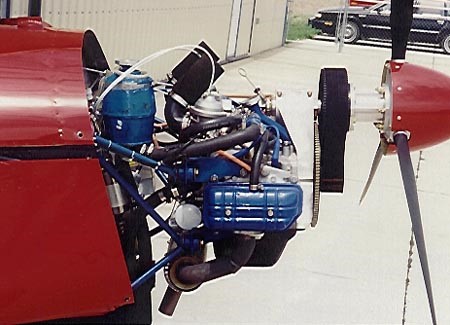
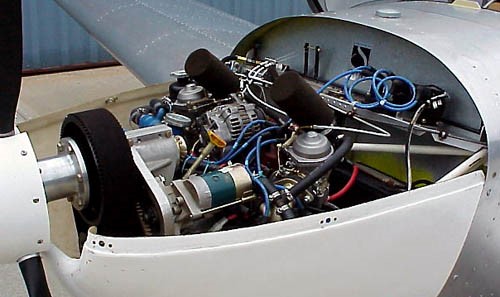
Stratus 2000, Inc specialized in the design and manufacture of engines based on Subaru automotive engines for homebuilt aircraft. Zenith Aircraft Company offered a firewall-forward package for the EA-81 Subaru engine conversion (from Stratus Inc.) for the ZODIAC CH 601 series.

The firewall-forward package was supplied by Zenith Aircraft Company.

Cycle: 4 stroke
No cylinders: 4
Bore: 92 mm / 3.62 in
Stroke: 67 mm / 2.64 in
Compression: 9
Displacement: 1781 cc / 109 cu. in.
Cooling: Liquid
Ignition: Electronic, single spark plugs
Reduction: 2.2/1 HTD belt (60 mm. wide)
Dimension: 660 x 533 x 444 mm
Weight: 84 kg / 185 lb (approx. 220 lb installed)
Max pwr: 100 hp / 75 kW at 5400 rpm
Max torque: 145 at 3800 rpm
Fuel consumption: 0.48 lb./hp/hr @ 75% power
Fuel: unleaded (automotive)
Carburetion: Dual Bing altitude-compensating carbs
Alternator: 45 amp
Starter: electric gear reduction
Price 1998: $6495

Stratus Inc / Stratus 2000

1998:
7750 Twelfth Avenue N.W.
Seattle
Washington 98117
USA

Since 1992, Stratus, Inc. has converted Subaru EA-81 engines for use in Avid Flyers and similar light, home-built aircraft. The company installed a 100-hp engine in a Cessna 150F with good results.

Originally founded as Stratus, Inc. in 1992 by Reiner and Petra Hoffmann, the company was sold in 1999 to Mykal Templeman and renamed Stratus 2000, Inc.

Based in Camano Island, Washington and later in Corvallis, Oregon. Stratus 2000, Inc specialized in the design and manufacture of engines based on Subaru automotive engines for homebuilt aircraft. Zenith Aircraft Company offers a firewall-forward package for the EA-81 Subaru engine conversion (from Stratus Inc.) for the ZODIAC CH 601 series.

The company built two Subaru-derived designs, the Stratus EA 81 based on the Subaru EA 81 automotive engine and the Stratus EJ 22 based upon the Subaru EJ 22 automotive engine. The company also designed its own 2.2:1 ratio propeller speed reduction unit.

Some existing airframe designs, like the Zenith CH 601, have been adapted for the Stratus engines, while other aircraft have been designed around the engines from the start, such as the Airdale Backcountry. Stratus powerplants have also been used as retrofits in production aircraft, such as the Cessna 150.

The company seems to have gone out of business about 2008 and engine production ended.

Stratos Aviation Stratos

Single seat single engined mid wing monoplane with conventional three axis control. Wing has unswept leading and trailing edges, and constant chord; cruciform tail. Pitch control by elevator on tail; yaw control by fin mounted rudder; roll control by one third span spoilers; control inputs through stick for pitch/roll and pedals for yaw. Wing braced from below by struts; wing profile NACA Series 23000; double surface. Undercarriage has three wheels in tricycle formation; suspension on all wheels (type NC). Push right go right nosewheel steering connected to yaw control. Aluminium tube/fabric/ steel tube framework, with optional pod. Engine mounted at wing height driving pusher propeller.

The prototype Stratos made its first flights during the summer of 1982. It had been designed and built by Larry Burke, an engineer specialised in the study of fatigue problems and the breaking points of materials at Lawrence Livermore National Laboratory.

Commencing design studies on this single seater in December 1981, Larry included in his design target a minimum load factor of +6, 3g at 5001b (227kg) weight. The Stratos was designed to be a low profile fully triangulated strut braced aircraft that places the pilot ahead of the wing, almost giving 360 degrees visibility. The machine is expected to be on sale in ready built form during the summer of 1983 and Stratos Aviation has plans for a two seater which will be classified as an experimental aircraft in the United States.

The Stratos single seater is fitted with a Cuyuna 430R but the manufacturer intends that alternative engines shall be offered eventually as an option.

Engine: Cuyuna 430R, 30 hp at 5500 rpm
Propeller diameter and pitch 50 x 32 inch, 1.27 x 0.81 m
Belt reduction, ratio 2.0/1
Power per unit area 0.18 hp/sq.ft, 1.9hp/sq.m
Fuel capacity 5.0 US gal, 4.2 Imp gal, 18.9 litre
Length overall 19.0ft, 5.79 m
Height overall 4.5ft, 1.37m
Wing span 33.0ft, 10.05m
Constant chord 5.0 ft, 1.52 m
Sweepback 0 degrees
Total win area 166 sq.ft, 15.4 sq.m
Total spoiler area 4.0 sq.ft, 0.36 sq.m
Wing aspect, ratio 6.5/1
Empty weight 250 lb, 113kg
Max take off weight 500 lb, 226kg
Payload 250 lb, 113kg
Max wing loading 3.01 lb/sq.ft, 14.6 kg/sq.m
Max power loading 16.7 lb/hp, 7.5 kg/hp
Load factors +6.0, 3.0 design
Max level speed 63 mph, 101 kph
Never exceed speed 70 mph, 112.5 kph
Cruising speed 63 mph, 101 kph
Stalling speed 27 mph, 43 kph
Max climb rate at sea level 750 ft/min, 3.8 m/s
Min sink rate 250 ft/min at 35 mph, 1.3 m/s at 56 kph
Best glide ratio with power off 8/1 at 35 mph, 56kph
Take off distance 100ft, 30 m
Land¬ing distance 100ft, 30m
Service ceiling 16,500 ft, 5030 m
Range at average cruising speed 150 mile, 241 km

Storo Bristol F.2B

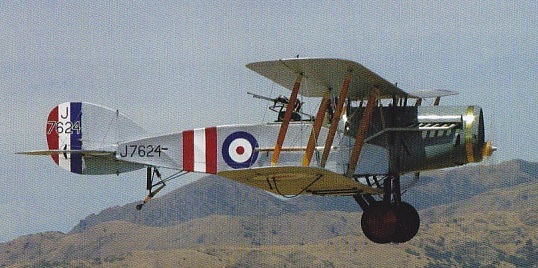
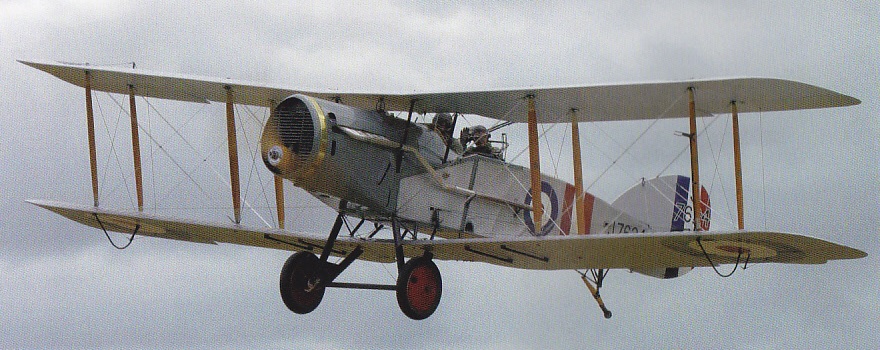
Ed and Pete Storo built a replica 1917 Bristol F.2B Fighter. The aircraft took seven years to build and was first registered in 1992 as N624.

The fuselage features chrome-molybdinium tubing and is based on an Australian replica. The wings, tail, undercarriage and other assemblies were all built from Bristol drawing and could be fitted to an original. The only accommodations to modern practicalities are the inclusion of brakes and a small tailwheel.

The replica is powered by a 200hp Ranger 440-5 engine which is installed in an upright position – which suits the propeller and cowl configuration of the F.2B.

The replica was first flown in 1993.

It was subsequently sold to TVAL in NZ in late 2001 for the Classics Fighters airshow and changed colour scheme.

After TVAL brought it to the Australian International Airshow at Avalon in February 2015, it remained in Australia and is now operated as part of the Australian Vintage Aviation Society (TAVAS) collection.

Registered ZK-PRK and carrying a ‘2’ behind the roundel it was operated by TVAL from 2001 to 2015, then to NZ Warbirds.

Storm Williwaw

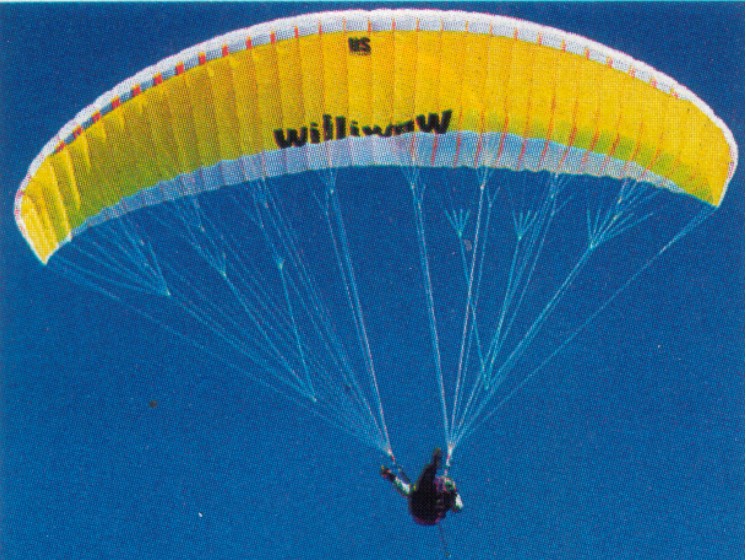
Paraglider circa 1998.

Williwaw 100
Wing area: 31.5 sq.m
Certification: Afnor
Pilot weight: 92-115 kg
No. of cells: 39
Wing span: 12 m
Aspect ratio: 4.6
Min sink: 1 m/s
Max speed: 45 kph
Price (1998) 17600 Fr

Williwaw 90
Wing area: 25.2 sq.m
Certification: Afnor
Pilot weight: 60-80 kg
No. of cells: 39
Wing span: 10.8 m
Aspect ratio: 4.6
Min sink: 1 m/s
Max speed: 45 kph
Price (1998) 17100 Fr

Williwaw 95
Wing area: 28.35 sq.m
Certification: Afnor
Pilot weight: 75-95 kg
No. of cells: 39
Wing span: 11.4 m
Aspect ratio: 4.6
Min sink: 1 m/s
Max speed: 45 kph
Price (1998) 17300 Fr