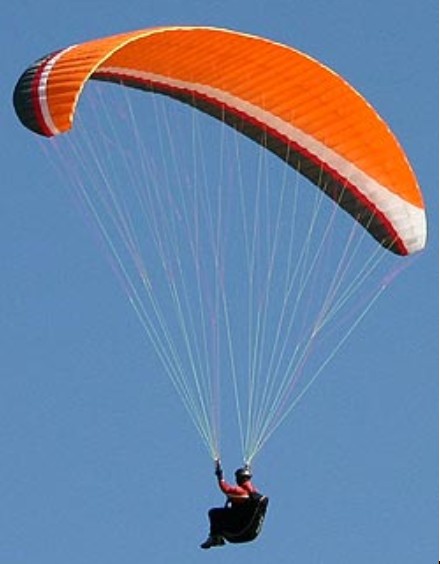
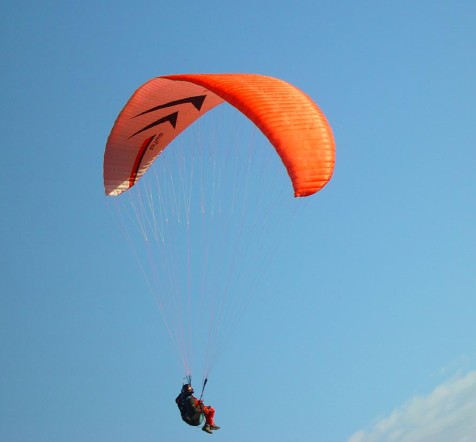
The Mistral range was presented in 1996. The DHV1-2 model Swing is aimed to “appeal to all kinds of pilot” thanks to an increased performance, sensitive handling and high safety level. It has 51 cells and an aspect ratio of 5,36. The design team at Swing focused on reducing drag by optimizing the glider’s flow profile and reducing lines by 20% . “The result is a glider which scores a noticeable improvement in performance compared to its predecessor without compromising on safety. Its handling has become a little more lively and direct” say Swing.
It was available in 8 new color combinations, and the option of a personal choice of colors, and 5 sizes.
The Mistral is an intermediate glider using high tech “spare boom” technology. The application of this technology means that less lines are required and wind resistance is therefore minimized. Porcher Marine material is utilised for the Mistral cell wall construction. Carrington N1080 Nylon is used for upper and lower sail material. This material is ideally suited as it features a soft smooth surface and the lowest possible porosity level.
The Mistral is stable in turbulent air, features very direct handling without a tendency to go negative and highly comfortable brake pressure levels. Good launch, light weight and small pack volume characteristics, make the Mistral an ideal glider for the mountain climbing fraternity. A fast trim speed, high glide ratio and broad speed range combine to make the Mistral suited to cross country flying.
The Mistral 2 bridges the gap between beginner and intermediate gliders, designed for the advanced beginner.
Numerous new designs with differences in the basic form and profile variations underwent computer simulation before the decision on the first prototype of the Mistral 3 was made. The Mistral 3 combines new safety requirements in the DHV 1-2 category with climb and glide performance along with lively handling. With its agile handling and performance-oriented design, the Mistral 3 is aimed at advanced pilots and pilots taking a step back from higher categories. Despite high steering agility, the Mistral 3 has good dampening and very high stability in turbulence.
The Mistral 3 has 50 cells and an aspect ratio of 5.25. The interior of V-tapes and a system of load-bearing tapes ensure good canopy stability. The riser system of the Mistral 3 was integrated with the canopy to allow effective acceleration with only the slightest drop in performance. A line configuration suited for the canopy design with reduced overall line use reduces the overall drag and increases the agility and performance.
Practical detail solutions such as the ERGO.GRIP – brake handles and DIRT.EX openings to remove dirt from the inside of the glider complete the Mistral 3.
The Swing development team set about improving on the Mistral 3 with the Mistral 4. From the outset the designers and test pilots concentrated on the glider’s performance. A major limitation is drag, and it was on precisely this point that the team focussed, optimising the glider’s flow profile and reducing its lines by 20%, a line length of 70m. The result is a glider with a noticeable improvement in performance. Its handling has become a little more lively and direct.
New software, many prototypes, countless tests under the leadership of Manuel Croci created the Mistral 5. Its convincing balance, combined with appealing sportiness, make the Mistral 5 a classy DHV1-2 glider.
Main differences from the Mistral 4
more lively and appealing handling with linear increase in control pressure
better performance
no D main lines
greater aspect ratio
higher wing-loading
symmetrical and sporty design
The Mistral 5 has excellent launch and handling features, and was type-tested by the DHV for paramotor use (with and without trimmers and with extended take-off weight ranges). A raiser specifically for paramotor use was available separately from Swing for sizes 24, 26 and 28. There are no other changes compared to the LTF version.
The Mistral 6 provides an aspect ratio of 5.9. The combination of aspect ratio, plan form, profile, trim and sail tension is the reason for the performance of the Mistral 6. This glider is in the EN-B category and the Mistral 6 offers a speed increase of 13-14km/h.
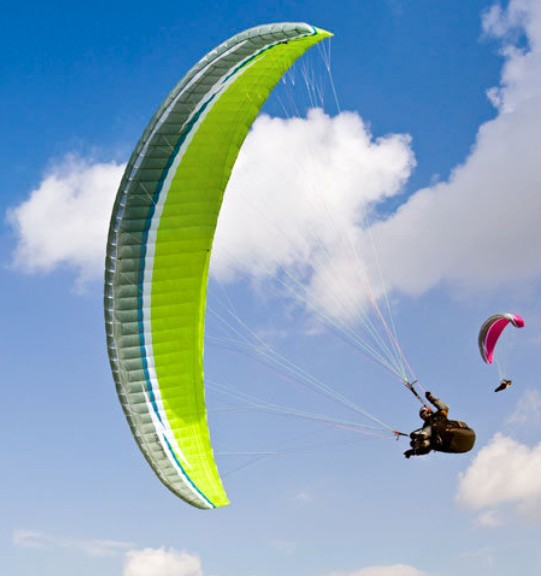
Even with a forward launch in nil wind, it striking easily and reliably rises above the pilot. High Arc Technology (HAT) gives this intermediate glider very appealing and sporty handling with good-natured extreme flight behaviour, despite its high aspect ratio. The Mistral 6 was very deliberately designed as a high-end intermediate glider. Thin risers, a high aspect ratio and sporty handling should appeal to the performance-oriented or advanced pilots.
Minimal steering input is all that is needed for the Mistral 6 for tight and well-defined circles. How it differs from the Mistral 5
aspect ratio 0.5 higher (5.4 / 5.9)
HAT – High Arc Technology
Flex Sticks in the leading edge
Thinner risers
Four new colours
Seven colour combinations
More direct and sporty handling
Lighter canopy
Status – 3-4 weeks delivery time update on 22. Nov 2010
The Swing development team wanted to design a high-performance tandem glider with good-natured flight characteristics, so it returned to the design principles of the successful Mistral 3. The result is the Mistral Twin, which combines direct and energy-saving handling with simple launch and flight behaviour. The particularly simple launch characteristics and excellent thermal properties of the Mistral Twin make it suitable both for professional use with inexperienced passengers and also for tandem cross-country flights.
The Mistral Twin has low take-off speed, and even with a high load, three steps are generally needed for the pilot and passenger to take off. The control pressure of the Mistral Twin is very low compared to other tandem gliders in the upper range and increases progressively. The glider has good dampening and high ground stability in turbulence and at the same time gives the pilot sensitive feedback on air movement and canopy response. With its large weight range from 135 to 230 kg, the Mistral Twin is particularly suitable for professional use.
The glider has a similar design to that of the Mistral 3 with 50 cells and an aspect ratio of 5.05. The elaborate interior of V-tapes and a system of load-bearing tapes ensures high canopy stability. The glider is equipped with an adjuster which enables a speed increase of approx. 5-6 km/h.
The results from the Mistral Twin’s load test showed that the glider would withstand 8g with a take-off weight of 304 kg. The wing was even subjected to top loads of 2.9 tonnes, without it being damaged. The top surface of the Mistral Twin is siliconised, which gives it high UV-resistance and ensures that the glider will have a long life.
Mistral 24
Pilot weight without equipment: 45 -65 kg
Pilot weight including equipment: 60-80 kg
Number of cells: 42
Number of additional ribs/spare booms: 34/56
Surface flat: 25,7 sq.m
Projected surface: 23,7 sq.m
Wingspan: 11,1 m
Wingspan projected: 10,1 m
Aspect ratio: 4,8
Aspect ratio projected: 4,3
Weight of glider: 5,6 kg
Minimum sink: 1,10 m/s
VMin / Vmax: 22 – 47 km/h
Trim – speed: 42 km/h
ACPUL Performance: Standard
DHV 2-3
Mistral 27
Pilot weight without equipment: 53-80 kg
Pilot weight including equipment: 68-95 kg
Number of cells: 44
Number of additional ribs/spare booms: 36/62
Surface flat: 28,7 sq.m
Projected surface: 26,7 sq.m
Wingspan: 11,7 m
Wingspan projected: 10,6 m
Aspect ratio: 4,8
Aspect ratio projected: 4,3
Weight of glider: 5,9 kg
Minimum sink: 1,10 m/s
VMin / Vmax: 22 – 47 km/h
Trim – speed: 38 km/h
DHV 2
Mistral 30
Pilot weight without equipment: 75-110 kg
Pilot weight including equipment: 90-125 kg
Number of cells: 44
Number of additional ribs/spare booms: 36/62
Surface flat: 32,1 sq.m
Projected surface: 30,1 sq.m
Wingspan: 12,3 m
Wingspan projected: 11,2 m
Aspect ratio: 4,8
Aspect ratio projected: 4,3
Weight of glider: 6,2 kg
Minimum sink: 1,10 m/s
VMin / Vmax: 22 – 47 km/h
Trim – speed: 37 km/h
DHV 2
Mistral 33
Pilot weight without equipment: 85-120 kg
Pilot weight including equipment: 100-135 kg
Number of cells: 46
Number of additional ribs/spare booms: 38/62
Surface flat: 34,5 sq.m
Projected surface: 32,5 sq.m
Wingspan: 13,0 m
Wingspan projected: 11,8 m
Aspect ratio: 4,95
Aspect ratio projected: 4,4
Weight of glider: 6,4 kg
Minimum sink: 1,10 m/s
VMin / Vmax: 22 – 47km/h
Trim – speed: 38 km/h
DHV 2
Mistral Twin
Pilot weight without equipment: 120-180 kg
Pilot weight including equipment: 150-200 kg
Number of cells: 48
Number of additional ribs/spare booms: 0/0
Surface flat: 42,3 sq.m
Projected surface: 39,3 sq.m
Wingspan: 14,3 m
Wingspan projected: 12,8 m
Aspect ratio: 4,8
Aspect ratio projected: 4,3
Weight of glider: 8,5 kg
Minimum sink: 1,10 m/s
VMin / Vmax: 22 – 42 km/h
Trim – speed: 42 km/h
DHV 2
Price (1998) 6650 DM
Mistral 2 2.22
Take-off weight incl. Equipment: 60-80 kg
No. of cells: 52
Area flat: 23,9 sq.m
Area projected: 21,1 sq.m
Span flat: 11,4 m
Span projected: 9,4 m
Aspect ratio: 5,2
Glider weight: 5,7 kg
Trim speed approx: 35-36 km/h
Max. speed approx: 47 km/h
LTF-certification: 1-2 GH
Mistral 2 2.24
Take-off weight incl. Equipment: 70-95 kg
No. of cells: 52
Area flat: 26,7 sq.m
Area projected: 23,6 sq.m
Span flat: 11,8 m
Span projected: 9,9 m
Aspect ratio: 5,2
Glider weight: 6 kg
Trim speed approx: 35-36 km/h h
Max. speed approx: 47 km/h
LTF-certification: 1-2 GH
Mistral 2 2.26
Take-off weight incl. Equipment: 85-110 kg
No. of cells: 52
Area flat: 29,5 sq.m
Area projected: 25,7 sq.m
Span flat: 12,4 m
Span projected: 10,4 m
Aspect ratio: 5,2
Glider weight: 6,3 kg
Trim speed approx: 35-37 km/h
Max. speed approx: 48 km/h
LTF-certification: 1-2 GH
Mistral 2 2.28
Take-off weight incl. Equipment: 100-130 kg
No. of cells: 52
Area flat: 31,9 sq.m
Area projected: 27,8 sq.m
Span flat: 12,9 m
Span projected: 10,8 m
Aspect ratio: 5,2
Glider weight: 6,7 kg
Trim speed approx: 35-36 km/h
Max. speed approx: 47 km/h
LTF-certification: 1-2 GH
Mistral 3 3.22
Take-off weight incl. Equipment: 55-80 kg
No. of cells: 50
Area flat: 25,5 sq.m
Area projected: 22,1 sq.m
Span flat: 11,60 m
Span projected: 9,20 m
Aspect ratio: 5,25
Aspect ratio projected: 3,8
Glider weight: 6,1 kg
Min. sink rate approx: 1,05
Max. speed approx: >50 km/h
Trim speed approx: 37 km/h
LTF-certification: 1-2
Mistral 3 3.24
Take-off weight incl. Equipment: 65-90 kg
No. of cells: 50
Area flat: 27 sq.m
Area projected: 23,5 sq.m
Span flat: 11,90 m
Span projected: 9,50 m
Aspect ratio: 5,25
Aspect ratio projected: 3,8
Glider weight: 6,4 kg
Min. sink rate approx: 1,05 m/s
Max. speed approx: >50 km/h
Trim speed approx: 37 km/h
LTF-certification: 1-2
Mistral 3 3.26
Take-off weight incl. Equipment: 80-105 kg
No. of cells: 50
Area flat: 29,2 sq.m
Area projected: 25,4 sq.m
Span flat: 12,40 m
Span projected: 9,90 m
Aspect ratio: 5,25
Aspect ratio projected: 3,8
Glider weight: 6,8 kg
Min. sink rate approx: 1,05 m/s
Max. speed approx: >50 km/h
Trim speed approx: 37 km/h
LTF-certification: 1-2
Mistral 3 3.28
Take-off weight incl. Equipment: 95-125 kg
No. of cells: 50
Area flat: 31,4 sq.m
Area projected: 27,3 sq.m
Span flat: 12,80 m
Span projected: 10,20 m
Aspect ratio: 5,25
Aspect ratio projected: 3,8
Glider weight: 7,1 kg
Min. sink rate approx: 1,05 m/s
Max. speed approx: >50 km/h
Trim speed approx: 37 km/h
LTF-certification: 1-2
Mistral 3 3.28 3.30
Take-off weight incl. Equipment: 105-140 kg
No. of cells: 50
Area flat: 32,9 sq.m
Area projected: 28,5 sq.m
Span flat: 13,1 m
Span projected: 10,5 m
Aspect ratio: 5,25
Aspect ratio projected: 3,8
Glider weight: 7,4 kg
Min. sink rate approx: 1,05 m/s
Max. speed approx: >50 km/h
Trim speed approx: 37 km/h
LTF-certification: 1-2
Mistral 4 4.22
Take-off weight incl. Equipment: 55-75 kg
No. of cells: 51
Area flat: 25,4 sq.m
Area projected: 21,9 sq.m
Span flat: 11,67 m
Span projected: 9,3 m
Aspect ratio: 5,36
Aspect ratio projected: 3,86
Glider weight: 6,1 kg
Min. sink rate approx: 1,05 m/s
Max. speed approx: >50 km/h
Trim speed approx: 37 km/h
LTF-certification: 1-2
Mistral 4 4.24
Take-off weight incl. Equipment: 65-90 kg
No. of cells: 51
Area flat: 26,9 sq.m
Area projected: 23,2 sq.m
Span flat: 12 m
Span projected: 9,50 m
Aspect ratio: 5,36
Aspect ratio projected: 3,86
Glider weight: 6,25 kg
Min. sink rate approx: 1,05 m/s
Max. speed approx: >50 km/h
Trim speed approx: 37 km/h
LTF-certification: 1-2
Mistral 4 4.26
Take-off weight incl. Equipment: 80-105 kg
No. of cells: 51
Area flat: 28,9 sq.m
Area projected: 24,9 sq.m
Span flat: 12,5 m
Span projected: 9,82 m
Aspect ratio: 5,36
Aspect ratio projected: 3,86
Glider weight: 6,5 kg
Min. sink rate approx: 1,05 m/s
Max. speed approx: >50 km/h
Trim speed approx: 37 km/h
LTF-certification: 1-2
Mistral 4 4.28
Take-off weight incl. Equipment: 90-115 kg
No. of cells: 51
Area flat: 30,4 sq.m
Area projected: 26,2 sq.m
Span flat: 12,80 m
Span projected: 10,1 m
Aspect ratio: 5,36
Aspect ratio projected: 3,86
Glider weight: 7,1 kg
Min. sink rate approx: 1,05 m/s
Max. speed approx: >50 km/h
Trim speed approx: 37 km/h
LTF-certification: 1-2
Mistral 4 4.30
Take-off weight incl. Equipment: 105-135 kg
No. of cells: 51
Area flat: 32,5 sq.m
Area projected: 28,1 sq.m
Span flat: 13,2 m
Span projected: 10,4 m
Aspect ratio: 5,36
Aspect ratio projected: 3,86
Glider weight: 7,4 kg
Min. sink rate approx: 1,05 m/s
Max. speed approx: >50 km/h
Trim speed approx: 37 km/h
LTF-certification: 1-2
Mistral 5 5.22
Take-off weight incl. Equipment: 60-80 kg
No. of cells: 52
Area flat: 25,0 sq.m
Area projected: 21,5 sq.m
Span flat: 11,6 m
Span projected: 9,2 m
Aspect ratio: 5,4
Aspect ratio projected: 3,9
Glider weight: 5,5 kg
Min. sink rate approx: 1,05 m/s
Max. speed approx: >50 km/h
Trim speed approx: 38 km/h
EN Homologation: B
LTF-certification: 1-2
Mistral 5 5.24
Take-off weight incl. Equipment: 75-100 kg
No. of cells: 52
Area flat: 27 sq.m
Area projected: 23,2 sq.m
Span flat: 12,1 m
Span projected: 9,6 m
Aspect ratio: 5,4
Aspect ratio projected: 3,9
Glider weight: 5,8 kg
Min. sink rate approx: 1,05 m/s
Max. speed approx: >50 km/h
Trim speed approx: 38 km/h
EN Homologation: B
LTF-certification: 1-2
Mistral 5 5.26
Take-off weight incl. Equipment: 85-110 kg
No. of cells: 52
Area flat: 28,9 sq.m
Area projected: 24,9 sq.m
Span flat: 12,5 m
Span projected: 9,9 m
Aspect ratio: 5,4
Aspect ratio projected: 3,9
Glider weight: 6,15 kg
Min. sink rate approx: 1,05 m/s
Max. speed approx: >50 km/h
Trim speed approx: 38 km/h
EN Homologation: B
LTF-certification: 1-2
Mistral 5 5.28
Take-off weight incl. Equipment: 95-130 kg
No. of cells: 52
Area flat: 30,4 sq.m
Area projected: 26,2 sq.m
Span flat: 12,80 m
Span projected: 10,2 m
Aspect ratio: 5,4
Aspect ratio projected: 3,9
Glider weight: 6,35 kg
Min. sink rate approx: 1,05 m/s
Max. speed approx: >50 km/h
Trim speed approx: 38 km/h
EN Homologation: B
LTF-certification: 1-2
Mistral 5 5.30
Take-off weight incl. Equipment: 105-150 kg
No. of cells: 52
Area flat: 33,4 sq.m
Area projected: 28,9 sq.m
Span flat: 13,4 m
Span projected: 10,6 m
Aspect ratio: 5,4
Aspect ratio projected: 3,9
Glider weight: 6,55 kg
Min. sink rate approx: 1,05 m/s
Max. speed approx: >50 km/h
Trim speed approx: 38 km/h
EN Homologation: B
LTF-certification: 1-2
Mistral 6 22
Take-off weight incl. Equipment: 60-80 kg
No. of cells: 52
Area flat: 24,2 sq.m
Area projected: 20,7 sq.m
Span flat: 11,94 m
Span projected: 9,37 m
Aspect ratio: 5,9
Aspect ratio projected: 4,25
Glider weight: 5,3 kg
Min. sink rate approx: 1,05 m/s
Max. speed approx: >50 km/h
Trim speed approx: 38 km/h
EN: B
LTF-certification: B
Mistral 6 24
Take-off weight incl. Equipment: 65-90 kg
No. of cells: 52
Area flat: 25,6 sq.m
Area projected: 21,9 sq.m
Span flat: 12,3 m
Span projected: 9,65 m
Aspect ratio: 5,9
Aspect ratio projected: 4,25
Glider weight: 5,6 kg
Min. sink rate approx: 1,05 m/s
Max. speed approx: >50 km/h
Trim speed approx: 38 km/h
EN: B
LTF-certification: B
Mistral 6 26
Take-off weight incl. Equipment: 80-105 kg
No. of cells: 52
Area flat: 27 sq.m
Area projected: 23,1 sq.m
Span flat: 12,62 m
Span projected: 9,9 m
Aspect ratio: 5,9
Aspect ratio projected: 4,25
Glider weight: 5,85 kg
Min. sink rate approx: 1,05 m/s
Max. speed approx: >50 km/h
Trim speed approx: 38 km/h
EN: B
LTF-certification: B
Mistral 6 28
Take-off weight incl. Equipment: 90-115 kg
No. of cells: 52
Area flat: 28,4 sq.m
Area projected: 24,3 sq.m
Span flat: 12,95 m
Span projected: 10,15 m
Aspect ratio: 5,9
Aspect ratio projected: 4,25
Glider weight: 6,1 kg
Min. sink rate approx: 1,05 m/s
Max. speed approx: >50 km/h
Trim speed approx: 38 km/h
EN: B
LTF-certification: B
Mistral 6 30
Take-off weight incl. Equipment: 105-130 kg
No. of cells: 52
Area flat: 29,8 sq.m
Area projected: 25,5 sq.m
Span flat: 13,25 m
Span projected: 10,41 m
Aspect ratio: 5,9
Aspect ratio projected: 4,25
Glider weight: 6,4 kg
Min. sink rate approx: 1,05 m/s
Max. speed approx: >50 km/h
Trim speed approx: 38 km/h
EN: B
LTF-certification: B
Mistral Twin 35
Take-off weight incl. Equipment: 125-195 kg
No. of cells: 50
Area flat: 40,1 sq.m
Area projected: 34,8 sq.m
Span flat: 14,2 m
Span projected: 11,27 m
Aspect ratio: 5,05
Aspect ratio projected: 3,65
Glider weight: 8,8 kg
Min. sink rate approx: 1,05-1,15 m/s
Max. speed approx: 42-45 km/h
Trim speed approx: 36-39 km/h
LTF-certification: 1-2
Mistral Twin 38
Take-off weight incl. Equipment: 130-230 kg
No. of cells: 50
Area flat: 43,4 sq.m
Area projected: 37,7 sq.m
Span flat: 14,8 m
Span projected: 11,72 m
Aspect ratio: 5,05
Aspect ratio projected: 3,65
Glider weight: 9,3 kg
Min. sink rate approx: 1,05-1,15 m/s
Max. speed approx: 42-45 km/h
Trim speed approx: 36-39 km/h
LTF-certification: 1-2

 All Aero