Westminster CA.
USA
Formed c.1980 by Clarence Gilbert Taylor and son Bruce to manufacture kits for the Bird two-seaters.
Westminster CA.
USA
Formed c.1980 by Clarence Gilbert Taylor and son Bruce to manufacture kits for the Bird two-seaters.

This single pilot manned test-bed was built by Jim Kern’s TASK Research Inc. of Santa Paula, California in 1982, which supplied many composite structures/components for the Rutan designed Long-EZ, Defiant, and Voyager aircraft during the early to mid-1980’s under contract to Northrop’s Electric Mechanical Division in the late 1980s to test early avionics/electronic equipment for remotely piloted vehicles.
The Vantage was a single-seat pusher canard which resembled a Rutan Long-EZ, but was slightly larger with more rounded fuselage sides, a large bulbous two piece canopy. The craft also incorporated an extra long pitot tube in the front. Power was supplied by a single Lycoming O-360 (180 HP) engine turning a variable pitch wood or composite propeller. The aircraft incorporated a retractable nose gear which was powered by an electric motor. The wing root to fuselage joint was blended/contoured and flowed seamlessly into the cockpit. Nicknamed “Sneeky Pete” by its pilots, the undesignated aircraft was outfitted with various special avionics depending on the specific mission requirement. The exterior was painted white, with the name “Sneeky Pete” written along the side of the fuselage, though this is not apparent in the one picture that was released.
Although the maiden flight of “Sneeky Pete” took place at Mojave Airport on July 18th, 1982 with Dick Rutan at the controls (Mike Melvill, along with many others served as test pilots for this aircraft), Rutan Aircraft Factory or Scaled Composites apparently were not involved in the elaboration and building process of the aircraft. It is believed that the flight test program for “Sneeky Pete” first took place at the remote Groom Lake test site in Nevada widely known as “Area 51” (AFFTC DET. 3) in late 1982. The aircraft was periodically tested over the years with various equipment, put into seclusion at various times, but has never been officially retired. During its “down time”, “Sneeky Pete” was most likely stored in a top-secret facility known as “Dyson’s Dock” at Groom Lake which was also the location of the Northrop “Tacit Blue” technology demonstrator after it was retired in 1985.
In 1993, “Sneeky Pete” was acquired and rebuilt by Scaled Composites and experimentally fitted with a Williams FJ107 jet engine, a small turbofan engine designed to power cruise missiles and developed by the Williams International company from their WR19.The FJ107 was notably the powerplant for the AGM-86 ALCM, BGM-109 Tomahawk, and AGM-129 ACM, as well as the experimental Williams X-Jet flying platform. In its jet-powered form, the aircraft was first tested in August 1993 and was known at Scaled Composites as the Jet LEZ Vantage or Model 61-B. A striking feature of the revised aircraft was a square, flat section, as seen from below, added at the back of the aircraft. The section wasn’t as wide as the strakes at the front wing roots but was longer along the fuselage, in comparison.
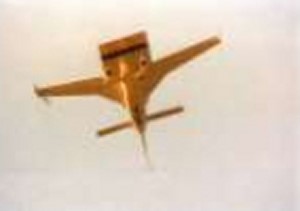
Only one airframe was ever constructed. The data gathered throughout the “Sneeky Pete” program contributed to today’s advanced UAVs such as the Northrop/Grumman Global Hawk, General Atomics Predator, Boeing X-45, Northrop/Grumman X-47 Pegasus. The aircraft was returned to a more conventional configuration and still appears on the civil register as being owned by Scaled Composites, but its current whereabouts are unknown, and, like many experimental variants of the Long-EZ, it is not properly documented, due to its classified use by the military.
N3142B c/n 1
Powerplant:1 x Lycoming O-360 (180 hp) / 1 x Williams FJ107 / 1 x Lycoming IO-320 (150 hp)
Wingspan: 28 ft.
Overall length: 17ft. (approximate)
Weight: up to 12,499 lb. (with Lycoming engine)
Crew/passengers: 2
The 1984 Task Research Inc Silhouette was a single-place cabin, low-wing monoplane of composite construction for kit builders.
The prototype was registered N84TR.
Engine: 44hp Rotax 447
Wingspan: 31’20”
Length: 19’4″
Cruise: 120 mph
Stall: 52 mph
Ceiling: 14,000′
Seats: 1
Santa Paula CA.
USA
Built the 1984 Silhouette kit-built composite aircraft.
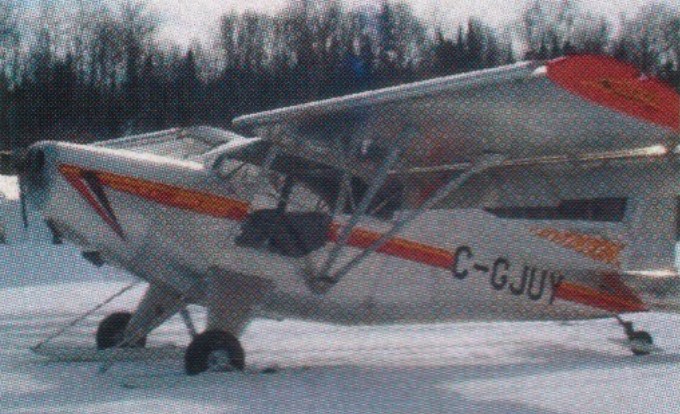
The Tapanee Levitation 4 is a Canadian four-seat STOL aircraft designed to be homebuilt by Michel Lequin for Tapenee Aviation of Quebec. A larger version of the companies earlier Pegazair bushplane, the Levitation is a high-wing monoplane with V-strut bracing, first flown in 2002. Powered by a 180 hp (134 kW) Lycoming O-360 flat-six piston engine with a two-blade propeller. The Leviation has a fixed conventional landing gear with a tailwheel and a cabin holding a pilot and three passengers in two rows of side-by-side seating. By December 2004 five kits had been sold.
Variants:
Levitation 2
Levitation 4
Specifications:
Levitation
Engine: Lycoming O-360, 180 hp / 134 kW
Propeller: Hartzell 80 in
Length: 7.47 m (24 ft 6 in)
Overall Height: 2.44 m (8 ft 0 in)
Wingspan: 10.21 m (33 ft 6 in)
Wing area: 180 sq.ft / 16.72sq.m
Wing Loading: 13.9 lb/sq.ft
Gross weight: 2500 lbs / 1133 kg
Empty Weight: 621 kg (1368 lb)
Usefull load: 1138 lbs
Stall Speed: 38 Mph / 62 km/h
Cruise speed: 115-120 Mph
VNE: 159 Mph / 255 km/h
Range at cruise: 575 sm / 925 km
Gross wgt takeoff dist: 400 ft
Landing Distance: 300 ft
Climb rate at Gross: 700 fpm / 3.6 m/s
Power Loading: 13.9 lb/hp
Cabin Length: 109 in
Cabin width at elbow: 48 in
Usable fuel: 55 US Gallons
Fuel Optional, Wings: 36 USG
Baggage Area: 25 cu.ft
Seats: 4
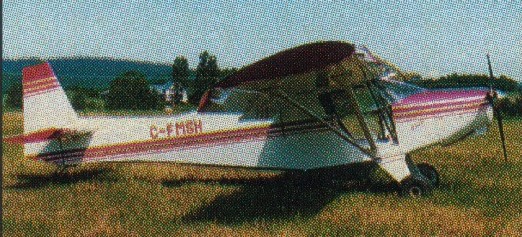
A conventional sheet metal, tubing and fabric high wing tail dragger. It was available as a kit or plans.
Engine: Continental O-200, 100 hp
HP range: 85-115
Length: 22.5 ft
Wing span: 29 ft
Wing area: 150 sq.ft
Fuel capacity: 36 USG
Empty weight: 791 lb
Gross weight: 1450 lb
Top speed: 122 mph
Cruise: 105 mph
Stall: 28 mph
Range: 660 sm
Rate of climb: 900 fpm
Takeoff dist: 250 ft
Landing dist: 300 ft
Seats: 2
Cockpit width: 40 in
Landing gear: tailwheel
1997: 437 Rte 309 Nord Mont-St-Michel, QB J0W 1P0, Canada.
Manufacturer’s Kit for the Pégazair & Lévitation LSAs.
The company was incorporated on 22nd July 1988, for manufacture of aircraft for civilian use. It was promoted by B. R. Taneja, his associates and The Indian Seamless Metal Tubes Ltd.
The company undertook to set up a project for manufacture of P-68 aircrafts with three variant viz. P-68C (twin piston engine, non pressurised), P-68 C-TC (twin piston engine turbo Charged) and P-68 Observer (same as P-68 C-TC with forward and downward view equal to that of a helicopter). It has an empty weight of 1320 Kgs and payload of 764 Kgs, with a capacity to attain a maximum speed of 322 Kmph, 1550 ft./min rate of climb, landing run of 215 mtrs and an optimum cruising range of 2170 Kms at 12000 ft.
Land admeasuring 4438 sq. mtrs. was acquired at Denkanikotta Taluka, Dharmapuri dist. of Tamil Nadu. Main items of plant and machinery such as jigs and testing facilities were to be imported from Partenavia SRL Via G. Pascoli, Casoria (Napoli) Italy, and control tooling from Allied Signals Pennsylvania, USA. The company would get part of aircraft to be assembled in India.
The company entered into two agreements with Partenavia Construzioni Aeronutliche S.R.L. Italy for manufacture and sale in India P-68 and Viator aircraft. The agreement was valid for a period of 10 years. All detailed parts and assemblies including seats, electrical looming, cable assemblies etc. were manufactured at TAAL’s facilities.
In 1995, in addition to having been appointed as Authorised representative of Cessna’s business jet line of aircraft, the company also expected to be appointed a the ASR for Cessnas Caravan Aircraft. During the year, as a part of its diversification programme the company undertook to set up repairs and maintenance facilities for Cessna aircraft and was also exploring the posibility of expanding the flying academy facilities with the objective of making it an academy of international repute.
In 1995 2,05,600 No. of equity shares of Rs. 10 each were issued, subscribed and paid up. 112,94,400 No. of equity shares of Rs. 10 each then issued at par of which 62,94,500 shares were reserved for allotment on a firm basis to promoter company, promoters, directors etc. Of the balance, the following were reserved for allotment on a preferential basis to the following:
In 2003 Indus Aviation, a US based company, has tied up with Taneja Aerospace & Aviation Ltd. (TAAL) to produce light aircraft in India.
Taneja Aerospace signed a contract with Cessna Aircraft Company for two aircrafts – Citation XLS and CJ2 in 2007.
The Registered Office of the Company has been shifted From Lunkad Towers, Viman Nagar, Pune – 4110114 To Belagondapalli Village, Thally Road, Denkanikotta Taluk, Krishnagiri District, Belagondapalli – 635114, Tamil Nadu in 2008
TAAL Technologies Pvt. Ltd has become a Wholly Owned Subsidiary of the Company in 2009.
In December 2003, TAAL was part of the Rs. 1000 crore ISMT Group, TAAL is the first company in the private sector to manufacture general aviation aircraft in India.
TAAL was involved in building up the first three prototypes of the 14 seat, SARAS aircraft for the National Aerospace Laboratories (NAL). TAAL has manufactured the entire airframe of the aircraft (excluding the wings which are manufactured by HAL) including tooling, parts and assembly. The first prototype is now under flight-testing.
Also entered into another agreement with National Aeronautical Laboratory, Bangalore as a risk sharing partner for joint development and commercial production of NAL’s indigenous composite material two seater light trainer aircraft. A two-seat all composite (glass fiber) trainer aircraft called the “HANSA”.
TAAL is manufacturing the airframes for the full composite (carbon and glass -wet lay up and room temperature cured) NISHANT, Remote Pilotless Vehicle developed by the Aeronautical Defense Establishment (ADE) and TAAL manufactures all the composite components (Tail cone, Nose cone and air-intake) for the LAKSHYA, Pilotless Target Aircraft (PTA).
TAAL is manufacturing the Elevator and Stabilizer for the Intermediate Jet Trainer (IJT) manufactured by HAL. TAAL also manufactures a variety of aircraft tooling (bakelite), Sheet Metal Parts etc., for the Advanced Light Helicopters (ALH); Light Combat Aircraft (LCA) Light Combat Helicopter (LCH);Sukhoi (SU-30) & MIG Series projects of Hindustan Aeronautics Limited ( HAL).
TAAL is manufacturing Auxiliary Fuel tank, stretcher, Armour Panel and interiors for Advanced Light Helicopters of HAL and also interiors for Defence Service Helicopter, and parts for Jaguar Drop tanks and Incendiary Containers.
TAAL is doing space structures for PSLV and GSLV of Indian Space Research Organization (ISRO).
Manufacture of THORP T211 Two Seater aircraft for Domestic and Export Markets.
In the past TAAL has undertaken certain sub-contract work for the Israel Aircraft Industries (IAI) in India.
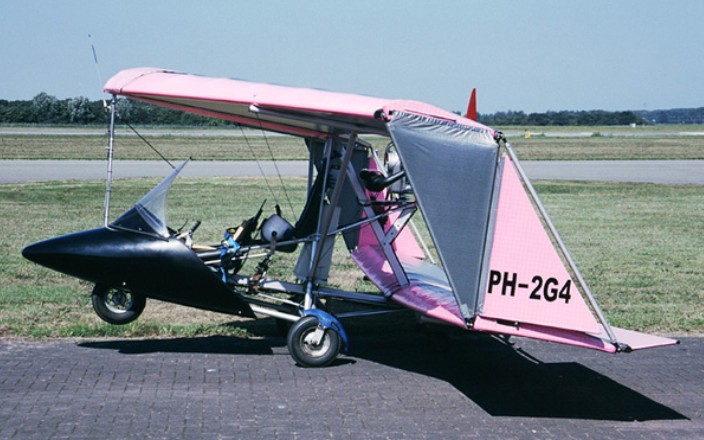
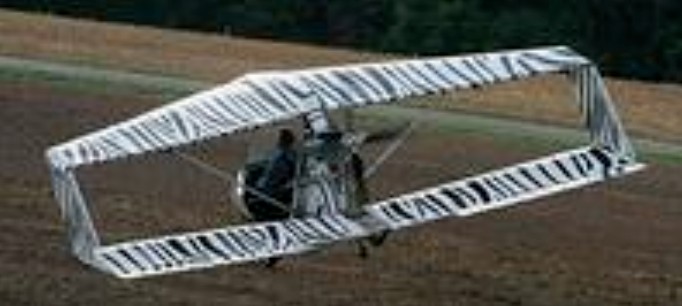
The Sunny is a tube and fabric design ultralight aircraft that was designed by Dieter Schulz. The aircraft complies with the Fédération Aéronautique Internationale microlight category rules. It features an unusual diamond-shaped biplane, strut-braced closed wing layout, a two-seats-in-tandem enclosed or open cockpit, fixed tricycle landing gear and a single engine in pusher configuration. The upper wing is swept back, while the lower wing is straight, but mounted further aft. The two wings are joined by swept tip rudders. The elevons are mounted to the lower wing only.
The aircraft is made from bolted-together aluminum tubing, with its flying surfaces covered in Dacron sailcloth. Standard engines available include many models of Hirth, Rotax, BMW and Verner 133M powerplants, ranging from 65 to 80 hp (48 to 60 kW).
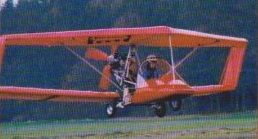
A side by side trainer, production of the Sunny Sport UL-biplane was started by Dieter Schulzs company, Tandem Aircraft KG of Saulgau, Germany, in 1989. In the first year 25 Sunnies were sold, however the sale figures of the Sunny went down over the years. About 150 examples between 1989 and 1999. Finally in 1999 Tandem Aircraft KG became bankrupt.
Alexander Dewald bought the rights in 1999 and it was then produced by Dewald Leichtflugzeugbau Gmbh of Bad Schönborn, Germany and more recently by Airkraft Gmbh Leichtflugzeugbau of Beringen, Switzerland, who seem to have gone out of business in about 2011 and production ended after 250 were built.
Originally supplied ready-to-fly, later the aircraft was supplied as a kit for amateur construction or as a complete ready-to-fly-aircraft. Both the tandem-seat Sunny Sport and the side-by-side versions were produced by Dewald. Both versions feature a number of small, but significant, design changes.
The price in 2009 was €13499, and €21,000 (assembled, 2011).
Variants:
Sunny Light
Version with open cockpit
Engine: 1 × Rotax 582, 48 kW (64 hp)
Wingspan: 7 m (23 ft 0 in)
Wing area: 17 sq.m (180 sq ft)
Empty weight: 220 kg (485 lb)
Gross weight: 450 kg (992 lb)
Fuel capacity: 44 litres (9.7 imp gal; 12 US gal)
Optional fuel capacity: 80 litres (18 imp gal; 21 US gal)
Maximum speed: 145 km/h (90 mph; 78 kn)
Cruise speed: 100 km/h (62 mph; 54 kn)
Stall speed: 55 km/h (34 mph; 30 kn)
Rate of climb: 4 m/s (790 ft/min)
Seats: 2
Sunny Sport
Two seat tandem version with enclosed or semi-enclosed cockpit
Sunny Side-By-Side
Version with side-by-side configuration seats
Sunny Targa
Fully enclosed version.
Sunny Amphibian
Version with amphibious floats
Engine: Rotax 582, 65 hp
HP range: 50-90
Height: 6.42 ft
Length: 12 ft
Wing span: 23 ft
Wing area: 184 sq.ft
Fuel cap: 14 USG
Weight empty: 396 lbs
Gross: 816 lbs
VNE: 76 kt / 87 mph / 140 kmh
Speed max: 80 mph
Cruise: 62 mph
Range: 220 sm
Stall: 31 mph
ROC: 1180 fpm
Take-off dist: 130 ft
Seats: 2
Landing gear: nose wheel
Engine: Hirth 2706, 65 hp
Wing span: 7 m
Wing area: 17 sq.m
MAUW: 450 kg
Empty weight: 170 kg
Fuel capacity: 50 lt
Max speed: 150 kph
Cruise speed: 120 kph
Minimum speed: 65 kph
Climb rate: 5 m/s
Certification: VZ
Seats: 2
Fuel consumption: 12 lt/hr
Price (1998): 37,000 DM
1995-8: Flugpotz, D-88348 Saulgau, Germany.
UL builder
In 1999 Tandem Aircraft KG became bankrupt.
 All Aero