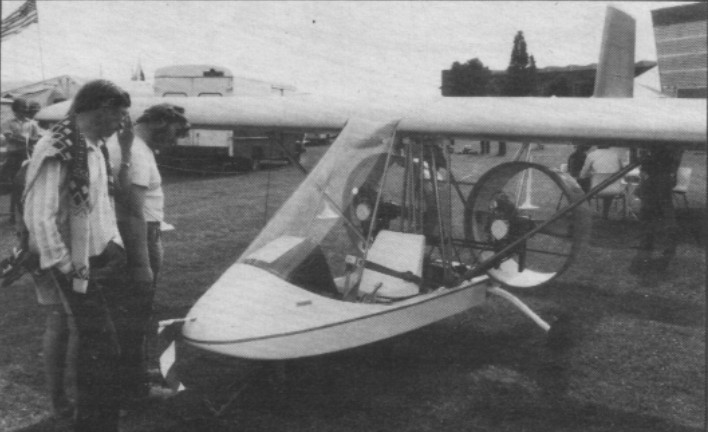
Single seat single engined high wing monoplane with conventional three axis control. Wing has unswept leading and trailing edges, and constant chord; flaps fitted. Conventional tail. Pitch control by elevator on tail; yaw control by fin mounted rudder; roll control by 39% span ailerons; control inputs through stick for pitch/roll and pedals for yaw. Wing braced from below by struts; wing profile Wortmann FS67 170 17; 100% double surface. Undercarriage has three wheels in tricycle formation; no suspension on nosewheel and glass fibre suspension on main wheels. Push right go right nosewheel steering connected to yaw control. No brakes. Aluminium tube framework, with pod. Engine mounted below wing, driving pusher propeller. Flying surfaces use foam/glassfibre/epoxy composite construction, not press moulded, with covering of rip stop reinforced Mylar.
In concept the Tirith Firebird is more of a mini aeroplane than a microlight. Designed by J Webb and Prof D Howe, both of Cranfield College of Aeronautics. Controls and flying surfaces are all thoroughly conventional and aircraft release materials have been used in all critical areas. There are no control cables, push rods being used instead. Moreover, the Firebird is fitted with 60% span flaps.
In 1982 the aircraft was still being tested and still at prototype stage.
This single seat microlight is a three axes design powered by two Weslake WAE342 engines. Firebird has a rigid composite structure, but Tirith Microplane is at pains to point out that only approved materials are used for critical areas. The Firebird was designed for Tirith Microplane by Cranfield’s Prof Hower and J. H. Webb.
Initial trials following the first flight in October 1982 found the single engine under some strain. This led to the prototype being cannibalised to provide the foundation for a twin engined machine. The powerplants are mounted side by side behind the pilot, and slightly forward of the trailing edge of the high wing. Shrouds surround the 30in diameter propellers, which are driven directly by Weslake twin cylinder two-stroke engines giving 45 hp. Flight testing was in the hands of Angus McVitie.
Engine: NGL WAE342, 25 hp at 5000 rpm
Propeller diameter and pitch 36 x 16 in, 0.91 x 0.41 m
No reduction
Max static thrust 118 lb, 54 kg
Power per unit area 0.16 hp/sq.ft, 1.8 hp/sq.m
Fuel capacity 4.8 US gal, 4.0 Imp gal, 18.2 litre
Length overall: 18.5 ft, 5.65 m
Height overall: 8.7ft, 2.64m
Wing span: 29.1ft, 8.86m
Constant chord: 5.2ft, 1.60m
Dihedral: 0 deg
Sweepback 0 deg
Tailplane span 11.5 ft, 3.52 m
Fin height 3.4 ft, 1.05 m
Total wing area 153 sq.ft, 14.2 sq.m
Total aileron area 11.1 sq.ft, 1.03 sq.m
Fin area 7.5 sq.ft, 0.70 sq.m
Rudder area 3.1 sq.ft, 0.29 sq.m
Tailplane area 20.2 sq.ft. 1.88 sq.m
Total elevator area 10.4 sq.ft, 0.97 sq.m
Wing aspect ratio 5.5/1
Wheel track 5.7 ft 1.75 m
Wheelbase 5.8ft, 1.78 m
Nosewheel diameter overall: 10 inch, 25 cm
Main wheels diameter overall: 10 inch, 25 cm
Empty weight 254 lb, 115kg
Max take off weight 474 lb, 215kg
Payload 220 lb, 100kg
Max wing loading 3.10 lb/sq.ft, 15.2kg/sq.m
Max power loading 19.0 lb/hp, 8.6kg/hp
Load factors +4.0, 2.7 design; +6.0, 4.0 ultimate

 All Aero