Carbon fibre is the material of choice for Zivko Aeronautics. The cowl, the fairings, the instrument panel and even the wheel pants are all carbon fibre, as is the canopy frame which has the perspex moulded into it. Traditional tubular steel is used for the fuselage, engine mount and empennage. The Edge 540 has balancing spades on its large ailerons, which run almost three-quarters the length of the wing. These essentially take the load of the ailerons (off the stick) so it doesn’t matter what speed you’re flying, you can get full aileron with relative ease. The generous ailerons give the aircraft a roll-rate of about 420 deg a second. Weights and performance vary from aeroplane to aeroplane.
First flying in 1996, eight had been sold by the end of 1997 at $177,407.
Two versions were available, the Edge 540 (single place) and Edge 540-T (two place).
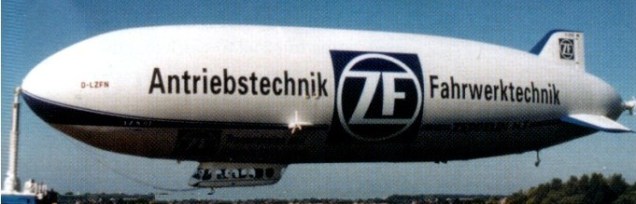
The 75m prototype Zeppelin NT LZ07 first flew in 1997. A semi-rigid airship, the LZ07 received type certification in the commuter category for up to 19 passengers.
In May 2011, Goodyear announced it will be replacing its fleet of three blimps with three semi-rigid airships built by Luftschiffbau Zeppelin.
The new airships are faster, quieter, larger, easier to fly and more manoeuvrable than the blimps it introduced more than 90 years ago. Still, the company plans to keep calling the new models blimps “Because a Goodyear Semi-rigid Dirigible doesn’t roll off the tongue”.
The switch to dirigibles offers a similar-looking, cigar-shaped flying machine but one that’s nearly the length of a football field and about 15 metres longer than the old blimps. With room for three engines instead of two, it will be able to hit speeds of over 110 kilometres per hour.
The quieter engines also will provide an advantage in covering golf tournaments. The ability to hover will allow a pilot to better position the aircraft to capture NASCAR race finishes and key moments in a baseball game.
Construction began in 2012 on the first of three new semi-rigid airships; the first completed in March 2014.
Assembly of Wingfoot One began in March 2013 at Goodyear’s Wingfoot Lake hangar. An international team of engineers and technicians from Goodyear and Germany’s ZLT Zeppelin Luftschifftechnik worked side by side to complete the build project. Parts such as the tail fins and gondola were built in Germany and shipped to the U.S. for assembly. The balloon-like body of the airship – the “envelope” – is made of polyester with an innovative film from DuPont™ called Tedlar®, surrounding a semi-rigid internal structure, which differentiates this airship from previous Goodyear blimps.
Spirit of Innovation, a model GZ-20A blimp (non-rigid airship), was retired on March 14, 2017, and Wingfoot One (N1A), the first such model in Goodyear’s U.S. fleet, was christened on August 23, 2014, by Good Morning America anchor Robin Roberts, near the company’s world headquarters in Akron, Ohio. Wingfoot Two, the name of Goodyear’s second semi-rigid airship, was unveiled in April 2016.
Wingfoot One (N1A (model LZ N07-101), based in Pompano Beach, Florida
Wingfoot One N1A
Wingfoot Two (N2A) (model LZ N07-101), based in Suffield Township, Ohio
Wingfoot Two N2A
All three craft will be outfitted with LED sign technology Goodyear calls “Eaglevision.” This allows the aircraft to display bright, multi-colored, animated words and images. Goodyear also has blimps operating in other parts of the world. These airships are built and operated by Van Wagner of Orlando, Florida.
The new airships are 246 feet long, 52 feet longer than Goodyear’s old model, the GZ-20. The Zeppelin NT model is also slimmer, has a top speed of 70 miles per hour (versus 50 for the blimp), and has a passenger gondola that seats 12 (compared to seven in the blimp). The gondola even has a bathroom.
The blimps are filled with helium. The helium is maintained under low pressure, so small punctures do not pose serious consequences for the blimp. One inspection element of the blimps is to look into the envelope for pinpoints of light which are indicative of small holes.
Goodyear decided a celebration for its centennial year the main event was giving the iconic airship a retro makeover with a black-and-silver color scheme, complete with a vintage Goodyear logo and a reappearance of the blue-and-yellow Goodyear “house flag” that donned the side of the company’s earliest blimps. The retro design is intended to replicate the look of the first Goodyear blimp, dubbed “Pilgrim,” that appeared 100 years ago. It’s important to know that only one Goodyear blimp, Wingfoot One, gets the special treatment. There were currently four Goodyear blimps wafting overhead in 2025: Wingfoot One, Wingfoot Two, Wingfoot Three, and a fourth airship based in Germany, Europe Blimp. It is operated by noted blimp company Zeppelin. These three blimps will maintain their current blue-and-yellow design.
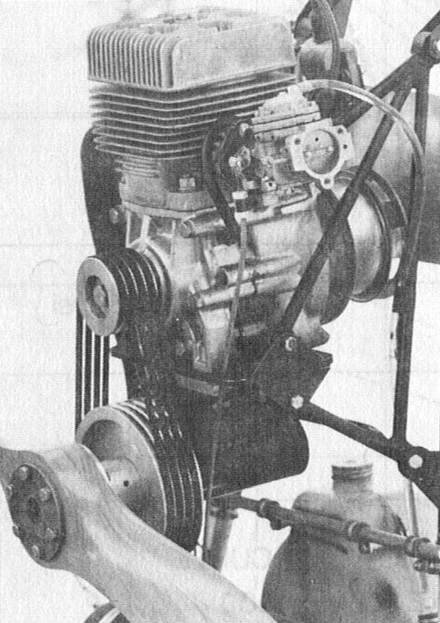
The Zenoah G-25 is a single cylinder, two stroke, carburetted aircraft engine from Japan, with optional fuel injection, designed for use on ultralight aircraft.
The Zenoah G-25 is equipped with single capacitor discharge ignition and a single Mikuni slide-type carburetor. It is equipped with a recoil starter system or optionally electric start and a 2.5 or 2.8:1 belt reduction drive.
The engine runs on a mixture of unleaded auto fuel and oil.
Producing 22 hp (16 kW) at 6600 rpm, the G-25 competed in the early 1980s ultralight powerplant market against the similar Rotax 277. Production of the engine was completed in the late 1980s and today only used engines and parts are available.
Applications: Adventure F series Aerodyne Systems Vector AmeriPlanes Mitchell Wing A-10 Beaujon Mach .07 Carlson Sparrow Cascade Kasperwing I-80 Cloudbuster Ultralights Cloudbuster Cosmos Samba DTA Alizés Fly Hard Trikes SkyCycle Greenwood Witch Hill Hummer ISON Airbike LiteWing Aircraft LiteTrike Lookout Mountain SkyCycle Manta FX-3 Mitchell Wing B-10 Monnett Monerai P North Wing ATF Paramotor Inc FX series Phoenix Industries B1Z ParaFlyer Pterodactyl Ascender Ritz Model A Rutan Solitaire St Croix Excelsior Striplin Lone Ranger
Specifications:
G-25B-1 Type: Single cylinder, two-stroke aircraft engine Bore: 72 mm (2.8 in) Stroke: 59.5 mm (2.3 in) Displacement: 242 cc (14.78 cu in) Length: 11.81 in (300.0 mm) Width: 11.57 in (293.9 mm) Height: 14.84 in (376.9 mm) Dry weight: 51 lb (23.1 kg) Ignition: CDI Valvetrain: piston ported Fuel type: unleaded auto fuel Oil system: pre-mixed Cooling system: free air Reduction gear: 2.47 or 2.8:1 Poly-V belt system Power output: 22 hp (16 kW) at 6600 rpm Compression ratio: 6.5:1
G-25B-2 Cycle: 2 No cylinders: 2 Bore: 72 mm Stroke: 59.5 mm Compression: 6.5 Displacement: 484 cc Cooling: Air Ignition: CDI Reduction: Poly-V belt 2.47-1 Length: 11.81 in (300.0 mm) Width: 11.57 in (293.9 mm) Height: 14.84 in (376.9 mm) Weight: 48 kg Max pwr: 45 hp at 6600 rpm
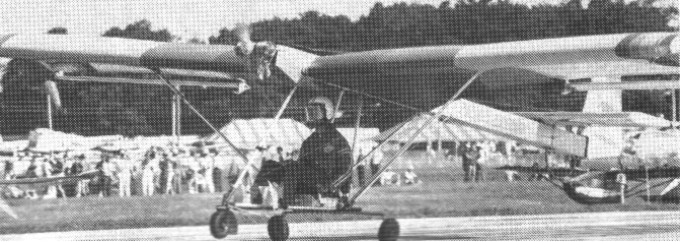
Single seat single engined high wing mono¬plane with conventional three axis control. Wing has unswept leading edge, swept for¬ward trailing edge and tapering chord; con¬ventional tail. Pitch control by fully flying tail; yaw control by fully flying rudder; roll control by half span ailerons; control inputs through stick for pitch/roll and pedals for yaw. Wing braced from below by struts; wing profile double surface. Undercarriage has three wheels in tricycle formation; glass fibre sus¬pension. Push right go right nosewheel steer¬ing connected to yaw control. Aluminium tube and sheet framework, with optional total enclosure pod. Engine mounted at wing height driving tractor propeller. All aluminium and hardware is of aircraft quality. The Zipper is a conventional three axis machine with rudder pedals and centre stick, and it appears to be quite conventional in its choice of materials, being basically a tube and Dacron machine. There are some interesting features though, such as the tail boom, which is not tubular but is constructed of sheet aluminium alloy formed into a rectangular cross section. Most of the innovation, however, is centred on the wing design, which has an unusual shape plan, with ailerons attached to the trailing edges. The design allows the wing to be folded in two minutes, the maker claims, after which the aircraft can be towed on its own wheels, avoiding the expense of a trailer. Engine is the direct drive JPX PUL425, which is available in two states of tune 22 hp standard or 26hp with tuned exhaust. The aircraft is sold in kit form, but Zenair says the kit takes only an afternoon to complete, having already been test assembled in the factory before shipping. Other options include floats and wheel spats, while an enclosed cockpit, skis and propeller spinner are also offered.
Length overall 14.5 ft, 4.42 m Height overall 5.5ft, 1.68m Wing span 28.0ft, 8.53m Mean chord 5.0ft, 1.52m Sweepback 0 deg Total wing area 140 sq.ft, 13.0 sq.m Wing aspect ratio 5.6/1 Engine: JPX PUL425, 22hp at 4600rpm Propeller diameter 42 inch, 1.07 m No reduction Max static thrust 180 lb, 82 kg Power per unit area 0.16hp/sq.ft, 1.7hp/sq.m Fuel capacity 6.0 US gal, 5.0 Imp gal, 22.7 litre Empty weight 180lb, 82kg Max take off weight 420 lb, 191 kg Payload 240 lb, 109 kg Max wing loading 3.00 lb/sq.ft, 14.7 kg/sq.m Max power loading 19.1lb/hp, 8.7kg/hp Load factors +6.0, 3.0 design Max level speed 50 mph, 80 kph Never exceed speed 80 mph, 129 kph Cruising speed 40mph, 64 kph Stalling speed 20 mph, 32 kph Max climb rate at sea level 700 ft/min, 3.6 m/s Take off distance 120 ft, 35 m Landing distance 80 ft, 25 m Range at average cruising speed 100 mile, 161 km Seats: 1






 All Aero