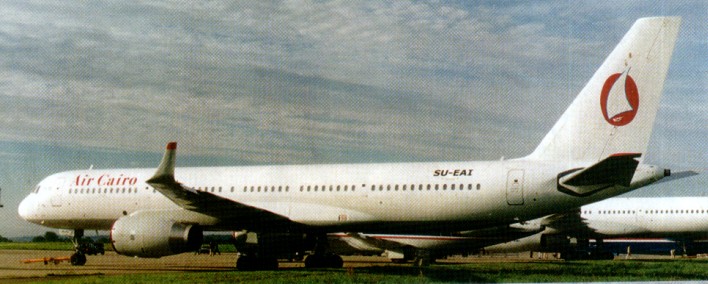
A medium-range passenger aircraft with 214 seats, designed as a replacement for the Tu-154. First flown on 2 January 1989, the Tu-204 was the first Soviet-built airliner with fly-by-wire controls.
The Tu-214 airliner is based on the Tu-204 but features increased take-off weights and longer range. The first flight of the Tu-214 was in March 1996.
Tu-214
Despite its formal designation as a civilian aircraft, the Tu-214 plane has never truly functioned as a commercial airliner. Instead, it has been produced almost exclusively in niche variants, such as the Tu-214R aircraft for reconnaissance, the Tu-214ON unit for observation, and various government “special mission” aircraft.
Tu-214 passenger jet
In 2014 Kazan Aviation Plant fulfilled only 10% of its production quota for the Tu-214 airliners, delivering just two aircraft instead of the planned twenty. The aircraft are even sent abroad, to Belarus, for painting. With a goal of building 70 Tu-214 units by 2030, manufacturing rates make that deadline highly unrealistic.
Tu-204 Engines: 2 x PS-90A turbofans, 157kN Max take-off weight: 93500 kg / 206133 lb Empty weight: 56500 kg / 124562 lb Wingspan: 42.0 m / 138 ft 10 in Length: 46.0 m / 151 ft 11 in Height: 13.9 m / 46 ft 7 in Wing area: 168 sq.m / 1808.34 sq ft Max. speed: 810-850 km/h / 503 – 528 mph Range: 4600 km / 2858 miles Crew: 2-3 Passengers: 214
Tu-204-120 Engines: 2 x Rolls-Royce RB211-535E4-B Pax seats: 208
Tu-204C-120 Engines: 2 x Rolls-Royce RB211-535E4-B
Tu-214 Maximum take-off weight: 110.7 tons Commercial payload: 25 tons
On 28 November 1967 the Soviet government specified the requirements for a competition for a new strategic bomber. Technical parameters were high. The aircraft was to reach 11000 to 13000 km (5,970 to 7,020 nm) and have a cruising speed of 3200 to 3500 km/h. The maximum range at subsonic speed was to be 16000 to 18000 km (8,640 to 9,720 nm) at high altitude. Basic armament was to be nuclear missiles, including heavy Kh-45 and small Kh-2000s.
Tupolev, which was formally called Moscow Engineering Plant ‘Opyt’ (meaning Test), joined Sukhoi and Myasishchev in the quest for a supersonic strategic bomber. Unlike the others, Tupolev started designing by not aiming at the specifications given by the government. Tupolev thought a Mach 3.0 to 3.2 bomber, compared with a Mach 2.3, did not off-set the cost of construction and technology. In the early 1970s Tupolev prepared a series of flying-wing designs designated 160M, which were based on the contemporary delta-winged Tu-144 supersonic airliner.
In 1972 the air forces selected Sukhoi as the winner, however it was realised a design with these specifications was not possible. So it was decided to start a second stage of the competition. The maximum speed was lowered to Mach 2.3 enabling Tupolev’s 160M flying-wing design to enter the competition. Myasishchev came with the M-18, based on the M-20 design which had a variable-geometry wing. Sukhoi gave up the competition and decided to concentrate on fighter aircraft.
The air force selected the M-18, because of its variable-geometry wing design and the design was supported by TsAGI (large and powerful Soviet technical research institute) and the Technological-Scientific Council of the Ministry of Air Industry. Tupolev’s flying-wing design was a single-mode aircraft and the air force required bomber following a compound flight profile and be able to also land at ‘smaller’ airfield.
Myasishchev’s winning design was developed by the Tupolev bureau, because the former’s team was too small. In 1973 the first design for the Tu-160 was prepared by Tupolev based on the M-18 variable-geometry design. The design was gradually improved and Tupolev began selecting the aircraft systems, together with the scientific and government research institutes. The NK-25 engine of the Tu-22M3 were selected at first, but the high fuel consume rate required a new development. In 1980 the first Nk-32 was test flown on a Tu-142 and production began in 1983.
Aleksei Tupolev (son of Andrei Tupolev, founder of the design bureau) lead the Tu-160 design program during the initial period, in 1975 Valentin Bliznyuk was appointed as chief designer and remained in charge of the program. In 1977 the preliminary design and a full scale mock up were submitted for state committee acceptance. At this stage the aircraft would carry two Kh-45 missiles. During the Strategic Arms Limitation Treaty II (SALT II) talks in the late 1970s, the plans for a new strategic bomber and the name Tu-160 were first revealed to the west.
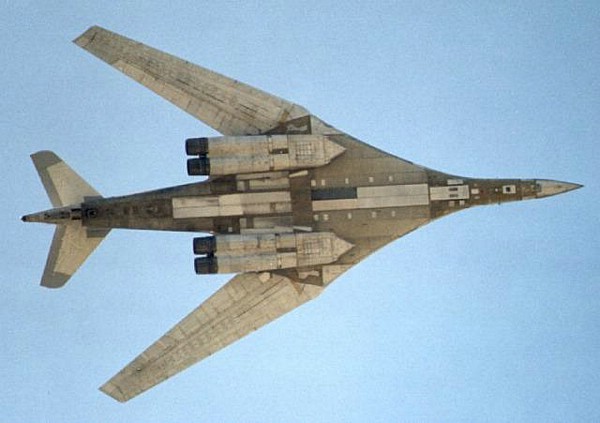
The aircraft has a slender long blended wing-body design with a variable-geometry wing. The four NK-32 afterburning turbofans are arranged in pairs under the mid-wing each with variable-area intakes. The undercarriage consists of one front double-wheel leg and two six-wheel bogies (three tandem pairs), which are located between the engine pairs. Along the aircraft’s centreline between the two gear units there are two weapon bays, which are divided by the wing carry-through structure.
The nose of the aircraft contains the Obzor-K (Survey) radar, which is used for both ground and air observation. It also contains another radar, the Sopka (Hill), which is used for terrain following when flying at low altitude. The upper center part in front of the windscreen contains the retractable inflight refuelling probe. Under the front fuselage there is a forward looking OPB-15T optical bombing sight and video. Behind the sight, there is the nose gear. The four man crew enters the cabin through the front gear bay. The pressurized cabin has four fighterjet-like K-36LM ejection seats. There are two control sticks for commander pilot (front left) and co-pilot (front right). The Tu-160 has a conventional flight deck, which is divided by a central console with the thrust and flap selection levers for the co-pilot. Behind the pilots there is the navigator/offensive weapons operator (left) and the navigator/electronic warfare and communications operator (right). Behind the crew there is corridor leading to a galley and a toilet.
The weapons carried in the weapon bays comprises of six (or a maximum of 12) Raduga Kh-55SM (NATO AS-15B ‘Kent’) cruise missiles, which are launched from two six-round MKU6-5U revolving launchers located in the forward area of each bay. The nuclear warhead loaded Kh-55SM is a development of the subsonic Kh-55 cruise missile. For guidance of the Kh-55SM the Tu-160 is equipped with the Sprut-SM (Octopus) navigation/attack system, which automatically aligns the coordination axes of both aircraft and weapons. It also generates a digital map of the terrain which is transferred from the aircraft to the missile before launch. Alternatively the Tu-160 can be equipped with up to 24 Raduga Kh-15 (NATO AS-16 ‘Kickback’) short-range attack missiles (SRAM) or Kh-15P anti radiation missiles, which are both launched from up to four MKU6-1U revolving drums. However reportedly the Kh-15 capability has not been implemented on any production aircraft.
The variable-geometry wing has three positions. 20 degree sweep for landing, 35 degree for cruise and 65 degree sweep for high speed flight. The inner portion of the wing forms a vertical plane for directional stability when the wings are fully swept backwards. When the wing is swept forwards this portion lies flat to fill the gap between wing and fuselage and forms the most inner part of the flap.
The Tu-160 houses a Baykal self-defence systems of which most systems are located in the ‘carrot’ tail cone. These systems include a Mak (Poppy) infra-red missile launch sensor, radar warning receiver, electronic jammer and a battery of APP-50 chaff/flare dispensers. The underside of the tailcone houses the brake chutes. Directional control is provided by an all moving fin.
When the Soviets learned about the American AGM-86 ALCM-B cruise missile, the requirement of the Kh-45 as main armament for the Tu-160 was dropped and a strategic (nuclear) version of the Kh-55 cruise missile was developed. The Tu-160 armament would now consist of 12 Kh-55SM missiles, with 12 to 24 Kh-15 being the alternative. Although there was enough time to design the weapon bays after the plans for Kh-45 were dropped, the Tu-160 design held its long weapon bays. The Kh-55SM and Kh-15 are much shorter, and can be launched with only the forward longer doors openened (each weapon bay has four doors). Initially a traditional self-defence system was proposed for the Tu-160, including a tail turret with a 30mm GSg-6-30 cannon. However the designer replaced the plans later during developed with the Baykal system. Also the plans for R-77 medium-range air-to-air missiles were abondoned.
The program was accepted in 1977 and Tupolev began production of three prototypes. Although the aircraft were assembled at Tupolev’s workshop at Moscow, the sub-assemblies were built at other production plants.
The first prototype 70-01 intended for flight testing the basic flight characteristics had incomplete equipment. Prototype 70-02 was built for static tests. Prototype 70-03 was practically an equivalent of series production aircraft. 70-01 was completed at Zhukovskity in January 1981. On 14 November, the aircraft taxied the airstrip for the first time, after months of testing. On 25 November 1981 a picture was taken of the aircraft near two Tu-144 by a US reconnaissance satellite, this was the first picture of the Tu-160 revealed to the world, at that time designated ‘RamP’.
On Friday 18 December 1981 Tu-160 70-01 made its maiden flight. Three months later the first supersonic flight was achieved. And during one of the test flight the top speed of 2200 km/h was reached. The 70-01 can be distinguished from the other Tu-160 by having a long probe at the nose tip. Internally there are greater differences in equipment and structural elements. Work on new materials and engineering methods, lead to postponement of the 70-03 prototype, which did not take off until 6 October 1984.
Although there are some differences between the first prototype, the development and the production aircraft, only one variant of the Tu-160 entered production. NATO codename for this variant is ‘Blackjack-A’.
Series production was started at Ulyanovsk production plant, but was soon replaced to KAPO (Kazan Aviation Production Association) in favor of the An-124 production. The first series Tu-160 took off from Kazan on 10 October 1984. The first aircraft to enter service took off from Kazan on 15 August 1986.
On 23 April 1987 this aircraft as well as a second example were delivered to the 184th Heavy Bomber Regiment of Guards, based at Pryluky airfield in the Ukaine. The squadron had previously been operating the Tu-16 Badger, so it obtained a small number of Tu-22M3 ‘Backfire-C’ to train the crew on high supersonic bombers, with a variable-geometry wing. Later the Tu-134UBL dedicated trainer for the Tu-160 replaced the Tu-22Ms. At the end of 1991, the 184th regiment had two squadron and a total of 19 Tu-160 were delivered.
The first time the Tu-160 was shown to the public was on 20 August 1989 flying over Tushino airfield in Moscow. The first ground presentation was in August 1992 at MosAeroshow held at Zhukovskiy. It made its international debut at the Paris Airshow in June 1995, were it was presented as space carrier for the Burlak space vehicle with a mock up of the Burlak under its belly.
After the break up of the Soviet Union the Ukrainian parliament took all military units based in its country under control. At first this had no effect on the 184th bomber regiments. But in 1992 25% of the pilots and personnel swore oath to the Ukraine. At Engels airbase in Russia, the first Russian Tu-160 regiment was formed. Russia had just three Tu-160 remaining at the Kazan factory. On 16 February the first arrived at Engels AB, but because of lack of pilots it was not until 29 July 1992 when the first Tu-160 took off from Engels. The production at Kazan continued for a short while until the air force ran out of money and in June 1994 the sixth and last Tu-160 left the factory for Engels. Four unfinished airframes remained at Kazan.
The Ukrainian 19 Tu-160 from the 184th regiment were flown only a small number of sorties, before they were grounded because of lack of technical support from Tupolev and manufacturer, lack of spares and lack of fuel. Also the Ukraine did not have areas suitable for training with strategic missiles. The Ukraine could not sustain the aircraft and had no need for them, so they started negotiations with Russia in 1991. When in 1998 no agreement was reached, Ukraine decided to scrap the aircraft. The first Tu-160 was cut up in November 1998.
In April 1999, Russia proposed buying back eight Tu-160 and three Tu-95MS ‘Bears’ which were in the best technical condition, as well as 575 Kh-55 and Kh-55SM missiles, documentation and ground equipment. On 6 October 1999 an agreement was signed and a total of US$285 million was deducted from the Ukraine’s outstanding payments to Russia for the supply of natural gas. On 5 November the first two bombers, a Tu-160 and a Tu-95MS, landed at Engels AB. The last two Tu-160 ‘Blackjacks’ arrived at Engels on 21 February 2000. All the aircraft were overhauled at the Kazan factory during 2001. On 5 May 2000, another aircraft that was nearly finished aircraft was commissioned into service at Engels as ’07’.
The 182nd Heavy Bomber Regiment of Guards operated 15 Tu-160 ‘Blackjacks’ after all eight Ukrainian Tu-160 were returned into service. In September 2003 one Tu-160 bomber was lost in a fatal crash. Reportedly production restarted work on another one of the unfinished Tu-160 airframes at Kazan to replace the lost bomber. This is the second Tu-160 bomber to be lost in a crash, in 1987 the first Tu-160 (a series production test aircraft) crashed due to an engine problem.
The total number of Tu-160 Blackjacks built was 35 at the end of 2000, comprising of 3 prototypes built in Moscow and 32 series aircraft built in Kazan. Three unfinished aircraft remain at the Kazan factory today. Of the 11 Tu-160 airframes that remained in the Ukraine 1 serves as a gate monument, while the remaining 10 were cut up. The last Ukrainian Tu-160 was cut up in 2001.
The Russian Air Force was planning a limited upgrade for their Tu-160 fleet. First stage of the upgrade was to equip the aircraft with the conventional armed Kh-101 and Kh-555 cruise missiles and a new fire control system for these missiles, called Sigma. The Kh-101 uses a electro-optical terminal homing system and the Tu-160 will be able to carry up to 12 of these missiles. The Kh-555 is a reworked Kh-55SM with uses the Kh-101 homing system and replaces the nuclear warhead with a conventional one. Second stage of the upgrade was to include upgraded mission equipment and a new search-attack radar. Besides the Kh-101, this will enable the Tu-160 to be equipped with the Kh-102 strategic missile, medium range subsonic Kh-SD and a medium range supersonic weapon, presumable designated the Kh-41. Other upgraded system include navigation, communication and self-defence systems. The upgrade was to be carried out by KAPO at Kazan and would extend the service life of the Tu-160 until at least 2020-2025.
Born in 1888, Andrei N Tupolev was an early pupil, at the Moscow Technical High School, of the internationally famous aerodynamicist, Professor N E Zhukovski. His studies and early gliding experiments were, however, interrupted in 1911 when he was arrested for revolutionary activities. During part of the first World War, Tupolev worked in the Duks aircraft factory in Moscow, then the largest in Russia.
After the Bolshevik Revolution, Tupolev became one of Zhukovski’s leading assistants in setting up the Central Aero and Hydro dynamics Institute (TsAGI). This brought together pre war Russian research establishments with other, newly created bodies, and in 1920 Tupolev became head of its design department (AGO) and president of commission to design and build all-metal aircraft 1922.
Initially followed Junkers formula, using corrugated metal skins; first to appear were ANT-1 and ANT-2 (A. N. Tupolev) cantilever monoplanes. Became head of AGOS department of the Moscow TsAGI in 1922; during 1920- 1936 most designs bore ANT designations although some emanated from his design team leaders, chief deputy A. A. Archangelskii, W. M. Petlyakov and P. O Sukhoi (e.g. Sukhoi designed ANT-25 and 37).
Tupolev’s first major design was ANT-4 (TB-1) heavy bomber of 1925, forerunner of several very large machines including ANT-6 (TB-3) bomber; ANT-9 commercial passenger transport and huge ANT-20 Maxim Gorkii propaganda aircraft of 1934. Also designed ANT-40 (SB-2) twin-engined medium bomber.
The enormous creativity of the Tu¬polev group stemmed in part from this designer’s ability to train and direct others, such as Sukhoi and Petlyakov. Petlyakov, for example, was responsible for the PE 8, a four en¬gine bomber that was larger and more powerful than the B 17.
In 1936 Tupolev was arrested during Stalin’s purges and condemned to death, but sentence commuted and after some five years’ imprisonment was released and restored to favour (ostensibly in recognition of Tu-2 medium bomber, designed while in prison) and given his own design bureau. After Second World War continued to place emphasis on large aircraft; Tu-4 copy of Boeing B-29 Superfortress helped win him a Stalin Prize in 1948.
Main early post-war products included Tu-14 twin-jet naval medium bomber; Tu-16 intermediate-range twinjet bomber (first flown April 1952; also produced in China as the Xi’an H-6); and a quartet of four-turboprop swept-wing giants: the Tu-95 long-range strategic bomber (first flown November 1952 and built up to 1992), Tu-142 naval variant for long-range antisubmarine warfare and communications relay (first flown June 1968), Tu-114 200-passenger transport based on Tu-95 (first flown November 1957) and Tu-126 AWACS aircraft (first flown 1962). Later military types included the twinjet Tu-22, the first Soviet supersonic bomber that first flew in 1959, and the Tu-128 very large all-weather interceptor (first flown March 1961), the variable-geometry wing Tu-22M Backfire intermediate- range Mach 1.8 bomber and missile launcher (first flown August 1969 and 514 built during 1971-90) and the variable-geometry wing Tu-160 Blackjack heavy missile bomber with a speed of Mach 2.05 and range of over 12,215km without in-flight refueling (first flown December 1981 and entered Soviet service from 1987), while projects include the Tu-204P maritime patrol derivative of the Tu-204 airliner, Tu-2000 hypersonic bomber, and a subsonic strealth bomber.
Early turbojet and turbofan powered transport aircraft included twin-jet Tu-104 (based on Tu-16 and first flown June 1955); Tu-124 (first flown March 1960); Tu-134 (first flown July 1963) and tri-jet Tu-154 (first flown October 1968). Tu-144 became, in December 1968, the first supersonic airliner in the world to fly. It exceeded Mach 2 for the first time in May 1970 and was the first of its type to enter regular service when, in December 1975, it began freighting for Aeroflot prior to initial passenger services in 1977. However, Tu-144 was not a success and services were terminated in June 1978; in November 1996 a converted Tu-144D flew again as the Tu-144LL, used thereafter for an international High-Speed Civil Transport research program to assist in the development of a nextgeneration supersonic transport.
Most recent Tupolev commercial transports, programs and projects include the convertible cargo/passenger Tu-130 (to fly on standard and liquid natural gas in the 21st century), Tu-136 projected light passenger/cargo transport with twin Pratt & Whitney turboprop engines, Tu- 155/Tu-156 conversions of Tu-154 to use cryogenic fuel engines (Tu-155 for research flew 1988), Tu-204 medium-range airliner for typically 214 passengers (first flown January 1989) and its projected Tu-206 cryogenic fuel derivative, Tu-214 and Tu-224 airliners based on Tu-204 but featuring increased take-off weights and longer range (first flight of Tu-214 March 1996), Tu-230 projected light/medium freighter, 166-passenger Tu-234 airliner as a short-length variant of Tu-204, Tu-244 projected supersonic airliner, Tu-304 and Tu-306 (cryogenic fuel variant) projected long-range airliners for up to 392 passengers, projected Tu-324 regional and business transport, Tu-330 and liquid-gas Tu-338 freighters, Tu- 334 medium-range airliner for typically 102 passengers (first flown February 1999) and its Tu-336 cryogenic fuel derivative, Tu-404 projected giant 850-seat airliner, and Tu-414 projected 70-passenger regional jet. Tupolev general-aviation projects include Tu-34 pressurized five/seven-seat STOL transport with twin turboprop engines and pusher propellers, Tu-54 single-seat agricultural monoplane, Tu-400 eight/ten-seat business jet with regional airliner potential, and Tu 4X4 four/seven seat business jet as smallest aircraft in the Tu- 324/400/414 range.
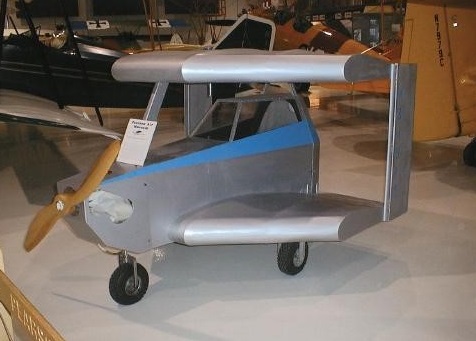
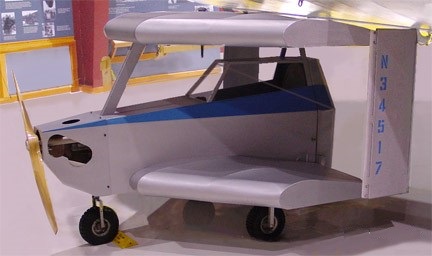
In 1987 Larry G. Trotter built the WSA-1, claimed of being the “World’s Smallest Airplane”.
With FAA registration N3417 c/n 001, on the first flight attempt, at about rotation speed the propeller threw a blade, which resulted in some extremely violent vibration that did some damage to the front cowling and motor mount and was bad enough to shake the hands off the altimeter.
After repair and the metal prop replaced with a wooden one, Trotter never got around to trying again.
It was later donated to the Pearson Air Museum (WA, USA).
High Tech Composites (HTC) in Oxnard, California, USA, owned by Rich Trickle, produced composite structures for other aircraft manufactures before Rich designed the two-seat KIS TR-1 (KIS stands for “Keep It Simple”). Constructed with the assistance of Vance Jaqua and Martin Hollmann, the aircraft was first presented at the EAA event at Oskosh, Wisconsin, in July 1991.
Subsequently HTC was renamed Tri-R Technologies and the composite kit plane was marketed to the homebuilt constructor.
1995-7: 1114 E. 5th St., Oxnard, CA 93030, USA.
In 2001 the Pulsar Aircraft Company (formed in 1999) acquired the design and production rights of Tri-R, while the latter still produced the composite parts. The two-seat KIS TR-1 was re-designated Pulsar 150, while the KIS Tr-4 Cruiser became the Pulsar Super Cruiser. In 2005 all aircraft production was transferred to Ilopango, El Salvador.
Pulsar Aircraft Corp improved the design and offered an new, larger version called the Super Pulsar 100. They also keep the original legacy Pulsar design alive under the name of Pulsar XP.
Markets kits to build the KIS (Keep It Simple) side-by-side two-seat composites monoplane (first flown 1991), plus the four-seat TR-4 Cruiser (first flown 1994).
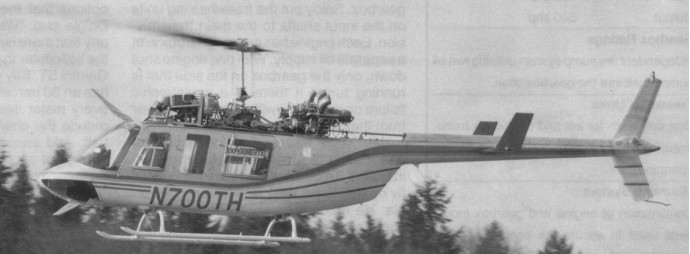
On 17 January 1991, the Tridair Gemini ST twin engine conversion of the Bell 206L LongRanger took to the air for the first time. The Gemini ST was designed to take off and hover at gross weight at sea level on one engine; the only twin engine helicopter that will have no written procedures for a single engine failure on takeoff.
The inspiration for the Gemini ST came to Doug Daigle, president of Tridair Heli¬copters in Costa Mesa, California, in 1986 when he successfully bid on a US Forest Service contract for a Bell LongRanger to be used as a rappelling platform for fire¬fighters.
This was the first time a single engine helicopter had been awarded this contract. The work had previously been done by a Bell 212, but this aircraft had become very expensive to contract, leading the Forest Service to look at the safety records of single engine helicopters and find the Bell LongRanger’s to be outstanding.
After Doug Daigle rappelled out of the helicopter to see what the fire crew would experience (an act he regrets to this day), he concluded that if the engine failed while the crew was rappelling, they would prob¬ably die. Even using a 212, the crew on the rope would be severely injured or killed. The 212 might be able to recover, but the team on the rope would be dragged through the trees or rocks. Mr Daigle then decided to try to design a twin engine conversion for the Bell LongRanger. While several people, includ¬ing from Bell Helicopter, had the same idea in the past, he took a different approach in wanting to design a helicopter that would take off on one engine at sea level at gross weight. The Bell TwinRanger project in¬volved a complete redesign that would weigh almost 1,500 lb more than the LongRanger, weight that caused the project to be shelved.
The first major obstacle overcome for the project was in 1988 when the FAA awarded the programme a grant of exemption. FAA regulations state that any time the number of engines or rotors is changed a new Type Certificate must be obtained. This would have cost many millions of dollars. The only time an exemption can be issued is for public safety and/or public economics. The Gemini qualified on both grounds.
Internally, the Soloy Dual Pac gearboxs have independent dry sump system utilising two oil pumps built into the gearbox case. Freewheel Units One unit each for left and right drive trains, ensuring minimum drag during single engine operation. Mounting System Combination of engine and gearbox mount pads used to secure the engines/gearbox assembly to the airframe. With one engine shut down, only the gearbox on the side that is running turns. If there is a catastrophic failure on one side it will not interrupt power from the good side.
Separate fuel systems for each engine had to be installed. The conversion also demanded a new cowling that incorporates dual oil coolers, blowers, and oil reservoirs.
The flight testing process began in February 1991.
The Gemini ST was certified by the US FAA to operate on one or both engines in all phases of flight.
206L-3ST Gemini ST Engine: 2 x Allison 250-C20R Instant pwr: 335 kW Rotor dia: 11.3 m MTOW: 1820 kg Payload: 570 kg Max speed: 130 kts Max cruise: 110 kts Max range: 745 km HIGE: 10,000 ft HOGE: 6,900 ft Service ceiling: 10,000 ft Crew: 2 Pax: 6 Seats: 8
206L-3ST Gemini ST Engine: 2 x Allison 250-C20R Instant pwr: 335 kW Rotor dia: 11.3 m MTOW: 2020 kg Payload: 770 kg Max speed: 130 kts Max cruise: 110 kts Max range: 465 km HIGE: 20,000 ft HOGE: 16,400 ft Service ceiling: 20,000 ft Crew: 2 Pax: 6 Seats: 8
BELL SDP H500A 206L 3ST Engines: 2 x Allison 250 C20R, 435 shp each Gearbox ratings Input (each side) 450 shp, Output 500 shp Seating: 7 Fuselage Length: 33ft 2.6in Overall Length: 42ft 8.5in Overall Height: 10ft 3.8in Rotor Diameter: 37ft Blades: 2 x semi rigid teetering all metal Max. Gross Weight: 4,450 lb Empty Weight: 2,590 lb Useful Load: 1,860 lb W/full fuel: 1,110 lb Max External Load: 2,000 lb Vne: 150 mph Cruise: 135 mph Max. Rate of Climb: 1,340 fpm Fuel Capacity: 750 lb 110 USgal Avg. Fuel Consumption: Single Engine 26 USgph, Twin Engine 42 USgph HIGE: 16,500 ft HOGE: 7,500 ft Service Ceiling: 20,000 ft
Established 1980. Offers modification of Bell LongRanger into twin-engined Gemini ST (first flown January 1991), with two Allison 250-C20R engines; modification also incorporates other changes.
1995: 3000 Airways Ave, Suite 250, Costa Mesa, CA 92626, USA.




 All Aero