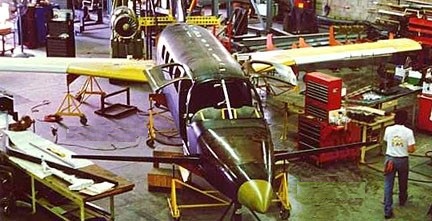
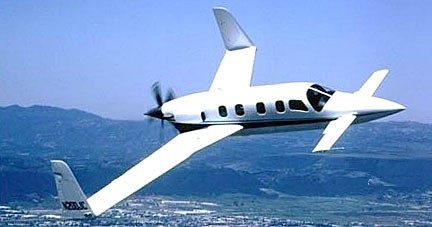
The design of the AASI Jetcruzer 450 began in March 1983 and the construction of a prototype featuring composites-built unpressurised fuselage, rear-mounted metal wings with winglets, metal canards, and rearmounted turboprop engine with pusher propeller, commenced in 1988. It first flew on 11 January 1989. A pre-production prototype flew three months later, followed by first to production standard September 1992. The Jetcruzer 450 received US certification (TC A49NM) in June 1994. AASI decided to concentrate on the Jetcruzer 500 and Jetcruzer 450 was not put into production.
The 6 seat Jetcruzer 500 was a version differing by having smaller windows, a six foot increase in fuselage length, and a PT6A-66A engine of 850shp. A prototype Jetcruzer 500 was first flown on 22 August 1997 and to be pressurised in production form.
Other versions designed included the Jetcruzer 650, 10-13 seat turboprop, and twin turbofan Stratocruzer 1250-ER but a financial partner was sought before development could continue.
The assets of US company Jetcruzer were auctioned recently (2002), with the top bid for the prototype aircraft, molds, drawings and a type certificate being a mere US$125,000. While the reserve was US$500.000, the offer may well be accepted. Jetcruzer spent nearly US$100 million in engineering, development and certification of its rear-engine turboprop.
Jetcruzer 500 Engine: Pratt & Whitney Canada PT6A-66 turboprop, 850 shp. Prop: 7’0″ 5-blade pusher Wingspan: 42 ft 2 in / 12.85m Length: 28 ft 2 in / 8.59m Height: 10 ft 5 in / 8.59m Foreplane span: 18 ft 9 in / 5.71m Wing area: 193.2 sq.ft / 17.94 sq.m Foreplane area: 39.9 sq.ft / 3.71 sq.m Empty weight: 2950 lb / 1338 kg MTOW: 5500 lb / 2495 kg Max Op Speed: 345 mph @ 22,000 ft Max Cruise: 345 mph @ 22,000ft Service ceiling: 30,000 ft TO dist to 50ft: 1530ft / 530m Ldg dist from 50ft: 1430 ft / 436 m Max range: 1818 sm / 2926 km Seats: 6
Jetcruzer 500P Engine: Pratt & Whitney Canada PT6A 66A, 1550 shp Length: 30.184 ft / 9.2 m Height: 6.988 ft / 2.13 m Wingspan: 42.192 ft / 12.86 m Wing area: 191.599 sq.ft / 17.8 sq.m MTOW: 5501.5 lb / 2495.0 kg Weight empty: 3080.4 lb / 1397.0 kg Max. speed: 320 kts / 593 km/h Initial ROC: 3503.94 ft/min / 17.8 m/s Service ceiling: 30000 ft / 9144 m Wing load: 28.7 lb/sq.ft / 140.0 kg/sq.m Range: 1627 nm / 3013 km Crew: 1 Payload: 5 pax (max 1100kg)
Aerodynamics & Structures Inc (ASI), set up by former airline pilot Darius Sharifzadeh, was succeeded by Advanced Aerodynamics and Structures Inc (AASI) to develop the Jetcruzer range of business aircraft. AASI failed, with two prototypes flying and close to certification.
1990: AASI Aircraft/Advanced Aerodynamics & Structures Inc (ceo: Roy Norris), Burbank CA.
1998: Long Beach CA. 2002: Acquired Mooney assets as Mooney Aerospace Group Ltd
The assets of US company Jetcruzer were auctioned recently (2002), with the top bid for the prototype aircraft, molds, drawings and a type certificate being a mere US$125,000. While the reserve was US$500.000, the offer may well be accepted. Jetcruzer spent nearly US$100 million in engineering, development and certification of its rear-engine turboprop.
Epsilon 2 25 Wing area: 25 sq.m Certification: Afnor Pilot weight: 65-80 kg No. of cells: 33 Wing span: 10.81 m Aspect ratio: 4.68 Min sink: 1.2 m/s Max speed: 43 kph Price (1998) £2,199
Epsilon 2 28 Wing area: 28 sq.m Certification: DHV 1-2 Pilot weight: 80-95 kg No. of cells: 35 Wing span: 11.41 m Aspect ratio: 4.69 Min sink: 1.2 m/s Max speed: 43 kph Price (1998) £2,299
Epsilon 2 31 Wing area: 30.8 sq.m Certification: DHV 1-2 Pilot weight: 95-110 kg No. of cells: 37 Wing span: 11.97 m Aspect ratio: 4.66 Min sink: 1.2 m/s Max speed: 43 kph Price (1998) £2,399
Wing area: 41.4 sq.m Certification: DHV 1-2 / Afnor Pilot weight: 140-210 kg No. of cells: 43 Wing span: 14.1 m Aspect ratio: 4.8 Min sink: 1.1 m/s Max speed: 40 kph Price (1998) £2,869
Sigma 4 The Sigma 4 paraglider was produced circa 1998-2005. Rated at DHV2 off speed bar, with speed bar on DHV2-3. Large size is 29sq.m for 95-120 kg pilots.
Advance Sigma 6
Sigma 4 24 Paraglider introduced in 1998. Wing area: 24 sq.m Certification: DHV / Afnor Pilot weight: 60-80 kg
Sigma 4 27 Wing area: 26.2 sq.m Certification: DHV / Afnor Pilot weight: 75-95 kg Wing span: 11.65 m Aspect ratio: 5.17
Sigma 4 30 Certification: DHV/Afnor Pilot weight: 90-110 kg
The high-performance Omega 7 glider from the Swiss factory has been certified in DHV2-3 class and is based on the World Champion prototype. The Omega 7 has a noticeable high arch of the canopy that makes it “inherently more stable and able to be flown faster without collapsing, even in turbulent air”, according to Advance. As a result, the Omega 7 also has a significantly higher aspect ratio than its predecessor for higher performance. It also incorporates a “carefully calculated” profile and competition lines. The manufacturer claims a glide ratio of 10:1 and an “exceptional glide angle” in the upper speed range, plus the “familiar, direct Advance handling”. The Speed Performance Indicator (SPI) also helps experienced pilots to choose the optimum speed. The Omega 7 is equipped with a variable transfer speed system that enables shortening or lengthening of the speed bar extension range and pressure to suit the user’s anatomical position. This new model is the first to feature a new fabric developed exclusively for Advance in collaboration with Porcher Sport as well as special coated lines developed with Liros, UV resistant. Other details include sewn-in compression and Mylar straps for better stability of the canopy, partially closed cells for higher internal pressure, winglets to reduce drag (vortex effect), velcro closures on the wingtips to remove debris from the glider, swivels on the steering lines, and different brake handles with magnetic clips depending on the canopy size. The Omega 7 was available in 4 sizes and 3 color schemes.
Omega 7
Omega 4 25 Wing area: 24.8 sq.m Certification: DHV 2-3GH / Afnor Pilot weight: 75-90 kg No. of cells: 78 Wing span: 12.1 m Aspect ratio: 12.1 Min sink: 1 m/s Max speed: 50 kph Price (1998) £2,899
Omega 4 28 Wing area: 27.4 sq.m Certification: DHV 2-3 / Afnor Pilot weight: 90-105 kg No. of cells: 78 Wing span: 12.6 m Aspect ratio: 12.6 Min sink: 1 m/s Max speed: 50 kph Price (1998) £2,969
Omega 4 31 Wing area: 30.3 sq.m Certification: DHV 2-3 / Afnor Pilot weight: 105-120 kg No. of cells: 82 Wing span: 13.3 m Aspect ratio: 13.3 Min sink: 1 m/s Max speed: 50 kph Price (1998) £2,999