AeroCad AeroCanard

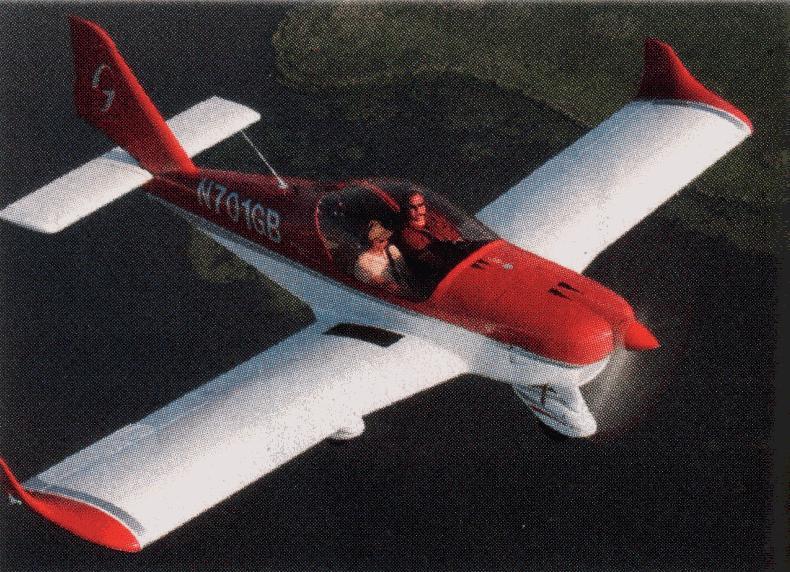
A development of the CO-z Development Cozy, the AeroCanard is a 4 seat canard type aircraft with a Lycoming LIO-360 engine. It has a 1000-mile range and typically cruises at over 200 mph on less than 10 gallons per hour. The AeroCanard FG can be built from just the plans only or is also available as a complete quick build aircraft kit. The AeroCanard SB has a smaller body width at the front seats. The plans include instructions for building either aircraft. The AeroCanard is available as a “Plans Built” or complete quick build kit aircraft or as an option, purchasing as few or as many pre-fabricated fiberglass kit parts to help reduce the building time. The AeroCanard RG is effectively the FG model with an electrical retracting nose gear and electro-hydralic retractable main gear.
The AeroCanard-FG plans includes plans, CAD converted M-Drawings, and Section 3 – Pilot Operating Handbook and Flight Testing Manual.
The AeroCanard SX will have a forward opening canopy so both pilot and co-pilot can enter both sides of the fuselage. The top is the major change on the standard AeroCanard FG fuselage.
The wider turtleback, larger canopy and round rear windows have all been changed for more room in the fuselage. Builders can still change the rap-a-round canopy to a full bubble canopy just by cutting more of the fuselage top out or cut in a larger rear windows.

AeroCanard
Engine: Lycoming IO-360, 200 hp
HP range: 160-200
Speed max: 225 mph
Cruise: 205 mph
Range: 1000 sm
Stall: 68 mph
ROC: 1500 fpm
Take-off dist: 1000 ft
Landing dist: 1500 ft
Service ceiling: 25,000 ft
Fuel cap: 62 USG
Weight empty: 1200 lbs
Gross: 2150 lb
Height: 7.75 ft.
Length: 16.75 ft
Wing span: 28.1 ft
Wing area: 102.3 sq.ft
Seats: 4
Landing gear: nose wheel. Only nose wheel retractable.

AeroCanard FG
Engine: Lycoming IO-360, 200 hp
Hp range: 160-230
Max speed: 225 mph
Cruise: 205 mph
Stall: 68 mph
Range: 1000 sm
Roc: 1750 fpm
To dist: 800 ft
Ldg dist: 1500 ft
Fuel cap: 63.5 USG
Empty wt: 1200 lb
Mtow: 2150 lb
Useful Load Less Fuel: 950 lb
Fuel Useful: 63 USG
Fuel Tanks: No Switch/3.5 Gal Sump
Height: 7.8 ft
Length: 16.75 ft
Wingspan: 28.1 ft
Wing area: 102.3 sq.ft.
Seats: 4
Undercarriage: Nose/retractable
Type Seats Used: F/Bench R/Bench
Front Seat width: 42in
Rear Seat width: 39.5in
Head Room Width F/Seat: 38in
Speed Brake: Electric
Head Room Width R/Seat: 38in
Control Stick: 2 Side Sticks
Throttle Quadrant: Center
Brake Pedals (Adjustable): Both Sides 5in
Cockpit Heat: Nose Oil Cooler
Standard Main Wheels: 600-6
Nose Gear (Standard): Retrectable

AeroCanard RG
Engine: Lycoming IO-360, 200 hp.
Hp range: 160-230.
Max speed: 225 mph.
Cruise: 210 mph.
Stall: 68 mph.
Range: 1000 sm.
Roc: 1900 fpm.
To dist: 800 ft.
Ldg dist: 1500 ft.
Useable Fuel cap: 63 USG.
Useful Load Less Fuel: 950 lb
Fuel Tanks: No Switch/3.5 Gal Sump
Empty wt: 1150 lbs.
MTOW: 2150 lbs.
Height: 7.8 ft.
Length: 16.75 ft.
Wingspan: 28.1 ft.
Wing area: 102.3 sq.ft.
Seats: 4.
Undercarriage: Nose/ retractable.
Type Seats Used: F/Bench R/Bench
Rear Seat width: 39.5in
Head Room Width F/Seat: 38in
Front Seat width: 42in
Head Room Width R/Seat: 38in
Control Stick: 2 Side Sticks
Throttle Quadrant: Centre
Speed Brake: Electric
Brake Pedals (Adjustable): Both Sides 5in
Cockpit Heat: Nose Oil Cooler
Standard Main Wheels: 600-6
Nose Gear (Standard): Retractable

AeroCanard SB
Engine: Lycoming IO-360, 200 hp.
Hp range: 160-230.
Max speed: 220 mph.
Cruise: 200 mph.
Stall: 68 mph.
Range: 1000 sm.
Roc: 1500 fpm.
To dist: 1200 ft.
Ldg dist: 1500 ft.
Fuel cap: 52 USG.
Empty wt: 1150 lbs.
Mtow: 2050 lbs.
Useful Load less Fuel: 900 Lbs
Fuel Useful: 63 USG
Fuel Tanks: Selector/1.5 USG Sump
Height: 7.8 ft.
Length: 16.75 ft.
Wingspan: 28.1 ft.
Wing area: 102.3 sq.ft
Seats: 4.
Undercarriage: Nose/ retractable.
Front Seat: 42in
Rear Seat: 36in
Head Room Width F/Seat 36in
Head Room Width R/Seat: 36in
Engines Used: O-320 – IO-360
Control Stick: 2 Side Sticks
Throttle Quadrant: Centre
Brake Pedals (Adjustable): Both Sides 5in
Speed Brake: Electric
Standard Main Wheels: 600-6
Type Seats Used: F/Bucket R/Bucket
Nose Gear (Standard): Retrectable

AeroCanard Velocity FG
Empty Weight: 1300 Lbs
Gross Weight: 2250 Lbs
Front Seat width: 42.50″
Rear Seat width: 39.50″
Head Room Width Front Seat: 40.00″
Head Room Width Rear Seat: 38.00″
Engines Used: O-320 – IO-360
Control Stick: 1 Center Sick
Cockpit Heat: Nose Oil Cooler
Standard Main Wheels: 600-6 Single Puck
Useful Load Less Fuel: 950 Lbs
Fuel Useful: 65 USGal
Fuel Tanks: No Switch/5 Gal Sump
Nose Gear (Standard): Fixed

AeroCanard MKIV
Empty Weight: 1100 Lbs
Gross Weight: 2050 Lbs
Front Seat width: : 42.00″
Rear Seat width: 36.00″
Head Room Width Front Seat: 36.00″
Head Room Width Rear Seat: 36.00″
Engines Used: O-360
Control Stick: 2 Side Sticks
Cockpit Heat: Muff Off Exhaust
Standard Main Wheels: 500-5 Single Puck
Useful Load Less Fuel: 950 Lbs
Fuel Useful: 52 US Gal
Fuel Tanks: Selector/1.5 YSbGal. Sump
Nose Gear (Standard): Retractable
Aero Bravo Industria Aeronautica Bravo 700

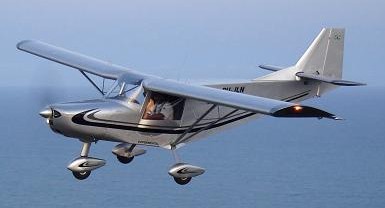
The Bravo 700 is a two-seat civil utility aircraft manufactured by Aero Bravo in Brazil in both kit and ready-to-fly form. It is a high-wing monoplane of metal construction with fixed tricycle undercarriage and is classed as an ultralight under Brazilian aviation regulations. An agricultural version, the Bravo 700 Agrcola with spraying gear and a chemical tank with a capacity of 140 l (37 US gal) had been developed to flight-testing stage.

Engine: 1× Rotax 912, 60 kW (80 hp)
Wingspan: 9.0 m (29 ft 6 in)
Length: 6.58 m (21 ft 7 in)
Height: 2.1 m (6 ft 11 in)
Wing area: 13 sq.m (140 sq.ft)
Empty Weight: 270 kg / 595 lb
MTOW: 500 kg / 1102 lbs
Max speed: 190 km/h (119 mph)
Stall: 30 kt / 35 mph / 56 kmh
Cruise: 91 kt / 104 mph / 168 kmh
Service ceiling: 4,000 m (13,120 ft)
Rate of climb: 300 m/min (984 fpm)
Range: 840 km (525 miles)
Wing loading: 38 kg/sq.m (8 lb/sq.ft)
Power/weight: 0.12 kW/kg (0.07 hp/lb)
Crew: one pilot
Capacity: 1 passenger

Aero Bonner V6 Super Sapphire

In 1979, this Chipmunk Mk.22A (G-ARWB c/n C1/0621) was modified to act as test bed and demonstrator for the 200 hp Aero Bonner Super Sapphire V6 aero engine, liquid-cooled by a ventrally mounted radiator. G-ARWB was flown for the first time with its new engine on July 2, 1979 and was subsequently displayed at the SBAC Show at Farnborough. The aircraft is also referred to as the Aero Bonner Chipmunk 200

Bill flew it at the 1980 Farnborough Airshow, when the RAF put in a request to re-equip their fleet of Chipmunks with the Sapphire engine, and Rolls-Royce announced their desire to take over and manufacture the engine in quantity.

Chipmunk Mk22A G-ARWB c/n C1/0621

At the Farnborough exhibitor’s dinner, guest of honour, Margaret Thatcher, said her govt. was happy to be a first customer for the kit on show, but we should also look to make our profits from the wider world. Fair enough; so Bill wrote to the PM, saying that the RAF wished to purchase the Bonner V6 aero engine for their Chipmunks, and could the MOD kindly put in a purchase order. Unfortunately, there was a moratorium on defence spending, came the reply from No 10, and the govt. could not afford it. Furthermore, by the end of 1980, R-R told Bill that they thought that the Bonner engine was pointing the way to the future of light piston aero engines, but nevertheless they were going through a divorce from Continental Motors and pulling out of light aviation altogether, and reluctantly could not remain in the sector for this engine alone.

Aeroandinas MXP-100 Hidro Adventura

Engine; Rotax 912, 80 hp
Wing span; 9m
Chord; 1.42m
Wing area; 18.2 sq.m
Wing loading; 46 kg/sq.m
Length; 6.7m
Seats; 2
Fuel capacity; 2 x 12 USG
Gross weight; 590 kg
Empty weight; 290 kg
Useful load; 302 kg
Load factors; +5 / -3.5 G
Vne; 90 mph / 145 kph
Top speed; 80 mph / 129 kph
Cuising speed; 65 mph / 105 kph
Stall; 38-45 mph / 61-72 kph
Rate of climb; 400 fpm / 122 m/min
Range; 140 miles / 255 km
Endurance; 2.2 hr
Service ceiling; 8000 ft / 2440m
Takeoff roll; 328 ft / 100m
Landing roll; 200 ft / 60m

Aero G700 / AT-4 / Gobosh G700

G700S

The G700 is an Americanised version of Aero designer Tomasz Antoniewski’s certified AT-3.
To qualify the all-metal Gobosh G700S as an LSA, the wingspan was increased and among other things for the US market, the addition of winglets.
Even the least expensive model, the Sport Edition, includes the standard six instruments, Garmin GPS and transponder, wheelpants and leather seats. They all feature dual controls and mechanically operated split flaps.

The former Gobosh G700 lives on as the Aero AT-4, distributed by Aero AT USA of New Hampshire, in 2012. The AT-4 is made in Poland by Aero Ltd., the all-metal LSA derives from the AT-3, which was certified at a higher gross weight. AT-4 base price 2012: $105,550.

Aero AT-4

Gobosh G700S
Engine: Rotax 912S, 100 hp
TBO: 1500 hr
Prop: Elprop 3 blade composite
Cabin width: 41 in
Fuel cap: 18.5 USG
Full fuel payload: 390 lb
LSA MTOW: 1320 lb
Empty wt: 820 lb
Useful load, std: 500 lb
Max cruise speed: 116 kt
Vso: 39 kt
Best rate of climb, SL: 850 fpm
Takeoff ground roll: 380 ft
Landing ground roll: 686 ft
Base price 2009: US$106,950 to $123,900

Aermacchi MB-339

MB-339CB

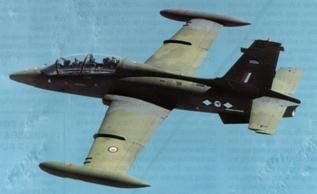
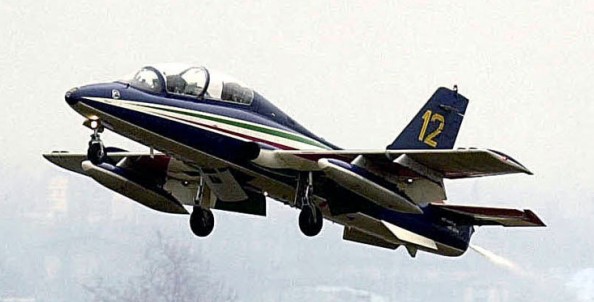
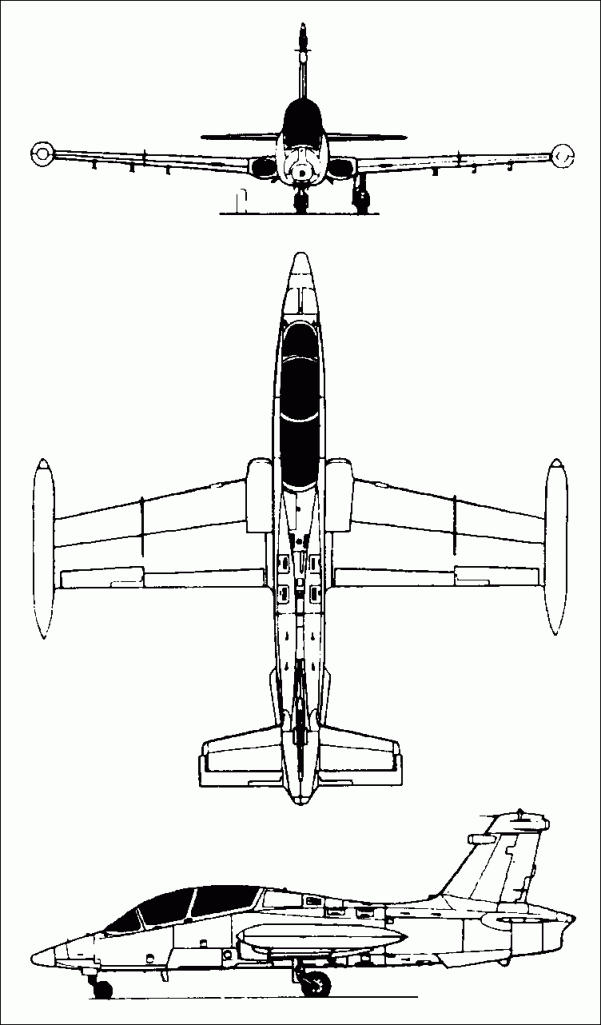
The 1972 designed Viper 632 powered Aermacchi MB339 produced in Varese, Italy, became the successor to the MB-326 and the Fiat G91. Sharing much of the MB-326K airframe structure, the MB-339 has a redesigned forward fuselage to allow the tandem seating to be staggered vertically, for the instructor to see over the pupil, the vertical tail enlarged, raised fin, a revised nose gear, stronger wings, Martin-Baker Mk.10 zero-zero seats, nose wheel steering and modern avionics. Six hardpoints (up to 1815 kg/4,000 lb) al¬low a combined trainer/light strike role. The wing is NACA 64A212 at the root and NACA 64A114 at the tip.

Aermacchi MB-339 Article

The first prototype MB-339X (I NOVE) made the type’s maiden flight on 12 August 1976, the second prototype was registered I NINE. Beginning production in 1976 was the MB.339A, of which the first of 100 for the Aeronautica Militare were handed over for pre service trials on 8 August 1979. Customers have included Argentina, Dubai, Ghana, Malaysia, Nigeria, and Peru.

MB.339As were the only operational jet aircraft deployed to the Falklands by the Argentineans during the hostilities, the Port Stanley runway being unable to accommodate Mirages or A 4s. An Argentine Navy MB.339 attacked a Royal Navy frigate, causing damage with 30 mm DEFA cannon fire and four Zuni 5 inch rockets. The trainer also has provision to carry the AGM65 Maverick ASM, the AIM 9 Sidewinder and the Sistel Marte II fire and forget sea skimming anti ship missile.

The MB.339B is basically a standard MB.339A advanced trainer with an uprated Viper 680 engine, enlarged tip tanks, and increased weapons carrying capability, enhanced for the ground attack role.

The MB.339C is designed to train pilots to use modern front-line mission management systems and powered by an uprated Viper 680-43 turbojet. Envisaged as a close support/maritime attack aircraft, the MB.339C first flew on December 17, 1985, equipped with a digital navigation/attack system including a GEC navigation computer, two Kaiser Sabre headup displays, a Litton inertial platform, CRT multifunction displays, a Fiat P-0702 laser rangefinder, an ELT-156 radar warning receiver, and a GEC AD-660 Doppler radar. Armament options included AIM-9L Sidewinder, AGM-65 Maverick ASMs, and Marte Mk.II anti-shipping missiles.

The MB-339CB with the Rolls-Royce Viper 680-43 jet engine experienced a number of engine problems. Flameouts on wet runways, compressor stalls during rapid acceleration/deceleration, defective fuel supply components, and turbine blade cracks. The subsequent repairs reduced the maximum thrust of the Viper to 4,280 lbs.

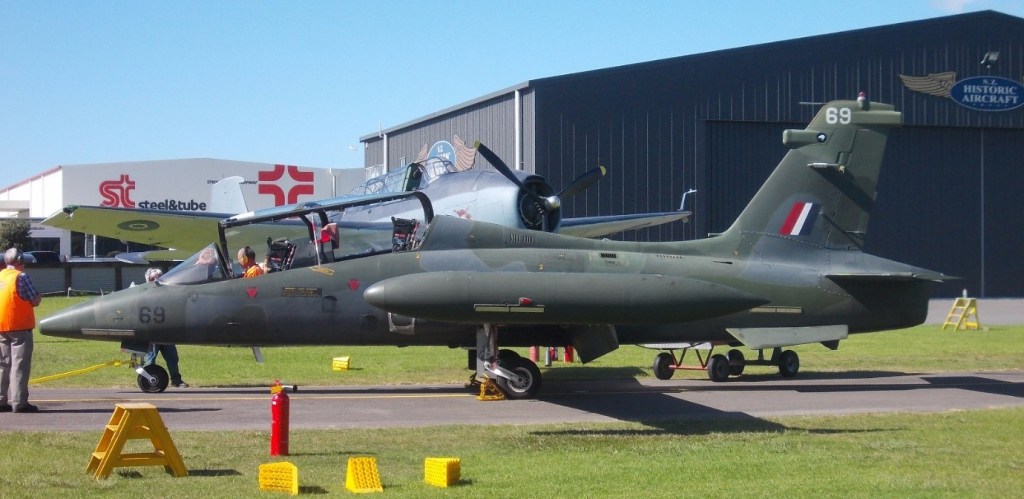
In 1991 the RNZAF purchased 18 of the model MB-339CB for use an advanced pilot trainer and weapons trainer with 14 Squadron based at Ohakea.

MB-339CB

The “CD” model was offered with HOTAS (Hands on Throttle and Stick), HUDs display and three LCD screens.

Development of the MB-339 has included the MB-339RM calibration model and 15 MB-339PAN delivered in 1982 for the Italian “Frecce Tricolori” aerobatic team.

Catastrope at Ramstein

The Viper 680 engined MB-339K, also known as the Veltro II, was a single-seat attack version. This aircraft first flew on 30 May 1980. In production form, the single-seat MB.339K Veltro 2, which flew in May 1980, was avail¬able with the digital navigation/attack system from the MB.339C.

Gallery

Prototype
Wing span: 35 ft 7.5 in (10.86 m).
Max speed: 558 mph (898 km/h).

MB-339A
Engine: 1x R-R Viper 632-43.
Installed thrust: 17.8 kN.
Span: 10.9 m.
Length: 11 m.
Wing area: 19.3 sq.m.
Empty wt: 3125 kg.
MTOW: 5900 kg.
Warload: 1815 kg.
Max speed: 925 kph.
Initial ROC: 2010 m / min.
Ceiling: 14,600+ m.
T/O run: 465 m.
Ldg run: 415 m.
Fuel internal: 1410 lt.
Endurance: 2hr 50min.
Combat radius hi-lo-hi: 590 km.
Hardpoints: 6.

MB-339C
Engine: Viper 680, 1995-kg (4,400 lb) thrust.
Max speed SL: 480 knots
Max speed 25,000 ft: 460 knots
ROC SL: 6500 fpm.
Time to 30,000 ft: 7 min 6 sec.
TO wt clean: 10,000 lbs.
Endurance: 2 hr 50 min.
Fuel Burn: 2500 lb/hr.
Max extenal load: 4000 lb on six pylons.

MB-339CB
Engine: Rolls-Royce Viper Mk.680-43, 4000 lb thrust.
Span: 11.22m.
Wing area: 19.3 sq.m.
Length: 11.24m.
MTOW: 6350 kg.
Internal fuel: 1430 kg. (+2 x 400 kg tip tanks).
Empty wt: 3414 kg.
Height: 3.9 m.
Max speed: M0.8, 575 mph.
T/o run: 550m.
ROC: 8500 fpm.
Service ceiling: 46,000ft.
Limits: +7.33 & -4g.
Ferry range: 1190 miles (2200 km)

MB-339K Veltro 2
Engine: 1 x Piaggio RR Viper 680-43 turbojet, 4,450lbs / 19.8 kN thrust.
Length: 36.88ft (11.24m)
Wingspan: 36.81ft (11.22m)
Height: 13.09ft (3.99m)
Wing area: 19.3 sq.m
Empty Weight: 6,889lbs (3,125kg)
Maximum Take-Off Weight: 13,999lbs (6,350kg)
Fuel internal: 2030 lt
Maximum Speed: 506mph (815kmh; 440kts)
Maximum Range: 231miles (371km)
Rate-of-Climb: 6,595ft/min (2,010m/min)
Service Ceiling: 46,719ft (14,240m)
T/O run: 580 m
Ldg run: 450 m
Armament: 2 x 30mm DEFA cannons / 1935 kg external
Seats: 2
Hardpoints: 6
Air refuel: No.