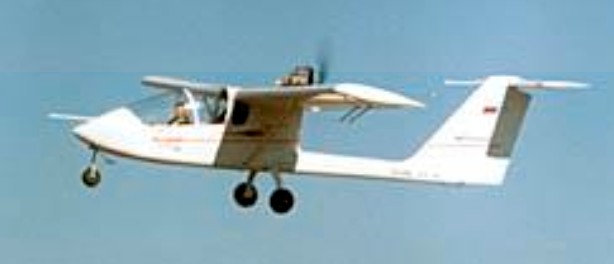
In 1991 the prototype A-20 was built by members of the Aeroprakt Aero Club at Kiev and it first flew in that year. The Vista has the engine installed on the top of the wing and the fuselage.
Aeroprakt started production of the A-20 in 1993, initially with Finnish funding.
1980->
Aeroprakt T-8
In winter of 1987 Kiev Aeroprakt started designing and building the two-seat primary trainer Aeroprakt “T-8”.
Aeroprakt A-6

A single seat, high wing monoplane Russia. Composite wing and tail with metal and composite fuselage.
Engine: 25 hp pusher
Length 15’
Wing span 23’
Wing area 61.3 sq/ft
Empty weight 240 lb
Top speed 62 mph
Stall speed 34 mph.
Tricycle landing gear
Aeroprakt
Aeroprakt Kiev began in 1986 when Yuri Yakovlev, after graduating from Kuybyshev (now Samara) aviation institute, was invited to work at the Antonov Design Bureau in Kiev. Having met friends, Yuri founded together with them an amateur aircraft design club which received the name Aeroprakt, similar named as the Aeropract in Kuybyshev the club where Yuri begun his activity as aircraft designer and made his first successful steps in this area.
Kiev Aeroprakt began its activity from aerodynamic research of Aeroprakt-8 aeroplane built by Yuri Yakovlev during his work in Kuybyshev Aeropract. The research was carried out in a wind tunnel of the Central Hydro-Aerodynamic Institute in Moscow.
Aeroprakt aircraft are marketed by Global Aero Design Centre headquartered in Singapore, and includes the A-20 tandem two-seat ultralight (first flown 1991) and A-22 side-by-side two-seat very light cabin monoplane for recreational and other uses (first flown 1996), and is developing the A-24 two-seat amphibian.
Aeropract A-25 Breeze
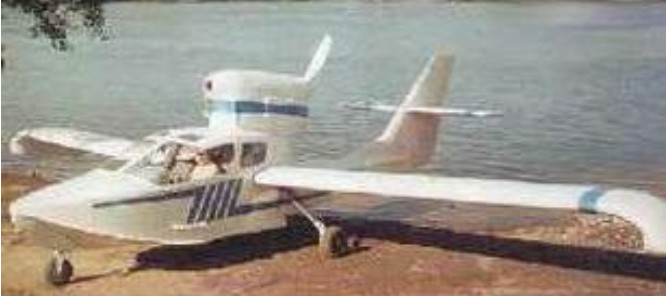
A four-seat amphibian first flown in November 1994.
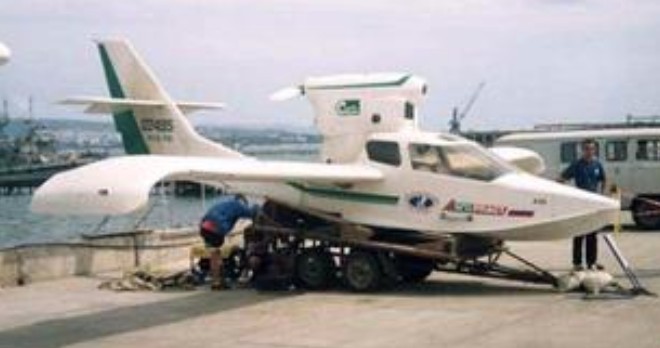
A-25 Breeze
Wing Span: 10.6 m
Length: 7.9 m
Height: 2.5 m
MTOW: 1200 kg
Fuel Capacity: 195 lt
Maximum Speed: 111 kt
Optimum Speed: 93 kt
Absolute Ceiling: 14,000 ft
Optimum Ceiling: 12,000 ft
Maximum Range: 600 nm
Maximum Climb Rate: 980 ft/min
Take Off Distance: 420 m
Seats: 4
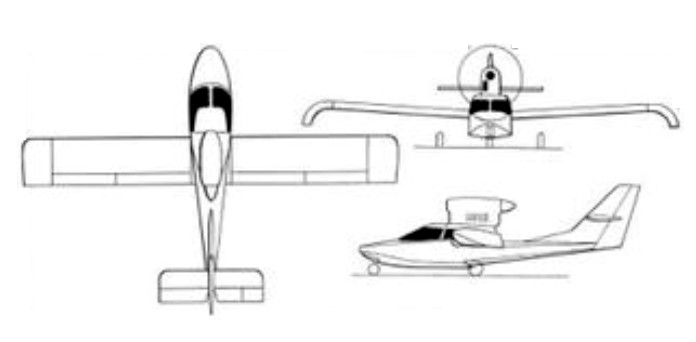
Aeropract A-23 Trainer / A-23 Coach / A-23M Baby Dragon
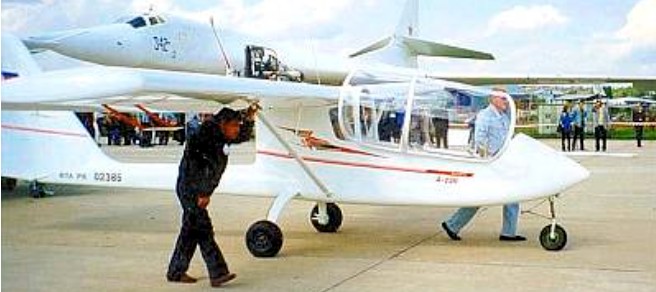
The Coach / Baby Dragon is a light light multi-purpose aircraft. It can be flown from land (wheels), snow (skis) or water (floats). The prototype A-23 first flew in 1992 with two RMZ-640 engines (replaced later by single 64hp Rotax-582) had a narrow angular fuselage. It served for four years in the pilot’s club.
For series production, a more powerful Rotax-912 engine was chosen (while the original engine was still available in the economy package). Cockpit width was increased to 760mm providing sufficient comfort for pilot. Both composite fuselage and wing are now made in matrixes. The slab-type fiberglass tailplane unit was revised – raised to the top of the tailfin.
A-23M wings carry single “flaperon” each – there is no separation between aileron and landing flap.
The first flight of the A-23M took place on August 5, 1999. The A-23M prototype flew approximately 120 hours during Fall 1999. The only problem was insufficient compensation of the large flaperons.
The A-23M may be built (converted?) as a crop duster. Wheels, skis and floats are included in standard package.
Production was launched in the winter of 2000. First batch – 3 machines with different engines. Available as a kit.
On June 24, 2000 director of Aeroprakt-Samara I.A.Vakhrushev and co-pilot were killed in crash of the series A-23M. This happened on landing approach at Smyshliaevka airfield near Samara. Probable cause – tailplane flatter.
A-23
Engines: 2 x RMZ-640 Bouran
Crew: 1+1
A-23 Coach
Year: 1992
Engines: 2 x Rotax 582, 64hp
Maximum range: 620 km
Fuel capacity: 75 lt
Crew: 1+1
Price 2010: 25,000US$
Unassembled kit 2010: 12,700US$
A-23M Baby Dragon
Year: 1999
Crew: 1+1
Engines: 2 x Rotax 952, 100hp
Length: 7.5m
Height: 2.4m
Wingspan: 9.8m
Empty weight: 300kg
Maximum Takeoff weight: 600kg
Power load: 6 kg/hp
Maximum sustained speed: 180km/h
Cruise: 130 to 150km/h
Range
Maximum range: 1000 km
Fuel capacity: 120 lt
Payload Total: 250kg
Price 2010: 35,000US$
Unassembled kit 2010: 12,700US$
Aeropract A-21 Solo

A small single-seat lightplane for recreational, agricultural, and civil patrol uses.

A-21 Solo
Wing Span: 6.6 m
Length: 4.7 m
Height: 1.8 m
Take Off Distance: 100 m
Absolute Ceiling: 14000 ft
Optimum Ceiling: 10,000 ft
Maximum Speed: 102 kt
Optimum Speed: 81 kt
Fuel Capacity: 22 lt
MTOW: 3000 kg
Maximum Range: 200 nm
Maximum Climb Rate: 1000 ft/min
Seats: 1

Aeropract
Yuri Yakovlev began his activity as aircraft designer and made his first successful steps in this area with an amateur aircraft design club named Aeropract in Kuybyshev
Aeropract offers various light aircraft, including the A-21 very small single-seat lightplane for recreational, agricultural, and civil patrol uses, A-23M tandem two-seat lightplane that can be purchased assembled or as a kit (first flown January 1993), A-25 Breeze four-seat amphibian (November 1994), and A-27 twin-float lightplane (first flown June 1998).
Aeroplane Marketing Swallow

A high-wing monoplane, with cruciform tail, the Swallow used conventional three-axis controls with stick and rudder bar for controlling ailerons, elevator and rudder. The Swallow was powered by two single-cylinder Yamaha engines nmounted at the front using a central drive shaft to pusher Yrral 52×34-inch prop. Fitted with tricycle undercarriage with fiberglass rod-sprung suspension. Wheels are 10-inch pneumatics.
Aeroplane Marketing Swallow Article
Engines: 2 x Yamaha 200cc, 30 hp
Wingspan: 34 ft
Wing area: 136 sq.ft
Empty weight: 225 lb
Wing loading: 2.87 lb/sq.ft
Fuel capacity: 3.8 USG
Aeroplane Marketing
1982: PO Box 833, Sparta, NJ 07871, USA.
UL manufactuer

