Paraglider circa 1998.
Parasolk’A 25
Wing area: 25 sq.m
Pilot weight: 60-85 kg
No. of cells: 20
Wing span: 9.3 m
Aspect ratio: 3.5
Min sink: 1.3 m/s
Max speed: 36 kph
Price (1998) 1955 DM
Paraglider circa 1998.
Parasolk’A 25
Wing area: 25 sq.m
Pilot weight: 60-85 kg
No. of cells: 20
Wing span: 9.3 m
Aspect ratio: 3.5
Min sink: 1.3 m/s
Max speed: 36 kph
Price (1998) 1955 DM
After the creation of Formula 1, Aeros started to produce paragliders of the Standard class: Mister X and Accent of 1999.

Paraglider circa 1998.
After the creation of Formula 1, Aeros started to produce paragliders of the Standard class: Mister X and Accent of 1999.
Mister X
Wing area: 30 sq.m
Pilot weight: 85-105 kg
No. of cells: 74
Wing span: 12.6 m
Aspect ratio: 5.29
Min sink: 1 m/s
Max speed: 50 kph
Price (1998) 3450 DM
Paraglider circa 1998.
Erebus 41
Wing area: 41.5 sq.m
Certification: Afnor
Pilot weight: 130-190 kg
No. of cells: 47
Wing span: 14 m
Aspect ratio: 4.7
Min sink: 1.2 m/s
Max speed: 41 kph
Price (1998): 4830 DM
A higher level of understanding how paragliders fly was acquired and Aeros’ own paraglider Enei was designed in 1995. But design was not enough, and the Enei was fine tuned and many pilots liked the wing.
In the very first year of the company’s existence it was decided to explore other spheres of ultralight aircraft. Fathers of paragliding theme were originally redesigned copy of a hang glider Airwave Black Magic, and the first independent creative work – paraglider Zig-Zag.
In the very first year of the company’s existence it was decided to explore other spheres of ultralight aircraft. Fathers of paragliding theme were originally redesigned copy of a hang glider Airwave Black Magic (called “the Parasol”), which was popular in the West, and the first independent creative work – paraglider Zig-Zag.
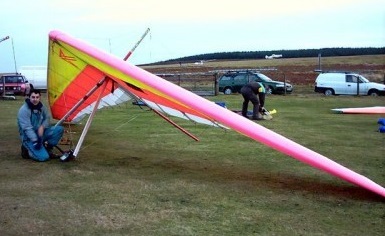
In 1991 specialists of the Ultralight Aircraft Department organised Limited Liability Association Aeros and starting from November 1991, began to manufacture new wings: sports hang glider Stalker-14 and wings for trike Stranger.
By 1992 the Stalker-14 had proved to be quite successful so it was prepared for certification with BHPA (UK). Over 50 Stalkers were made in 1993, and to satisfy demands of not very big pilots a small model Stalker-12 was developed. In 1994 Stalker-14 No.100 was made, dispatched to England and Model Stalker-12 was granted BHPA.
In 1999 Aeros designed and built a rigid wing Stalker (ultralight sailplane with beam aerodynamic control), certified by DHV in 2001.
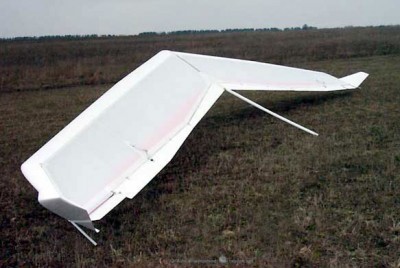
Stalker 12
Area, sqm: 12.0 sq.m
Wing span: 9.3 m
Aspect ratio: 7.2
Nose angle: 130 – 132 deg
Weight: 28 kg
Load weight: 45 – 65 kg
Number of upper battens: 21
Breakdown length: 5.1 x 3.3 x 2.0 m
Min. airspeed: 30 – 32 km/h
Max. airspeed: 90+ km/h
Best glide ratio: 11
Certificate: BHPA #9405097
Stalker 12
Wing area: 11.7 m²
Wing span: 9.2 m
Aspect ratio: 7.6
Minimum pilot weight: 45 kg
Maximum pilot weight: 65 kg
Packed length: 2 m
Nose angle: 131°
Stalker 13
Wing area: 12.9 m²
Wing span: 9.9 m
Aspect ratio: 7.6
Minimum pilot weight: 55 kg
Maximum pilot weight: 75 kg
Packed length: 2 m
Nose angle: 131°
Stalker 14
Area: 14.0 sq.m
Wing span: 10.3 m
Aspect ratio: 7.6
Nose angle: 126 – 128 deg
Weight: 34 kg
Load weight: 65 – 92 kg
Number of upper battens: 23
Breakdown length: 5.8 x 4.1 x 2.2 m
Min. airspeed: 29 – 31 kmh
Max. airspeed: 90 kmh
Best glide ratio: 11 +
Certificate: BHPA #9306091
Stalker 15
Wing area: 14 m²
Wing span: 10.3 m
Aspect ratio: 7.6
Hang glider weight: 34 kg
Minimum pilot weight: 65 kg
Maximum pilot weight: 92 kg
Minimum speed: 32 km/h
Maximum speed: 85 km/h
Max glide ratio (L/H): 11
Packed length: 2 m
Number of battens: 30
Nose angle: 131°
Stalker Rigid 12
Wing area: 12 m²
Wing span: 9.2 m
Aspect ratio: 7.2
Minimum pilot weight: 45 kg
Maximum pilot weight: 85 kg
Minimum speed: 25 km/h
Maximum speed: 130 km/h
Max glide ratio (L/H): 19
Minimum sink rate: 0.7 m/s
Nose angle: 127°
Stalker Rigid 14
Wing area: 14 m²
Wing span: 10.3 m
Aspect ratio: 7.6
Minimum pilot weight: 65 kg
Maximum pilot weight: 92 kg
Minimum speed: 25 km/h
Maximum speed: 130 km/h
Max glide ratio (L/H): 19
Minimum sink rate: 0.7 m/s
Nose angle: 127°
At the Antonov Construction Bureau there was an Ultralight Aircraft Department well-known for its creations: hang gliders Slavutich-UT, Sport-5 and trike T-2. These were created according to aircraft requirements, by people able both to compute endurance of anything and to test a hang glider in CAGI wind-tunnel. In the late 80s there started a co-operative trend and ITACO-CENTER co-operative was organised at the Ultralight Aircraft Department. This co-operative started to produce sports hang gliders C-14 and C-15, and about 150 of them were manufactured. Almost all members of USSR hang gliding national team used these hang gliders and after there appeared cracks in the “iron curtain”, it was attempted to sell these machines to the Western states and they even almost completed their certification in Germany.
32-B Obolonskiy pr
Kyiv 254205
Ukraine
In 1991 specialists of the Ultralight Aircraft Department organised Limited Liability Association Aeros and starting from November began to manufacture new wings: sports hang glider Stalker-14 and wings for trike Stranger which became Aeros’ “business cards” for the few next years.
In the very first year of the company’s existence its specialists launched hang glider’s safety parachute Down, a prototype of which was German canopy PSR. It was also decided to explore other spheres of ultralight aircraft. Fathers of paragliding theme were originally redesigned copy of a hang glider Airwave Black Magic (called “the Parasol”), which was popular in the West, and the first independent creative work – paraglider Zig-Zag. At that time Aeros’ staff consisted of not more than a dozen enthusiasts.
In 1993 the first representatives of the company Aeros appeared abroad – in the UK and in Spain.
In 1994, with little experience in paragliders’ manufacture, a decision was taken to start production of designs of АРСО: Starlite, Astra, Supra. These models were not the newest ones, but they fit in excellently for the CIS market. Over 80 paragliders were made, experience was acquired and production was organised. At this stage a framework decision was taken – to manufacture all aircraft only of high quality materials and parts. In most cases these were imported goods: fabric of a German company POLYANT, ropes and wire products LINDEMANN, plastic and special parts FINSTERWALDER, paraglider fabric CARRINGTON and GELVENOR. Full-scale production of harnesses for hang gliders and paragliders began.
In 1996, a new, kingpostless design had already completed flight trials – Stealth 14 KPL. By the end of the year the wing was ready for certification in England and there appeared a small model Stealth 12 KPL. While designers and pilots were busy resolving a complex of “kinpostless” problems, motor wings gave stable income to the enlarged staff. In the course of a year 220 wings of Stranger type has been manufactured and the Aeros’ staff expanded to 30 employees. Aeros was noticed not only in the Western Europe – within a year two distributors appeared in the USA, U.S.AEROS, dealing with hang gliders and Sabre Trikes dealing with trikes.
1998: ad32-B Obolonsky Pr., UKR-254205 Kiev, Ukraine
By 2001 the team consisted of over 70 specialists.
Aeroric Science and Production Enterprise has developed the Dingo passenger (up to nine seats) or cargo amphibious lightplane of unusual design, featuring an air cushion landing system which enables it to land on any surface; has twin-boom tail unit and single turboprop engine with pusher propeller. Mock-up displayed 1992, and prototype displayed in 1995 in incomplete form but not flown by 1998.

