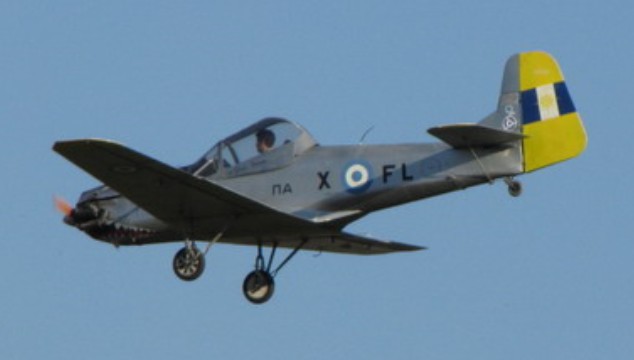
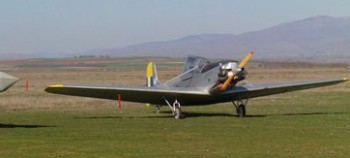
Single seat single engined high wing monoplane with conventional three axis control. Wing has swept back leading and trailing edges, and constant chord; V tall. Pitch/yaw control by elevon; roll control by half span ailerons; control inputs through stick for pitch/roll and yaw. Wing braced from below by struts; wing profile Worthmann FX 63-137; double surface. Undercarriage has three wheels in tail dragger formation; glass fibre suspension on main wheels. Push right go right tailwheel steering connected to yaw control. No brakes. glass fibre fuselage, partially enclosed. Engine mounted at wing height driving pusher propeller. The Pipistrelle was designed by Robert Jacquet. The first second generation microlight to appear in Europe, the prototype (designated P2A) accomplished its first flights at the end of 1981 and the first sales of the production model P2B commenced in March 1982. Built by the Aerostructure company, which specialises in aeronautical sub contract work in civil and military aviation, this machine uses its designer’s experience with composite materials and only the two struts carrying the wing are of Duralumin. The fuselage is made as two half shells of bonded layers, while the wings and tail surfaces are fixed to the fuselage in a similar fashion to that used for gliders. Control surfaces are operated by pushrods with sealed bearings so that the only two cables used on the Pipistrelle are those which steer the tailwheel from the rudder bar. The production aircraft have a JPX PUL425 26 hp engine. The machine is trans¬portable on a road trailer and can be rigged or derigged in 20 minutes by two people. Folded dimensions are 16.8 x 4.0 x 5.3 ft (5.00 x 1.20 x 1.60m). In France it is sold in two forms, either ready built or as a kit needing around 120 hours assembly.
Engine: JPX PUL425, 26 hp at 4600 rpm Propeller dia: 39 inch, 1.00 m Reduction: None Max static thrust: 155 lb, 70 kg. Power per unit area: 0.18hp/sq.ft, 1.9 hp/sq.m. Fuel capacity: 5.3 USG, 4.4 Imp gal, 20.0 litre. Length overall: 16.5 ft, 5.0 m. Height overall: 5.7ft, 1.70m. Wing span: 36.7ft, 11.2m. Constant chord: 3.9 ft, 1.20 m. Dihedral: 0.5deg. Sweepback: 1.5deg Tailplane span: 8.2 ft, 2.50 m. Total wing area: 146 sq.ft, 13.5 sq.m Total aileron area: 11.9sq.ft, 1.11sq.m. Total elevon area: 12.9 sq.ft, 1.20 sq.m Wing aspect ratio: 9.3/1. Wheel track: 3.6 ft, 1.07 m. Wheelbase: 10.6 ft, 3.20m. Tailwheel dia overall: 8 in, 20 cm. Main wheels dia overall: 16 in, 40 cm. Empty weight: 54 lb, 115kg. Max take off weight: 446 lb, 202kg. Payload: 192 lb, 87kg. Max wing loading: 3.06 lb/sq.ft, 15.0kg/sq.m. Max power loading: 17.2 lb/hp, 7.8kg/hp. Load factors: +6, 3 ultimate. Max level speed: 62 mph, 100 kph. Never exceed speed: 75 mph, 120 kph. Max cruising speed: 56 mph, 90 kph. Economic cruising speed: 50 mph, 80 kph. Stalling speed: 24 mph, 40 kph. Max climb rate SL: 600 ft/min, 3.0 m/s. Min sink rate: 200 ft/min at 34 mph, 1.0 m/s at 55 kph. Best glide ratio: 14/1 at 34 mph, 55 kph. Take off distance: 100 ft, 30 m. Land¬ing distance: 82 ft, 25 m. Service ceiling: 10,000 ft, 3050 m. Range average cruise: 155 mile, 250 km.
Since its establishment in 1953, the company’s name has changed in turn from U.R.A. to I.R.Av, I.Av. and finally Aerostar. It has been a subsidiary of the Ministry of Armed Forces, Air Defence Headquarters, General Industrial Direction of the Army, the Ministry of Machine Building Industry as part of the Central Department for Fine Mechanics and Aeronautical Industry, of Bucharest Aeronautical Group or of the National Centre of the Romanian Aeronautical industry.
Aerostar has provided repair and maintenance services for all the aircraft types used by the Romanian military. The company also developed the IAR-93 twin-engine, tactical ground attack and reconnaissance aircraft, the first fighter aircraft built in Romania after World War II. Upgrade programs for the MiG-21 (MiG-21 LanceR) and MiG-29 were developed by Aerostar in co-operation with Elbit Systems.
The company (based in Bacău, Romania) has produced more than 1800 Yak-52 aircraft, in three versions – IAK-52, IAK-52W and IAK-52TW.
Aerostar upgraded the Romanian Air Force’s MiG-21 LanceR aircraft. This program included the development of upgrade programs for the MiG-21, and MiG-21 bis and also the MiG-29 SNIPER upgrade demonstrator program. A modernization program was also carried out on the YAK-52W and YAK-52TW trainers. The LAROM modernization program upgraded the 40 APRA 122 FMC multiple rocket launchers belonging to the army.
Aerostar developed its own light civil aircraft for aerobatics and sport aviation, including the Festival light-sport aircraft.
The company has engaged in international projects with Elbit Systems, Thales Group (Thomson-CSF), EADS (DaimlerChrysler Aerospace) or Textron Marine & Land Systems.
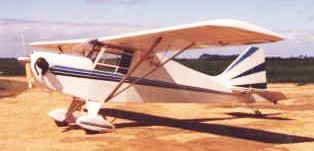
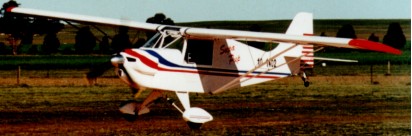
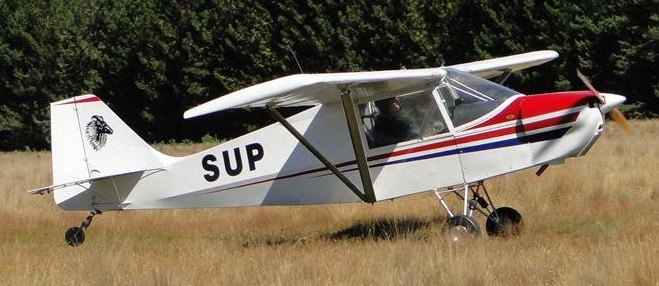
The pedigree of the SUPAPUP goes back to the early eighties when they were being individually hand built in Hahndorf, South Australia. The production gradually built up through Mk.1, Mk.2, and Mk.3 versions. Around 1987, production ceased and the former company disbanded due to having to invest prohibitive amounts of money to comply with stringent Australian aviation rules. Around forty deposit paid orders were refunded. The new company redesigned the concept to incorporate some very saleable features including the Fast Fold wing feature and invested the money necessary to bring the SUPAPUP to full maturity as a production plane made using jigs, and then designed the Aeropup in kit form. The Australian designed and built Supa Pup 2 is a conventional looking strut braced high wing tail dragger built of aircraft grade materials, chrom moly tube fuselage along with aircraft construction methods. The design criteria of the Supa 2 is to cater for the increased demand and reduce the man hour/cost production, the result is a more streamlined comfortable and efficient aircraft with better flight characteristics that still retains all the excellent qualities of the original Supa Pup. Rotax 447 engine is an option.
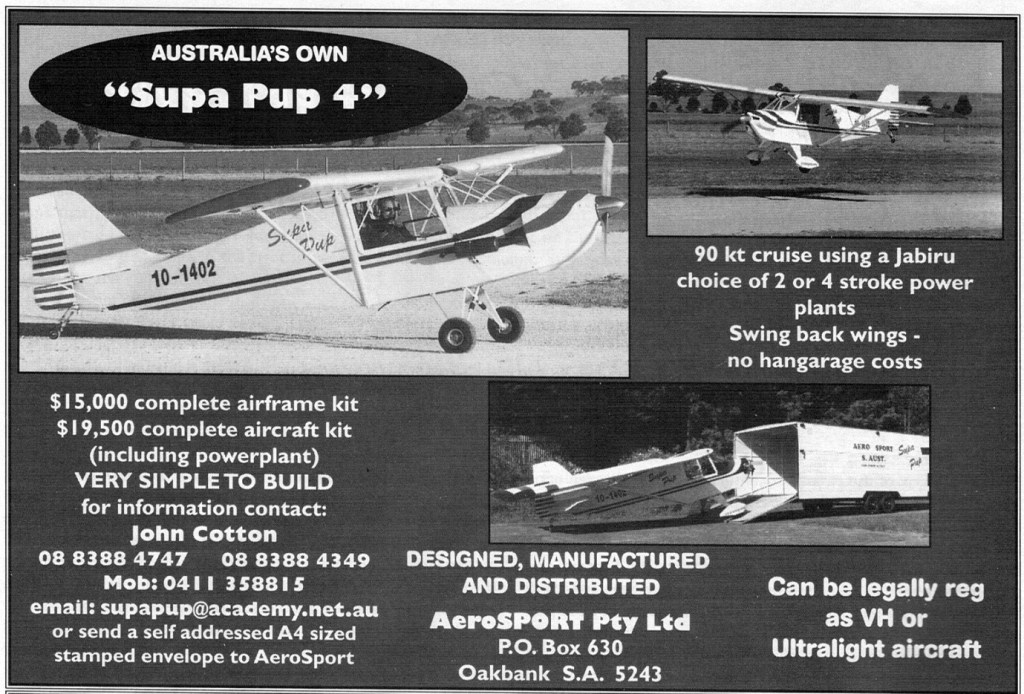
SupaPup Mk.4
Offered the Supa Pup 4 single-seat cabin lightplane in assembled or kit forms (first flown 1994). The Supa Pup 4 features folding wings.
1985: Sport Aircraft Pty Ltd, PO 101 Hahndorf, SA 5245, Australia. The Aerosport name was done away with, due to confusion with others, and the company became Aeropup Aircraft.
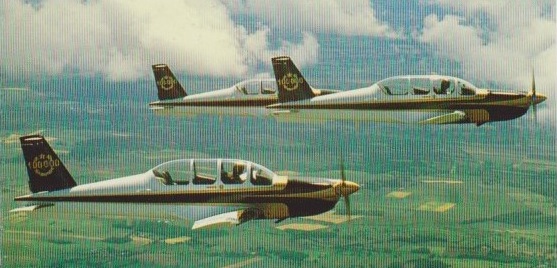
In September 1978 details were given of the Aerospatiale TB-30 piston-engined trainer, designed as a basic light trainer, in collaboration with the Armee de l’Air in response to rising costs before starting jet training. Features include a metal airframe with a life in the military training role of not less than 10,000 hours, a cockpit resembling that of a jet combat aircraft, and equipment for full basic flying training, including aerobatic, instrument, night, formation, navigation, combat manoeuvres and VFR/IFR navigation.
The first of two prototypes flew on 22 December 1977, but delays were caused by redesign of the wingtips, lowering the tail-plane and adding a ventral fin to cure high speed pitch and yaw instability. Deliveries beginning in 1982 from SOCATA, the Aerospatiale subsidiary at Tarbes for the Armee de l’Air, the first of 150 aircraft to the French Air Force was accepted in July 1983. An armed export version of the Epsilon, featuring structural reinforcement, a gunsight, and four under-wing hardpoints to carry up to 300kg of stores, flew in February 1983.
TB-30, Le Luc A/B 26 June 1989
Assembled by OGMA for the Forca Aerea Portuguesa, 18 of the piston-engined Epsilon were ordered by Portugal in October 1987. The Togolaise Air Force operated three Epsilons for dual training/light attack use, with four underwing pylons for a total of 661 lb (300 kg) of stores. Powerplant is a 300 hp (224 kw) Lycoming AEIO-540-L1B5D. On November 9, 1985, an Epsilon flew powered by a TP-319 turboprop. The aircraft was being used as a testbed for the engine, which has been developed by Turbomeca from the TM-319 turboshaft.
On 30 April 1989 SOCATA flew the first example of its turboprop-powered Omega trainer.
Omega is the outcome of re-engining the Epsilon using a 360 shp (269 kW) Turbomeca TP319-1A2. To familiarise students with future jet aircraft, engine power and propeller settings are controlled through a single lever and there is a 31 per cent increase in fuel capacity, allowing Omega to fly two full training missions without refuelling. The airframe has been strengthened to cope with the higher acrobatic weight.
Epsilon Engine: 1 x Lycoming AEIO-540-L1B5D, 300 hp (224 kW)
Epsilon Engine: 1 x Avco Lycoming AEIO-540-K, 225 kW Span: 7.9 m / 25 ft 11 in Length: 7.6 m / 24 ft 11 in Height: 2.7 m / 8 ft 10 in Wing area: 9 sq.m / 96.88 sq ft Empty wt: 932 kg MTOW: 1250 kg Max. speed: 355 km/h / 221 mph Ceiling: 6100 m / 20000 ft Initial ROC: 565 m / min Ceiling: 7000 m T/O run (to 15m): 640 m Ldg run (from 15m): 440 m Fuel internal: 210 lt. Range/Endurance: 1250 km / 3.75 hr Combat radius: 465 km.
Omega Engine: 1 x Turbomeca TP319-1A2, 360 shp (269 kW)
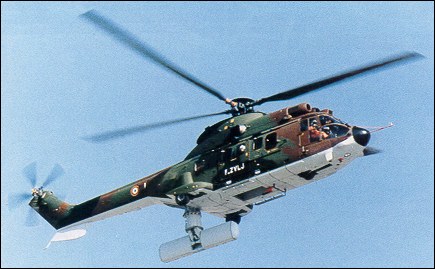
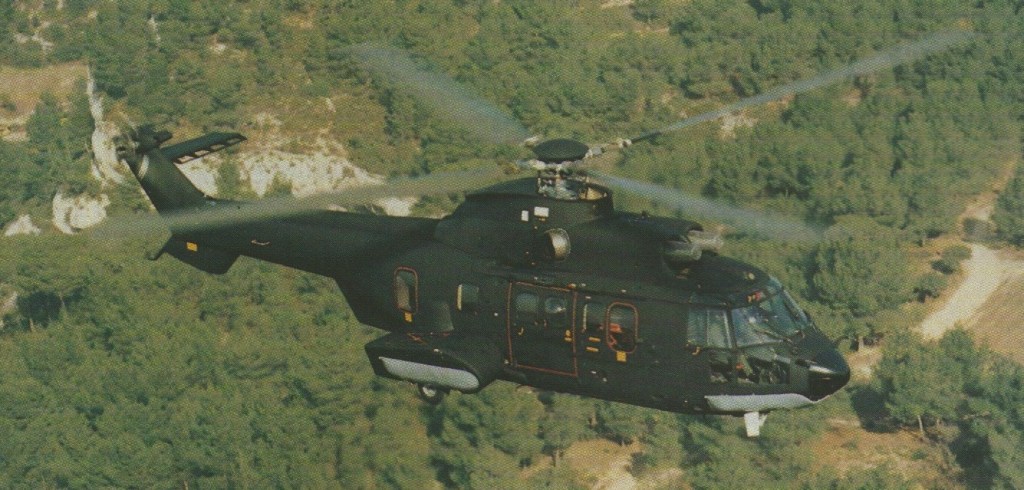
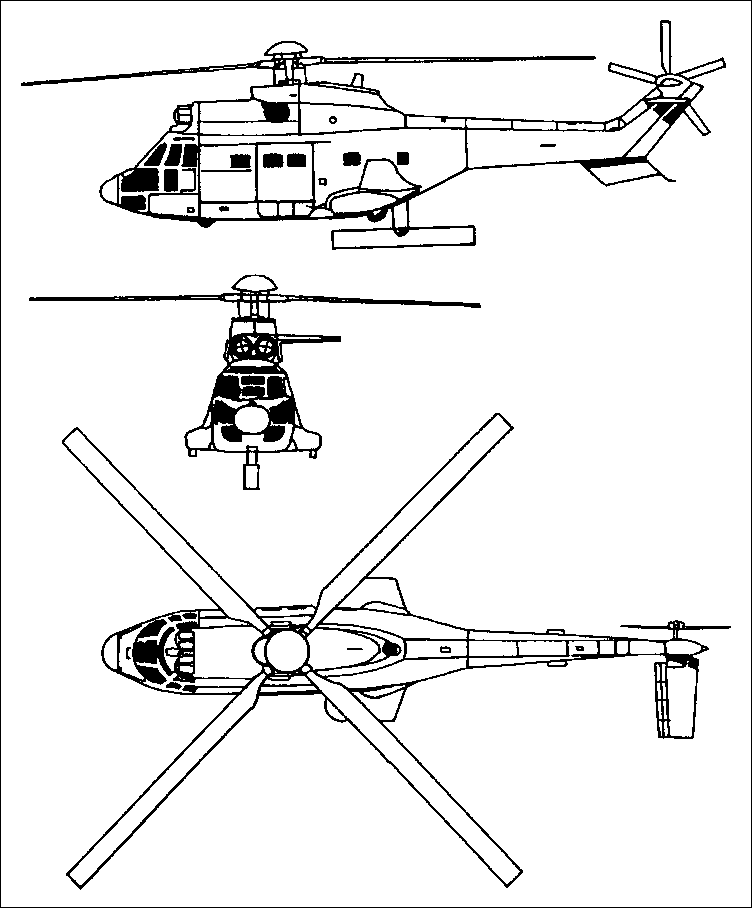
Beginning in 1990, Super Pumas were separated in their civilian and militarized forms by the latter taking on the production designation of AS 532 “Cougar” (civilian models still retained their AS 332 designations). The Cougar family now consists of the AS 532MC Mk I (note the “Mk I” mark designation was retroactively applied to previous Super Puma forms) as a Search & Rescue (SAR) platform, the AS 532SC Mk I as a short-fuselage anti-submarine variant, the AS 532U2 Mk II as an unarmed base model, the AS 532A2 Mk II as another Search & Rescue form, the AS 532L2 Mk II featuring a lengthened fuselage for extra seating and extended main rotor blades, and the simplified AS 532 “Cougar 100” with fixed landing gear. Militarized Super Puma/Cougar aircraft can display a broad range of armaments including 7.62mm general purpose cabin-door machine guns (on pintle mountings), 7.62mm gun pods, rocket pods, anti-ship missiles and various makes of air-to-surface missiles.
The AS 532U2 Cougar Mk.2 incorporated new main and tail rotors, a lengthened rear fuselage and four-tube EFIS cockpit display and digital autopilot. Powered by two 1,877 shp (1400 kW) Turbomeca Makila turboshafts, the standard military AS 532M1 can carry 25 troops while the civil AS 332L1 seats up to 24 passengers.
AS 532 Cougar
Versions include the AS.532SC, navalised; AS.532UC, tactical transport; AS.532AC, armed with pod mounted cannon; AS.532UL, tactical transport; and AS.532AL, armed with pod mounted cannon or side firing cannon. The Horizon system, Helicoptere d’Observation Radar et d’Investigation sur Zone, includes a Cougar AS 532 UL twin-engine helicopter with radar and electronic countermeasures and a ground station. The helicopter surveillance system was originally developed to counter any possible threat by tank fleets of the Warsaw Pact countries. The French Ministry of Defence awarded a development contract to Eurocopter in 1992 initially for two then four AS 532 UL Horizon systems. The first flight of the Horizon Cougar helicopter with the full radar system took place in late 1992. The first AS 532 Horizon was delivered to the French Army in July 1996. The Swiss Air Force, ordered 27. The unarmed AS 532 UL is equipped with a long range multi-mode retractable pulse Doppler radar with a rotating antenna carried beneath the fuselage. The radar range is 200km with the helicopter operating at an altitude of 4000m and a cruise speed of 180 km per hour. The radar scans a ground area of 20,000 sq.km over a depth of 200km in 10 seconds and the data is transmitted to a ground station. For moving targets the radar provides a speed resolution of the target of 2 m/second. The cockpit is night vision goggle compatible and a weather radar is fitted. The navigation equipment includes a Decca navigator and flight log with an SFIM model 155 autopilot, inertial navigation and global positioning system. The engine is fitted with jet efflux diluters and the crew are armour protected. The helicopter is equipped with anti-icing systems. The AS 532 UL Cougar helicopter is equipped with two Turbomeca Makila 1A1 turboshaft engines with the air intakes protected from debris with a grille. Centrisep multipurpose air intakes are provided for operations in high dust/particulate or desert conditions. Six flexible self-sealing fuel tanks have a capacity of 2,020 litres.
AS.532SC Cougar Engine: 2 x Turbomeca Makila 1A1 Instant pwr: 1400 kW MTOW: 9000 kg Payload: 4500 kg Max speed: 135 kts Max range: 800 km HIGE: 9156 ft HOGE: 5413 ft Crew: 2 Pax: 2
AS.532U2 Cougar Mk.2 Engines: 2 x Turbomeca Makila 1A2 turboshaft, 1,845shp Instant pwr: 1570 kW Length: 51.02ft (15.55m) Width: 60.01ft (18.29m) Height: 16.11ft (4.91m) Empty Weight: 10,902lbs (4,945kg) Maximum Take-Off Weight: 21,493lbs (9,749kg) Maximum Speed: 170mph (273kmh; 147kts) Maximum Range: 494miles (795km) Rate-of-Climb: 1,260ft/min (384m/min) Service Ceiling: 13,448ft (4,099m) HIGE: 8525 ft HOGE: 4921 ft Accommodation: 3 + 19 Hardpoints: 2
AS.532UC/AC Cougar Engine: 2 x Turbomeca Makila 1A1 Instant pwr: 1400 kW MTOW: 9350 kg Payload: 4670 kg Max speed: 140 kts Max range: 845 km HIGE: 9196 ft HOGE: 5413 ft Crew: 2 Pax: 21
AS.532UL/AL Cougar Engine: 2 x Turbomeca Makila 1A1 Instant pwr: 1400 kW MTOW: 9350 kg Payload: 4500 kg Max speed: 140 kts Max range: 1245 km HIGE: 9196 ft HOGE: 5415 ft Crew: 2 Pax: 25
AS.532 Cougar AEW Main rotor diameter: 15.60 m Fuselage length: 15.53 m Height: 4.92m MTOW: 9000 kg Cruising speed: 262km/h HOGE: 2300 m Range: 910 km Crew: 4-5
Developed from the turbine powered SA 360 Dauphin, Aerospatiale’s SA 365 introduced twin turbines and became named Dauphin 2 to indicate this. Aerospatiale flew the prototype (F-WVKE) of the SA 365 Dauphin on 24 January 1975. Certificated by the French Government for VFR, the Dauphin 2 should carry 3,478 pounds of payload at a cruise speed of 143 knots. Flown on 24 January 1975, the first SA 365C was powered by two 492 kW (660 shp) Turbormeca Arriel engines.
From the SA.365C model, the AS.365N variant was developed; it looked similar to its predecessor but in fact had 90 per cent new or improved parts. Modifications included extensive use of composite materials for the structure, rotor blades with a different profile, a modified fuselage and a retractable tricycle landing gear. The SA.366G version was developed at the same time as the AS.365N. Designed in response to an order from the US Coast Guard, it differed primarily in using 590 hp (440 kW) American Avco Lycoming LTS-101 engines. An SA 366 Dauphin prototype first flew on 28 January 1975. For the search and rescue missions for which it is intended, the aircraft has sophisticated avionics equipment by Collins. It has two sliding doors, a rescue hoist and can take three stretchers and four assistants. One of the first civil models set a world speed record on 9 February 1980 by flying non-stop from Paris (heliport) to London at an average of over 294km/h, beating this two days later by a direct flight from Paris (Issy-les-Moulineaux) to London at 321.9km/h.
In 1979 the US Coast Guard ordered 90 SA365G-1s (HH 65A Dolphin) for short range recovery tasks which, though not requiring offensive capabilities means the aircraft must have the latest maritime search and surveillance equipment. These all feature the retractable undercarriage and other new features that distinguish the Dauphin IIN from the original SA 365 Dauphin II.
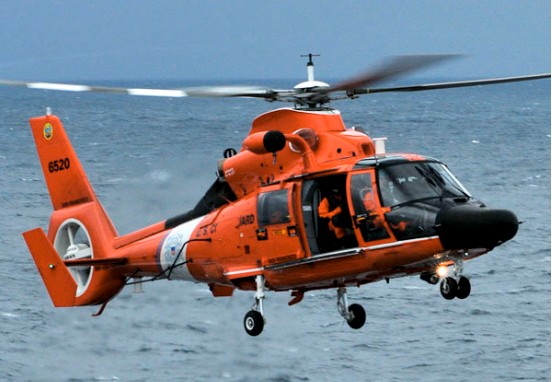
The HH-65 is based on the Eurocopter Dauphin (AS 365N) but despite its origins in the French-made Aerospatiale/Eurocopter system, the HH-65 Dolphin is produced in the United States by American Eurocopter, Textron Lycoming (turboshaft engines) and Rockwell Collins (electronics). First flight was achieved in 1980 and the system was introduce in whole by 1985. In service in the USCG with some 102 total Dolphins making up the Coast Guard HH-65 force.
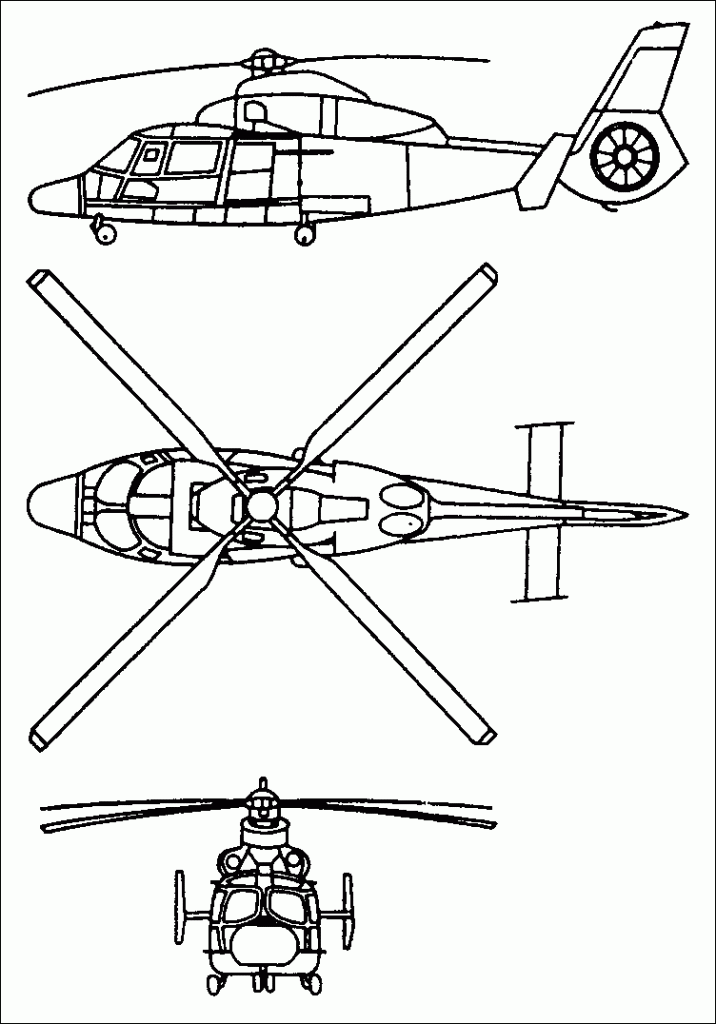
The HH-65 design in characterized by her low-set forward cockpit showcasing a smallish pointed nose assembly and a shrouded Fenestron tail section. The undercarriage is fully retractable and is made up of two single-wheeled main landing gears and a double-wheeled nose gear. Engines are mounted hit and above the crew cabin about midway on the design. The body integrates smoothly into a finely contoured empennage that fits a single vertical tail fin (above the Fenestron shroud) and a horizontal tailpane situated.
Power is derived from twin Turbomeca Arriel 2C2-CG turboshaft engines delivering up to 934 shaft horsepower and driving a corrosion-resistant composite four-bladed main rotor. Maximum speed tops 184 miles per hour with a range of 409 miles and a service ceiling of 15,000 feet. The Dolphin sports an empty weight of approximately 6,333lbs and a maximum take-off weight of up to 9,480lbs. Like the main rotor blades, the fuselage and rotor head are both constructed of corrosion-resistant materials for operations over the salty ocean. In fact, this type of composite construction makes up some 75% of the helicopter design.
Crew accommodations onboard a typical HH-65 model include the pilot, co-pilot, flight mechanic/flight engineer and rescue swimmer. Visibility is rated an excellent thanks to heavy use of glazing in the forward, side and top portions of the cockpit. The flight mechanic is afforded a chair which can slide on rails from one cabin side to the other as needed. The original Dolphin paint design featured a red, white and black scheme but this has since been changed to an overall red (still maintaining the black nose and exhaust sections) for easy visual marking from icebreaker vessels. The change in color has also cut off three days to the overhaul time needed for the aircraft.
The Dolphin maintains a distinct operating capability that allows its autopilot system to bring the aircraft to a hover or fly a designated flight pattern without the need for pilot intervention. This obviously frees up the pilots to other mission matters, particularly when having to visibly scan the surface of the ocean for persons or vessels. Deployment for Dolphins usually originates at land bases but Coast Guard Cutters are designed to take on the type.
The HH-65 has since been spawned into four major versions. The initial production model entered service in 1985 as the HH-65A, fitting twin LTS101-750B-2 series turboshaft engines of 735 shaft horsepower each. This was followed in 2001 by the upgraded HH-65B model with its revised avionics suite, twin global positioning integrated systems and two cockpit-mounted multi-function flat displays. If there was a drawback to the Dolphin system up to now, it lay in her Lycoming-brand engines, forcing the USCG to look through other powerplant options available.
The HH-65C’s were essentially A and B production models fitted with twin the French-made Turbomeca Arriel 2C2-CG turboshaft engines of 934 shaft horsepower each. These powerplants were already proven components of the Eurocopter EC155 series and marked an improvement in both efficiency and reliability over the original set of American-made Lycoming (Honeywell) LTS101-750B-2 turboshafts. Other changes to this model included new gearboxes for main rotor and tail, an 11-blade Fenestron tail rotor, an increase to its MTOW (Maximum Take-Off Weight) and a lengthened nose of new equipment. The first post-conversion C-models were made available in late 2004. A- and B-model Dolphins were retrofitted with the new Turbomeca Arriel 2C2-CG turboshafts and brought up to C-model standard, taking on the designation of HH-65C as well.
The MH-65C is a derivative of the HH-61C with an improved transmission, digital autopilot, revised avionics, increase fuel capacity, increased MTOW and a new 10-bladed tail rotor featuring noise reduction. The MH-65C has been used by the US Coast Guard’s Helicopter Interdiction Tactical Squadron (HITRON) “Force from Above” armed helicopters. Based out of Jacksonville and operating with the Department of Homeland Security, these Dolphins are armed aircraft charged with conducting “Airborne Use of Force” sorties in high drug trafficking areas as well as to counter general security threats in American waters. To compliment this new-found role, the MH-65C’s utilized by HITRON field a 7.62mm M240B general purpose machine gun and a 12.7mm Barrett M107CQ anti-materiel rifle. HITRON Dolphins are also used to guide their accompanying “Over The Horizon Cutter Boats” (OTHCB) to the scene of a given crime for possible interception and/or apprehension. MH-65C “HITRON” Dolphins began operations in 2008.
The HH-65 Dolphin replaced the Sikorsky HH-52A Sea Guards then in service with the United States Coast Guard (USCG).
HH-65
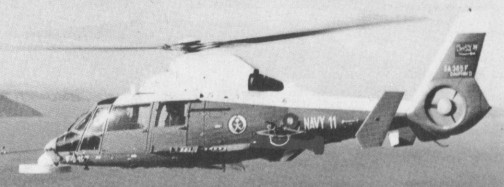
Israel purchased two HH-65s, and in trials operated them from the navy’s fleet of fast patrol craft, plus two HH-65s were used by the US Navy test centre at Patuxent River, Maryland. Powered by two Avco Lycoming LTS101 engines of 507 kW (680 shp) one was a prototype; two of the first five production aircraft were SA 365Gs, one of which was been flying in France with a production-standard 680 shp Avco-Lycoming LTS101-750AA turboshafts while the other was at the Aerospatiale Helicopter Corp, Grand Prairie, Texas, facility for installation and flight testing of the Rockwell-Collins avionics. An even bigger contract gained in 1980 by France, was the vast ‘Sawari’ order for military equipment for Saudi Arabia. Part of this comprised 24 SA 365F Dauphin 2 maritime versions, the final 20 being equipped with four AS.15TT anti ship missiles. This anti ship Dauphin, which is in¬tended to compete with the already existing Lynx with Sea Skua missiles, was developed with Saudi funds and has a Thornson CSI` Agrion radar which provides guidance for the AS.15TT, which itself was financed by this contract. The SA 365K differs considerably by being almost 75 per cent of composite construction, such as Kevlar, The Nomex and carbonfibre. A Dauphin AS 365X set a speed record in March 1991 flying a 3km course. These earlier versions were super¬seded by the standard civilian variant, the SA 365N Dauphin 2 first flying in March 1979, and first seen at the 1979 Paris Air Show and its derivatives, which have a new structure making extensive use of composite materials such as glass¬fibre, Nomex, Kevlar and Rohacell, and with carbon fibre composite in the spars of the rotor blades. The SA 365N also features fully retractable tricycle landing gear, and is one of the fastest of all helicopters, having set many world point to point speed re¬cords including Paris London in 63 mi¬nutes at an average of just over 322 kph (200 mph). The standard AS 365N can accommodate up to 13 passengers. Powerplants are two Turbomecca Arriel 1C1 turboshafts, each rated at 724 shp (540 kW). A naval variant, designated AS 565F, was in production in 1990. Arriel powered military versions of the Dauphin include the AS.15TT-equipped SA.365F for the Saudi Navy, with either an Omera ORB-32 of Thomson-CSF Agrion radar, and the similar but unarmed SA.365F for the Irish Air Corps, fitted with Bendix RDR-L500 search radar and a Crouzet ONS-200A long-range navigation system. A military development of the Dauphin is the multirole SA.365M Panther. A production standard Panther was demonstrated in April 1986, and was planned to be available for delivery in 1988, followed in 1992 by a further-refined version with full day and night combat capability. The SA.365M has a Turbomeca TM333-1M powerplant, and is based on the standard SA.365N airframe, but makes extensive use of composite materials, in addition to having military features such as armoured crew seats, self-sealing fuel tanks, and cable cutters. Engine exhausts are designed for reduced infrared signature, and armament options include 20mm gun pods, rocket pods, Matra Mistral AAMs, and HOT anti-tank missiles with an associated Viviane roof-mounted sight. In the assault transport role eight to ten troops may be carried. French certification (VFR, day and night, category A and B) was awarded to the Aerospatiale SA 365N Dauphin IIN on 9 April 1981.
Aerospatiale AS-365N-2 Dauphin 2
The AS.365N3 with wide 12-passenger fuselage, five-blade main rotor and improved avionics suite, first flew in prototype form on 16 June 1997. It was later redesignated EC-155. Commercial and military sales of the AS 365 Dauphin 2 exceeded 500 aircraft for operators in some 44 countries by 1990. The total also includes production in China as the Harbin Z-9/Z9A, an initial batch of 50 having been due for completion in 1989.
Z-9A
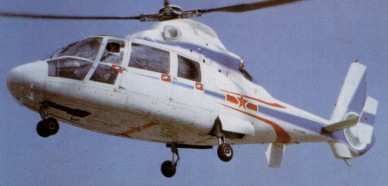
The Harbin Z-9 (Chinese name: Zhishengji-9 / Vertical take-off aircraft 9) are licence-built AS 365N Dauphin 2. A licence agreement (Aerospatiale/CATIC) was signed on 2 July 1980 and the first (French-built) example made the initial acceptance flight in China on 6 February 1982. Chinese parts manufacture began in 1986 for the initial agreed batch of 50, the last of which was delivered in January 1992. The transmission was manufactured by Dongan Engine Manufacturing Company at Harbin, and hubs and tail rotor blades by Baoding Propeller Factory. Production continued under a May 1988 domestic contract. Plans to introduce the Arriel 2C were announced in mid-2001, following delivery of two of these engines in April. The first flight was achieved in September 2001.
A total of 110 (all versions) were reportedly built by mid-2001 and eight H410As were ordered mid-2002 by Far Eastern Leasing Company, China State Oceanic Administration and Zhoushan Civil Aviation Development Company. Most early production was for Chinese armed services (People’s Navy Aviation and Army Aviation each at least 25) and People’s Armed Police (four delivered 12 September 2001). The type entered service with two PLA army groups in January and February 1988 (Beijing and Shenyang Military Regions respectively). The People’s Navy Aviation was believed to use Z-9A for commando transport as well as shipboard communications. Ten were based at the former Royal Air Force airfield at Sek Kong in the third quarter of 1997, following the 1 July handover of Hong Kong by UK. The first export was made in late 2000 (two to Mali Air Force).
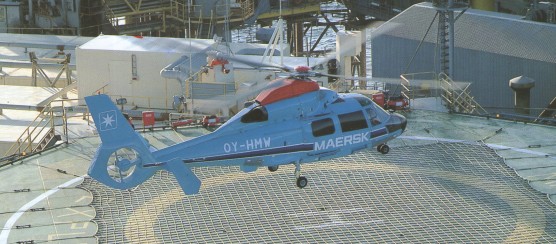
Civil models were used for various duties including offshore oil rig support and air ambulance (four stretchers/two seats or two stretchers/five seats). In 1992, Flying Dragon Aviation received two (late production Z-9s, augmenting an Aerospatiale Dauphin) which are operated on behalf of the Ministry of Forestry. Five civil Z-9s ordered by Shenzhen Financial Leasing Company (SFLC) in 2001. One Z-9A was deployed to Arctic regions in mid-1999, on a scientific survey ship.
The multi-role SA 565UA Panther is a military development of the twin-engined SA 365 Dauphin first flown on 29 February 1984. Based on the standard SA.365N1 airframe, the primary changes include more composite materials and armoured crew seats to maximize survivability in combat zones, the introduction of Turbomeca TM333-1M turboshafts with a continuous rating of 751shp, and the provision of equipment to permit the use of armament and to allow for night operations. Fuselage-mounted outriggers can carry air-to-ground weapons such as rocket or gun pods and/or air-to-air Matra Mistral missiles. For the assault role, up to ten troops can be carried, or external freight up to 3,515 lb (1 600 kg). First customer was the Brazilian Army, which had ordered 42.
Aerospatiale AS.565 Panther
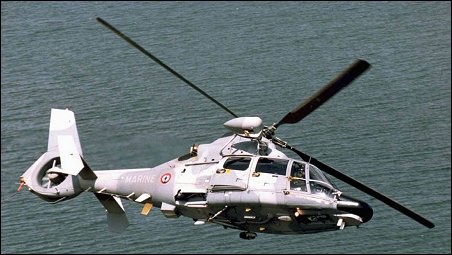
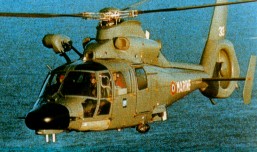
The SA575-SA is a navalised derivative of the Panther light military helicopter, itself a derivative of the Dauphin. The AA version can be equipped with pod mounted cannon etc, the MA is a SAR version, and the SA is armed for anti-ship or ASW. Chile operates four AS 565 MAs fitted with radar warning and Exocet missiles and Saudi Arabia uses AS 565s equipped with the AS.15TT short-range anti-ship missile. Also licence built by Harbin as the Z-9.
Principal versions: SA.365 Dauphin 2 SA.360 fitted with two 650shp Turbomeca Arriel 1A turboshafts Prot. F-WVKE FF 24 Jan. 1975. Second prot. F-WVKD used for testing retractable u/c.
SA.365C Dauphin 2 Civil production version of SA.365 with 3382kg TOGW.
SA.365C1 Dauphin 2 SA.365C with 667shp Arriel 1A1 turboshafts.
SA.365C2 Dauphin 2 SA.365C with 670shp Arriel 1A2 turboshafts, 3480kg TOGW and modified transmission system.
SA.365N Dauphin 2 SA.365C with retractable tricycle u/c, lengthened cabin with max 11 pax separated from crew, pointed nose, composite rotors new air intakes and redesigned under-floor fuel tanks. 710shp Turbomeca Arriel IC turboshaft, 3977kg TOGW. FF 31 Mar. 1979. Prot. F-WZJD.
SA.365N1 Dauphin 2 SA.365 with 724shp Arriel 1C1 turboshafts, 4076kg TOGW and recontoured lower tail section eliminating ventral fin.
AS.365N2 Dauphin 2 SA-365N with two 763shp Turbomeca Arriel 1C2 turboshafts, new gearbox, 4226kg TOGW.
AS.365N3 Dauphin 2 AS.365N with quiet tail rotor and two Arriel 2C turboshafts. Prot. FF Oct. 1996.
AS.365N4 AS.365N3 with wide 12-passenger fuselage, five-blade main rotor and improved avionics suite. Prot. FF 16 Jun. 1997. Redesignated EC-155.
SA.365F Dauphin 2 Navalised SA.365N for Saudi Arabia etc. With pointed radar nose and either under-nose radar dish or antisubmarine missile system and 700shp Arriel 1M turboshafts. Prot. F-WZJD FF in this form 22 Feb. 1982.
SA.365M Dauphin 2 Army light tactical version of SA.365N1 with 12-troop capacity. Powered by two 913shp Turbomeca TM.333-1M turboshafts. 4077kg TOGW. Prot. F-WZJV FF 29 Feb. 1984. Later named Panther.
Harbin Z-9 Initial Chinese version, equivalent to French AS 365N1 and assembled from French-built kits: 28 completed.
Harbin Z-9A Follow-on kit-built version, to AS 365N2 standard. Final 22 of first 50 were of this version.
Harbin Z-9A-100 Effectively, prototypes for domestic licence-built version, with WZ8A engines and much increased local manufacture (72.2% of airframe and 91% of engine). Two built; first flight 16 January 1992; flight test programme completed 20 November 1992 after almost 200 flight hours (408 flights); Chinese type approval received 30 December 1992.
Harbin Z-9B First indigenous production version, based on Z-9A-100. Modified Fenestron with 11 wider-chord, all-composites blades instead of 13 metal blades as in AS 365N1. Principal unarmed PLA version for SAR, artillery direction, EW, troop transport (accommodates eight), communications and other utility duties. Certified also for domestic commercial operations 19 April 2001.
Harbin Z-9C Version for PLA Naval Air Force, for deployment aboard certain classes of destroyers and frigates; in service by late 2000. Believed to be equivalent to Arriel 2-engined Eurocopter AS 565 Panther, but equipped with Thales HS-12 dipping sonar and KLC-11/J-band (Chinese version of Agrion 15) surface search radar; armament includes two Yu-7 torpedoes or TV-guided C-701 anti-surface vessel missiles.
Harbin WZ-9 Armed (wuzliuang) version (also reported as Z-9W); eight Norinco HJ-8 (Hongjian: Red Arrow) wire-guided anti-tank missiles, twin 12.7mm machine gun or 23mm cannon pods, or twin 57 or 90mm rocket pods, and gyro stabilised, roof-mounted optical sight. First flight thought to have been in early 1989; in production. Export designation Z-9G, available with or without roof-mounted sight.
Harbin H410A Version with 635kW Arriel 2C (WZ8C) turboshafts for improved ‘hot-and-high’ performance. (Designation signifies 4.10 tonne MTOW.) First flight September 2001; CAAC certification 10 July 2002. Initial orders for eight.
Harbin H425 VIP version of H410A (thus 4.25 tonne MTOW); improvements to rotor system, fuel system and structure (crashworthiness), avionics and interior layout.
AS.365K Panther SA.365M with 748shp Arriel 1M1 turboshafts. Redesignated AS.565.
X.380 Dauphin SA.365N with combined composite rotor hub/mast, 5-blade rotor with swept tips, and 837shp Turbomeca Arriel IX turboshafts.
AS.366G / HH-65A Dolphin Three-seat SA.365N for US Coast Guard short-range recovery tasks with internal stretcher fittings, rescue hoist, pop-out flotation bags etc. 4027kg TOGW. Powered by two 680shp Textron-Lycoming LTS.101-750A-1 turboshafts. Prot. USCG.4101 FF 23 Jul. 1980. Four built.
AS.366G1 Dolphin Production AS.366G with LTS.101-750B-2 turboshafts and 4036kg TOGW. 92 built.
Specifications:
AS365 Dauphin 2 Engine: 2 x Turbomeca Arriel turboshafts, 650 hp (485 kW)
AS365C Dauphin 2 Engine: 2 x Turbomeca Arriel 1A, 651 / 670 shp TBO: 2000 hrs Main rotor: 39.1 ft / 11.68m Seats: 14 Length: 44.2 ft / 13.29m Height: 13.2 ft / 3.5m Max ramp weight: 8490 lb Max takeoff weight: 8490 lb Standard empty weight: 4314 lb Max useful load: 4176 lb Max landing weight: 8490 lb Max sling load: 3748 lb Disc loading: 7.1 lb/sq.ft Power loading: 6.1 lb/hp Max usable fuel: 2336 lb Max rate of climb: 1515 fpm Service ceiling: 15,000 ft HIGE: 3445 ft HOGE: 3445 ft Max speed: 165 kt Normal cruise @ 3000 ft: 150 kts Fuel flow normal cruise: 648 pph Endurance normal cruise: 3.4 hr Pax seats: 13
SA 365F Dauphin 2 Engines: 2 x Turbomeca Arriel turboshafts, 710 shp (529 kW) Max cruise SL (clean): 252 km/h (156 mph) Max cruise alt. (clean): 259 km/h (161 mph) Max speed: 280 kph Fuel cap: 1140 lt Range (max fuel, SL): 898 km (558 miles) Endurance (max fuel): 4 hrs 25 min Endurance (two missiles): 3 hrs 45 min Endurance (four missiles): 2 hr 45 min Empty weight: 2141 kg (4,720 lb) MTOW: 3900 kg (8,598 lb) No. Blades: 4 Main rotor diameter: 11.93 m (39 ft 1¾ in) Fuselage length: 12.11 m (39 ft 8¾ in) Height: 3.99 m (13 ft 1 in) Main rotor disc area: 111.7 sq.m (1,202.4 sq.ft) Crew: 2 Pax: 9 Armament: four Aerospatiale AS.15TT radar guided missiles.
SA 366 Dauphin Engines: 2 x Avco Lycoming LTS 101 turboshafts, 590 hp (440 kW)
Aerospatiale / Eurocopter HH-65C Dolphin Engines: 2 x Turbomeca Arriel 2C2 turboshaft, 853shp Length: 44.29ft (13.5m) Height: 12.80ft (3.90m) Maximum Speed: 137mph (220kmh; 119kts) Maximum Range: 345miles (555km) Service Ceiling: 7,510ft (2,289m) Armament HITRON Dolphins: 1 x 7.62mm M240B General Purpose Machine Gun 1 x 12.7mm M107CQ Anti-Materiel Rifle Accommodation: 4 Empty Weight: 6,173lbs (2,800kg) Maximum Take-Off Weight: 20,900lbs (9,480kg)
SA.365N2 Dauphin II Engine: 2 x Turbomeca Arriel 1C2 or 2 x Turbomeca 1M1 Instant pwr: 550 or 570 kW Rotor dia: 11.9 m MTOW: 4250 kg Useful load: 1970 kg Max cruise: 150 kts Max range: 880 km HIGE: 8365 ft HOGE: 5905 ft Seats: 14
Aérospatiale SA 365 M Panther Engine: 2 x Turbomeca TM 333-1M, 672 shp Length: 39.698 ft / 12.1 m Height: 13.123 ft / 4.0 m Rotor diameter: 39.042 ft / 11.9 m Max take off weight: 9040.5 lb / 4100.0 kg Weight empty: 5071.5 lb / 2300.0 kg Max. speed: 148 kt / 275 km/h Cruising speed: 138 kt / 255 km/h Initial climb rate: 1574.8 ft/min / 8.0 m/s Service ceiling: 15420 ft / 4700 m Range: 421 nm / 780 km Fuel capacity: 300 gal / 1135 lt Crew: 2 Payload: 8-10 pax
Harbin Z-9A Engine: 2 x South Aeroengine Co WZ8A Instant pwr: 527 kW Rotor dia: 11.9 m MTOW: 4100 kg Empty weight equipped: 2050kg Payload: 1660 kg Useful load: 2038 kg Fuel capacity 1,140 lt / opt. 180 litre aux Max speed: 159 kts / 315km/h Max cruise sea level: 153 kts / 280km/h Max range at 250km/h, standard tanks: 860 km HIGE: 8530 ft / 2150m HOGE: 5900 ft / 1150m Service ceiling: 19,685 ft / 6000m Max vertical rate of climb: 252m/min Max forward rate of climb: 396m/min Crew: 2 Pax: 12
AS.565AA Panther Engine: 2 x Turbomeca Arriel 1M1 Instant pwr: 570 kW MTOW: 4250 kg Payload: 1600 kg Max speed: 147 kts Max range: 860 km HIGE: 6726 ft HOGE: 4101 ft Crew: 2 Pax: 10
AS.565MA/SA Panther Engine: 2 x Turbomeca Arriel 1M1 Instant pwr: 558 kW MTOW: 4250 kg Payload: 1600 kg Max speed: 147 kts Max range: 875 km HIGE: 2726 ft HOGE: 4101 ft Crew: 2 Pax: 10
AS.565UA Panther Engine: 2 x Turbomeca Arriel 1M1 Instant pwr: 570 kW MTOW: 4255 kg Payload: 1600 kg Max speed: 147 kts Max range: 858 km HIGE: 6726 ft HOGE: 4101 ft Crew: 1 Pax: 10
Eurocopter Panther 800 Engine: 2 x LHTEC T800-800 Instant pwr: 657 kW MTOW: 4250 kg Max speed: 143 kts Max range: 778 km HOGE: 6500 ft Crew: 2 Pax: 10