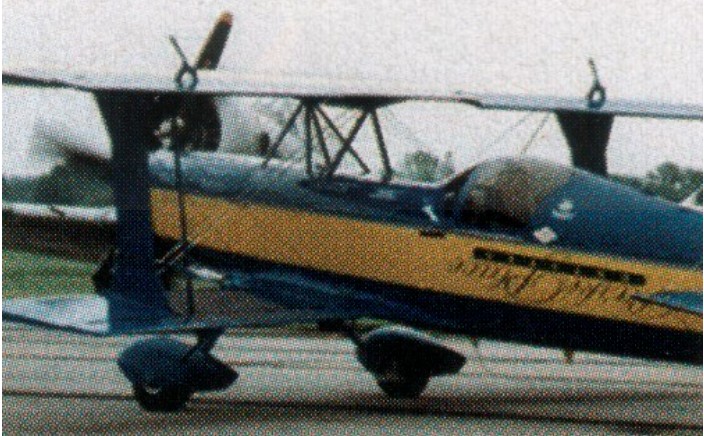
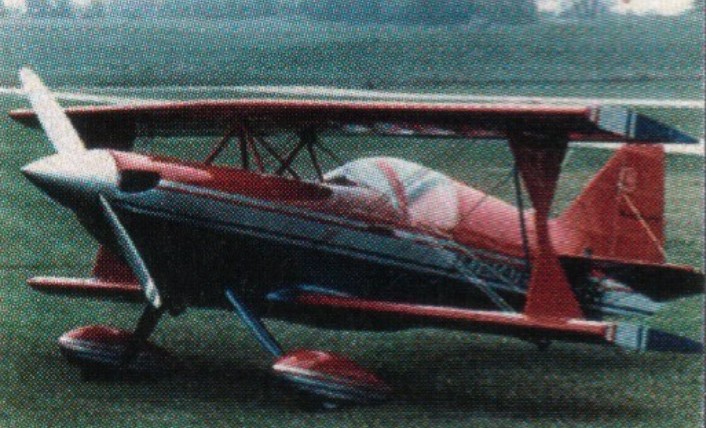
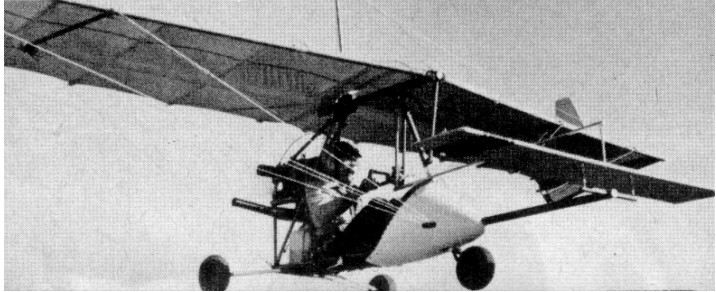
Ultra-Classics Bearcat

Centre mounted joy stick, rudder pedals, tail wheel steerable through rudder pedals.
Construction: Aluminium, Dacron, Chrome-moly

Engine: Kawasaki 440 (436 cc) 40 hp
Static thrust: 230 lbs
Wing span: 29’6”
Wing area: 147.5 sq.ft
Height: 6’
Length: 17’6”
Fuel cap; 5 USG
Empty wt: 261 lbs
Max wt: 500 lbs
Stall: 26 mph
Max speed: 64 mph
Vne: 75 mph
Climb rate: 650 fpm
Design limit: +6, -4g
Glide ratio: 8-1
Wing loading: 3.39 lbs/sq.ft
Power loading: 12.5 lbs/hp

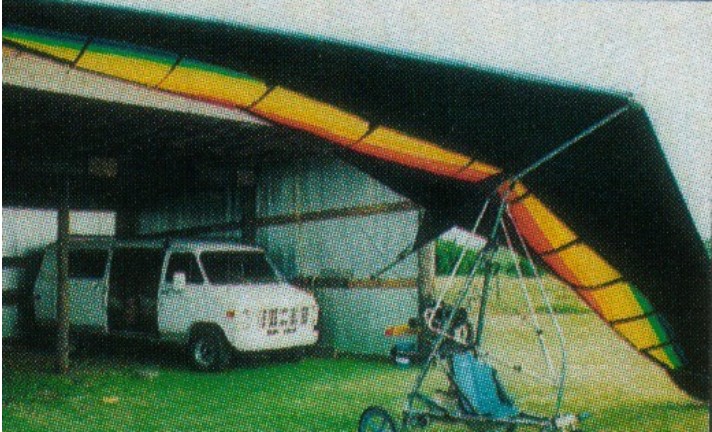
Ultimate Flite Designs Super Jetwing II ATV

Circa 1998. Manufactured in the US, the Jetwing ATV is Part 103 legal.

Super Jetwing II ATV
Engine: Fuji-Robins, 50 hp
HP range: 30-50
Length: 12 ft
Wing span: 33.6 ft
Wing area: 175 sq.ft
Height: 12 ft
Empty weight: 217 lb
Gross weight: 480 lb
Fuel capacity: 5 USG
Top speed: 48 mph
Cruise: 42 mph
Range: 100 sm
Rate of climb: 1000 fpm
Takeoff dist: 100 ft
Landing dist: 100 ft
Service ceiling: 10,000 ft
Seats: 1
Landing gear: nosewheel

Ultimate Flying Object / UFO Helithruster / Gillespie Helithruster

The UFO-HeliThruster was developed in the backcountry of New Zealand, designed by Mac Gillespie from the floor up. This is not a re-vamp of an old idea. UFO wanted a great engine and an equally good PSRU, and made their own. Its a gear driven design with a ratio of 2.3 to 1. The craft can lift and fly with more than a 1600-pound bulk weight. The UFO-HeliThruster is capable of flying 600 miles (960 kms) on one fill at the “regular” petrol pump and that is with a 1/2 hour fuel safety margin.

The performance of the UFO-HeliThruster is the EJ25 engine gives 164hp the power from that goes through a 2.3-1 PSRU (Propeller speed reduction unit – or “Gearbox”) that feeds a prop. (72″ – 76″) inch propeller. The UFO-HeliThruster has more stability and thus a larger safety margin than other gyros because the tail surfaces are larger and give good lateral plane area.

The UFO-Heli-Thruster’s fuselage is higher from the ground than most gyros. This when added to the fact that the rotor blades are also a little higher above the cockpit that on “standard” gyros results in greater safety, avoiding rotor strike. Also, the UFO-HeliThrusters design distance between the rotor disc and the thrust line of the engine is greater as well. Again, this increases safety by making it less prone to “tumble” (PPO) the gyro forward due to overly large control/throttle input combinations.

The UFO was first drawn in 1991, it took two years for the first prototypes to be constructed and flown, 1993.
They were flown as UFO’s in 1996. The first official flight took place in December 1997, and UFO’s were exported in the same year but remained a Southern Hemisphere phenomenon. One person initially built the UFO and every single part, and the quantity reflects that, there were 23 completed, 9 exported.

In July 2000 the decision was made to broadcast the UFO.

The UFO-HeliThruster has a large usable interior space, with a 1.1 meter (39 inches) of space available from on top of the seat to the cabin ceiling, and 1.2 meter (47 inches) of leg space from the back-rest of the seat to the pedals.
The UFO-HeliThruster’s performance has a climb rate at 1500 foot per minute. The UFO-HeliThruster can climb at 1500 foot per minute while maintaining a forward speed (TAS) of 90 miles per hour.

Designed by New Zealander’s Mac Gillespie and Geoff Price, UFO stands for Ultimate Flying Options. The first six were manufactured at Auckland, NZ. The test flying was carried out by Alf Crowe at Feilding, New Zealand.

The price for a complete kitset (2009) was NZ$63,000 or a factory prepared and Ready to Fly UFO-HeliThruster at NZ$75000.

The airframe is aeronautical aluminium, tig welded. Fiberglass/composite fuselage canopy. Fiberglass wheel pants. Fiberglass instrument panels. Controls are Dual Rudder and Throttle control and central Stick.

Standard equipment includes Electric Starter, ASI “0-160” mph, Mechanical Prerotator, Rotor Brake, Wheel Brakes, Steering, Wheel Pants, Altimeter, VSI, Compass Rotor Tach, and Hobbs.

UFO/PSRU-G
Engine: Subaru EJ25, 4 cylinders, 4-stroke, water-cooled, 165 hp
Displacement: 2500cc
Ignition: ECU Single Spark per cylinder
Reduction ratio: 2.3:1
Propeller: Composite 72-74 in 3-blade carbon fiber ground adjustable pitch
Rotor: 29-33ft two-blade, extruded aluminium.
Blade Cord: 8 1/2 in
Length: 13 ft 1.5 in / 4.000 m
Height: 10 ft 2 in / 3.100 m
Width: 7 ft 2.5 in / 2.200 m
Gross Weight: 1600 lb
Dry Weight: 950 lb
Payload: 650 lb
Fuel Capacity: 22 Imp.gal / 100 lt / 26 US gal
Unusable Fuel: 0.75 US gallon / 3 lt
Consumption: 3.75 US gph / 15 lt/hr
Top speed: 120 mph
Cruise speed: 100 mph
Never exceed (Vne): 150 mph
Takeoff distance: 50 to 150 ft
Landing distance: 50 ft
Takeoff over 50 ft obstacle: 100 ft
Climbing rate: 1,500 fpm
Service ceiling (est.): 10,000 ft
Range at cruise speed: 600 miles / 960 km
Endurance: 6 hours + 1/2 hour reserve
Rudder: 1.6 m high x 800 mm
Shoulder room: 1400mm / 55 in
Headroom: 1100mm / 43 in
Legroom: 1200mm /47 in
Cabin Width doors on: 1400mm / 55 in
Cabin Length: 1680mm / 66 in
Cabin Height: 1370mm / 54 in

Ultimate 10-200

Ultimate Biplane Corp 10-200
Engine: Lycoming O-360, 200 hp
HP range: 200-230
Length: 17.4 ft
Wing span: 16 ft
Wing area: 96 sq.ft
Empty weight: 925 lb
Gross weight: 1350 lb
Fuel capacity: 22 USG
Cruise: 170 mph
Stall: 60 mph
Range: 580 sm
Rate of climb: 2000 fpm
Takeoff dist: 450 ft
Landing dist: 500 ft
Seats: 1
Landing gear: tailwheel

Ultimate

Ultimate Aerobatics Ltd.
Ultimate Aircraft Corp
Ultimate Biplane Corp

Canada
Put on to market in 1980s kits to modify Pitts Special aerobatic biplane to improve performance.

Ultimate Aircraft Corp was founded 1990 to market modified Pitts Special aerobatic biplane in plans, kits and assembled forms, plus series of aerobatic/competition biplanes as 10 Dash 100,10 Dash 200,10 Dash 300 single-seaters, and two-seat 20 Dash 300.

Ultavia Aircraft Ultavia

Single seat single engined high wing mono¬plane with conventional three axis control. Wing has swept back leading and trailing edges, and constant chord; no tail, canard wing. Pitch control by fully flying canard; yaw control by tip rudders; roll control by spoilers; control inputs through yoke for pitch/roll and pedals for yaw. Wing braced from above by kingpost and cables, from below by cables; wing profile; single surface. Undercar¬riage has three wheels in tricycle formation; suspension NC on nosewheel and glass fibre suspension on main wheels. Push right go-¬right nosewheel steering connected to yaw control. Brake on nosewheel. Aluminium tube framework, with pod. Engine mounted below wing driving pusher propeller. Rudders and canard are covered in Stits polyriber fabric.

The prototype having made its first flights at the end of the summer in 1982. The prototype used a KFM 107ER motor which gives, according to Ultavia Aircraft, 25 hp at 6300 rpm and is becoming optional on the production models, the standard version coming with a Cuyuna 430R; a 2/1 reduction drive system for the 430R is also optional for $300 extra. The Ultavia is fitted with a yoke, rather than a stick. Its spoilers can be used differentially to control roll and together to act as air brakes. This machine comes as standard with a glass fibre nose cone, fitted with a Lexan transparent windscreen. The accent is put by the manufacturer on rapid rigging and de rigging, with single ¬surface resin impregnated Dacron wings which can be rolled up around the spars and stored in a bag, like a Rogallo wing. A genuine 15 min rigging time is claimed.

The Ultavia will be available during the summer of 1983, as a kit requiring 30h assembly at a price of $4595 (with a Cuyuna 430D) or factory built for $5395. A KFM 107ER engine costs $640 extra; an instrument panel is also available.

Engine: Cuyuna 430R
Max power 30hp at 5500rpm
Propeller diameter and pitch 54 x 17 inch, 1.37 x 0.43 m
Belt reduction, ratio 2.0/1
Power per unit area 0.19 hp/sq.ft, 2.1 hp/sq.m
Fuel capacity 5.0 US gal, 4.2 Imp gal, 18.9 litre
Wing span 32.0ft, 9.75m
Constant chord 5.0 ft, 1.52 m
Main wing area 155 sq.ft, 14.4 sq.m
Main wing aspect ratio 6.6/1
Nosewheel diameter overall 11 inch, 28 cm
Main wheels diameter overall 11 inch, 28cm
Empty weight 230 lb, 104kg
Max take off weight 480 lb, 217kg
Payload 250 lb, 113kg
Max wing loading 3.09 lb/sq.ft, 15.1kg/sq.m
Max power loading 16.0lb/hp, 7.2kg/hp
Never exceed speed 55mph, 88kph
Stalling speed 24mph, 39 kph
Best glide ratio with power off 10/1
Take off distance 150 ft, 45 m
Service ceiling 13,000 ft, 4000 m