Airtour Balloon Co Limited was incorporated on 26 September 1983.
By 22 Sep 1996 Airtour Balloon Co was inactive.
Airtour Balloon Co Limited was incorporated on 26 September 1983.
By 22 Sep 1996 Airtour Balloon Co was inactive.

Explorer motorised hang glider harness, by Airtime.
Radne Raket 120cc 2 stroke motor factory modified for FLPHG, 15Hp. Pull start, manual decompression.
Suits pilot 5 ft 8 in to 6 ft 2 in
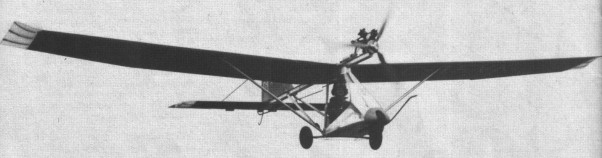
The Skylark is high-wing with a forward engine mounted on a cantilever beam fuselage. The forward-swept wing is rectangular with a tapered trapezoidal tip, and is supported by a single strut. Tail surfaces are classic, and tricycle landing gear is used. The engine and propeller are well forward of the cockpit. The forward-swept wing and under-wing cockpit location produce good visibility; pilot weight has minimal effect on the aircraft’s center of gravity; and the ideal spanwise lift distribution inhibits stalling of the wingtips, ensures against spinning and signals approaching stall by buffeting of the tail surfaces. Two people can easily disassemble the Skylark. By removing three bolts, the horizontal tail surfaces can be folded up against the fin. Each wing can be detached by removing only four bolts. The Skylark wing profile was designed by NASA using technology specially for use in slow-flying aircraft. Features in¬clude low drag in the range of useful air¬speeds, low stall speed, and mild stall characteristics (which are fully exploited by the forward-swept wing to produce a “spinproof” design). Aluminium sheet, extruded tubes and angles, all of general-aviation proven 2024 alloy are used throughout. Airtech uses modern adhesive bonding technology, along with blind and solid rivets. High-strength PVC foam, stamped aluminum ribs, silky-smooth Teflon bellcrank bearings, aluminum pushrods with spherical couplings, “Ceconite 7600 Process” aircraft fabric, precision molded fiberglass fairings, molded plexiglas windscreen all combine to satisfy the most demanding aviators. The standard airspeed indicator, altimeter, tachometer and toe-operated disk brakes are as comforting to the pilot as the contoured seat designed for those up to 6 feet, 6 inches, with “stick-and-rudder” controls. The Skylark uses the Konig SD-570 four-cylinder radial. Using a 2.8:1 reduction drive, the Skylark’s engine turns its 72-inch propeller at only 1500 rpm during takeoff; the result is exceptional static thrust and the virtual elimination of propeller noise.
Engine: Koenig SD-570 4-cyl radial two-stroke
Reduction: 2.8:1
Prop: 72 in
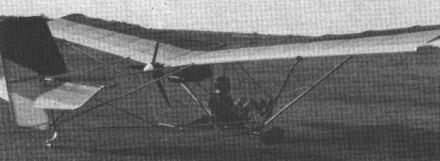
Engine: Rotax 377
Wing span: 30 ft
Fuel cap: 4.5 USG

Developed by CASA of Spain and IPTN of Indonesia, and marketed by the joint company of Aircraft Technology Industries (AirTech), the CASA/IPTN-designed, General Electric CT7-powered CN-235 first flew in I November 1983. In military configuration a 15,000kg payload may be carried, comprising 48 passengers, 41 paratroops, or 24 stretchers.
Orders to 1990 were nearing 200, with a majority for military operators, including the air arms of Spain Indonesia and those of France, Saudi Arabia, Ecuador, Botswana, Panama, Morocco and Turkey – where the CN-235 will also be assembled.
Export deliveries began in February 1987, when the Royal Saudi Air Force received the first of four aircraft. Jordan
ordered two in 1985, while the Indonesian armed forces will receive 50, comprising 32 for the Air Force and 18 for the Navy. At least six of the latter will be of the maritime surveillance version, with equipment including a 360 degree-scan search radar, AM.39 Exocet anti-shipping missiles, and Mk.46 torpedoes.
CN.235-100
Engine: 2 x GE CT7-9C turboprops, 1,870 shp (1 394 kW)
Installed pwr: 2536 kW
Span: 25.8 m
Length: 21.3 m
Wing area: 73 sq.m
Empty wt: 8600 kg
MTOW: 14,400 kg
Payload: 5000 kg
Cruise speed: 454 kph
Initial ROC: 540 m / min
Ceiling: 8110 m
T/O run: 554 m
Ldg run: 585 m
Fuel internal: 5268 lt
Range/payload: 600 km with 5000 kg
Capacity: 38/40 pax
Aircraft Technology Industries founded 1980 by IPTN of Indonesia and CASA of Spain. Produces the 44- passenger CN 235 twin-turboprop regional airliner and CN 235 M military freighter variant (plus Persuader and MPA medium-range maritime patrol/surveillance, anti-submarine, anti-surface vessel, over-the-horizon targeting, and search and rescue variants). The C 295 stretched version offers 50 percent more capacity (for typically 69 troops or freight).
Paraglider circa 1998.
Njam Njam 30
Wing area: 30sq.m
No. of cells: 80
Wing span: 13.42 m
Aspect ratio: 6
Paraglider circa 1998.
Gamma L
Wing area: 28.7 sq.m
Pilot weight: 80-100 kg
No. of cells: 70
Wing span: 12.3 m
Aspect ratio: 5.27
Min sink: 1 m/s
Max speed: 50 kph
Gamma M
Wing area: 25.7 sq.m
Pilot weight: 70-90 kg
No. of cells: 70
Wing span: 11.3 m
Aspect ratio: 4.97
Min sink: 1 m/s
Max speed: 50 kph
Gamma XL
Wing area: 31.2 sq.m
Pilot weight: 95-120 kg
No. of cells: 74
Wing span: 13.1 m
Aspect ratio: 5.4
Min sink: 0.9 m/s
Max speed: 50 kph
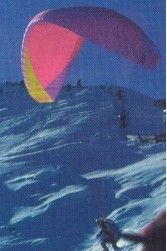
Paraglider circa 1998.
Beta L
Wing area: 27.8 sq.m
Pilot weight: 80-100 kg
No. of cells: 58
Wing span: 12.1 m
Aspect ratio: 5.2
Min sink: 1.3 m/s
Max speed: 45 kph
Beta M
Wing area: 27.5 sq.m
Pilot weight: 60-70 kg
No. of cells: 70
Wing span: 11.3 m
Aspect ratio: 4.97
Min sink: 1 m/s
Max speed: 45 kph
Beta XL
Wing area: 31.2 sq.m
Pilot weight: 95-120 kg
No. of cells: 62
Wing span: 12.7 m
Aspect ratio: 5.2
Min sink: 1.3 m/s
Max speed: 45 kph
Paraglider circa 1998.
Alpha
Wing area: 30 sq.m
Pilot weight: 70-100 kg
No. of cells: 40
Wing span: 10.5 m
Aspect ratio: 4.5
Min sink: 1.3 m/s
Max speed: 40 kph

