Aquilair ULM

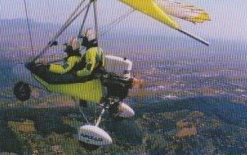
Aquilair SA (English: Eagle Air) is a French aircraft manufacturer based in Theizé. The company specializes in the design and manufacture of ultralight trikes.

The privately held company originally produced named trike models with specific wing and engine combinations, such as their Aquilair Swing two-seater and Aquilair Kid single-seater. By 2014 they had moved to a modular system offering any combination of their single seat carriage (Chariot Monoplace) or two seat carriage (Chariot Biplace), five models of Ipsos wings made by La Mouette, various propellers, the 48 kW (64 hp) Rotax 582 twin cylinder, inline, liquid-cooled two-stroke or the 63 kW (84 hp) Verner VM133MK two cylinder, horizontally-opposed, four-stroke engines, instruments, radios and intercoms.

1998:
Pont de Lignon
F-43120 Monistrol
Loire
France

Aircraft built by Aquilair included
Aquilair Swing: Two seat ultralight trike
Aquilair Kid: Single seat ultralight trike
Aquilair Chariot Biplace: Two seat ultralight trike
Aquilair Chariot Monoplace: Single seat ultralight trike

Apollo Ultraleightflug Racer

Racer GT

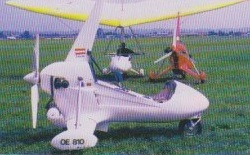
A straightforward design using bolted dural tube.

The Racer S has a laminated fairing over the rear undercarriage and engine, and gas struts in the rear suspension.

Racer S

Racer GT
Empty weight: 165 kg
Wing span: 10.4 m
Wing area: 17 sq.m
Fuel capacity: 32 lt
Certification: A
Engine: Rotax 503, 48 hp
MAUW: 374 kg
Seats: 2
Max speed: 120 kph
Cruise speed: 80 kph
Minimum speed: 40 kph
Climb rate: 5 m/s
Fuel consumption: 8 lt/hr
Price (1998): 17 500 DM

Racer S
Empty weight: 195 kg
Wing span: 10.4 m
Wing area: 17 sq.m
Fuel capacity: 40 lt
Certification: A
Engine: Rotax 582, 65 hp
MAUW: 430 kg
Seats: 2
Max speed: 110 kph
Cruise speed: 85 kph
Minimum speed: 45 kph
Climb rate: 3 m/s
Fuel consumption: 14 lt/hr
Price (1998):224 500 DM

Applebay Zia

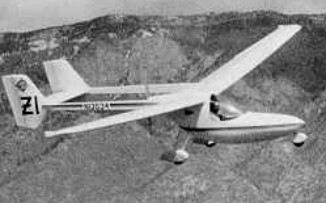
The Zia was originally conceived as a tailless motor glider and transformed by Oshkosh 1983 into the twin-boom pusher.

George Applebay entered the ultralight world with a very soaring oriented design, the Zia, whose control system consists of tip rudders, angled so that they work in roll as well as yaw and controlled by stick and pedals through a mixer, and a slotted flap occupying 25% of the canard surface, which provides pitch control. Glidepath control is by flaps which extend to 45 degs.
The tricycle undercarriage has a steerable nosewheel and the braked main wheels are suspended on glass fibre struts reinforced with Kevlar. He designed the Zia according to the JAR22 standard, using composite construction in the main but with Dacron wing covering.
Single seat single engined mid wing monoplane with conventional three axis control. Wing has swept forward leading and trailing edges, and tapering chord; no tail, canard wing. Pitch control by flaps on canard; yaw/roll control by angled tip rudders; control inputs through stick for pitch/yaw/roll and pedals for yaw/roll. Cantilever wing; wing profile; double surface. Undercarriage has three wheels in tricycle formation; suspension on nosewheel and glass fibre/Kevlar suspension on main wheels. Flush right go right nosewheel steering connected to yaw control. Brakes on main wheels. Composite construction fuselage, totally enclosed. Engine mounted at wing height driving pusher propeller. The engine is started by a pull rope either on the ground or for air starting.

Engine: Robin EC25PS, 18 hp.
Power per unit area 0.14 hp/sq.ft, 1.6 hp/sq.m.
Fuel capacity 4.0 US gal, 3.3 Imp gal, 15.0 litre.
Length overall 13.1ft, 4.00m.
Wing span 43.3ft, 13.20m.
Total wing area 125sq.ft, 11.6sq.m.
Empty weight 209 lb, 95kg.
Max take off weight 452 lb, 205kg.
Payload 243 lb, 110kg.
Max wing loading 3.62 lb/sq.ft, 17.7 kg/sq.m.
Max power loading 25.l lb/hp, 11.4kg/hp.
Never exceed speed 81 mph, 130kph.
Cruising speed 59mph, 95 kph.
Stalling speed 28 mph, 45 kph.
Best glide ratio with power off 27/1 at 42 mph, 67 kph.
No. of Seats: 1

Wing span: 14m / 46ft
Wing area: 118 sq.ft / 10.96 sq.m
Empty Weight: 182kg / 400lb
Payload: 113kg / 250lb
Gross Weight: 295kg / 650lb
Wing Load: 26.92kg/sq.m / 5.5lb/sq.ft
Aspect ratio: 18
Airfoil: Wortmann FX 66-197
Structure: fiberglass, carbon spar

Applebay Zuni / Aero Tek Model V

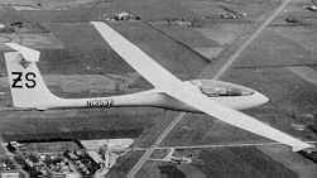
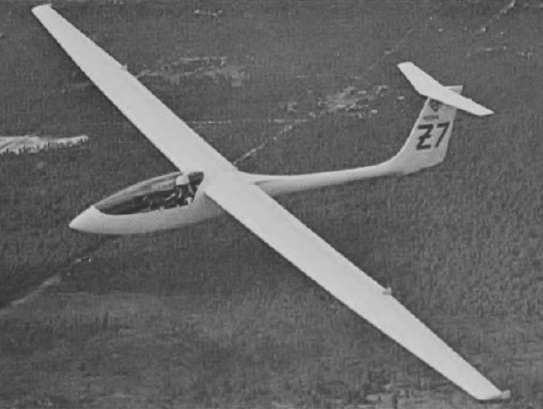
Designed and built by the New Mexico-based firm of Aero Tek under the direction of George Applebay, the Zuni, previously known as the Aero Tek Model V Zuni.

The single-seat 15-meter Zuni, which first flew on 18 November 1976 in New Mexico, was in limited production from 1977 until 1983.

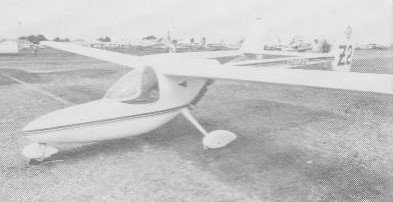
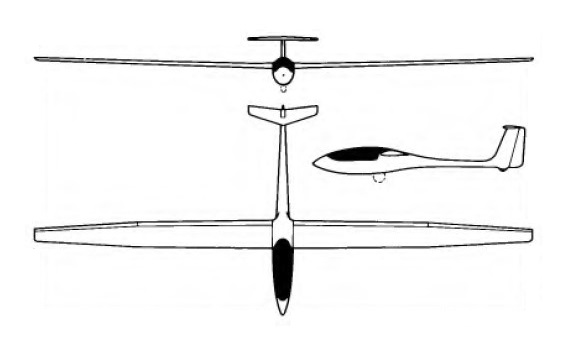
It is sailplane of conventional layout, with a flush transparent canopy and a T-tail. It made its first fight on 18 November 1976, and is of glassfibre construction overall. The cantilever shoulder-mounted wing has a Wortmann wing section developed at the Akaflieg Stuttgart and has full-span camberchanging flaps and ailerons. The flaps and ailerons may be operated separately or interconnected. There is provision for up to 180kg (397lb) of water ballast in the wing, and the undercarriage consists of a single monowheel with a tail bumper fairing under the fin; the forward fuselage tapers to a slimmer boom section carrying the tail unit, and the wings have rectangular inner sections and tapered outer panels.

The fuselage features a roomy cockpit with a semi-reclining seat and in-flight adjustable rudder pedals under a large one-piece canopy. The controls for flaps and landing gear are mounted on the left-hand side of the cockpit, with a side-mounted control stick on the right. The all-moving tailplane is trimmed with a press-button on the control stick.

The two-piece high-set wings contain control linkages which engage automatically when the sailplane is rigged. The interconnecting flaps and ailerons extend the full span of the wings. Flaps can be lowered to +90° for landing or for use as airbrakes. The landing gear consists of a large manually operated retractable monowheel, designed to withstand landings at maximum weight including water ballast, and a tail wheel.

The Zuni II model has carbon spar caps and optional carbon control surfaces, and water ballast capacity is increased to 219 kg. / 483 lb.

Aero-Tek Model V Zuni
Length: 22.047 ft / 6.72 m
Height: 4.265 ft / 1.3 m
Wingspan: 49.213 ft / 15.0 m
Aspect ratio: 22.2
Wing area: 108.716 sq.ft / 10.1 sq.m
Height: 4 ft 8in
Max take off weight: 959.2 lb / 435.0 kg
Weight empty: 493.9 lb / 224.0 kg
Max. speed: 157 kts / 290 km/h / 207mph (in smooth air)
Min sinking speed: 1.71 ft/sec at 50mph
Landing speed: 37 kts / 68 km/h
Cruising speed: 45 kts / 84 km/h
Wing load: 8.82 lb/sq.ft / 43.0 kg/sq.m
Crew: 1

Zuni II
Wing span: 15m / 49.2ft
Wing area: 10.13sq.m / 109sq.ft
Empty Weight: 238kg / 525lb
Payload: 306kg / 675lb
Gross Weight: 544kg / 1000lb
Wing Load: 53.7kg/sq.m / 11.01lb/sq.ft
Water Ballast: 220kg / 483lb
L/DMax: 38@ 98 kph / 53 kt / 61 mph
Aspect ratio: 22
MinSink: 0.55 m/s / 1.8 fps / 1.07 kt
Airfoil: Wortmann mod.
Structure: all fiberglass
No. of Seats: 1

Applebay Zuni
Wing span: 15.0 m (49 ft 2 l/2 in)
Length: 6.71 m (22 ft 0 in)
Height: 1.3 m (4ft 3 in)
Wing area: 10.13 m 2 (109.0 sq ft)
Wing section: Wortmann FX-67K-1707150
Aspect ratio: 22.2
Empty weight: 249 kg (550 lb)
Max weight: 544 kg (1,200 lb)
Water ballast: 181 kg (400 lb)
Max wing loading: 53.7 kg/sq.m (11.0 lb/sq ft)
Max speed: 180 kt (334 km/h)
Stalling speed: 34 kt (63 km/h)
Min sinking at 43.5 kt (80 km/h): 0.52 m (1.71 ft) /sec

Apis

Apris 2

The Apis series includes both a 13- and 15-meter sailplane, is a combination of composite construction and old world craftsmanship. The Apis is intended for the sport flyer, but still holds several world records. They offer a forward-hinged canopy, automatic control hookups, in-flight adjustable rudder pedals, full-span flaperons, blended winglets, and Schempp-Hirth type airbrakes. They also make the Apis M, a 15-meter motorglider.

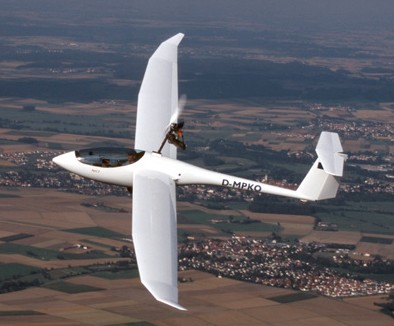
The Apis 2 is built with CFRP technology with 15 m span and T-tail. The wings are a multi trapezoid with raising tips. Aileron and flaps are interconnected (flaperons) and standard SH airbrakes give short landing approaches.
The spars are connected with two bolts in tongue/tongue technique. Rigging is straight forward and can be easily accomplished by one person. The glider fits in a standard sailplane trailer. The large canopy opens to the side and allows easy access to the ergonomic and roomy cockpit.
The Apis 2 includes a parachute rescue system. Wearing a pilots parachute is therefore not necessary and allows tall pilots to fit in the Apis 2.
The Apis 2 has a large canopy that opens to the side. The back-board can be adjusted continuously, the rudder pedals have some detents, and both can be readjusted during flight. The electric starter button and the throttle are located in the arm rest on the left side. The panel offers space for six instruments with 57 mm diameter in addition to the ECU indicator. One of these six can be replaced by a 80-mm-instrument alternatively. The battery fits into the quick-release rack in the fuselages nose. It energises both the ECU and the instruments.
The Apis 2 cockpit is made up of a double hull. The lightweight hollow section frame of the canopy offers a maximum stiffness in this area.
The Apis 2 takes off under its own power as a self launch glider. Despite the fixed tailwheel it is easy to control on the ground. Two aerodynamic tip wheels help eliminate the need for a wing runner.
The Apis 2 has a fixed gear with a wheel brake on the 4″ wheel.
After a short roll only climb rate is about 2.5 m/s (4.8 kt) at a speed of 80 to 85 km/h (45 kt). After about 150 m (500 ft) it will be airborne and it takes about 290 m (950 ft) over the 50 ft obstacle.
There is almost no trim change flying under engine or in gliding mode or while extending or retracting the engine. The camber changing flaps with a neutral trim will give you a speed range of 80 km/h (43 kt) at +9° to 160 km/h (86 kt) at -6°.
Thermal speed is about 80 km/h (43 kt) and minimum sink is 0.6 m/s (115 fpm). Best glide speed is 95 km/h (52 kt) which will give you a L/D of 39. Landing approach is at 90 km/h (48 kt) with positive flaps. The highly efficient airbrakes allow safe and steep approaches into short airfields. The Apis 2 can be landed with retracted or with extended engine.
The Apis 2 powerplant is an aircooled single cylinder Hirth F33 with intake and exhaust silencer. It generates 27 hp from 303 cc. The 148 cm ground adjustable carbon fibre propeller has been developed by Martin Wezel specially for the Apis 2. The noise level of the Apis 2 is at 57.7 db(A).
The powerplant is retractable. The process is controlled by ECU (Engine Control Unit) an instrument by TL elektronic. The extension of the powerplant is started by switching on the main switch, then the ignition. The ECU then takes over the process and the pilot can start the engine with the starter button. It is not necessary to manually control fuel valve or a choke lever. The ECU is optimizing the engine according to the temperature. During the retraction procedure for the powerplant the ECU is activating the propeller stop as soon as the RPM allows. Then the ECU is controlling the full procedure until the engine is completely stowed away.
The whole process takes about 20 seconds.
German certification in the Ultralight category was issued on 4 September 2003.

Apis 2
Span: 15 m
Wing area: 12.4 sq.m
Aspect ratio: 18.2
Length overall: 6.5 m
Empty weight: from 210 kg
Max. gross weight: 320 kg
Max. load factor: +5.3 / -3.3 g
L/D: 39 at 95 km/h (52 kt)
Min. sink rate: 0.6 m/s at 80 km/h (43 kt)
Flap settings: +9°, +5°, 0°, -3°, -6°
Stall: 35 kt / 40 mph / 65 kmh
Cruise: 81 kt / 93 mph / 150 kmh
VNE: 200 km/h (108 kt)
Engine: Hirth F 33 B, 27 PS / 19.3 kW
Carburetor: Mikuni membrane carburetor
Drive: Poly-V-belt 1:2.5
Propeller: Wezel 2-blade CFRPØ 1.48 m
Fueltank: 14 liter
Fuel consumption while climbing: 9 l/h
Noise level: 57.7 dB(A)

Apis 15M
Cruise: 51 mph
Stall: 36 mph
Aspect Ratio: 17-1
L/D: 40:1
Min sink: 115 fpm
Empty weight: 327 lb
Gross weight: 661 lb
Length: 20.6 ft
Wing span: 49.2 ft
Wing area: 132 sq.ft
Cockpit width: 32 in
Landing gear: tailwheel
Seats: 1

Apis M
Cruise: 56 mph
Stall: 36 mph
Aspect Ratio: 17-1
L/D: 40:1
Min sink: 115 fpm
Engine: Rotax 447, 40 hp
Fuel cap: 3.5 USG
Empty weight: 445 lb
Gross weight: 710 lb
Length: 20.6 ft
Wing span: 49.2 ft
Wing area: 132 sq.ft
Cockpit width: 32 in
Landing gear: tailwheel
Seats: 1

Apis Electric Self-Launch
Cruise: 51 mph
Stall: 36 mph
Aspect Ratio: 18.35-1
L/D: 40:1
Min sink: 108 fpm
Engine: Brushless DC, 13 kW
Empty weight: 452 lb
Gross weight: 710 lb
Length: 20.6 ft
Wing span: 49.2 ft
Wing area: 132 sq.ft
Cockpit width: 32 in
Landing gear: tailwheel
Seats: 1