Sweden Marketed a certificated version of the Highlander, as the Opus 280.
1980->
ARV Super 2 / ASL Hagfors Aero AB Opus 280
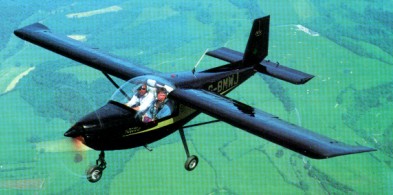
Richard Nobles design team aimed for an aircraft that was inexpensive to fly and buy; have two seats; should have an all-metal airframe; and be available as either factory assembled or as a simply assembled kit. The engine, custom-designed by Mike Hewland, is an inverted, inline three cylinder, 77 hp, water-cooled engine weighs in at 120 lbs with a 14 lb radiator located under the fuselage behind the cabin. It featured electronic ignition. The aircraft has been approved to United States FAR Part 23 requirements.
The engine burns a two stroke mixture on a 40-1 ratio although testing has provided satisfactory performance throughout a range of 20-1 to 95-1. Fuel burn is around three gallons an hour, either an avgas or mogas mix with oil.
The prototype, G OARV, made its first flight on 1lth March 1985 and was followed into the air by the second aircraft on 12th November. The fourth (004) was delivered in kit form to L.Wensley of Lincoln.
The Super 2 was later developed into the Swedish, certificated, Opus 280 by ASL Hagfors.
The Super 2 later became the Island Aircraft ARV-1 Super 2, then the Aviation Scotland ARV-1 Super2.
Highlander Aircraft Corp offered Highlander two-seat monoplane in kit form circa 1997.
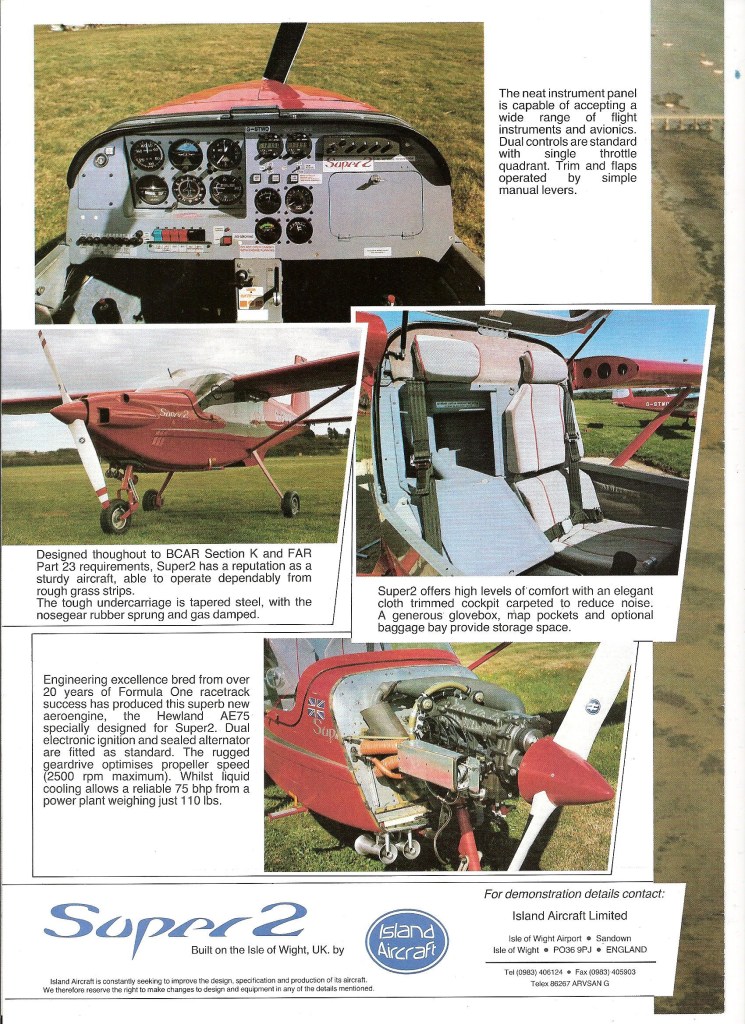
ASL Hagfors Aero AB of Sweden marketed a certificated version of the ARV Super 2 Highlander, as the Opus 280.
ARV Super 2
Engine: Hewland AE75, 77 hp
Length: 18.045 ft / 5.5 m
Height: 7.546 ft / 2.3 m
Wingspan: 28.543 ft / 8.7 m
Wing area: 92.57 sq.ft / 8.6 sq.m
Max take off weight: 1102.5 lb / 500.0 kg
Weight empty: 674.7 lb / 306.0 kg
Max. weight carried: 427.8 lb / 194.0 kg
Max. speed: 103 kt / 190 km/h
Landing speed: 48 kt / 88 km/h
Cruising speed: 86 kt / 160 km/h
Initial climb rate: 590.55 ft/min / 3.00 m/s
Service ceiling: 13123 ft / 4000 m
Wing load: 11.89 lb/sq.ft / 58.0 kg/sq.m
Range: 367 nm / 680 km
Crew: 2
Engine: MWAE AE100R (100hp 2 rotor Wankel).
Max speed: 98 kts.
Cruise: 84 kts.
Highlander Aircraft Highlander
Engine: Rotax 912, 80 hp.
Speed max: 145 mph.
Cruise: 125 mph.
Range: 530 sm.
Stall: 50 mph.
ROC: 800 fpm.
Take-off dist: 600 ft.
Landing dist: 700 ft.
Service ceiling: 10,000 ft.
Fuel cap: 20 USG.
Weight empty: 715 lbs.
Gross: 1165 lbs.
Height: 10 ft.
Length: 18 ft.
Wing span: 29.5 ft.
Wing area: 92.5 sq.ft.
Seats: 2.
Landing gear: nose wheel.
Arrow-Flite of Michigan Whitney Porta-Wing

The Whitney Porta-Wing spars are in 4 ft lengths with aluminium sleeves which allows it to be disassembled in 10 minutes to a 5 ft package. A cable leading edge forms a cylindrical edge shape to give a gull dihedral for more lift.
The airframe consists of a keel and a wing spar that are kept under compression by a cable around the perimeter. Tubing is 2in x .058 6061-T6 anodised aluminium, reinforced with internal bushings. Sleeves are quad-spaced pop riveted into the main tubes.
All rigging is 3/322in 7 x 7 aircraft quality. At the cable leading edge the wire rope is sleeved with “Eastman” plastic tubing. Double swagged throughout. All fasteners are grade 8 and thimbles are stainless steel, except heavy galvanised at the wing tips. Tangs are machined from stainless steel. Turnbuckles are polished bronze. All nuts and pins are aircraft quality. The sail is double zig-zag stitched from 3.8oz Bainbridge stabilised dacron. Critical areas are reinforced.
A swing seat was provided with 3/32in wire rope. The harness included sheathed tubing over the cables. Armaflex sleeves were on the control bars.
A low aspect ratio glider, it folds down into a small package 5ft x 1ft.
Leading edge: 18 ft
Keel length: 16 ft
Wing span: 26 ft
Wing area: 208 sq,ft
Aspect ratio: 1.6
Nose angle: 135˚
Sail billow: varies˚
Weight: 35 lb
Pilot weight: 140-220 lb
Takeoff speed: 5-7 mph
Stall speed: 4-5 mph
Max speed: 20 mph
Best glide ratio (L/D): 4-1
Best L/D speed: 15 mph

Arno Chereau Aeronautique J 300
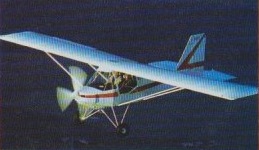
The J300 has a welded steel tube construction for the fuselage and dural foam laminate for the wings. In 1998 the constructor was offering a kit complete with two-stroke engine, at less than 100,000F.
Engine: Rotax 912, 79 hp
Wing span: 10.20 m
Wing area: 19 sq.m
MAUW: 450 kg
Empty weight: 174 kg
Fuel capacity: 2 x 63 lt
Max speed: 205 kph
Cruise speed: 140 kph
Minimum speed: 60 kph
Climb rate: 5 m/s
Fuel consumption: 8.90 lt/hr
Seats: 2
Price (1998): 240,000 Fhc
Kit price (1998): 79,000 Fhc
Arno Chereau Aeronautique SA
1998:
La Tiercerie
F-37110 Morand
France
UL builder
Arizona Powerchutes Phoenix Powerchute

Engine: Rotax 503, 52 hp.
HP range: 52-65.
Height: 6 ft.
Length: 8.5 ft.
Wing span: 32 ft.
Wing area: 500 sq.ft.
Speed max: 26 mph.
Cruise: 26 mph.
Range: 100 sm.
ROC: 150 fpm.
Take-off dist: 450 ft.
Landing dist: 50 ft.
Service ceiling: 10,000 ft.
Fuel cap: 5 USG.
Weight empty: 225 lbs.
Gross: 650 lbs.
Seats: 1-2.
Landing gear: nose wheel.
Arizona Powerchutes
1995: 1738 W. Taro Lane, Phoenix, AZ 85027, USA.
Trike builder
Arctic Aircraft S1B2 Interstate / Tern

A successor to the L6 Grasshopper of WW2, the S.1 BE is a strut-braced high-wing monoplane known as the Arctic Tern, a developed version of the Interstate S.1A, first flown in the 1950s.
The Tern aka Interstate S-1-B2 was 1975 continued production of Interstate L-6 (S-1-B1) revised for bush operations. Tooling and jigs re-acquired by Interstate Co in 1985. (No connection, nor similarity, between this and Rocheville-EMSCO Arctic Tern.)
Interstate S1B2 Tern
Engine: Lycoming O-320-A2B, 150 hp.
TBO: 2000 hrs.
Prop: McCauley 2-blade, 72-in.
Length: 24 ft.
Height: 7 ft.
Wingspan: 36.8 ft.
Wing area: 186.2 sq.ft.
Maximum takeoff weight: 1850 lbs.
Standard empty weight: 1075 lbs.
Maximum useful load: 775 lbs.
Maximum landing weight: 1850 lbs.
Wing loading: 9.97 lbs/sq.ft.
Power loading: 12.3 lbs/hp.
Maximum usable fuel: 240 lbs.
Best rate of climb: 1275 @ 60 kts.
Climb gradient: 765 ft/nm.
ROC @ 8000 ft: 820 fpm.
Service ceiling: 19,000 ft.
Maximum speed: 103 kts.
Stalling speed clean: 42 kts.
Stalling speed flaps down: 28 kts.
Turbulent-air penetration speed: 105 kts.
Seats: 2.
Fixed tail wheel under carriage.
First built: 1975.
Arctic Aircraft Co
1980: PO Box 6-141, Anchorage, Alaska, USA.
Established at Anchorage, Alaska to build and market as the S.1 BE, a strut-braced high-wing monoplane known as the Arctic Tern, a developed version of the Interstate S.1A, first flown in the 1950s.
ARCO AB – Trike Twin
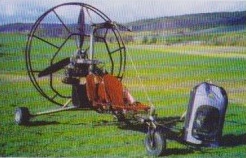
A twin engine two seat paraplane, the AB-Trike Twin is made up of stainless steel welded tubes, with two Solo engines powering one large propeller via a toothed belt. The machine is quiet enough to meet German regulations.
Empty weight: 65 kg
Certification: vVz
Engine: 2 x Solo 440, 35 hp
Seats: 2
Price (1998): 10 900 DM

