UP Ultralight Products / UP Europe / UP Delta

UP Ultralight Products
4054 W – 2825 N
Mountain Green UT, 84050
USA

Pasadena California, 1970. Pete Brock finishes his studies at the Art Center, a world-renowned school of industrial design, as its youngest graduate ever. Brock soon discovers a new passion: hang gliding- probably the most radical sport imaginable in the early 70s. While there are several glider models on the market there is only one common theme – they are all extremely dangerous. This also holds true for Pete’s first design, the Brock Redtail.

However, when Pete Brock gets together with the young designer Roy Haggard, a new concept is born. The Dragonfly is the first tenable post-Rogallo glider and becomes the flagship of their newly founded company, Ultralight Products. A series of successful designs follow, including the Condor with its world record duration flight of 16 hours, 4 minutes in 1979.

Helping the company gain success quickly is Pete Brock’s logo design. The UP arrow achieves cult status from the beginning and for many pilots characterises the spirit of hang gliding and later paragliding. The logo and the brand’s positive image attract the interest of various investors over the company’s three-decade history. The first is in 1980, when Yuseke Yamazaki, a Japanese investor, lays the foundation for UP’s success in Asia.

The year 1980 also marks the introduction of Roy Haggard’s pioneering development, the UP Comet. The Comet’s outrigger-free construction concept was revolutionary. Jim Lee sets the world distance record at 268 km with a Comet in 1981, and eventually the UP Comet becomes one of the biggest-selling hang gliders of all time. Success breeds followers, and the Comet is a natural target for copying. In 1982 Airwave, UP’s representative in Europe, produces the Magic, which is nothing more than a modified Comet.

In the mid-80s Pete Brock and Roy Haggard retire from the everyday business. Ownership and location of the firm change in the following years. Through the continued influence of Yuseke Yamazaki, UP becomes UP International, a wholly owned subsidiary of a Japanese parent company, Isomura, Inc. Encouraged by the success of the hang gliding business, Isomura diversifies the UP brand into windsurfing, UL-flying and fashion. In Japan one can find the UP arrow on the UP-Sports clothing line, and on T-shirts, jackets and socks. Even today at Venice Beach in Los Angeles one can find rollerbladers leaning against the UP arrow logo as they take breaks on park benches donated by the local UP surf shop in the mid-80s.

The TRX, the first production series hang glider with carbon tube elements, is developed at the UP Soaring Center in Salt Lake City under the guidance of UP’s new designer, Terry Reynolds. Despite various technical innovations, the TRX remains the last successful UP hang glider for some time.

Though UP is a latecomer to paragliding, the company hits the mark in 1990 with the relatively unknown Korean designer Gin Seok Song. The Flash, developed by Gin in the U.S. together with test pilot Greg Smith, is revolutionary. The Flash is the first paraglider with a perfectly smooth leading edge and has more performance than anything else on the market. The glider dominates in competition and becomes a bestseller. Yet the Flash remains Gin’s only design for UP since he is coaxed to another paragliding newcomer, Edel, with a lucrative offer.

At this time, Claus Bichlmeier is UP’s importer for the German-speaking markets.
Global Expansion from Germany

UP Europe
Ultralight Products Europe
1998: Altjoch 19 A, D-8243 kochel am See, GERMANY
By 1998 UP Delta had bought out aircraft manufacturer Thalhofer.

In 1992 Ernst Schneider establishes UP Europe in Sindelsdorf near Garmisch and all development and testing is carried out in Europe. Designer Rasso von Schlichtegroll, later co-founder of freeX, develops best-selling gliders like the Katana, the Vision and the tandem Pickup. Chief Test Pilot Ernst Strobl crowns his competition career in 1992 by winning the European Championship.

That same year Uli Wiesmeier wins the first Paragliding World Cup series on a Katana. In addition to his involvement in competition, Uli is responsible for UP’s public image. Uli’s advertising work, his eye for style in developing the Skywear line of clothing and his award-winning creativity in filmmaking all contribute greatly to ensuring that the UP thrives in paragliding. French UP pilot Richard Gallon wins the 1994 PWC. In 1995 the new World Champion Stephan Stiegler and top pilots like Peter Hensold, the Italian cross-country ace Eduard Taschler and Sebastian “Rambo” Bourquin become members of the UP team.

Motivated by UP’s success in paragliding, Ernst Schneider establishes a hang gliding department under the auspices of UP Europe. The original Salt Lake development team at the Soaring Center starts a separate company that eventually leads to the formation of Altair under the leadership of Dick Chainey and John Heiney. Bernd Weber, the manager of Thalhofer and co-founder of the rigid wing manufacturer A.I.R. takes charge of UP’s new hang gliding line. The Speed, UP’s first hang glider in nearly five years, is introduced in 1995, and the topless version, the Speed TL follows in 1997.

UP Europe Delta
1998: Salzstrasse 6, D-72589 Römerstein, GERMANY
In 1998 UP Europe was manufacturing the wings for the rigid wing Pegasus of Jurgen Lutz, having bought out aircraft manufacturer Thalhofer.

Ernst Schneider sells UP Europe, and the buyer is once again from Japan. The profitable entertainment group Daiichi Kosho is seeking to diversify from the Karaoke industry and is looking to the flying industry for an additional profit center. With the continually developed paragliders from Europe and their own paragliding schools domestically, “DK” quickly enjoys market leadership in Japan.

The Japanese invest substantially in UP Europe, where the workforce and the competition team are expanded. In 1997 half of the German League is flying UP’s new performance glider, the Escape. During this time, UP Europe relocates to offices north of Garmisch in Kochel am See, where up to 20 employees are working.

By this time, the paragliding boom is subsiding and high quality designs like those of the Escape, the Soul, and the Blues do not attain the market successes of their predecessors.

Daiichi Kosho and UP part ways in 1999. At the same time, Bernd Weber gives up the hang gliding part of the business. Of the several parties interested in the remaining paragliding business with the exceptional UP brand, the successful bidder is the Swede Christian Rönning. Flying since 1988, Christian is one of the pioneering paraglider pilots in Sweden. He also brings with him a wealth of experience gained as a management consultant to multinational firms in Asia.

At the end of 1999 Christian Rönning began UP anew with a substantially reduced, yet highly experienced staff at his side. Torsten Siegel, Georg Maier and former World Champion Stephan Stiegler were responsible for product development, and it was upon their know-how that the first UP Europe product line was based. A new era for UP was firmly established when in just one year UP progressed from the old designs to a whole new glider range including the Pulse, the Makalu, the Summit, the Gambit, the Sherpa, and the Gambit C. UP’s R&D department has since adopted a roughly three-year cycle for the renewal of gliders, which led to a number of even more succesful designs being launched, not least the World Champion 2003 winner called the Targa, the Serial Class reference wing for almost 4 years called the Trango, and later the successor to these, the Targa 2 which won the World Cup in 2004. Torsten Siegel eventually decided to pursue his career goals with Swing, and some time later Stephan Stieglair departed to form his own new brand called Air Design.

Since 2010 the new design team, which picks up the baton from the Stieglair/Siegel years, is headed by Czech industry old-timer Frantisek “Franta” Pavlousek and supported by both new faces and experienced people. In the former category not least German aerospace engineer Matthias Hartmann, who is a passionate hobby paraglider pilot, and Czech young test pilots Michal “Snajby” Sneiberg and Jirik “Jirka” Dlask, and in the latter category German lightweight guru Stefan “Boxi” Bocks.
University Of Pretoria Exulans

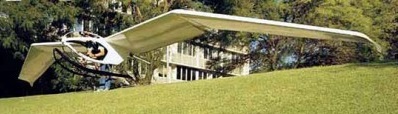
Designed by three engineers from the University of Pretoria, Exulan I is inspired by the shape of albatrosses and pteranodons.

The 1989 Exulans (named after the scientific name for albatros) used some wingtip pivot shift for pitch control, in combination with elevons to overcome the inherent inefficiency of elevons for pitch alone. It was tested successfuly but no commercial version was released.

Designer Joachim Huyssens and his team were working on a second prototype since 2004.

Wing area: 12 m²
Wing span: 12 m
Length: 3 m
Minimum pilot weight: 65 kg
Maximum pilot weight: 150 kg
Minimum speed: 150 km/h
Maximum speed: 40 km/h

Unique Paragliders XT

XT 24
Paraglider circa 1998.
Wing area: 25.6 sq.m
Certification: DHV 2
Pilot weight: 60-85 kg
No. of cells: 53
Wing span: 11.2 m
Aspect ratio: 5
Min sink: 1.1 m/s
Max speed: 51 kph
Price (1998) 40900 OS

XT 26
Paraglider circa 1998.
Wing area: 26.9 sq.m
Certification: DHV 2 GH
Pilot weight: 80-105 kg
No. of cells: 53
Wing span: 11.8 m
Aspect ratio: 5
Min sink: 1.1 m/s
Max speed: 51 kph
Price (1998) 41900 OS

XT 28
Paraglider circa 1998.
Wing area: 28.2 sq.m
Certification: DHV 2 GH
Pilot weight: 100-120 kg
No. of cells: 53
Wing span: 12.5 m
Aspect ratio: 5
Min sink: 1.1 m/s
Max speed: 51 kph
Price (1998) 42900 OS

Unique Paragliders Level

The Level features ‘M’ diagonal bracing.

Level 60
Paraglider circa 1998.
Wing area: 25.5 sq.m
Certification: DHV 1-2
Pilot weight: 64-90 kg
No. of cells: 37
Wing span: 10.9 m
Aspect ratio: 4.7
Min sink: 1.3 m/s
Max speed: 45 kph
Price (1998) 31900 OS

Level 80
Paraglider circa 1998.
Wing area: 27.6 sq.m
Certification: DHV 1-2
Pilot weight: 85-110 kg
No. of cells: 39
Wing span: 11.7 m
Aspect ratio: 4.9
Min sink: 1.3 m/s
Max speed: 45 kph
Price (1998) 32900 OS

Unique Paragliders Crazy

The Crazy features ‘M’ diagonal bracing.

Crazy 26
Paraglider circa 1998.
Wing area: 25.4 sq.m
Pilot weight: 65-90 kg
No. of cells: 100
Wing span: 12.8 m
Aspect ratio: 6.5
Min sink: 1 m/s
Max speed: 59 kph
Price (1998) 59900 OS

Crazy 30
Paraglider circa 1998.
Wing area: 30.1 sq.m
Pilot weight: 90-115 kg
No. of cells: 100
Wing span: 13.7 m
Aspect ratio: 6.5
Min sink: 1 m/s
Max speed: 59 kph
Price (1998) 59900 OS

Unique Paragliders Basic

The Basic features ‘M’ diagonal bracing.

Basic L
Paraglider circa 1998.
Wing area: 28.3 sq.m
Pilot weight: 75-100 kg
No. of cells: 72
Wing span: 12 m
Aspect ratio: 4.8
Min sink: 1.2 m/s
Max speed: 49 kph
Price (1998) 38600 OS

Basic M
Paraglider circa 1998.
Wing area: 26.9 sq.m
Pilot weight: 65-85 kg
No. of cells: 72
Wing span: 11.4 m
Aspect ratio: 4.8
Min sink: 1.2 m/s
Max speed: 49 kph
Price (1998) 38600 OS

Basic XL
Paraglider circa 1998.
Wing area: 31.42 sq.m
Pilot weight: 95-130 kg
No. of cells: 72
Wing span: 12.6 m
Aspect ratio: 4.8
Min sink: 1.2 m/s
Max speed: 49 kph
Price (1998) 38600 OS

Ultravia Super Pelican

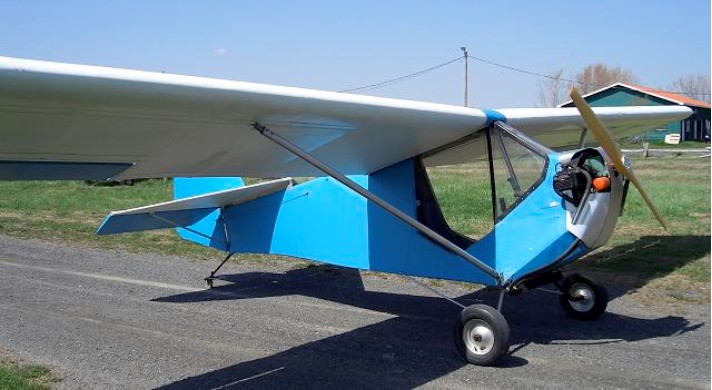
The Super Pelican is a Canadian design built by Ultravia Aero, Repentigny, Quebec. Being similar in appearance to the Piper Cub it is a high wing taildragger monoplane with a semi-enclosed cabin/fuselage powered by 35hp, Global engine. A conventional 3 axis control microlight of aircraft tube and dacron cover.
Engines suitable for the Super Pelican include the Global flat twin four-stroke, 35 hp at 3200 rpm, the three cylinder Konig radial, 25 hp at 4200 rpm, the four cylinder Konig radial, 28 bp at 4200 rpm, or Rotax 277 or 377.

Engine: Global 2 cyl 4 stroke (1039cc), 35 hp
Empty wt: 250 lb (113 kg)
Max wt: 525 lb (238 kg)
Wing span: 35 ft (10.67m)
Max cruise: 65 mph (101kph)
Stall: 27.5 mph
ROC: 950 fpm
TO dist 50 ft: 250 ft
Seats: 1
Range: 422 km

Ultravia Le Pelican

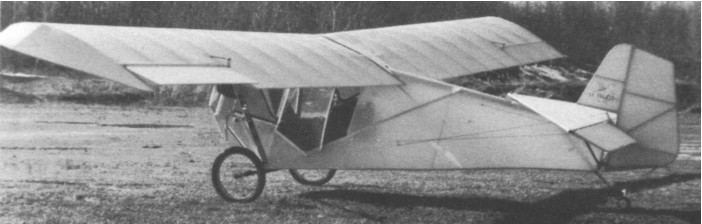
Single seat single engined high wing mono¬plane with conventional three axis control. Wing has unswept leading and trailing edges, and constant chord; cruciform tail. Pitch control by elevator on tail; yaw control by fully flying rudder; roll control by 40% span ailerons; control inputs through stick for pitch/roll and pedals for yaw. Wing braced from below by struts; wing profile double surface. Undercarriage has three wheels in tail dragger formation; axle Flex suspension on main wheels. Push right go right tailwheel steering connected to yaw control. Optional brakes on main wheels. Aluminium tube framework with glass fibre nose and fabric covering, partially enclosed (total enclosure optional). Engine mounted below wing driving tractor propeller. Covering of framework and wing is Dacron. Ribs made from foam-¬aluminium composite. Aircraft grade aluminium used for structural components. AN hardware.

Ultravia’s publicity material describes Le Pelican as ‘a new ultralight respectful of aircraft tradition’ and is powered by a four stroke twin¬-cylinder Briggs & Stratton engine. Designer Jean Rene Lepage, the Canadian engineer who developed the aircraft over a period of three years, realised that the four stroke was fairly heavy for its rated horsepower and therefore designed the aircraft with long wings and a relatively short nose. Le Pelican is basically a tube and Dacron machine, with D cell wings braced by a single strut and using composite¬ construction ribs made from foam and alumi¬nium alloy. The entire structure was designed in accordance with FAR Part 23, the first aircraft taking to the air on 31 May 1982.

The prototype used spoilers for roll control, though ailerons are now standard, as is a steerable tailwheel (also absent from the prototype). Doors have now been developed to make the cockpit fully enclosed if desired. For those wanting more power, Onan engines of 20 or 22 hp are offered In this form the aircraft was introduced at C$5800 in kit form, the first machines being delivered in February 1983, though this price rose to C$6500. 2009 Price: 5500 US$. Claimed construction and rigging times respectively are 150h and 30 min.

The Pelican was sold in kit form by Ultravia in 1984. It is an aircraft of traditional configuration with a taildragger landing gear and steerable tailwheel. The aircraft was originally fitted with a Global engine and aluminum cowling. The fuselage and tail unit are built with aluminum tubes covered with doped fabric. The wing structure consists of an aluminum D-cell spar on which the styrofoam ribs are mounted. The wings are also covered with doped fabric. Wings are hung to the fuselage with a single strut. All these characteristics combine to give an aerodynamically clean wing with a 12-to-1 glide ratio.

Le Pelican has been compared with the Aeronca C-2, with earlier models being po¬wered by horizontally opposed 4-stroke en¬gines. The strut braced high-wing monoplane is built of aluminium tube gussett rivetted and dacron covered. The engine cowling is one piece fibreglass and the cockpit has remov¬able doors for summer flying.

The Pelican is powered by a Gobal engine. This is the original engine that came with this airframe kit in 1984. The Global is a 4-stroke, 2-cylinder engine based on the Volkswagen flat four, air-cooled engine, except that this one has 2 cylinders instead of four. For this reason, it is often referred to as a half-VW engine. However, the castings are especially designed for aircraft use. This engine is very fuel efficient and burns only 1 gallon of autogas per hour. It is also more reliable than 2-strokes. It is free-air cooled and the oil circulates through an oil cooler located below the fuselage. This engine is devoid of all the troublesome components such as a cooling fan, radiator, hoses, thermostat and other hardware associated with liquid-cooling systems; making it more reliable and less hassle to maintain. The 58 X 24 inch wood propeller is bolted directly to the solid forged crankshaft. This eliminates the potential problems of reduction drives with their added mechanical complexity and heavier weight. The Global develops 35 hp @ 3250 RPM and has plenty of torque for a direct-drive prop. Ignition is by a magneto. This eliminates the need for a battery and alternator and allows for a very simple and reliable electrical system. The Global is started by hand propping; another simple and reliable system that never breaks down. This engine is surprisingly light for a 4-stroke; it weighs only 76 lbs ready-to-run.

Engine: Global, 35 hp @ 3250 RPM
Span: 35 ft
Length: 15 ft
Height: 6.5 ft
Wing area: 136 ft.sq
Max wing loading: 3.86 lbs.sq.ft
Empty weight: 113 kg / 250 lbs
MTOW Weight: 238 kg / 525 lbs
Useful load: 275 lbs
Cruise speed: 60-70 mph
Max speed: 80 mph
Stall speed: 23 kt / 27 mph / 43 kmh
Vne: 78 kt / 90 mph / 145 kmh
Max climb rate: 900 ft/min / 5 m/s
Fuel capacity: 5 USG
Fuel burn: 1 to 1.2 gal.hr
Max range: 300 miles
Glide Ratio: 12:1
Takeoff distance: 50 ft
Landing roll: 100 ft
Load factors at 525 lbs: +4 -2 G’s Limit, +6 -3 G’s Ultimate

Engine: Briggs & Stratton, 18 hp at 3600 rpm
Prop¬eller diameter 43 inch, 1.09m
No reduction
Power per unit area 0.13hp/sq.ft, 1.4hp/ sq.m
Fuel capacity 2.5 US gal, 2.1 Imp gal, 9.5 litre
Empty weight 210lb, 95kg
Max take off weight 450lb, 204kg
Payload 240lb, 109 kg
Max wing loading 3.21 lb/sq.ft, 15.7 kg/sq.m
Max power loading 25.0lb/hp, 11.3kg/hp
Load factors +4.4, 2.2 design; +6.6, 3.3 ulti¬mate
Max level speed 60 mph, 97 kph
Never exceed speed 85 mph, 137 kph
Max cruising speed 55 mph, 88 kph
Economic cruising speed 50 mph, 80 kph
Length overall 14.0 ft, 4.27 m
Height overall 6.0ft, 1.83m
Wing span 37.0ft, 11.28m
Constant chord 3.8ft, 1.17m
Dihedral 3 deg
Sweepback 0 deg
Tailplane span 8.0ft, 2.44m
Fin height 3.8ft, 1.14m
Total wing area 140 sq.ft, 13.0 sq.m
Wing aspect ratio 9.8/1
Wheel track 6.0 ft, 1.83 m
Wheelbase 11.0 ft, 3.35m
Tailwheel diameter overall 4 inch, 10 cm
Main wheels diameter overall 20 inch, 51 cm
Stalling speed 26 mph, 42 kph
Max climb rate at sea level 500 ft/min, 2.5 m/s
Min sink rate 250 ft/min at 30 mph, 1.3 in/s at 48 kph
Best glide ratio with power off 13/1 at 35 mph, 56kph
Take off distance 150ft, 45m
Service ceiling 12,500 ft, 3810 m
Range at average cruising speed 104 mile, 167 km

Engine: Rotax 277
Prop: 147cm
Wing span: 10.67 m
Length: 4.57m
Weight: 115kg
Fuel capacity: 19 ltr
Econ cruise speed: 55 kts
Stall: 25 kts