CFM Shadow

Streak Shadow

Developed in 1982 by David Cook in England, the Shadow has two seats with fully enclosed cockpit in tandem and fibreglass fuselage. First flew in 1983. Detachable wings and horizontal tail surfaces with conventional 3-axis control, and a tricycle undercarriage, and is certified to BCAR Section S.
Tandem one/two seat single engined high¬wing monoplane with conventional three axis control. Wing has swept back leading and trailing edges, and tapering chord; flaps fitted. Two fin tail. Pitch control by elevator on tail; yaw control by fully flying ventral rudder; roll control by half span ailerons; control inputs through stick for pitch/roll and pedals for yaw. Wing braced from below by struts; wing profile Cook devised section; 100% double surface. Undercarriage has three wheels in tricycle formation; rubber suspension on nosewheel and glass fibre sus¬pension on main wheels. Ground steering by differential braking. Brakes on main wheels. Honeycomb laminate fuselage, totally en¬closed. Engine mounted below wing driving pusher propeller. Flaps and ailerons made from honeycomb laminate. Composite con-struction wing.
The Shadow is an advanced design which has been developed with the backing of Ciba Geigy Aerospace and makes extensive use of honeycomb laminates. The first prototype was started in January 1982 and was a pusher aircraft powered by a 430 Cuyuna engine. First flown in August of that year by its designer and D Clarke, it showed over 80mph (130kph) on only 80% power and without any form of pod.
Encouraged by this performance, Dave Cook then designed a second prototype, this time using a Robin EC44 engine and aiming to produce a machine which would be a direct bridge between microlights and conventional aircraft. Control surfaces are differential ailerons, a fully flying ventral rudder, normal elevator and four position flaps, the latter added to keep landing speeds down. For ground steering the hydraulic disc brakes can be operated independently.
The wing design uses a plywood I section spar stiffened at the flanges by the addition of a fabricated aluminium¬ alloy box section. Foam ribs support plywood leading and glass fibre trailing edges, the whole wing being covered by Dacron, glued in place and scaled with dope. The wing has been static tested at + 5.5 g.
The Streak Shadow is a shorter span and thinner wing version of the Shadow which first flew in 1986.

Following on from the Shadow C, the Shadow D has better visibility and more room.

Shadow D

Shadow
Engine: Robin EC44, 50 hp at 7000 rpm.
Propeller diameter and pitch 50 x 34 inch, 1.27 x 0.86 m.
Reduction ratio 2.1/1.
Power per unit area 0.32hp/sq.ft, 3.4 hp/sq.m.
Fuel capacity 6.0 US gal, 5.0 Imp gal, 22.7 litre,
Optional fuel Additional bag tank, capacity 21.6 US gal, 18.0 Imp gal, 81.8 litre.
Empty weight 323 lb, 147kg.
Max take off weight 623 lb, 283kg.
Payload 300 lb, 136kg.
Max wing loading 3.9 lb/sq.ft, 19.3 kg/sq.m.
Max power loading 12.5 lb/hp, 5.7 kg/hp.
Load factors +5.5, 3.0 design.
Max level speed: >100mph, >160kph.
Max cruising speed 85mph, 137kph.
Economic cruising speed 70 mph, 113 kph.
Length overall 21.0 ft, 6.40 m.
Height overall 5.5ft, 1.68m.
Wing span 31.5ft, 9.60m.
Chord at root 5.8ft, 1.77 m.
Chord at tip 4ft, 1.22m.
Dihedral 0 degs
Tailplane span 8.0 ft, 2.44 m.
Fin height 2.0 ft, 0.61 m.
Total wing area 158 sq.ft, 14.7 sq.m.
Total aileron area 16.4 sq.ft, 1.52 sq.m.
Fin area (each) 1.5 sq.ft, 0.14 sq.m.
Rudder area 5.5 sq.ft, 0.51 sq.m.
Tailplane area 14.5 sq.ft, 1.35 sq.m.
Total elevator area 9.2 sq.ft, 0.85 sq.m.
Wing aspect ratio 6.4/1.
Wheel track 5.5ft, 1.68 m.
Wheelbase 6.0ft, 1.83 m.
Nosewheel diameter overall 10 inch, 25 cm.
Main wheels diameter overall 12 inch, 30 cm.

Engine: Rotax 503, 50 hp.
HP range: 30-50.
Speed max: 102 mph.
Cruise: 75 mph.
Range: 165 sm.
Stall: 25 mph.
ROC: 1100 fpm.
Take-off dist: 75 ft.
Landing dist: 150 ft.
Service ceiling: 25,000 ft.
Fuel cap: 6.5 USG.
Weight empty: 349 lbs.
Gross: 824 lbs.
Height: 5.75 ft.
Length: 21 ft.
Wing span: 32.9 ft.
Wing area: 162 sq.ft.
Seats: 1/2.
Landing gear: nose wheel.

Engine: 40 hp Rotax 447 two cylinder two stroke (437cc).
Wing Span: 10.03m.
Length: 6.40m.
Empty Weight: 150 kg.
MAUW: 332 kg.
Max. Cruise Speed: 75 kt (121 kph).
Range: 240 km.

Laron Shadow
Engine: Rotax 503, 50 hp.
HP range: 30-50.
Speed max: 102 mph.
Cruise: 75 mph.
Range: 165 sm.
Stall: 25 mph.
ROC: 1100 fpm.
Take-off dist: 75 ft.
Landing dist: 150 ft.
Service ceiling: 25,000 ft.
Fuel cap: 6.5 USG.
Weight empty: 349 lbs.
Gross: 824 lbs.
Height: 5.75 ft.
Length: 21 ft.
Wing span: 32.9 ft.
Wing area: 162 sq.ft.
Seats: 1/2.
Landing gear: nose wheel.

Streak Shadow
Engine: Rotax 582, 65 hp.
Speed max: 121 mph.
Cruise: 101 mph.
Range: 435 sm.
Stall: 31 mph.
ROC: 1700 fpm.
Take-off dist: 100 ft.
Landing dist: 200 ft.
Service ceiling: 29,000 ft.
Fuel cap: 14 USG.
Weight empty: 388 lbs.
Gross: 900 lbs.
Height: 5.75 ft.
Length: 21 ft.
Wing span: 28 ft.
Wing area: 140 sq.ft.
Seats: 2.
Landing gear: nose wheel.

Shadow B-D –

Shadow D
Engine: Rotax 582, 64 hp
Wing span: 10 m
Wing area: 15.25 sq.m
Empty weight: 203 kg
Fuel capacity: 23 lt
MAUW: 390 kg
Max speed: 178 kph
Cruise speed: 145 kph
Minimum speed: 61 kph
Climb rate: 4.8 m/s
Fuel consumption: 15 lt/hr
Certification: BCAR S
Seats: 2
Price (1998): £22,995
Kit price (1998): £16.495

Laron Streak Shadow
Engine: Rotax 582, 65 hp.
Speed max: 121 mph.
Cruise: 101 mph.
Range: 435 sm.
Stall: 31 mph.
ROC: 1700 fpm.
Take-off dist: 100 ft.
Landing dist: 200 ft.
Service ceiling: 29,000 ft.
Fuel cap: 14 USG.
Weight empty: 388 lbs.
Gross: 900 lbs.
Height: 5.75 ft.
Length: 21 ft.
Wing span: 28 ft.
Wing area: 140 sq.ft.
Seats: 2.
Landing gear: nose wheel.
Cessna CE-750 Citation X

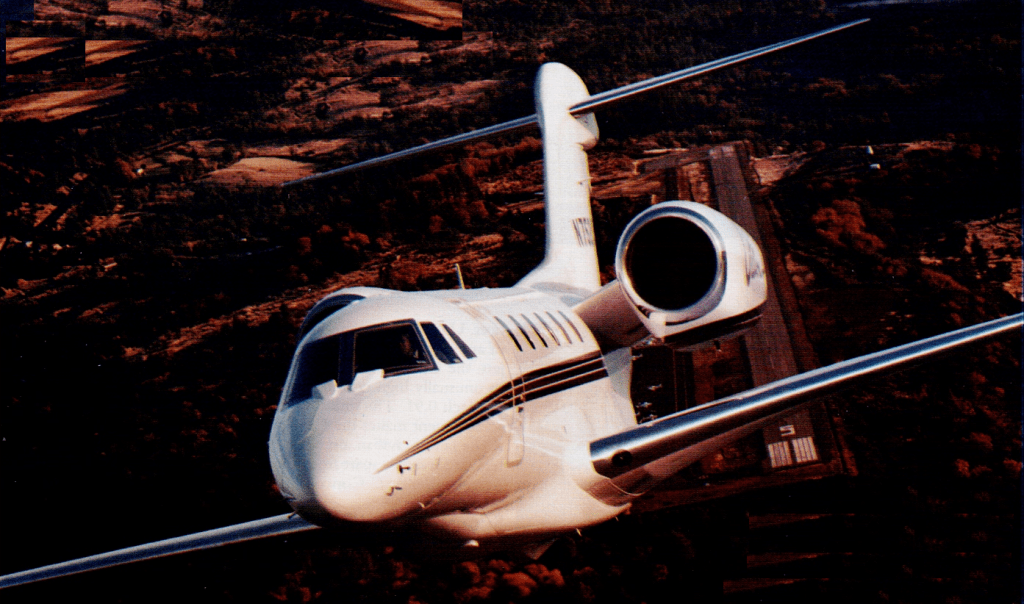
Skipping the unused Citation VIII and IX designations, the company announced in May 1990 the development of a ‘larger mid-size’ long range executive transport. The aircraft, heavily promoted by Cessna as the world’s fastest business jet, was publicly launched as the Model 750 Citation X at the NBAA Convention in New Orleans in October 1990. 1.5m longer than the III, the Xs powered by two GM/Allison GMA-3007A turbofans, each rated at 2720kg, enabling the new aircraft to fly 6111km at a cruising Mach number of 0.88 at 11278m. Improvements to to Citation X announced by Cessna are the result of increasing the power of the engines, RR AE 3007C-1s from 6442 to 6764 lbs thrust. This increases the allowable MTOW by 400 lbs.

Cessna CE-750 Citation X Article

The Citation X first flew on 21 December 1993.

The first Citation X was delivered to Arnold Palmer on 29 August 1996.


The Citation X (Model 750) became the fastest civil airplane in service with the retirement of the Concorde. The 750 can fly from LA to New York in just over four hours, and cruises at 51,000′ where conflicts with other air traffic are improbable.

Gallery

Cessna 750 Citation X
Corporate Jet, USA, 1993
Engine : 2 x Rolls Royce AE3007C1, 6764 lbs / 3067 kp
Length : 72.178 ft / 22.0 m
Height : 19.029 ft / 5.8 m
Cabin height : 5.577 ft / 1.7 m
Cabin width : 5.577 ft / 1.7 m
Cabin length : 28.215 ft / 8.6 m
Wingspan : 63.648 ft / 19.4 m
Wing area : 527.005 sqft / 48.96 sq.m
Max take off weight : 36106.9 lbs / 16375.0 kg
Max ramp weight : 36404.6 lbs / 16510.0 kg
Max landing weight : 31804.9 lbs / 14424.0 kg
Max zero fuel weight : 24404.9 lbs / 11068.0 kg
Weight empty : 21703.8 lbs / 9843.0 kg
Total operating weight empty : 22102.9 lbs / 10024.0 kg
Payload with full fuel : 1360.5 lbs / 617.0 kg
Max. speed : 528 kts / 977 km/h / M0.92
Cruising speed : 460 kts / 851 km/h
Initial climb rate : 4409.45 ft/min / 22.40 m/s
Service ceiling : 51001 ft / 15545 m
Cruising altitude : 36991 ft / 11275 m
Wing load : 67.04 lb/sq.ft / 327.0 kg/sq.m
Range : 3390 nm / 6278 km
Crew : 2
Payload : 8-12 pax (max. 1179kg)
Takeoff distance 5,140 ft
Landing distance 3,400 ft

Cessna CE-525 CJ1 / CJ2

Cessna 525 CJ1

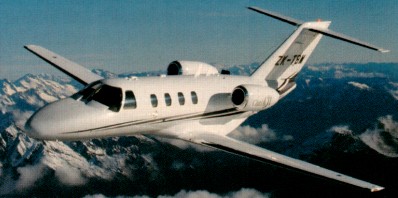
Cessna’s new CitationJet made its first flight on 29 April 1991 from Wichita, powered by two Williams Rolls FJ44 advanced turbo¬fan engines; claimed as providing all the benefits of a turbofan at more favourable economics than a turboprop. The six pas¬senger, T tailed fanjet is the first business jet to use a true natural laminar flow wing which assists with achieving a 437 mph cruise over a maximum range of over 1,500 nm 10 percent further than the Citation 1, using 19 percent less fuel. At 10,000 lbs, the takeoff weight of the CitationJet is nearly a ton lighter than the Citation 1 and should be able to take off from runways as short as 2960 feet. Cessna forecast 1000 deliveries over the next ten years following FAA certification in late 1992. The 1,900 lbs thrust FJ44 engine is the result of co-operation between Williams International and Rolls Royce.
The Citation Jet (with 360 sales) remained Cessna’s entry level jet until 2000 when, with top of the range avionics and slightly increased take-off weight, the Citation CJ1 entered production, certified for single pilot operation.

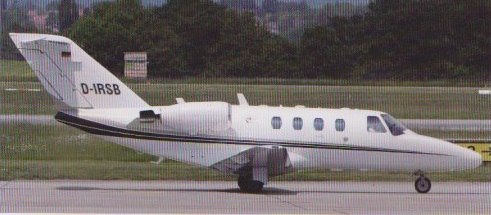
Cessna Citation CJ1 D-IRSB

The Citation CJ1+ was first announced in 2004 and October 2004 marked the first flight.
The Citation CJ2, was Cessna’s response to customer requests for an improved CitationJet with higher cruise speeds, more cabin room and greater range, made its first flight ahead of schedule on April 27, 1999. Powered by a pair of Williams Rolls FJ44 2C engines, the CJ2 prototype took off from Wichita’s McConnell Air Force Base and flew a 65 minute test program, after which it landed at Mid-Continent Airport where Cessna’s main facility is located. During the flight the CJ2 climbed to 10,500 feet, where it performed stability and control tests, including cycling the gear, flaps and speeds.

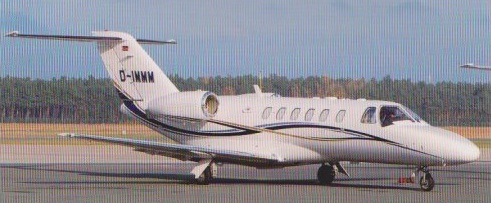
Cessna Citation CJ2 D-IMMM

The new CJ2 delivers cruise speeds of up to 400 knots (460 mph). A range of more than 1,935 statute miles, and the freedom to get in and out of runways shorter than 3,500 feet.
The Citation CJ2+ was first announced in 2004 and the first delivery was in 2006.

CE-525 CJ-1
Engines: 2 x Williams-Rolls FJ44 turbofan, 8446 N / 1900 lb.
Length : 42.585 ft / 12.98 m
Height : 13.681 ft / 4.17 m
Wingspan : 46.752 ft / 14.25 m
Wing area : 240.037 sqft / 22.3 sq.m
Max take off weight : 10401.0 lb / 4717.0 kg
Weight empty : 6275.4 lb / 2846.0 kg
Landing speed : 82 kts / 152 km/h
Cruising speed : 383 kts / 709 km/h
Take off distance : 3081 ft / 939 m
Landing distance : 2749 ft / 838 m
Initial climb rate : 3543.31 ft/min / 18.00 m/s
Service ceiling : 41011 ft / 12500 m
Cruising altitude : 35007 ft / 10670 m
Wing load : 43.46 lb/sq.ft / 212.00 kg/sq.m
Maximum range : 1485 nm / 2750 km
Range : 1076 nm / 1992 km
Crew : 2+6

Cessna 525A CitationJet 2 / CJ2
Business Jet, USA, 1999
Engine : 2 x Rolls Royce Williams FJ44 2C, 10301 N / 1050 kp
Length : 46.916 ft / 14.3 m
Height : 13.911 ft / 4.24 m
Wingspan : 49.508 ft / 15.09 m
Max take off weight : 12427.4 lbs / 5636.0 kg
Cruising speed : 400 kts / 741 km/h
Service ceiling : 41011 ft / 12500 m
Range : 1680 nm / 3111 km
Crew : 2
Payload : 6 pax (max. 272kg)

Cessna CE-680 Citation Sovereign

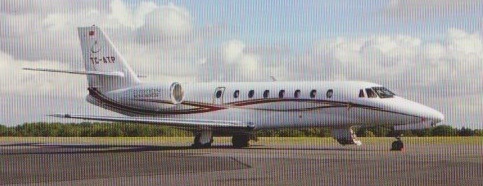
Citation Sovereign TC-ATP

Ultimately the 600 series Citations translated to the Model 680 Sovereign. The Citation Sovereign was first announced in 1998 and the first delivery was in September of 2004.
First flown on 27 February 2002, the eight seat Sovereign has a 2500 nm range and a fully integrated avionics system, with four large active matrix colour liquid crystal displays.

Cessna 680 Citation Sovereign
Engines two 5,690-lb / 2580 kp Pratt & Whitney PW 306C turbofans.
Length : 61.713 ft / 18.81 m
Height : 19.193 ft / 5.85 m
Wingspan : 63.123 ft / 19.24 m
Wing area : 510.214 sqft / 47.4 sq.m
Gross wt. 30,000 lb.
Max. speed : 443 kts / 820 km/h
Initial climb rate 4,100 fpm.
Service Ceiling 47,000/ 14325 m.
Cruising altitude : 35105 ft / 10700 m
Range : 2484 nm / 4600 km
Payload : 10 pax (max. 1134kg)

Cessna CE-560 Citation V / CE-560 Encore / CE 560XLS / Excel / Ultra

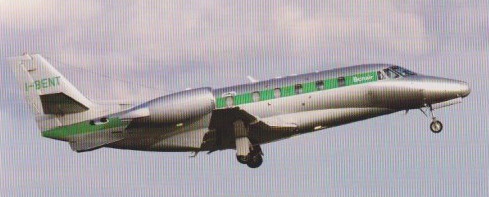
Citation Excel I-BENT

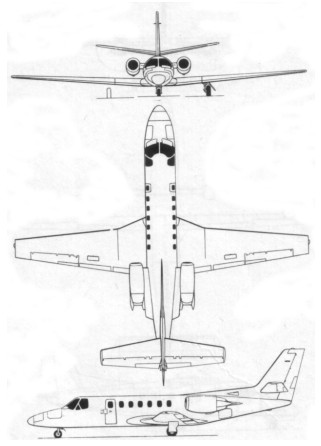
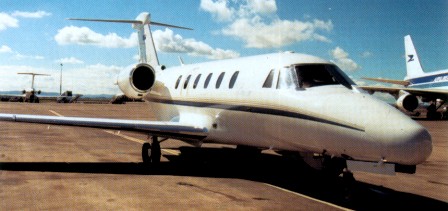
In August 1987, Cessna flew an engineering prototype of the eight-seat Model 560 Citation V This is essentially a development of the S/II equipped with 2,900 lb st / 1315kg JT15D-5A engines, and a longer fuselage fitted with a seventh cabin window. The type was certificated on 9 December 1988, first delivery made the following April and by the end of 1989 the company had delivered 33 and claimed a full orderbook for the US $3.8M Citation V to the end of 1991. More than 60 had been delivered by 1990.

Production ended in 1994 as the model morphed once again into the Citation Excel (XLS).

The Citation XLS+ was first announced in 2006. The first flight was in 2007.

The first new Cessna Citation Encore entered service on 29 September 2000 for customer demonstrations.

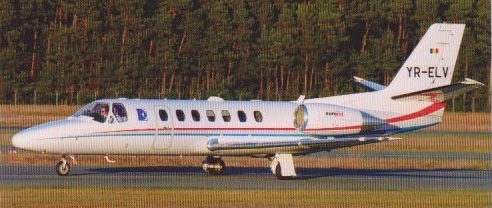
Citation Encore YR-ELV

The Citation Encore+ was first announced in 2005.

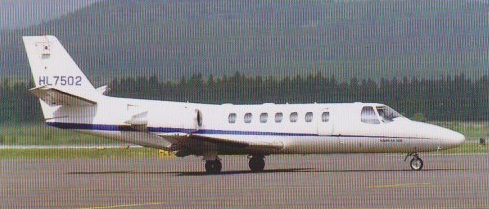
Citation Ultra HL7502

CE-560 Citation V
Engines: 2,900 lb st / 1315kg JT15D-5A

CE-560 Encore
Engines two 3,360-lb. Pratt & Whitney PW535 A turbofans.
Seats 7-8.
Gross wt. 16,630 lb.
Empty wt. 9,977 lb
Max cruise 431 kts.
Initial climb rate 4,100 fpm.
Range 1,700-1,960 nm.
Ceiling 45,000.

CE-560 XLS
Engines two 3,804-lb. Pratt & Whitney PW545 A turbofans.
Seats 6-10.
Gross wt. 20,200 lb
Empty wt. 11,910 lb
Max cruise 429 kts.
Initial climb rate 4,100 fpm.
Range 1,700-2,080 nm.
Ceiling 45,000.

Cessna CE-650 Citation III / VI / VII

Citation III

Cessna’s Citation III business jet made its first flight on 30 May 1979. The aircraft, powered by dual 1655kf Garrett AiResearch TFE 731-3-100S turbofans, was scheduled for certification in in April 1982 and first deliveries made in the spring of 1983.

Cessna CE-650 Citation III Article

Apart from the rear-mounted engines, the Citation III bears little visual similarity to Cessna’s other Citation designs. The Citation III is a completely new design using no major components of the Citation I or II. As the company’s ‘top of the range’ biz-jet, the Model 650 Citation III was certificated by the UK’s CAA in 1988 and by most European countries as well as the USA. More than 160 had been delivered by 1990. The two engines are 3,650 lb st (16,24 kN) Garrett TFE731-313-1005 turbofans and the cabin has standard seating for six passengers and two crew. Incorporates a swept super critical wing and T-tail, the Citation III first flew on 30 May 1979 and deliveries began in late 1982. The Citation III is a totally new airplane which takes advantage of many technological developments, including a high aspect supercritical wing, upgraded fanjet engines, and lighter weight structure, which give it the capacity to caxpy its passengers in extraordinaxy comfort at 540 mph with range to cross a continent or an ocean.
Certification of the Citation III was obtained on 30 April 1982, under FAA Part 25 plus extra special conditions to cover altitudes up to 51,000 ft / 15,550 m. More than 1700 hrs were flown by the two prototypes prior to certification. Powered by Garrett TFE-731-3B-100S engines, the Citation III seats up to 10 passengers and a crew of two; cruising at up to 540 mph / 869 kph, it has a range of more than 2500 nm / 4630 km.

In July 1982 the Citation III backlog was more than 140, the current price quoted at $5.196m / £2.89m in 1981 dollars.

Citation VI and VII were developed as lower-cost derivatives for 1992 delivery. The Citation IV as a lower priced version of the III by standardising systems.
The VII is a higher powered version of the III using Garrett TFE731 4 engines. Cessna Citation III’s cruise speed is 540 mph. Standard range is 2,875 statute miles. And with the long range option (its extra tankage does not reduce the cabin size) Citation III will cover 3,450 miles non stop. Citation III is designed to cruise at 50,000 feet, and can take off, fully loaded, in only 3,900 feet of runway. The primary controls are manual (only the stabilizer and spoilers are mechanically assisted). There are no “stick pushers stick pullers” or other mechanical augmentation systems.
The Citation III set time-to-climb records, performance not immediately associated with the original Citations.
By the end of 1989 174 had been delivered.
The 8-10 seat Citation VI and VII were announced in May 1990, both based on the Citation III airframe but with factory-installed interior and avionics package. The ‘simpler’ and thus lower priced $8.6M Citation VI features a ‘low speed’ wing and a modified undercarriage bestowing and the ability to operate from grass fields. Powered by two Garrett TFE 731-3B-100 turbofans, the Citation VI is designed to cruise at 874km/h at 15500m.
The longer range Citation VII version of the III is high powered with 1850kg thrust TFE 731-4 turbofans offering improved performance. First models were priced at US$8.6M.

CE-650 Citation III
Engines: 2 x Garrett TFE 731-3B-100S, 3650 lbs / 1624 kp thrust.
Seats: 8/10.
Length: 55.5 ft / 16.9 m.
Height: 17.3 ft.
Wingspan: 53.5 ft / 16.3 m.
Wing area: 312.156 sqft / 29.0 sq.m
Wing aspect ratio: 8.9.
Maximum ramp weight: 20,200 lbs.
Maximum takeoff weight: 20,000 lbs.
Standard empty weight: 10,951 lbs.
Maximum useful load: 9249 lbs.
Zero-fuel weight: 13,700 lbs.
Maximum landing weight: 17,000 lbs.
Wing loading: 64.1 lbs/sq.ft.
Power loading: 2.7 lbs/lb.
Maximum usable fuel: 7155 lbs.
Best rate of climb: 4140.
Certificated ceiling: 51,000 ft / 15545 m.
Max pressurisation differential: 9.5 psi.
8000 ft cabin alt @: 51,000 ft.
Initial climb rate : 3681.10 ft/min / 18.70 m/s
SE Rate of Climb; 1,006 ft @ 129 kts.
SE Climb Gradient; 476 ft/nm.
SE Ceiling; 25,000 ft.
Maximum speed: 467 kts.
Normal cruise @ 45,000ft: 423 kts.
Fuel flow @ normal cruise: 992 pph.
Stalling speed gear/flaps down: 89 kts
Stall Clean; 111 kts.
Turbulent Air Penetration Speed; 200 kts.
Landing speed : 97 kts / 180 km/h

Citation VII
Engines: 2 x Garrett TFE 731-4.

Cessna CE-414 Chancellor

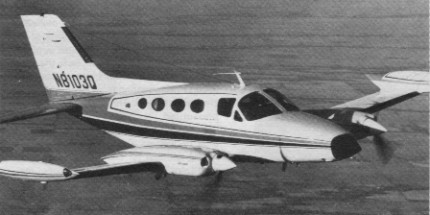
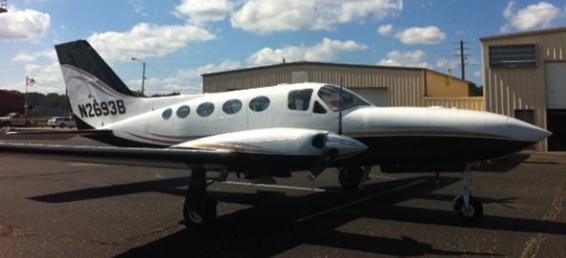
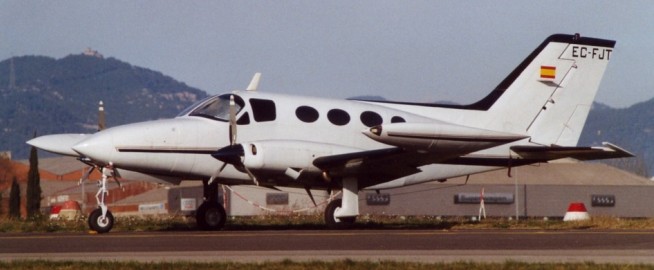
To provide the pressurised 414 twin-engined transport, Cessna married the basic fuselage of the Model 421 with the wing developed for the Model 401. The resulting aircraft was flown for the first time on 1 November 1968 and certificated during the following August. New features introduced on the aircraft included engine cowlings with flush intakes to improve engine cooling and an accurate fuel monitoring system developed by Cessna to provide better fuel management.
From the time of its introduction until 1976, improvements introduced for the Model 402 were reflected in the Model 414, and in that year the name Chancellor was adopted. It was available for 1976 in standard and Model 414 II versions, the latter incorporating a package of factory-installed avionics and equipment.
After 513 of the original Model 414s had been built, Cessna combined the air¬frame that was developed for the Golden Eagle in 1978 with the 310 hp engines of the 414 to produce the 414A Chancellor. The engines are direct drive Continental TSIO 520s. The gross weight and useful load of the new airplane both are substantially greater than those of the old 414, which gives it much better payload and endurance numbers and makes it a more viable corporate transport. The pressure differential five pounds per square inch is greater so that the airplane can cruise at higher altitudes. Major changes included a redesigned and increased-span wing incorporating integral fuel tanks and more baggage capacity in an extended nose.

Cessna CE-414A

Versions available between 1978 and 1986, were the standard Model 414A Chancellor, the Chancellor II and later the Chancellor III, all with differing factory installed avionic/equipment packages. When Model 414/414A production ended in 1986 a total of 1,067 variants had been built.

The old 414’s service ceiling was 11,350 feet, and with the same engines and gross weight 400 pounds greater, the new airplane does 19,850 feet. The new airplane has four and a half feet more span as well as 30 more square feet of wing area, and these two factors do wonders for single engine ceiling.
On the old 414, fuel was carried in as many as six tanks, only two of which were standard equipment. Fuel management included the operation of transfer pumps, the monitoring of fuel return and the bother of tank selection. The new air¬plane carries a standard 103 gallons in each wing, virtually no management is required and the total capacity is greater than was available with all six tanks on the 414.

Scenic Air Lines, in 1977, acquired from American Jet Industries engineering and manufacturing rights for turboprop conversions of Cessna Models 402 and 414, now known as Turbo Star 402 and Turbo Star Pressurised 414.

Gallery

Variations:
Riley Super 414

CE-414
Engine: 2 x Continental TSIO-520-N, 310 hp.
Seats: 7.
Wing loading: 32.4 lb/sq.ft.
Pwr loading: 10.2 lb/hp.
Gross wt: 6350 lb.
Empty wt: 4126 lb.
Equipped useful load: 1889 lb.
Payload max fuel: 671 lb.
Range max fuel/75% pwr: 1168nm/5.1hr.
Range max fuel / 55%: 1309nm/7.2hr.
Ceiling: 30,100 ft.
75% cruise: 225 kt.
55% cruise: 183 kt.
Vmc: 84 kt.
Stall: 74-86 kt.
1.3 Vso: 96 kt.
ROC: 1580 fpm.
SE ROC: 240 fpm @ 105 kt.
SE ceiling: 11,350 ft.
Min field length: 2350 ft.
Fuel cap: 600/1218 lb.
Cabin pressure: 4.2 psi.

CE-414A Chancellor
Engines: Continental TSIO-520-NB, 310 hp, 231kW.
TBO: 1400 hrs.
Props: McCauley 3-blade, 76.5-in.
Seats: 6/8.
Length: 11.09 m / 36 ft 5 in.
Height: 3.49 m / 11 ft 5 in.
Wingspan: 13.45 m / 44 ft 2 in.
Wing area: 20.98 sq.m / 225.83 sq ft.
Wing aspect ratio: 8.6.
Wing loading: 29.7 lb/sq.ft.
Power loading: 10.8 lb/hp.
Maximum ramp weight: 6785 lbs.
Maximum takeoff weight: 3062 kg / 6750 lbs.
Standard empty weight: 4368 lbs.
Maximum useful load: 2417 lbs.
Zero-fuel weight: 6515 lbs.
Maximum landing weight: 6750 lbs.
Wing loading: 29.9 lbs/sq.ft.
Power loading: 10.9lbs/hp.
Maximum usable fuel: 1236 lbs/204 USG.
Best rate of climb: 1520 fpm @ 108 kts.
Climb gradient: 853 ft/nm.
Rate of climb @ 8,000 ft: 1400 fpm.
Certificated ceiling with oxygen equipment: 30,000 ft.
Certificated ceiling without oxygen equipment: 25,000 ft.
8000ft cabin alt @: 21700 ft.
10,000ft cabin alt at: 26,500 ft.
Maximum single-engine rate of climb: 290 fpm @ 108 kts.
Single-engine climb gradient: 161 ft/nm.
Single-engine service ceiling: 19850 ft.
Maximum speed: 235 kts.
Max cruise, 77.5 % power at 24,500 ft: 225 kts.
Duration at max cruise: 5.67 hrs.
Cruise @ 65% pwr @ 8,000ft: 177 kts.
Cruise @ 65% power @ 18,000ft: 190 kts.
Fuel flow @ 65% pwr @ 18,000 ft: 180 pph.
Endurance at 65% pwr @ 18,000 ft: 6.5 hrs:
Econ cruise, 60.8% power at 20,000 ft: 187 kts.
Duration at econ cruise: 7.14 hrs.
Stalling speed clean: 82 kts.
Stalling speed gear/flaps down: 72 kts.
Turbulent-air penetration speed: 144 kts.
Takeoff Dist 50 ft obstacle: 2,595 ft.
Landing dist 50 ft obstacle: 2,393 ft.
Pressurization differential: 5.0 psi.

1980 Cessna 414A
Engines: RAM Overhauled TSIO-520-B, 335 hp
TBO: 1600 hour
Propellers: McCauley Series Saber Tip C500, Model 3AF32CC515, 3 Bladed
Prop TBO: 2000
Gross Ramp Weight: 7140 lb
Max Gross Takeoff Weight: 7105 lb
Empty Weight: 5120.72 lb
Useful Load: 1979.28 lb
Useful load W/full main tanks (206USG): 743.28 lb
Nose Baggage capacity: 332 lb
Fuel burn: 35.8GPH @ 185-195K @ 16000 – 17000 Ft.
Range with 206USG: 800 miles w/ 1 hr reserve.
Seats: 7 / 8

CIDC Turbo Star 414 / Cessna 414
Engines: 2 x Allison 250-B17B, 420 hp.
Seats: 6/8.
Wing loading: 33.5 lb/sq.ft.
Pwr loading: 7.7 lb/hp.
Max TO wt: 6525 lb.
Empty wt: 3705 lb.
Equipped useful load: 2492 lb.
Payload max fuel: 534 lb.
Range max fuel/cruise: 996 nm/4.4 hr.
Range max fuel /range: 1390 nm/ 6.7 hr.
Service ceiling: 25,000 ft.
Max cruise: 226 kt.
Max range cruise: 209 kt.
Vmc: 81 kt.
Stall: 70-85 kt.
1.3 Vso: 91 kt.
ROC: 2180 fpm.
SE ROC: 510 fpm @ 86 kt.
SE ceiling: 13,800 ft.
Min field length: 1290 ft.
Fuel cap: 1512/1958 lb.

Cessna CE-208 Caravan / C-98

CE-208B Grand Caravan

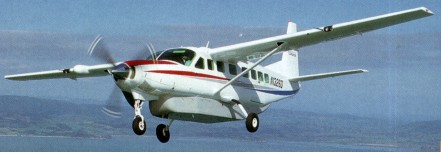
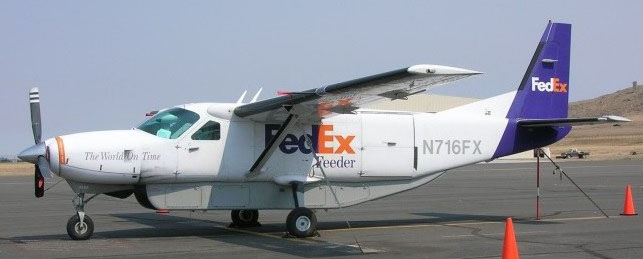
First flown on 9 December 1982, the Caravan I was Cessna’s first wholly new design for some years. The type was planned as the Model 208 to succeed the company’s earlier Models 180, 185, and 206 while also assuming the utility mantle of de Havilland Canada types such as the Beaver and Otter. The Caravan I is a thoroughly utilitarian design with a strut-braced wing in the high-set postion, a capacious fuselage accessed by large doors, and fixed tricycle landing gear with tall legs so that a ventral freight container can be fitted when required. The spring steel main undercarriage legs were designed to tear away without damaging the fuselage structure in an accident. The nosewheel fore-and-aft location is taken not on the airframe but by means of a drag link spring, attached near the fork to reduce bending loads in the strut. Steering to 15 degs either way is by linkage to the rudder pedals, and the wheel is free to castor to 56 degs either side. All fuel is carried inside the wings between the two spars for safety, and the tips and leading and trailing edges are made from lighter-gauge metal than the rest of the wing structure, which should thus remain intact in the event of minor damage. The wings are an aerofoil section the same as the Citation’s, and the flaps take up so much of the span that lateral control is helped by spoilers on the top surface acting in conjunction with the ailerons.

Cessna CE-208 Caravan Article

The first production aircraft rolled out in August 1984.
The 208 received FAA certification in October 1984 and the first deliveries in February 1985. Because of FAR Part 23 restrictions, American registered Caravans have no more than 10 seats in their 17 foot cabins. An increase in MAUW to 8000 lbs (from 7300) allows them to carry more than their basic empty weight of 3800 lbs and promising much useful load-carrying.
The higher gross weight Model 208A, ordered in December 1983 by the US small parcel airline Federal Express and called Cargomaster by them, is fitted with more comprehensive all-weather avionics and an underfuselage pannier, but has the fuselage windows deleted. Flight testing began on 3 March 1986, followed by certification and first delivery to Federal Express, who have ordered 210, in October the same year. By the end of 1989 more than 370 variants of the Model 208 had been delivered.
In 1984 the company launched development of a purely military model as the U-27A. This is externally identical with the Model 208A but is stressed for higher maximum take-off and landing weights in its role as a utility transport for troops and freight. The type can also be configured for the casualty evacuation and forward air control roles, while the 100-cu ft (2.83 cu.m) freight container can be replaced by a reconnaissance pod with optical and infra-red sensors as well as a data-link.
In 1985 Cessna released details of a quasi-military/special mission version of the Caravan I designated U-27A by the US Department of Defense and marketed as the Low Intensity Conflict Aircraft (LICA). Equipped with six hardpoints under the wing plus another on the fuselage centreline able to carry either a General Dynamics F-16 reconnaissance pod, or a cargo pannier, the LICA also has a electrically operated ‘roll up’ cargo door with slipstream deflector, openable in flight, and bubble windows for downward surveillance and observation. Cessna are also offering a similarly equipped version of the stretched Model 208B for special mission.
Following experience with the 208A, Federal Express ordered the Model 208B Super Cargomaster with the fuselage stretched by four feet / 1.22m, also built without windows and equipped with a pannier. The first Caravan Super Cargomaster flew on 3 March 1986.

Cessna 208B Super Cargomaster

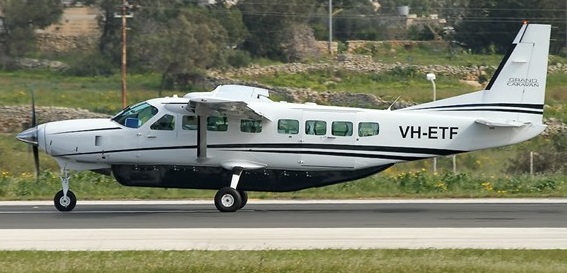
The Caravan family of aircraft consists of four distinct aircraft: the original Cessna Caravan, the Grand Caravan, the Super Cargomaster and the Caravan Amphibian. The original Caravan had its origins dating back to the early 80s and the Grand Caravan, like the Super Cargomaster, is essentially a stretched version of the original Cessna Caravan but powered by the A variant of the reliable Pratt and Whitney Canada PT6A-114 turboprop, which produces 675 shp (75 shp more than the standard version).

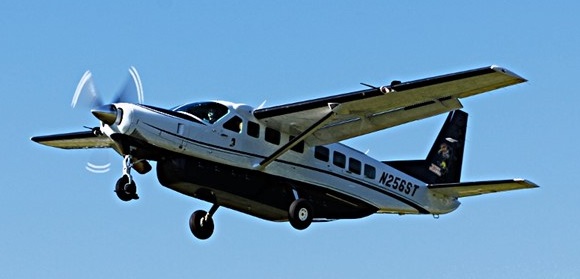
The Grand Caravan 208B first flew in 1990, some eight years after the Caravan I, and retains all of the conventional design aspects of the original: single-engine, high wing, unpressurised, with a fixed tricycle undercarriage. The PT6A-114A drives a three-blade McCauley propeller, which is governed to a constant speed of 1900 rpm and can be both feathered and reversed. While 1.2 m longer at 12.7 m, the Grand Caravan has room for up to fourteen (a pilot and thirteen passengers), the same as the Caravan I, and the fuselage itself is made up of a sheet metal bulkhead and a stringer and skin design. Although it narrows slightly towards the tail, the 5.1 m cabin is spacious and offers 9.6 cu.m of volume. This, combined with the more powerful turboprop, means that the Grand Caravan does have a higher useful load than the original. The wings on the Grand Caravan (which span 15.9 m) are conventional aerofoils, and both contain an integral fuel bay with a capacity totalling 1270 litres which feeds into a fuel reservoir before continuing to the turbine. The tail stands 4.5 m high and the control surfaces are again conventional: horn-balanced elevators and rudder. The flight control system is cables, bell cranks and push-pull rods, providing positive control and simple maintenance. The aircraft is steered by the nose wheel and the shock absorption for the main landing gear is provided by the tubular spring steel struts with an “intertube” connecting the two. Once at 10,000 ft, the Grand Caravan will cruise at 184 kts and, with a payload of just under 2,000 lbs and a reserve of 45 minutes, has a range of about 900 nm. Block time for such a flight would be around five hours. With 3,500 lbs on board, range drops to about 100 nm. It is these tasks where the Grand Caravan comes into its own; flying large loads to or from rough and short surfaces. At gross weight, landing requires just 745 ft, 1655 ft to clear a 50-ft obstacle, while a zero-wind take-off requires 1205 ft (2,210 ft to clear a 50 ft obstacle).
In 1997 the Caravan 675, which used the same engine as the Grand Caravan, was announced and deliveries started in May 1998.
The type was in service with military air arms in Brazil, Liberia, Thailand and with the Royal Canadian Mounted Police as amphibians.

Variations:
Soloy Corp Pathfinder

Gallery

CE-208
Engine: Pratt & Whitney PT6A-114, 600 shp.
Prop: Hartzell 3 blade 100-inch dia.
Wing span: 51ft 8in.
Length: 37ft 7in.
Height: 14ft 2in.
Cruise: 186 kt (214 mph).
MTOW: 6,700 lbs.
Seats: 14 pax.
Cabin width: 5ft 2in.
Cabin height: 4ft 3in.
Cabin vol: 337 cu. ft.
Payload: 3000 lbs.
Fuel cap: 330USG.

Cessna 208 Caravan I
Engine: 1 x Pratt & Whitney Canada PT6A-114 turboprop, 477kW
Take-off weight: 3629 kg / 8001 lb
Empty weight: 1752 kg / 3863 lb
Wingspan: 15.88 m / 52 ft 1 in
Length: 11.46 m / 37 ft 7 in
Height: 4.32 m / 14 ft 2 in
Wing area: 25.96 sq.m / 279.43 sq ft
Cruise speed: 341 km/h / 212 mph
Ceiling: 8410 m / 27600 ft
Range: 1797 km / 1117 miles

Cessna 208 B Caravan I
Engine: Pratt & Whitney Canada PT 6 A 114, 441 shp
Length: 37.73 ft / 11.5 m
Height: 14.108 ft / 4.0 m
Wingspan: 52.165 ft / 15.9 m
Wing area: 279.864 sq.ft / 26.0 sq.m
Max take off weight: 7336.0 lb / 3327.0 kg
Weight empty: 3801.4 lb / 1724.0 kg
Payload: 3534.6 lb / 1603.0 kg
Max. speed: 184 kts / 341 km/h
Landing speed: 60 kts / 111 km/h
Cruising speed: 175 kts / 325 km/h
Initial climb rate: 1200.79 ft/min / 6.10 m/s
Service ceiling: 26608 ft / 8110 m
Wing load: 26.24 lbs/sq.ft / 128.00 kg/sq.m
Range: 972 nm / 1800 km
Crew: 1
Payload: 9-14pax

2008 Cessna 208B Grand Caravan
Standard Price: US$1,990,000
Engine: Pratt & Whitney PT6A-114A, 675 shp
Prop: 2.7m
Length: 12.7m.
Wing span: 15.9m.
Height: 4.5m
Max ramp wt: 8785 lbs.
Gross Weight (lbs.): 8750
Empty Weight (lbs.): 5013
Useful Load (lbs.): 3772
Max ldg wt: 8500 lb
Fuel Capacity (gals./lbs.): 335/2245, 1270 lt
Payload, Full Standard Fuel (lbs.): 1548
Rate Of Climb, SL (fpm): 975
Max Operating Altitude (ft.): 23,700
Max Cruise Speed, 10,000 Ft. (kts.): 184
Max Range, 10,000 Ft. (nm): 917
Ldg roll: 745 ft
T/O run: 1205 ft
Ldg dist from 50 ft: 1655 ft
T/O dist to 50 ft: 2210 ft
Capacity: 450 cu.ft

U-27A Caravan I
Engine: one 600-shp (447-kW) Pratt & Whitney Canada PT6A-114 turboprop.
Maximum speed 203 mph (326 km/h) at optimum altitude
Initial climb rate 1050 ft (320 m) per minute
Service ceiling 30,000 ft (9,145 m)
Range 1,105 miles (1,778 km)
Empty wt: 3,850 lb (1,746 kg)
Maximum take-off 8,000 lb (3,629 kg)
Wing span 52 ft 1 in (15.88 m)
Length 37 ft 7 in (11.46 m)
Height 14 ft 2 in (4.32 m)
Wing area 279.4 sq ft (25.96 sq.m).
Payload: 14 passengers or 4,185 lb (1,898 kg) of freight.

Caravan 675
Engine: Pratt & Whitney PT6A-114A turboprop, 675 shp.