1998:
Heinerich-Heine-Straβe 15
D-52249 Eschweiler
Germany
Built the Project Aachen
1998:
Heinerich-Heine-Straβe 15
D-52249 Eschweiler
Germany
Built the Project Aachen
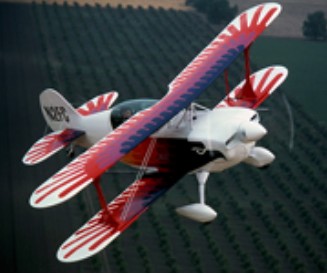
Frank Christensen says he once tried to buy the Pitts Special type certificate but was turned away by the price. That apparently bothered him, because he went out and designed his own family of kit built sport biplanes, and the results were on view for the first time at Oshkosh 1977.
The criteria were: unlimited class aerobatic performance; a two place cockpit; all the creature comforts the Pitts lacked; attractive styling; and, last but in a way most essential, that the airplane should be amateur built. To certificate and sell the airplane in the normal market would be too confining and too expensive, Christensen felt. By selling it as a kit, he could channel his expenditures where they belonged into providing materials of the highest quality instead of into justifying everything to the FAA.
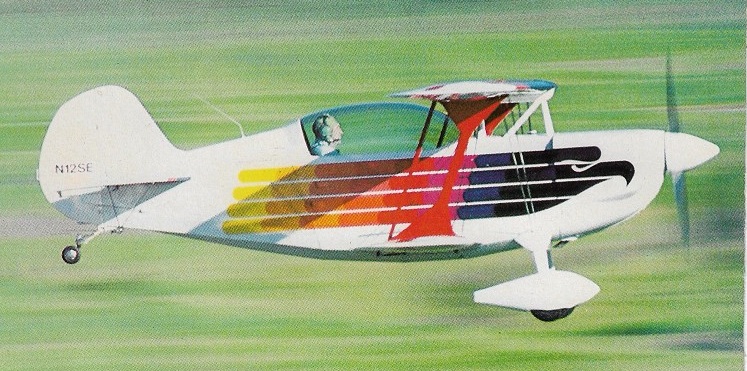
The Eagle is a biplane with a swept symmetrical wing structure of built up wooden ribs and spars. The Eagle’s bubble cano¬py, hinged oh the right side of the airplane, slides back to unlock and swings aside to ad¬mit the pilot and passenger to a long, wide tandem cockpit with a single instrument pan¬el in front and dual controls. The fuselage is built from welded steel tube and covered with metal back to the rear cockpit, then fabric the rest of the way aft. The fabric-covered wings are built with wood ribbing over spruce spars. The amateur builder has the option of buying 26 kits in sequence, starting with the ailerons, to test his dexterity.
Many parts are prefabricated or partially prefabricated, and the Ea¬gle’s steel tube structures are welded at the factory. Christen kits include everything you need to build them. Price in 1982: $41,000 (includes complete kit). Kit less engine and propeller, costs $26,000. Units delivered to June 1982: 450 started, 100 flying.
The Eagle I and I F will be the single-¬place unlimited competition version, pow¬ered by a 260 horsepower Lycoming aero¬batic engine; the F means fixed pitch. The I model will compete at 1,262 pounds and carry 1,478 pounds at gross with a wing loading of 11.82 pounds per square foot. Its empty weight power loading is 3.83 lbs. per hp. With a rate of climb of 2,640 fpm, it offers social climbers a verti¬cal penetration of 1,650 feet.
The II, by comparison, is pure luxury, featuring a spacious forward cockpit with no intruding instructor’s feet and a huge bubble canopy molded of a single hunk of clear plastic. It rides behind 200 hp Lycoming AEIO 360 AlD and a second F version, except that this time, the F means the 260 hp en¬gine of the I model. Its gross weight is 1,578 pounds, and it provides for an elec¬trical system and a radio.
Both models are stressed to +9and 6 Gs and have roll rates of 187 degrees per second and a power loading of 5.25 lbs/hp.
For a second time, Christensen turned his attention toward the Pitts factory (locat¬ed at Afton, in the middle of nowhere in Wy¬oming). This time, he was successful: Pitts Aerobatics is now part of Christen Indus¬tries, and Christensen wants the Pitts and the Eagle, formerly arch rivals in the field of competition aerobatics, to live in harmony as stablemates.
Christensen himself, of course, developed the Eagle as a refined Pitts after purchase negotiations with Curtis Pitts fell through in the mid 1970s. Although the very exis¬tence of the Eagle testifies to which airplane Christensen thinks is better, he is quick to assure the Pitts purists that their airplane has its own special place in the past and in the future.
Christensen had no plans to axe the Pitts marque, but one model, the 200¬hp two seat S 2A, will mutate to become the factory built Eagle. This is a crucial reason behind Christen Industries’ acquisition of Pitts Aerobatics. It is the most direct route to a factory built, certificated Eagle. For the purposes of certification, the factory built Eagle will actually be a Pitts S 2A modified to Eagle standards.
The Christen Eagle is very similar to the S 2A: both share the same airfoil, span, length, engine and propeller, but the Eagle has less lower wing dihedral, a further aft CG, different cowling and landing gear, modified ailerons and linkages and a more spacious and better designed interior. Christensen sees the Eagle as being almost imperceptibly different: “Like a washed car, it runs smoother.”
At the time he was developing the Eagle, Christensen was convinced that an unusual¬ly complete kit would appeal to a larger market than would comparable homebuilts or factory built airplanes. With 550 kits sold by 1975, it seems he was right.
The Eagle II is a two-seat sporting biplane that can be used for unlimited-class aerobatics as well as for advanced training. The Eagle II and II-F have a full electrical system (starter-alternator-battery). The Eagle II uses a 200-hp engine with constant-speed propeller. The Eagle II-F uses a 260-hp engine with fixed-pitch propeller. Characterized by their startling paint scheme, the Eagles feature swept symmetrical wings, a strong fuselage, and a blown canopy that covers both cockpits. With a roll rate of 187 degrees/second and a power loading of 7.89 lbs./hp, the Eagle is a strong performer. The fuselage is finished in metal from the cowling back to the rear cockpit. The midsection, all the way to the empennage, is covered in fabric. The fabric-covered wings are built with aluminum ribbing over spruce spars. The amateur builder has the option of buying 25 kits in sequence, starting with the ailerons, to test his or her dexterity.
The Eagle II, first offered in kit form in 1977, was still available in 1998 at US$55,000.
Eagle
Engine: Lycoming AEIO-360-A1D, 200 hp.
Propeller: Hartzell® HC-C2YK-4/C7666A Constant Speed
Speed max: 184 mph.
Never Exceeded Speed: 210 mph
Cruise: 165 mph.
Range: 380 sm.
Stall: 58 mph.
ROC: 2100 fpm.
Take-off dist: 1450 ft.
Landing dist: 2100 ft.
Service ceiling: 22,000 ft.
Wing Loading: 12.62 lb/sqft
Power Loading: g 5.13 lb/sqft
Length: 17 feet 11 inches
Height: 6 feet 6 inches
Wing Span : 19 feet 11 inches
Wing area: 125 sq.ft.
Gross Weight: 1578 pounds
Competition Weight: 1290 pounds (with 190 pound pilot)
Empty Weight: 1025 pounds
Useful Load: 553 pounds
Roll Rate: 187 Degrees/second
Baggage Allowance: 30 pounds
Fuel Capacity: 25 U.S. Gallons (24 Usable)
Structural Limits: +6g, -4g Operational
Seats: 2.
Landing gear: tail wheel.
Aviat Eagle II
Engine: Lycoming IO-360A1D, 200 hp.
Length: 18.5 ft.
Wing span: 19.9 ft.
Wingarea: 125 sq.ft.
Empty wt: 1125 lbs.
Mtow: 1578 lbs.
Fuel cap: 25 USG.
Seats: 2.
Undercarriage: Tail wheel.
Cruise: 165 mph.
Stall: 58 mph.
Range: 440 sm.
ROC: 2100 fpm.
To dist: 1450 ft.
Ldg dist: 2100 ft.
First flew in 1977 Eagle II two-seat unlimited-class aerobatic biplane; hundreds of kits sold for amateur construction. In 1983 acquired former Pitts Aerobatics company and this plant at Afton in Wyoming became company headquarters. Thereafter added Pitts Special aerobatic biplane to product line, plus A-1 Husky two-seat cabin monoplane (first flown 1986) as assembled and certificated aircraft.
In response to the considerable aging and reduction of the inventory of the country’s air fleet, the FAA encouraged a plan for the progressive replacement of the fleet through manufacturers of national origin.
It was decided for Chincul SACAIFI to manufacture aircraft under license from Piper Aircraft Corporation. The company was a wholly owned subsidiary of “La Macarena S.A.”, Piper’s Argentine distributor. Thanks to Piper’s licensed production plan to produce aircraft. abroad, it envisaged assembly in emerging third world countries, with the main benefit of commercial penetration and the reduction of labor costs that this implied.
With industrial promotions, which gave reductions and tax deferrals to certain areas of the country, they took the owners of Chincul to settle in the town of Pocito in the province of San Juan.
There were built two hangars: Endings, and production: 70 m front by 110 m long. Together with other sectors and annexed workshops, the total covered area reached 14,000 sq.m covered.
The inauguration of the plant occurred on December 12, 1972. The plant maintained a simultaneous process with 10 assembly lines, with about 450 employees (between technicians and aeronautical mechanics), working 24 hours a day, 365 days a year “24×7”. In total they produced some 960 aircraft. In 1978 there were 500 employees.
By the middle of the 1980s, the Sanjuanina plant started a slow downward slope due to the inflationary process that was experienced at that time, in addition to the bankruptcy of its Piper Aircraft mother house.
The Cuyano settlement of the Beraza tried to keep the head for a while longer, but 10 years of setbacks prevented it.
Signed agreement with Bell Helicopter Textron 1990 for helicopter co-production.
Finally, between 1991 and 1994, a final series of the PA-18 Super Club model was produced, definitively ceasing the activity on January 31, 1995, the date on which its huge gates were closed at the Pocito plant.
Today the facilities offer the image of a sad abandonment.
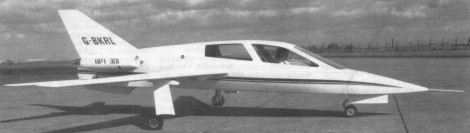
Ian Chichester-Miles, formerly Chief Research engineer of British Aerospace Aircraft Division at Hatfield, Hertfordshire, established Chichester-Miles Consultants (CMC) to develop a high performance light business jet.
Design of the four-seat Leopard started in January 1981 and was sufficiently advanced for a mockup to be completed in early 1982. Detail design and construction of a prototype by Designability Ltd of Dilton Marsh, Wiltshire, began in July 1982, under contract to CMC.
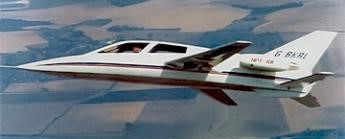
A four-seat light business jet aircraft, the wings are two-spar structure, primarily of GFRP, with some carbonfibre reinforcement. Full span electrically actuated trailing-edge flaps of carbonfibre, with deflections of +/- 45° for high drag landing and air-braking/lift dumping. No ailerons or spoilers. Thickness/chord ratio 14% at root, 11% at tip. Sweepback at quarter-chord 25°.
The Leopard airframe has an all-moving fin and tailplane and wings that combine laminar flow with supercritical technology.
Cantiler mid-wing monoplane. ARA designed wing section and 3D profiles combining laminar flow and super critical wing technology.
The fuselage is built in three sections: Unpressurised nose section accomodating avionics and nosewheel gear when retract, pressurised cabin section (production aircraft only) and unpressurised rear section providing a baggage bay, with fuel tanks below and equipment bays to rear.
Basic monocoque structure, primarily of GFRP with some carbonfibre reinforcement; fore and aft cabin bulkheads, engine and tailplane axle frames moulded in.
Pressure cabin section divided approximately along aircraft horizontal datum, with upper section formed by electrically actuated upward opening canopy hinged at windscreen leading-edge. Multiple latches around canopy lower-edge. Bonded-in acrylic side windows carry pressurisation tension. Nose opens for access to avionics.
Powered by two NPT 301 engines developing 300-350 lb thrust, this glass-fibre composite mini business jet is designed to keep pace with Learjets and Jumbos. Complete with a glass cockpit, the Leopard will carry four passengers and baggage over 1500 nm at around 500 mph at 41,000-45,000 feet.
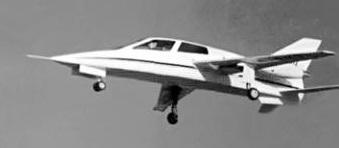
First shown statically at Farnborough in 1986, the first flight of the prototype (G-BKRL) took place on 12 December I988 at RAE Bedford, piloted by Cranfield test pilot Angus McVitie for a 27min flight.
CMC has limited the aircraft to 130kt and a maximum altitude of 3,500ft. The Leopard prototype was tested from speeds as low as 75kt with maximum 41° flap. Minimum zero-flap speed was less than 90kt. Undercarriage cycling was proved during this flight.
The prototype flying in the 1990 Farnborough display.
The converted missile NPT301 turbojet engines were intended solely for the 001, and NPT was slated to develop new engines for the final version of the aircraft. But when NPT went bankrupt, the entire Leopard project was delayed for one year until CMC teamed up with Williams International Corp., Walled Lake, Michigan.
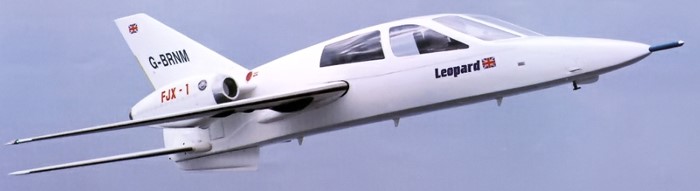
Williams developed the FJX-1 engine for CMC’s first production-configured aircraft, the 002, built at the Designability R&D Center in Dilton Marsh, England. Rated at 680 lb-thrust, the FJX-1 had more than twice the power of the NPT301. That was okay for the 002, but it was not quite enough for the final aircraft.
Engines: 2 x Noel Penny NPT 301 turbofan, 300-350 lb.
Seats: 4.
Cruise: 800+ kph.
Range: 2775+ km.
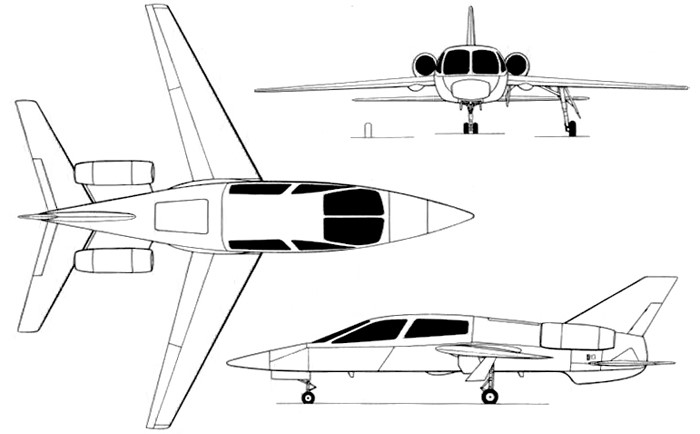
Chichester-Miles developed the Leopard four-seat sports executive jet, powered in latest production form by two Williams International FJX turbofan engines (first flown December 1988 and production deliveries anticipated from the year 2002).
Founded in 1958 for jet fighter and jet trainer development and production, based on original Soviet designs. J- 7 tactical fighter and air-defense interceptor first flew in January 1966, developed from the Soviet MiG-21 F-13 following 1960-1961 discussions between the two nations, though technology transfer had not been completed when cooperation came to an abrupt end. J-7 originally assembled by Shenyang, but production moved to Chengdu in 1967. Many new versions followed, including F-7 Airguards for export, with production and development continuing in 1999. A replacement for J-7/F-7 has been under development as the FC-1. Another early program led to the JJ-5 which first flew in May 1966 as an advanced lead-in/fighter conversion trainer, based on the Shenyang J-5A single-seat fighter (itself a Chinese-produced variant of the Soviet MiG-17PF), but with a MiG-15UJI-style tandem cockpit arrangement. Much more recently, Chengdu has also developed the new J-10 as a very advanced multirole fighter, first flown in March 1998 and possibly using some technology derived from the abandoned Israeli Lavi program of the 1980s. A further multirole fighter has been under development as J-12, about which little is yet known.

Engine: YIWUPROMOTION Power STRONG
Volume: 98.2 cu.cm
Power: 18HP at 9700 rpm
Carburetor: Walbro 32
Thrust: 55KG
Drive Method: Belt-Drive & Gearbox Drive
Start Method: Hand
Oil box volume: 8-10 lt
Engine Oil rate: 3%
Propellers diameter: 115cm, 122cm, 130cm
Oil consumed: 2.1-2.4 lt/hr
Reduction Drive Ratio: 1:3.3
Weight: 11.5 KG
Pilot Max Weight: 90KG
Max flight time: Around 3 hours
Coating of Cylinder Bore: Pottery-Plating Technology

Development by Chinese Helicopter R&D Institute began in 1991, the Z-11 (Zhishengji-11 / Vertical take-off aircraft 11) appears identical externally to Eurocopter AS 350B Ecureuil except for nose contours, but CHAIG publicity in mid-2001, stated that “China owns its independent intellectual property rights”. Eurocopter (which sold eight Ecureuils to China in 1996) declines to comment on its provenance.
First details officially released at China Air Show in Zhuhai November 1996, together with photographs showing one or two Z-11s in flight, the quoted first flight date of 22 December 1994 is thought to refer to re-engined modification of two secondhand ex-US AStars (Ecureuils) acquired earlier that year. In early 1997, a Chinese government agency announced that the Z-11 had flown for the first time on 26 December 1996.
Technical appraisal was completed in 1996, and small batch production began in 1997. Test programme included flights totalling 1332km in temperatures from —43 to +6°C, including a 2-hour sortie cruising at -38°C. Design was finalised in December 2000, and the Z-11 received CAAC certification in April 2001. CAAC approval for series production for civilian use was announced on 23 December 2002. Power was one 510kW WZ8D turboshaft (licence-built Turbomeca Arriel ID), reportedly produced by Liming engine factory.
Eight said to have been completed by late 1996, of which four had been delivered. All photographs released before late 1998 showed Z-11 in military camouflage with PLA insignia. One report from Aviation Expo China in October 1997 stated that the PLA had ordered 20 military Z-11s, these apparently going to Army Aviation’s training school. Production amounted to ‘several dozen’ by mid-2001, at which time some 10,000 hours flown and 50,000 take-offs and landings. Chongqing Three Gorges General Aviation Airlines (one ordered) reported as first civil customer in mid-2001; China Central Television of Jiangxi Province received one on 25 August 2002.
An armed version, equipped with cannon, ATMs, unguided rockets and a roof-mounted low-light/infra-red sight, has been reported. Later version to be announced is the Z11-MB1, which made its first flight on 7 Match 2003 powered by a 632kW Turbomeca Arriel 2B1A turboshaft.
CHAIG Z-11
Engine: WZ8D turboshaft, 510kW
Main rotor diameter: 10.69m
Tail rotor diameter: 1.86m
Length overall, rotors turning: 13.01m
Fuselage length: 11.24m
Height over tailfin: 3.02m
Height to top of rotor hub: 3.14m
Empty weight: 1120kg
Max take-off weight: 2200kg
Max level speed: 278km/h
Cruising speed: 240km/h
Hovering ceiling IGE: 5240m
Hovering ceiling OGE: 4500m
Max range: 600km
Endurance: 3 h 54 min
Changhe began producing coaches and commercial road vehicles in 1974. These and other automotive products still account for much of output, but batch-produced helicopters have included the Z-8 and Z-l 1. First flew in December 1985 a heavy commercial/military transport and anti-ship helicopter as the Z-8, based on the French Aerospatiale Super Frelon. More recently developed a small multipurpose single-turboshaft helicopter as the Z-11, first flown 1996 and possibly based in part on Eurocopter Ecureuil. Name changed to Jingdezhen Helicopter Corporation in 1998.
CHAIG (formerly Changhe Aircraft Factory), occupied a 433 ha site at Jingdezhen, had a workforce of more than 10,000 in 1998.
CHAIG is responsible for manufacture of the tailcone vertical fin and horizontal stabiliser of the Sikorsky S-92 helicopter. The tail for the first S-92 was delivered to Sikorsky in May 1997. Changhe is also thought likely to become the centre for any Chinese licensed manufacture of the AgustaWestland A 109E Power, which was the subject of Sino-Italian negotiations in late 2002/earIy 2003.

