
Each model has two finishes: Club or Prestige (£750 extra).
Alligator Club
Empty weight: 22 kg
Engine: Solo, 12 hp
Reduction: 1:2.5
Prop diameter: 123 cm
Fuel capacity: 10 lt
Price (1998): £2,700
Each model has two finishes: Club or Prestige (£750 extra).
Alligator Club
Empty weight: 22 kg
Engine: Solo, 12 hp
Reduction: 1:2.5
Prop diameter: 123 cm
Fuel capacity: 10 lt
Price (1998): £2,700
1998:
Aerodrome BP 213
F-26205 Montelimar cedex
France
Power pack builder
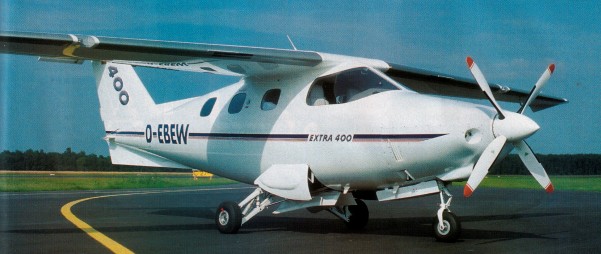
German designer Walter Extra, in the late 1990s, began to work on a larger idea—the Extra 400. Pressurization differential was 5.5 psi, providing an 8,000-foot cabin at 25,000 feet, and max gross was set at just above 4,400 pounds (or 1,999 kilograms because users of the European airway system pay progressively higher charges to operate aircraft weighing 2,000 kilograms or more).
The Extra 400, six seat, pressurised single is made from composite materials, mostly at Dinslaken. The fuselage is made in two parts, which are joined down the centre line. The wings are also constructed in two parts, top and bottom. Then the internal components are installed before the two parts are brought together. All fibreglass parts are cured in a heat room for 40 hours before moving on to the next stage in the construction process.
The engine in the 400 is the liquid cooled 350 hp Continental TSIOL 550-A Voyager, with an intercooled turbocharger. The propellor is a composite Muhlbauer constant speed four blade, with an option for a three blade version.
The Fowler flaps are in two parts on each wing, with all the working mechanism internal.
The Extra 400 six place pressurized piston single earned full certification from the FAA. The approval is in the normal category, for day/night/IFR operations. Powered by a 350 hp liquid cooled Continental TSIOL 550C powerplant, the Extra 400 can cruise at up to 230 knots at altitude, with a maximum no-wind range of better of 1,000 nm. Extra said that it would deliver the first two 400s in November 1999, before boosting production to two airplanes a month in the first half of 2001.
In parallel to the piston model, the company also developed a turbine version of the super-single, with a compact 450 shp Rolls-Royce/Allison engine.
Engine; Continental TSIOL-550-A, 350 hp, 325 hp cont.
TBO; 800 hr
Fuel type: 100LL
Prop; Mulhlbauer constant speed 3 or 4 blade 76.77 in
Length; 30 ft 10 in
Height; 10 ft 2 in
Wingspan; 37 ft 9 in
Wing area; 153.55 sq ft
Max ramp weight: 4409 lb
MTOW; 4299 lb
Landing weight: 4409 lb
Empty weight; 2659 lb
Useful load; 1640 lb
Total fuel; 178.5 USG
Max op alt; 25,000 ft
Pressurisation; 5.5 psi
Max cruise 20,000 ft; 259 kts
Max cruise 75% 25,000 ft; 243 kt
Econ cruise 65% 25,000 ft; 229 kt
Max. range economy (55%): 1160 nm
Stall; 55-57 kt
Initial climb rate: 1,400 fpm
Takeoff distance: 1,475 ft
Landing distance: 1,000 ft
Electrics; 24v, 1 battery
Alternators; 1 x 100 amp, 1 x 85 amp
Wheel base: 8.25 ft
Cabin doors: 1
Cabin width: 4.56 in
Cabin height: 4.07 in
Seats: 6
Landing gear type: Retr.
1997 price: 1,300,000DM / US$1.3m
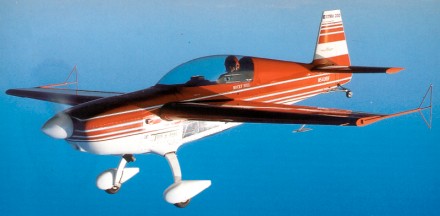
Extra 300 in single-seat 300 hp aerobatic competition (300 S), tandem two-seat aerobatic and training/cross-country (300), and 300 L low-wing (instead of mid-wing) variants; Extra 330 as a derivative of Extra 300 with Textron Lycoming AEIO-580 engine.
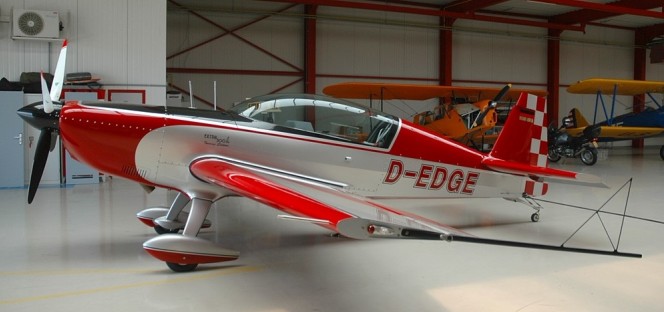
The Extra 330 LE high performance electric aerobatic airplane, jointly developed by Extra Aircraft and Siemens, has successfully demonstrated aerobatic performance as well as the capacity of glider towing and has beaten several world records. At a Paris Airshow the aircraft towed an aerobatic glider to 1000 Meter (with an average climb rate of 9.5 meters per second) then the glider performed aerobatics while the Extra landed and then after the glider landed the Extra, without recharging, took off again and for an aerobatic show with 260Kw on the prop.
Extra 300
Engine: Lycoming AEIO540, 300HP
Propeller: MT Composite 3 Blade Constant Speed
Top Speed: 220 knots
Roll Rate: 420 Degrees per Second
Climb Rate: 3,200 feet per minute
Load Limits: +/- 10G
Weight: 950kg
Fuel Capacity: 171 litres
Airframe: Composite Monoplane

The Extra 200 is a lower-cost, two-seat and 200 hp aerobatic competition and aerobatic training monoplane (first flown 1996).
Produces the Extra 200 lower-cost, two-seat and 200 hp aerobatic competition and aerobatic training monoplane (first flown 1996); Extra 300 in single-seat 300 hp aerobatic competition (300 S), tandem two-seat aerobatic and training/cross-country (300), and 300 L low-wing (instead of mid-wing) variants; Extra 330 as a derivative of Extra 300 with Textron Lycoming AEIO-580 engine; and Extra 400 pressurized high-wing six-seat touring cabin monoplane (first flown 1996).
First flown in 1993 as Express Design type
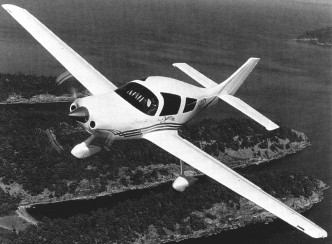
The Wheeler Express was designed not around the standard issue 170lb pilot/passenger, the aircraft providing two inches additional head and leg room. Cockpit width is the same as a late model Beech Bonanza. Designer Ken Wheeler reasoned that, as a four place aircraft, much of the flight time would be logged on long distance cross country with a consequent requirement for comfort. The basic construction of the Express is a foam covered sandwich, monocoque structure; built up from E glass, various foam core materials and vynalester resin.
Formed in two pieces split horizontally, the fuselage comes ready to be joined; the packing case serving as the lower fuselage jig.
The aircraft is stressed to 11 Gs. Powered by a Lycoming IO-360, the low wing, fixed tricycle undercarriage Wheeler Express is said to out-lift a Cardinal, out-distance a Bonanza and out-climb a Mooney.
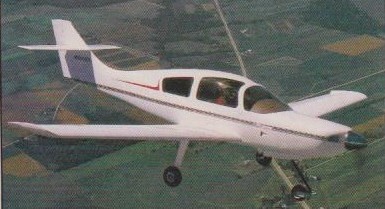
In 1988 the kit price was US$19,750.
In 1998 Express Aircraft offered a revised version of the Express in kit form. The claim was the composite four seater would be easier to build, lighter, and with a larger tailplane to improve handling. Construction time was still more than 2000 hrs.
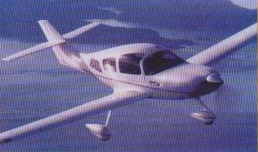
The production Express featured a larger fuselage and a new powerplant. The four seat composite aircraft is now powered by a six cylinder, 210 hp Continental engine, which provides a 210 mph cruise over a 1,200 mile range.
Optional low or cruiciform tail, and cargo pod requiring a minimum of 250 hp.
Wheeler Express
Engine: Lycoming IO-360, 200 hp
Wingspan: 31 ft
MTOW: 2300 lb
Fuel capacity: 51 USG
Cruise: 195 mph at 7000 ft
Range: 1100 mi
Engine: Lycoming IO-540, 300 hp
Wing span: 9.45 m
Wing area: 11.96 sq.m
MAUW: 1452 kg
Empty weight: 835 kg
Fuel capacity: 348 lt
Max speed: 362 kph
Cruise speed: 338 kph
Minimum speed: 92 kph
Climb rate: 8 m/s
Fuel consumption: 50 lt/hr
Seats: 4
Kit price (1998): $32,000
90 FT
Engine: Lycoming IO-540, 300 hp.
Speed max: 220 mph.
Cruise: 220 mph.
Range: 1450 sm.
Stall: 58 mph.
ROC: 1200 fpm.
Take-off dist: 1200 ft.
Landing dist: 800 ft.
Service ceiling: 20,000 ft.
Fuel cap: 92 USG.
Weight empty: 1875 lbs.
Gross: 3200 lbs.
Height: 8 ft.
Length: 25 ft.
Wing span: 31 ft.
Wing area: 130 sq.ft.
Seats: 4-6.
Landing gear: nose wheel.
90 TD
Engine: Lycoming IO-550, 280 hp.
Speed max: 235 mph.
Cruise: 225 mph.
Range: 1600 sm.
Stall: 58 mph.
ROC: 1200 fpm.
Take-off dist: 1200 ft.
Landing dist: 800 ft.
Service ceiling: 20,000 ft.
Fuel cap: 92 USG.
Weight empty: 1790 lbs.
Gross: 3200 lbs.
Height: 8 ft.
Length: 25 ft.
Wing span: 31 ft.
Wing area: 130 sq.ft.
Seats: 4-6.
Landing gear: tail wheel.
S-90
Engine: Lycoming IO-540-K1G5, 300 hp.
Vne: 230 kt.
Cruise 75%: 185 kts.
Stall: 55 kts.
Seats: 4.
1995: PO Box 609, Redmond, OR 97756, USA.
Ken Wheeler first produced the Express but on the 1992 bankruptcy, the rights were acquired by Ralph Kenner.
1997-8: Express Aircraft Co. LLC, 7825 Old Highway 99 SE, Ste 200 Olympia, WA 98501, USA.
In 2003 Larry Olson, the owner of Express Aircraft, crashed enroute to AirVenture in his turbine powered, retractable Express.
2004: Wheeler Technologies, Tacoma-¬Narrows Airport, Gig Harbor, Washington 98335, USA,
Company re-formed 1997 to sell kits of the Express four seat composites-built cabin monoplane, previously marketed by Wheeler, Express Design, and Experimental Aircraft Technologies. Also marketing kits for six-seat Loadmaster (first flown 1993 as Express Design type), Express CT, Srs 90 and Auriga.
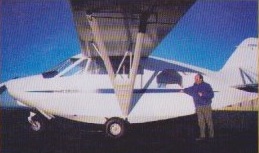
The tube and spaceframe Private Explorer offers 9.5sq.m of cabin area, high enough to stand up in. Circa 1998.
Engine: Lycoming
Wing span: 14.4 m
Wing area: 26.7 sq.m
MAUW: 1667 kg
Empty weight: 973 kg
Fuel capacity: 300 lt
Max speed: 200 kph
Cruise speed: 180 kph
Minimum speed: 67 kph
Fuel consumption: 40 lt/hr

