USA
Bought some assets of Bellanca Aircraft Corporation 1982, and initially provided product support for Bellanca Viking, thereafter intending to put Viking back into production. Company became known as Bellanca Inc.
1980->
Viking Aircraft Dragonfly / Dart Industries Dragonfly
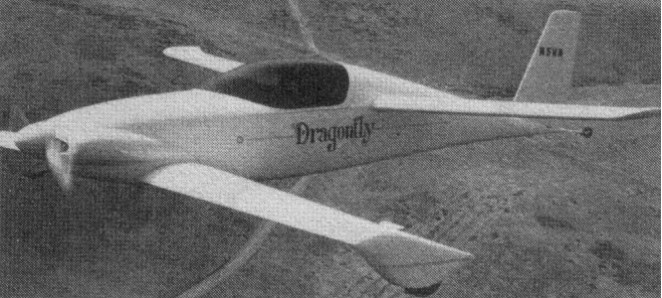
Designed by Robert J. Walters and winner of the Outstanding New Design Award at Oshkosh 1980, the Dragonfly is another canard-configured composite homebuilt in the same vein as the Quickie and VariEze. First flying on 16 June 1980 (N5WN) with two-place side-by-side seating under a bubble canopy, the Dragonfly is powered by a 56 hp 1600cc HAPI/VW engine. The intention of the aircraft is to provide builders with a project that is inexpensive to build and also inexpensive to operate on a readily available engine. The wing and canard are built as a single piece in a jig and the job can be accomplished in a normal two-car garage. The cockpit width is 43 inches, like that of a Cessna 172. A molded canopy was selected to avoid the soapbubble effect of a free-blown canopy. A typical 140-mph cruise burns gas at the rate of 45 mpg. The propeller used is a Great American, with a 40-inch pitch and 52-inch diameter.
Available in three under-carriage options as Mk.I, II or III.
By 1998, out of 2000 plans or kits that had been sold, about 500 were finished.
This 2 place composite design can be built from plans or can be quick built using pre-fab parts.
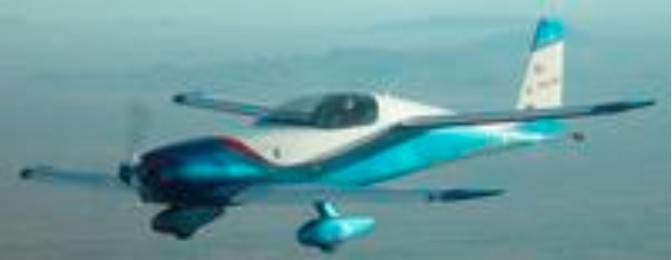
The DRAGONFLY, in 2008 was available from:
DART Industries
PO Box 223, Botha’s Hill
Kwazula Natal, So Africa 3660
Engine: VW
Wing span: 6.71 m
Wing area: 9.45 sq.m
MAUW: 522 kg
Empty weight: 277 kg
Fuel capacity: 57 lt
Max speed: 290 kph
Cruise speed: 265 kph
Minimum speed: 77 kph
Climb rate: 4 m/s
Seats: 2
Plan price (1998): $260
Kit price (1998): $8600
Engine 45-hp 1600 cc Volkswagen
Gross Wt. 1075 lb
Empty Wt. 805 lb
Fuel capacity 15 USG
Wingspan 22 ft
Wing area: 97 sq.ft
Top speed 150 mph
Cruise 155 mph
Climb rate 800 fpm solo
Ceiling 17,000 ft
Seats: 2
Dragonfly
Engine 56hp 1600 cc HAPI/Volkswagen
Wingspan 22 ft
Wing area: 97 sq.ft
Length: 19’0″
Gross Wt. 1075 lb
Empty Wt. 805 lb
Fuel capacity 15 USG
Top speed 168 mph
Cruise 140 mph
Stall: 45 mph
Climb rate 1050 fpm solo
Ceiling 18,500 ft
Range: 500 mi
Seats: 2
Engine: VW 1835cc
Speed max: 180 mph
Cruise: 165 mph
Range: 550 sm
ROC: 850 fpm
Take-off dist: 1200 ft
Landing dist: 2000 ft
Service ceiling: 18,500 ft
HP range: 60-82
Fuel cap: 15 USG
Weight empty: 610 lbs
Gross: 1150 lbs
Height: 4.2 ft
Length: 20 ft
Wing span: 22 ft
Wing area: 102.7 sq.ft
Seats: 2
Landing gear: tail wheel
Dart Industries Dragonfly
Stall: 58 kt / 67 mph / 107 kmh
Cruise: 145 kt / 167 mph / 269 kmh
VNE: 200 kt / 230 mph / 370 kmh
Empty Weight: 370 kg / 815 lbs
MTOW Weight: 551 kg / 1215 lbs
Climb Ratio: 600 ft/min / 3 m/s
Engine: 2180 70HP VW
Span: 22 ft
Length: 19 ft
Empty Weight: 600 lb
Useful Load: 545 lb
Wing Area: 92.2 sq. ft.
Seats: 2 side by side
Take Off Distance: 1200 ft
Stall: 48 mph
Cruise: 165 mph
Rate of Climb: 850 fpm
Viking Aircraft
1979: Viking Aircraft Ltd.
(pres: Robert J Walters),
Carlsbad CA.
USA
Offers plans and kits to construct Dragonfly two-seat composites monoplane of unusual design, with mid-mounted wings and canards, plus kits for Cygnet two-seat monoplane (originally the Sisler SF-2 Whistler).
1996-8: PO Box 646, Elkhorn, WI 53121, USA.
2008: Viking Aircraft, 333 Sunny Hill Dr, Elkhorn, Wisconsin 55312, USA
Vietnamese Air Force Institute TL-1 Tu luc
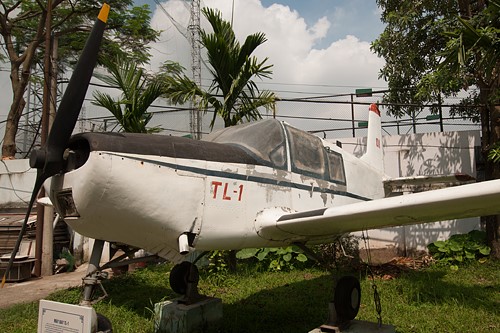
The TL-1 Tu luc was the first product studied, designed and successfully manufactured in 1984-1985 by Vietnamese Air Force Institute.
The TL-1 was tested successfully ten times totalling 102 minutes on the air.
Vidor Guiseppe
1998
Via Nazionale 38
I-31020 Tovena (TV)
Italy
Airplane builder
Vertidynamics Elite
Developed from 1992, the Elite is a 10 seat highly modified version of a Sikorsky S-55. One development aircraft was registered N2650M.
Engine: Garrett TSE331, 700hp
Useful load: 2500 lb
Max speed: 114 mph
Range: 325 mi
Vertical Aviation Technologies Hummingbird

The Hummingbird helicopter kit programme began in 1988. A 4 place helicopter based on a Sikorsky S-52. Of aluminium construction with carbon-graphite composite nose, powered by an aluminium 6.5 lt V8 of 260hp. Rotor mechanics remained the original.

By 1995, equipped with an electric cyclic trim system and hydraulic driven radiator fan. This helicopter was still available in fit form in 2004.
After a break in production of six years the company produced a new and improved Hummingbird in 1991, the 260L.
The Hummingbird 260L is a highly modified version of the four place Sikorsky S 52¬-3 with major changes to the nose, windshield, and powerplant installation turned into a kit. A modification has been the installation of a 260 h.p. Lycoming powerplant. The Hummingbird 260L is an FAA approved helicopter combined with an FAA approved powerplant. The Lycoming VO 435 A1F was designed to operate in an oblique position. One version can be turbo charged to 280 h.p. The Lycoming VO 435 A1F can be operated with automobile gasoline making it “fuel friendly”, where Avgas availability is limited. This entire powerplant installation was designed to meet the requirements of FAR 27 regulation standards for all helicopters in the Western world.
Another change to the new Hummingbird is the composite cabin doors and vertical/ horizontal stabilisers. The tail stabilisers were designed to increase lateral and longitudinal stability, increase tail rotor effectiveness, and reduce weight on the tail of the helicopter. Most components have a time/life of 1200 hours. New blade design will most likely extend blade life to 2000 hrs. A set of three main rotor blades costs about a third of the price of those for a comparable four place piston engine helicopter, with the total aircraft price less than half. The Hummingbird has strength inherent in its basic design. With a payload of over 900lbs, it will take a good size sling load, and with a quick removal of the rear seats, the “utility” configuration means bulky cargo can be carried. Also long range fuel tanks have just been designed as an extra.
As a Kit, the helicopter fits into the Amateur Built/Experimental Category and most of the maintenance can be done by the owner/assembler.
The Hummingbird is a single engine, single three-bladed main rotor type helicopter, with a tail rotor. The fuselage is made of aluminum and composites. The Hummingbird is powered by a FAA approved Lycoming aircraft engine. The transmission system consists of a clutch/freewheel unit between the engine and main gearbox, a main driveshaft extending from the top of the main gearbox to the main rotorhead, and a take-off drive from the main gearbox which drives the tail rotor driveshaft, intermediate gearbox and tail rotor assembly. These parts are manufactured to FAA design standards.
The Hummingbird cabin sits four people. The cabin is 55 inches wide, 56 inches high from floor to ceiling, and 110 inches in length. Two baggage areas 15” L x 20” W x 13” H are located under the forward two seats. Fly two people, 375 miles, with 220 lbs. of camping gear.
The many prefabricated components of the Hummingbird 260L make the kit an easy project for the first time builder. The average build time is 800 hours. There is no welding or composite work, only minor fabrication, and all major components are pre-assembled. The rotor blades for example come to you painted, balanced, and ready for installation. These blades have 7 degrees of twist to enhance performance.
The Hummingbird helicopter kit is assembled in 14 easy to follow sections. The first section consists of building the lower cabin. In this section, you will learn about real aircraft sheet metal fabrication and aircraft assembly. In the next section you will receive the upper cabin assembled.
After fitting the upper and lower cabin together, the landing gear is next, and then the nose. Flight controls, electrical components, instrumentation and fuel systems are next for installation.
The tailcone section is supplied assembled to assure uniformity. The powerplant and gearboxes are assembled for installation when received.
The main rotor blades and tail rotor blades will then come to you completely ready to install in the fully articulated rotor head. They will have been painted and pre-balanced at our factory. After rigging all the flight controls and cables, and calculating the Hummingbird’s weight and balance, it’s ready to fly.
Because of its inherently long tail, forward flight is very stable but very agile. The flight control system incorporates electric trim with force gradient spring pressure. Stick forces are very light. An appealing characteristic is the landing gear that is able to taxi and not have to hover, with hydraulic brakes and shock absorbing struts. The three blade rotor system is very smooth and has a medium inertia rotor providing excellent autorotation characteristics. The clutch is automatic for engaging the rotor system and a rotorbrake is included to slow the rotor during shut down.
Hummingbird
Engine: Aluminium V-8, 260 hp
hp range 260-315
Empty wt: 1,800 lb
Max wt: 2,700 lb
Rotor span: 33ft
Length: 30’6”
Height: 8’2”
Width: 8’7”
Service Ceiling: 11,000 ft
Max speed: 110 mph
Cruise: 90-95 mph
Range: 450 sm
Seats: 4
ROC: 1200 fpm
Fuel cap: 57 USG
Hummingbird
Engine: V8 6.5 lt, 260 hp
Rotor span: 10.05 m
MAUW: 1223 kg
Empty weight: 815 kg
Fuel capacity: 215 lt
Max speed: 176 kph
Cruise speed: 150 kph
Minimum speed: 0 kph
Climb rate: 4.75 m/s
Seats: 4
Fuel consumption: 50 lt/hr
Kit price (1998): $140,500
Hummingbird 260L
Engine: Lycoming V0-435
Rotor Blades: 3-blade
Main rotor dimension 33′ 0″
Tail rotor dimension 5′ 9″
Fuselage length 30′ 6″
Height 8′ 7″
Width 5′
Empty Weight 1,800 lbs
Useful Load 900 lbs
Gross Weight 2,700 lbs
Fuel 57 USG
Min Speed Hover
Vne 132 mph
Cruise 90-95 mph
Top Speed 110 mph
Rate of climb 1250 fpm at 2300 lb
Rate of climb 950 fpm at 2700 lb
Service ceiling 14,000 ft
Range 375 Miles
Kit: $169,000 in 2009.
Seats: 4
Vertical Aviation Technologies
Founded 1988. Under took repair of Sikorsky and Orlando helicopters; modifies Sikorsky S-55 helicopters for various uses including agricultural, passenger carrying, assault, heavylift, camping, computerised aerial advertising, and training (latter Aggressor, reconfigured to appear as a Russian Mi-24); and offers a modernized version of the four-seat Sikorsky S-52-3 helicopter, known as Hummingbird and sold in kit form.
Vertical Aviation Technologies, Inc. has principle offices and facilities at Orlando Sanford International Airport, Sanford, Florida. The company is engaged in research, design and manufacturing of helicopters worldwide from our four passenger Hummingbird helicopter kit to the nine passenger Sikorsky Whisper Jet quiet technology helicopter.
1996-2009: PO Box 2527, Sanford, FL 32772-2527, USA.
1998-2008: Vertical Aviation Technologies, Inc., 1609 Hangar Road, Sanford, FL 32773, USA.
Verner SVS 1400
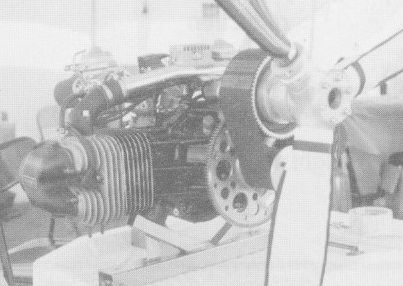
Circa 1998.
Cycle: 4 stroke
No cylinders: 2 opposed
Bore: 94 mm
Stroke: 100 mm
Compression: 8.9
Displacement: 1387 cc
Cooling: air/oil
Ignition: DCDI
Reduction: Toothed belt 2.06/1
Weight: 70 kg
Max pwr: 80 hp at 5000 rpm
Fuel consumption: 7.6 lt/hr at 3500 rpm
Price 1998: 52 700 Fttc
Verner Motor International
1998:
Vikyrovic 229
CZ-78813 Sumperk
Czech Republic
Engine builder
 All Aero