Fulmar HP-16 Héron

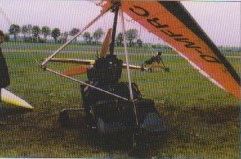
Single seat single engined high wing mono¬plane with two axis control. Wing has unswept leading and trailing edges, and constant chord; cruciform tail. Pitch control by eleva¬tor on tail; yaw control by fin mounted rudder; control inputs through stick for pitch/yaw/roll. Wing braced from below by struts; single surface. Undercarriage has three wheels in tricycle formation; no suspension on any wheels. Push right go left nosewheel steering indepen¬dent from yaw control. Optional brake on nosewheel. Aluminium tube framework, without pod. Engine mounted below wing driving pusher propeller.
The MP 16 Heron was designed by Pierangelo Mez¬zapesa, the driving force behind Fulmar. The prototype made its first flight on the 1 February 1983, and became available from April 1983 with two engine options: Sachs 330cc (see per¬formance characteristics below) or Hirth F 263R of 383 cc, which develops at 3900 rpm, an equivalent power (23 hp) to the Sachs. Despite the solidity of its tubular structure, the MP 16 Heron is foldable for transport on a road trailer, its space requirement then being 16.5 x 5.9 x 5.9 ft (5 x 1.74 x 1.75 m). A side by¬side two seater version is at the design stage.

Length overall 16.5 ft, 5.00 m.
Height overall 6.7ft, 2.00m.
Wing span 32.1ft, 10.0m.
Constant chord 4.7ft, 1.40m.
Dihedral 5 deg.
Sweepback 0 deg.
Tailplane span 8.2 ft, 2.50 m.
Total wing area 151 sq.ft, 14.0 sq.m.
Fin area 5.4 sq.ft, 0.50 sq.m.
Rudder area 14.0 sq.ft, 1.30 sq.m.
Tailplane area 13.5 sq.ft, 1.25 sq.m.
Total elevator area 9.2 sq.ft, 0.85 sq.m.
Wing aspect ratio 7.1/1.
Wheel track 5.9ft, 1.75m.
Nosewheel dia¬meter overall 12 inch, 30cm.
Main wheels diameter overall 16 inch, 40cm.
Engine: Sachs SA 340 engine.
Max power 22hp at 5250rpm.
Propeller diameter and pitch 41 x 18 inch, 1.05 x 0.46 m.
No reduction.
Max static thrust 155 lb, 70 kg.
Power per unit area 0.15hp/sq.ft, 1.6hp/sq.m.
Fuel capacity 2.6 US gal, 2.2 Imp gal, 10.0 litre in main tank; 5.3 US ga1, 4.4 Imp gal, 20.0 litre in reserve.
Empty weight 1991b, 90kg.
Max take off weight 419 lb, 190kg.
Payload 220 lb, 100kg.
Max wing loading 2.78 lb/sq.ft, 13.6 kg/sq.m.
Max power loading 19.1 lb/hp, 8.63 kg/hp.
Load factors design; +6.0, 3.0 ultimate.
Max level speed 44 mph, 70 kph.
Never exceed speed 50 mph, 80kph.
Max cruising speed 37mph, 60kph.
Economic cruising speed 34mph, 55kph.
Stalling speed 20 mph, 32 kph.
Max climb rate at sea level 300 ft/min, 1.5 m/s.
Min sink rate 400 ft/min at 31 mph, 2.0 m/s at 50 kph.
Best glide ratio with power off 7/1 at 34 mph, 55kph.
Take off distance 115 ft, 35 m.
Land¬ing distance 66 ft, 20 m.
Service ceiling 6560 ft, 2000 m.
Range at average cruising speed 50 mile, 80km.

Fulmar Ultralight Diffusion / Delta Fulmar

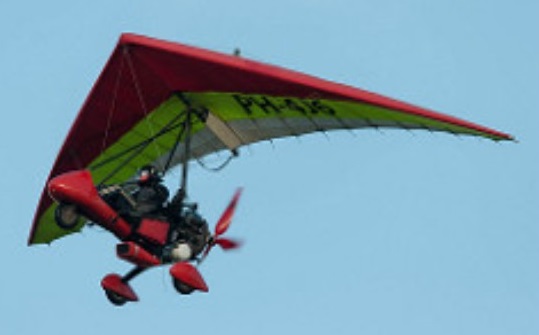
Fulmar first saw the light of day in 1978 and was one of the first manufacturers in Europe to motorise a hang glider, their Fulmar I, of 183 sq.ft (17.0 sq.m) area, using a Soarmaster American supplied engine. The company was incorpo¬rated into SPRL in July 1981, at which time Fulmar Ultralight Diffusion not only made single seater and two seater trikes using Robin 244, 333 and 432cc engines under wings of their own design and manufacture, but also built Weedhoppers on behalf of the European dealer Media Systems. 50 machines were built in this way.
1983: Fulmar Ultralight Diffusion, rue des Palais 285A, B 1000 Bruxelles, Belgium; tel (02) 216.79.30. Designer: Pierangelo Mezzapesa.

Ful Graffiti

Graffiti MA 30

The Graffiti trike is made in the Ukraine by Aeros. The wing is the same as Aeros trikes, but the trike is not identical.

MA 30 Graffiti

The aircraft was supplied as a complete ready-to-fly-aircraft.

Graffiti MA 30
Empty weight: 185 kg
Wing span: 10.2 m
Wing area: 14.8 sq.m
Fuel capacity: 30 / 40 / 50 lt
Certification: Vz
Engine: Rotax 582E, 65 hp
MAUW: 450 kg
Seats: 2
Max speed: 130 kph
Cruise speed: 85-105 kph
Minimum speed: 45 kph
Climb rate: 6 m/s
Fuel consumption: 7.8 lt/hr
Price (1998): 27 600 DM

Ful Maverick

The Maverick is one of the few side-by-side trikes.

Empty weight: 176 kg
Wing span: 10.15 m
Wing area: 15.2 sq.m
Fuel capacity: 30-40 lt
Certification: Vz
Engine: Rotax 582E, 65 hp
MAUW: 450 kg
Seats: 2
Max speed: 118 kph
Cruise speed: 80-95 kph
Minimum speed: 40 kph
Climb rate: 5 m/s
Fuel consumption: 8.5 lt/hr
Price (1998): 29 900 DM

Fuji Jukogyo Kabushaikikaisha

1961:
So 18,
2-chrome,
Marunouchi,
Chiyoda-ku,
Tokyo

Successor to Nakajima Aircraft Company, established 15 July 1953 with factory at Utsunomiya City. Built Cessna L-19E Bird Dog observation aircraft under license. Concluded agreement with Beech in November 1953 to manufacture Beech B45 Mentor trainers; total of 124 built, deliveries commencing August 1954. From Mentor Fuji developed LM-1 Nikko four-seat liaison aircraft, first flown June 1955. Similar two-seat KM-2 developed. KM-2B with widened fuselage and tandem seating for two selected as JASDF primary trainer in August 1975. Fuji assembled or built more than 120 Bell 204B/B2 helicopters from 1962.
Fuji T-1 two-seat jet trainer was first postwar Japanese jet aircraft. Forty T-1 As built with Bristol Orpheus engines, and 20 T-1 Bs with Japanese engines. FA-200 Aero Subaru four-seat light aircraft first flown August 31,1965 (nearly 300 built). Work on FA-300 twin-engined light transport began 1971, continued as joint venture with Rockwell International, U.S.A., following agreement signed June 28,1974, as Rockwell Commander 700; prototype first flown in Japan on November 13,1974 and 30 delivered before cooperation ended in 1980 (also development of the higher-powered FA-300/Commander 710 then ended). Current programs include production of the T-5 primary/basic trainer for the JMSDF (as turboprop development of the KM-2, with KM-2Kai prototype flying in April 1988) AH-1S attack helicopter, 205B/UH-1J general purpose helicopters (205Bs from 1995, military UH-1s from 1993), participation in the Mitsubishi F-2 program, subcontract work on the Mitsubishi F-15J and Kawasaki P-3C and T-4, manufacture of assemblies for a range of Boeing airliners, production of UAVs, and participation in space programs.

Frontier MD-11

A metal monocoque aircraft kit with 2 seats side by side. The MD-11 can accommodate engines up to 200hp. Built with 2024 T-3 aluminium. First flown in 1993.
The standard kit price in 1996 was US$19,500.

Engine: Franklin, 120 hp.
HP range: 100-180.
Height: 6 ft.
Length: 24.5 ft.
Wing span: 29.5 ft.
Wing area: 155.9 sq.ft.
Weight empty: 925 lbs.
Gross: 1800 lbs.
Speed max: 180 mph.
Cruise: 125 mph.
Range: 875 sm.
Stall: 40 mph.
ROC: 1000 fpm.
Take-off dist: 500 ft.
Landing dist: 400 ft.
Service ceiling: 16,000 ft.
Seats: 2.
Landing gear: tail wheel.
Cabin width: 43 in

Engine: Walter Lom, 140 hp
HP range: 100-200
Fuel capacity: 43 USG
Height: 6.5 ft
Length: 27.5 ft
Wing span: 29.5 ft
Wing area: 177 sq.ft
Empty weight: 1150 lb
Gross weight: 2000 lb
Top speed: 200 mph
Cruise: 150 mph
Stall: 35 mph
Range: 700 sm
Rate of climb: 1000 fpm
Takeoff dist: 500 ft
Landing dist: 400 ft
Service ceiling: 16,000 ft
Seats: 2
Landing gear: tail
Cabin width: 43 in

Engine: Lycoming
HP range: 150-180
Height: 6.5 ft
Length: 27.5 ft
Wing span: 29.5 ft
Wing area: 177 sq.ft
Fuel capacity: 43 USG
Empty weight: 1150 lb
Gross weight: 2000 lb
Top speed: 200 mph
Cruise: 150 mph
Stall: 35 mph
Range: 700 sm
Rate of climb: 1000 fpm
Takeoff dist: 500 ft
Landing dist: 400 ft
Service ceiling: 16,000 ft
Seats: 2
Landing gear: tail
Cabin width: 43 in