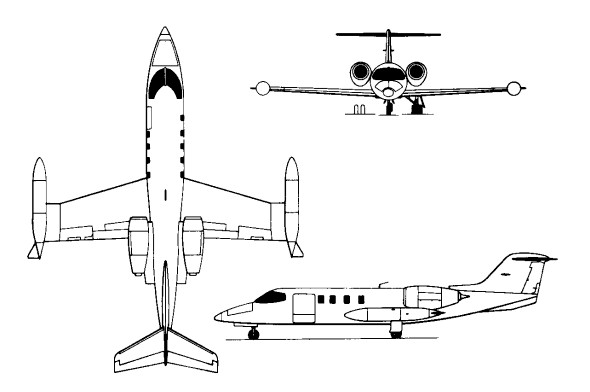
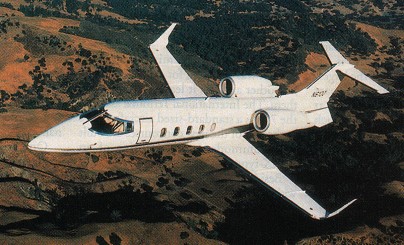
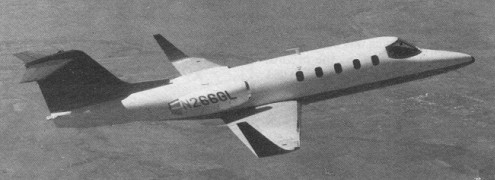
Gates Lear 36 / U-36

Compared with the Learjet 25s, the new Learjet 35 and Learjet 36 each had a 0.33m increase in length and, a 0.61m extension to each wingtip, outboard of the ailerons. They differed in fuel/seating capacity, the Learjet 36 seating up to six passengers but with the ability to trade two of them for the extra fuel to give non-stop capability across the North Atlantic.
The pilot on the first flight of the Learjet 26 (later designated the Learjet 36) with two TFE engines took place on 4 January 1973, piloted by Bob Fisher and Robert Berry.
Certification was gained and the first deliveries made in 1974. Two years later golf professional/ pilot Arnold Palmer used a Learjet 36 to establish a new round-the-world class record of 36990km completed in an elapsed time of 57 hours 25 minutes 42 seconds.
Gates Learjet expanded the slow speed boundaries of their entire bizjet line by certificating their Century III wing leading edge and flight control system modification. Aircraft with the modification bear the designation “A” following their model numbers. The Century III modifications on model 35s and 36s reduced the stalling speed and gave better low speed flying qualities.
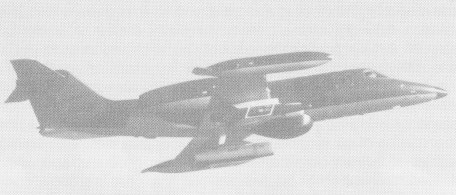
The JMSDF has procured a number of Learjet 36As, known as U-36As, for target-towing, sea-skimming-missile simulation, and ECM. These aircraft have an under-fuselage radome for a surveillance radar, a tip-tank-mounted missile seeker simulator, jammer pods, and chaff dispensers. Under-wing stores capability is improved, and maximum take-off weight is increased.

By 1991 around 750 Learjet Model 35/36 variants had been sold, including approximately 200 special mission versions to 20 customers around the world.

LR-36
Engines: 2 x Garrett AiResearch TFE 731-2 turbofan.
MTOW: 17,000 lb.

LR-36A Learjet Century III 36A
Engines: 2 x Garrett TFE 731-2-2B, 3500 lbs / 1588kg thrust.
Length: 14.83 m / 48 ft 8 in
Height: 3.73 m / 12 ft 3 in
Wingspan: 12.04 m / 39 ft 6 in
Wing area: 23.53 sq.m / 253.27 sq ft
Wing aspect ratio: 6.2.
Maximum ramp weight: 18,550 lbs.
Maximum takeoff weight: 18,300 lb / 8301 kg
Standard empty weight: 9970 lbs.
Maximum useful load: 5850 lbs.
Zero-fuel weight: 13,500 lbs.
Maximum landing weight: 15,300 lbs.
Wing loading: 71.1 lbs/sq.ft.
Power loading: 2.6 lbs/lb.
Maximum usable fuel: 7440 lbs.
Best rate of climb: 4339 fpm
Certificated ceiling: 45,000 ft / 13715 m
Max pressurisation differential: 9.4 psi.
8000 ft cabin alt @: 45,000 ft.
Maximum single-engine rate of climb: 1276 fpm @ 200 kts.
Single-engine climb gradient: 387 ft/nm.
Single-engine ceiling: 23,500 ft.
Maximum speed: 471 kts.
Normal cruise @ 41,000ft: 459 kts.
Fuel flow @ normal cruise: 889 pph.
Stalling speed gear/flaps down: 99 kts.
Balanced field length 4,784 ft
Seats: 8.

Gates Lear 31

The Model 31 was announced by Learjet in September 1987 and combines the fuselage, eight-passenger cabin and 3,500 lb st (15,6 kN) Garrett TFE731-2-2B turbofans of the Model 35A/36A with a longer span wing with winglets plus the prominent ventral strakes known as Delta-Fins.
The Learjet 31 aerodynamic prototype first flew on 11 May 1987 and the type was certificated by the FAA in August 1988. Able to carry seven passengers and two crew over ranges up to 3076km, the LJ31 can cruise at 15545m.
Four EFIS-equipped versions were ordered by Singapore Airlines specially configured for crew training (S/Ns 31-033, 31-033A, 31-033C, 31-033D). They were basically LR31’s but with Honeywell EFIS and some of the vertical instruments out of the LR55, and had the ER fuselage tank.
By mid-1991, when the type was superseded by the Model 31A and 31A/ER, about 30 had been delivered. The Learjet 31A replaced the earlier aircraft on the Wichita production line in July 1991 and features an integrated digital avionics package, and can also be equipped with a braking parachute installed internally under the tail. The extended-range Learjet 31A/ER is a Model 31A with a higher maximum takeoff weight and able to carry extra fuel.

Learjet 31A
Engines: 2 x Garrett TFE731-2 turbofans, 1588kg
Max take-off weight: 7030 kg / 15499 lb
Empty weight: 4575 kg / 10086 lb
Wingspan: 13.3 m / 43 ft 8 in
Length: 14.8 m / 48 ft 7 in
Height: 3.7 m / 12 ft 2 in
Wing area: 24.5 sq.m / 263.72 sq ft
Cruise speed: 832 km/h / 517 mph
Ceiling: 15545 m / 51000 ft
Range: 3076 km / 1911 miles

Gates Lear 29

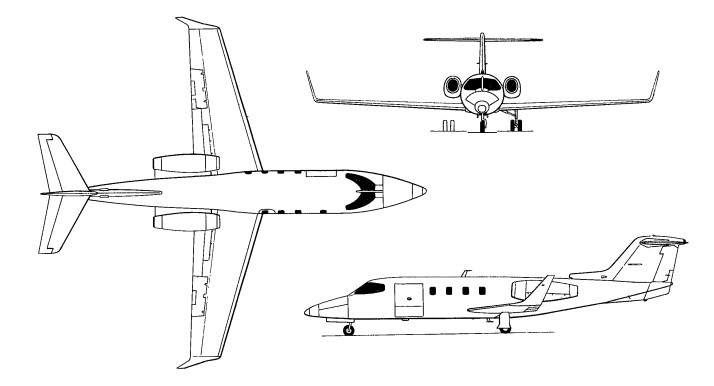
In January 1979 the company gained certification of the Learjet 28 and Learjet 29 Longhorn. Basically similar to the 10-seat Learjet 25D, these two models introduced a new wing of increased span. The introduction of winglets displaced the wingtip fuel tanks of earlier models, which meant that all fuel had to be carried internally.
This incorporated a cambered leading edge and supercritical winglets to provide improved performance and cruise efficiency, and 51,000-foot performance. The longer-range Learjet 29 traded two passengers for an additional 379 litres of fuel.
A line of five aircraft has been designated Longhorn series. They are the Learjet 28 and Learjet 29, both powered by General Electric turbojets, and the Learjet 54/55/56, and those three are powered by twin Garrett AiResearch fanjets.
The wing also has been responsible for significantly improved short-field performance. The balanced field length for the 28/29 series is only 2,520 feet and 3,520 feet for the 54/55/56 series. In addition, the 28/29 is able to climb from takeoff directly to 51,000 feet.
Wing manufacturing costs were considered prohibitive against the performance improvements gained and further development of both the Learjet 28 (five built) and 29 (two built) were terminated in August 1982. Around the same time, when sales of the Model 25 had reached 368, production was phased out in favour of the Learjet 35 and 36.

LR-29 Learjet Longhorn 29
First built: 1979.
Engines: 2 x General Electric CJ610-8A, 2950 lbs / 1338kg thrust.
Seats: 8.
Wingspan: 13.35 m / 43 ft 10 in
Length: 14.52 m / 47 ft 8 in
Height: 3.73 m / 12 ft 3 in
Wing area: 265 sq.ft. / 24.57 sq.m
Wing aspect ratio: 7.2.
Maximum ramp weight: 15,500 lbs.
Maximum takeoff weight: 15,000 lb / 6804 kg
Standard empty weight: 8924 lbs.
Maximum useful load: 6756 lbs.
Zero-fuel weight: 11,000 lbs.
Maximum landing weight: 14,300 lbs.
Wing loading: 56.7 lbs/sq.ft.
Power loading: 2.5 lbs/lb.
Maximum usable fuel: 5373 lbs.
Best rate of climb: 6925 fpm
Certificated ceiling: 51,000 ft.
Max pressurisation differential: 9.4 psi.
8000 ft cabin alt @: 51,000 ft.
Maximum single-engine rate of climb: 2125 fpm @ 220 kts.
Single-engine climb gradient: 580 ft/nm.
Single-engine ceiling: 29,000 ft.
Maximum speed: 477 kts.
Normal cruise @ 47,000ft: 448 kts.
Fuel flow @ normal cruise: 1047 pph.
Stalling speed gear/flaps down: 90 kts.
Balanced field length 2,700 ft

Gates Lear 28 Longhorn

In January 1979 the company gained certification of the Learjet 28 and Learjet 29 Longhorn. Basically similar to the 10-seat Learjet 25D, these two models introduced a new wing of increased span.
Learjet’s Longhorn series combines a revolutionary wing design, two of the most advanced engines introduced to the market, and 51,000-foot performance. The line of five aircraft has been designated the Learjet 28 and Learjet 29, both powered by General Electric turbojets, and the Learjet 54/55/56, and those three are powered by twin Garrett AiResearch fanjets. All the models are designed with a larger wing incorporating near-vertical winglets that have replaced the traditional Learjet tiptanks. The wing’s increased aspect ratio and super-critical winglets provide substantial aerodynamic improvements that in turn produce greater fuel efficiency and improved flight performance at high and low altitudes. The wing also has been responsible for significantly improved short-field performance. The balanced field length for the 28/29 series is only 2,520 feet and 3,520 feet for the 54/55/56 series. In addition, the 28/29 is able to climb from takeoff directly to 51,000 feet.
The Learjet 28 had 10-seat accommodation, but the longer-range Learjet 29 traded two passengers for an additional 379 litres of fuel. However, wing manufacturing costs were considered prohibitive against the performance improvements gained and further development of both the Learjet 28 (five built) and 29 (two built) were terminated in August 1982. Around the same time, when sales of the Model 25 had reached 368, production was phased out in favour of the Learjet 35 and 36.

LR-28 Learjet Longhorn 28
Engines: 2 x General Electric CJ610-8A, 2950 lbs thrust.
Seats: 10.
Length: 47.6 ft. / 14.52 m
Height: 12.3 ft. / 3.73 m
Wingspan: 43.8 ft. / 13.34 m
Wing area: 265 sq.ft. / 24.6 sq.m
Wing aspect ratio: 7.2.
Maximum ramp weight: 15,500 lbs.
Maximum takeoff weight: 15,000 lbs.
Standard empty weight: 8968 lbs.
Maximum useful load: 6532 lbs.
Zero-fuel weight: 11,000 lbs.
Maximum landing weight: 14,300 lbs.
Wing loading: 56.7 lbs/sq.ft. / 277.0 kg/sq.m
Power loading: 2.5 lbs/lb.
Maximum usable fuel: 4684 lbs.
Best rate of climb: 6925 fpm.
Certificated ceiling: 51,000 ft.
Max pressurisation differential: 9.4 psi.
8000 ft cabin alt @: 51,000 ft.
Maximum single-engine rate of climb: 2125 fpm @ 220 kts.
Single-engine climb gradient: 580 ft/nm.
Single-engine ceiling: 29,000 ft.
Maximum speed: 477 kts.
Normal cruise @ 47,000ft: 448 kts.
Fuel flow @ normal cruise: 1047 pph.
Stalling speed gear/flaps down: 90 kts.
Balanced field length 2,520ft

Gates Learjet Corp / Swiss American Aviation / Learjet Inc

Swiss American Aviation Corporation
Gates Learjet Corporation
Learjet Inc

William P. Lear founded the Swiss American Aviation Corporation in 1960 to build a twin-jet executive aircraft, originally designated SAAC-23. Tooling was completed in Europe but moved to Wichita, Kansas, in 1962, when the company became known as Lear Jet Corporation. By 1964 all work had been transferred to USA. In 1967, Bill Lear sold his 60 percent interest in the company to Gates Rubber Corporation, and in 1970 the name was changed to Gates Learjet Corporation. Became Learjet Inc. in 1987.
Lear Jet Inc becoming a division of Bombardier in 1990, offering the 11-seat light Learjet 31A (first flown May 1987), 11 -seat mid-size Learjet 45 (first flown October 1995), and 12-seat transcontinental Learjet 60 (first flown October 1990).

Garrett/ITEC F124 / TFE1042 / F125 / Honeywell/ITEC F124 / F125 / TFE1042

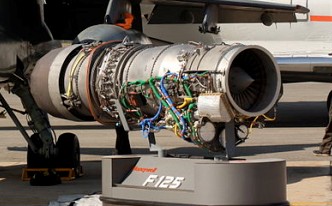
The Honeywell/ITEC F124 is a low-bypass turbofan engine derived from the civilian Honeywell TFE731. The F125 is an afterburning version of the engine. The engine began development in the late 1970s for the Republic of China (Taiwan) Air Force AIDC F-CK Indigenous Defence Fighter (IDF), and it first ran in 1979. The F124/F125 engine has since been proposed for use on other aircraft, such as the T-45 Goshawk and the SEPECAT Jaguar, and powers the Aero L-159 Alca and the Alenia Aermacchi M-346.

The F124 engine is fundamentally a low bypass, two spool engine (meaning that there are two rotational shafts, a high pressure shaft and a low pressure shaft. The fan/low pressure compressor section is made of three stages with titanium blades. The first stage has 30 un-shrouded blades, and the overall pressure ratio for the three stage fan section is 2.5:1. Some of the air is bypassed (Bypass ratio of 0.472:1), and the rest is fed to the high pressure compressor section.

The high pressure compressor (HPC) of the F124 is a fairly unique design among gas turbine engines; it employs both axial and a centrifugal compressors in a single design. There are four axial stages that lead to a fifth centrifugal stage. All the blades and the impeller are made from titanium.

The compressed air is combusted in an annular combustor and then exhausted to a single stage high pressure turbine (HPT) followed by a single stage low pressure turbine. The HPT is air-cooled. The exhaust is mixed, meaning the bypass air from the fan and the exhaust from the core exit through a common nozzle. In the F125 variant of the engine, the exhaust passes through the afterburner section. The F124 does not have an afterburner.

By 2004 at total of 460 F124 had been built with an estimated unit cost in 2006 of USD$2.5 million.

In 1978, Garrett announced joint research on the TFE1042 afterburner with Swedish company Volvo Flygmotor AB in order to provide an engine for the AIDC F-CK Indigenous Defence Fighter (IDF) being developed for the Republic of China (Taiwan) Air Force (ROCAF). The TFE731 Model 1042 was touted as a low bypass ratio “military derivative of the proven commercial TFE731 engine” and “provides efficient, reliable, cost effective propulsion for the next generation of light strike and advanced trainer aircraft”, with thrust of 4260 lbf (18.9 kN) dry and 6790 lbf (30.2 kN) with afterburner. After initial negotiation, the investment was going to be divided between Garrett, Volvo, AIDC, and Italian company Piaggio. The development would consist of the non-afterburning TFE1042-6 for light attack aircraft/advanced trainer, and TFE1042-7 for the AMX or F-5 upgrade. Garrett would be responsible for the core engine, and Volvo would be responsible for the fan section and the afterburner. The engine first ran for 3 hours at a Volvo test facility in 1979.

AIDC also suggested upgrading TFE1042-7 to 8000 lbf (31 to 36 kN) thrust as twin engine solution, in order to compete with General Electric F404 for applications such as the JAS 39 Gripen. However, the Gripen project decided to continue with a single engine F404 variant, built by Volvo, and Volvo left the project to at that point to focus on the Gripen work. Piaggio asked to participate at a later date due to financial reasons and left the program as well. Thus only Garrett and AIDC invested in the new International Turbine Engine Corporation (ITEC), with the contract signed in 1982.

In 1988, ITEC decided to invest in the 12,000 lb TFE1088-12, which was re-designated as TFE1042-70A (for political reason as well). Preliminary study had shown that IDF could supercruise with the new engine. At the same time, GE decided to enter the market with J101/SF, a smaller version of F404. However after the IDF order was cut in half due to budget concerns, the TFE1088-12 engine upgrade plan ended as well. The F-CK IDF first flew in 1989, and aircraft were delivered through 1999.

In the early 1990s, the United States Navy considered the re-engining their fleet of T-45 Goshawk trainer aircraft with the F124. In 1994, after flight testing a T-45 with the engine, the USN elected not to do that.

The possibility of a F124-powered T-45 arose again in 1996 when McDonnell Douglas offered an F124-engined T-45 to the Royal Australian Air Force as a competitor for their trainer requirement. BAe wanted to offer the F124 as an option on their entry for the RAAF trainer requirement, the BAE Hawk (which the T-45 is based on), but ITEC refused to give BAe permission to offer it. ITEC’s decision turned out to be a mistake, as the RAAF select the Hawk as their trainer. However, after the selection of the aircraft, the RAAF decided to have a separate competition between the F124 and the Rolls-Royce Turbomeca Adour (which was BAe’s selection) to power the new trainers. In 1997 the RAAF elected to used the Adour engine, effectively ending the F124’s chances of being used on Hawk or T-45 aircraft.

In 1994, the F124 engine was selected to power the Czech Aero L-159 Alca light combat aircraft. The combination first flew in 1997.

In 2000, Alenia Aermacchi announced that their new M-346 trainer/light attack aircraft would be powered by the F124 engine, choosing it over its common rival, the Adour. In 2009, the United Arab Emirates announced that their M-346 trainers would be powered by the F124-GA-200.

The F124 engine powered the Boeing X-45A unmanned combat air vehicle demonstrator in the early 2000s.

The afterburning F125 engine is being considered, as of 2009, by the Indian Air Force as a replacement for the Rolls-Royce Turbomeca Adour engines in their SEPECAT Jaguar aircraft. The new engine would be both lighter and more powerful. It was successfully demonstrated in 2007.

Variants:
F124-GA-100
This is the original variant of the engine. It powered the Boeing X-45 demonstrator.

F124-GA-200
Slightly de-rated variant of the F124-GA-100; the maximum thrust is 6250 lbf (27.80 kN) and the engine weighs 28 lb (13 kg) less. This variant utilizes an all new accessory gearbox, as well as other small upgrades. This variant is used in the Aermacchi M-346.

F124-GA-400
Variation of the F124-GA-100, modified for the T-45 Goshawk and the BAE Hawk. The engine was flight tested in the T-45, but the United States Navy decided not to re-engine the aircraft with this engine.

F125-GA-100
Also known as the TFE1042-70. This is the basic afterburning variant of the engine. Used in the AIDC F-CK-1 Ching-kuo.

F125X
Proposed advanced variant of the F125 engine, with a maximum thrust of 12,500 lbf (56 kN).

F125XX
Further advanced variant of the F125 engine, this one producing 16,400 lbf (73 kN) of thrust. If it were built, there would have been a related F124XX non-afterburning variant, producing only 10,800 lbf (48 kN) of thrust.

Applications:
F124
Alenia Aermacchi M-346 Master
Aero L-159 Alca
Boeing X-45

F125
AIDC F-CK-1 Ching-kuo

Specifications:
F124-GA-100
Type: Turbofan
Length: 67 in (170 cm)
Diameter: 36 in (91 cm)
Dry weight: 1178 lb (536 kg)
Compressor: 3 axial fan (low pressure compressor) stages, 4 axial high pressure compressor stages, 1 centrifugal high pressure compressor stage
Turbine: 1 stage high pressure turbine, 1 stage low pressure turbine
Maximum thrust: 6300 lbf (28 kN)
Overall pressure ratio: 19.4:1
Bypass ratio: 0.472:1
Specific fuel consumption: 0.81 lb/lbf-hr (82.6 kg/kN-hr)
Thrust-to-weight ratio: 5.3:1

Garrett F109 / TFE109

The Garrett F109 (Company designation TFE109) was a small turbofan engine developed for the Fairchild T-46 by Garrett AiResearch. With the United States Air Force’s cancellation of the T-46 program in 1986, further development of the engine ceased,and with it the civil TFE109 version.

Applications:
Fairchild T-46
Promavia Jet Squalus

Specifications:
Type: Turbofan
Length: 942 mm (37.1 in)
Diameter: 523 mm (20.6 in)
Dry weight: 182 kg (400 lb)
Maximum thrust: (Max takeoff) 5.92 kN (1,330 lb st),(Max continuous at 9,145 M/30,000 ft at Mach 0.5) 1.78 kN (400 lb st)
Specific fuel consumption: (At max takeoff) 11.10 mg/Ns (0.392 lb/hr/lb st)

Garrett AiResearch / AiResearch

Aircraft Tool and Supply Company
Garrett Supply Company
AiResearch Manufacturing Company
AiResearch
PW-je-tp

John Clifford “Cliff” Garrett founded a company in Los Angeles in 1936 which came to be known as Garrett AiResearch or simply AiResearch. Already operating his Garrett Supply and Airsupply businesses, in 1939 Cliff Garrett established a small research laboratory to conduct “air research” on the development of pressurized flight for passenger aircraft. “[AiResearch’s] first ‘lab’ was a small store building on Melrose Avenue in Los Angeles”.

In 1939 Garrett incorporated the “Garrett Corporation” and the three operating companies became divisions: Airsupply Division, Garrett Supply Division, and AiResearch Manufacturing Division. Needing additional space, they built their own manufacturing facility in Glendale, California, and thereby established the name AiResearch Manufacturing Company.

By 1941, AiResearch needed new space, and on April 28, 1941 moved from Glendale to what until then had been a beanfield on Sepulveda Boulevard, at the corner of Century Boulevard near Mines Field, which later became Los Angeles Airport. In 1942, the Army Air Force concluded that vital cabin pressurization manufacturing facilities should be relocated inland from the coast, and AiResearch set up the AiResearch Phoenix Division in Phoenix, Arizona. For this purpose, AiResearch Manufacturing Company of Arizona was established as a wholly owned subsidiary.

The Company’s first major product was an oil cooler for military aircraft. Garrett designed and produced oil coolers for the Douglas DB-7. Boeing’s B-17 bombers were outfitted with Garrett intercoolers, as was the B-25. The Company developed and produced the cabin pressure system for the B-29 bomber, the first production bomber pressurized for high altitude flying. By the end of World War II, AiResearch engineers had developed air expansion cooling turbines for America’s first jet aircraft, the Lockheed P-80 Shooting Star. In all during World War II, Garrett AiResearch sold $112 million in military equipment and had as many as 5,000 employees at peak.

Having to scale back its workforce to just 600 employees at the end of the war stimulated Garrett to look for new income sources. “He found them in the small turbines which patient Engineer [Walter] Ramsaur had been perfecting since 1943. So that jet pilots could endure the heat generated by air friction at supersonic speeds, a way had to be found to cool their cockpits. Ramsaur’s turbine provided the answer; by putting an engine’s heat to work turning the turbine, it cooled the air by expanding it, shot the air into the cockpit. As rearmament got under way, Garrett began turning out a total of 700 accessory products. With the Navy order for an on-board engine self-starter, by 1951 Garrett Corp. had a $120 million backlog, enough to keep 5,500 workers on three shifts busy for at least the next three years”.

By the end of the 1940s, Garrett Corporation was listed on the New York Stock Exchange. “In the late 1940s and early 1950s, Garrett was heavily committed to the design of small gas turbine engines from 20 – 90 horse power (15 – 67 kW). The engineers had developed a good background in the metallurgy of housings, high speed seals, radial inflow turbines, and centrifugal compressors”.

By 1949, the Sepulveda Blvd. property was increasingly constrained by the demand for development of commercial space near the fast-growing Los Angeles International Airport (LAX). At that time, 2000 people worked at the facility “and Garrett was ranked one of the top three aircraft accessory manufacturers in the world”. In 1959 ground was broken for construction of an additional facility at 190th Street and Crenshaw Boulevard in Torrance, California. Part of that facility was occupied a year later. “By 1962, 1000 employees were working at the Torrance location and by 1972, 3000 employees were based there”. After a gradual series of moves, the Sepulveda facility was closed in 1990.
During the 1950s AiResearch initiated activities in the field of aircraft electronics, “first with an angle-of-attack computer to eliminate gunfire error and then with its first delivery of a complete centralized air data system”. In the 1950s and 1960s Garrett diversified and expanded. Garrett AiResearch designed and produced a wide range of military and industrial products for aerospace and general industry. It focused on fluid controls and hydraulics, avionics, turbochargers, aircraft engines, and environmental control systems for aircraft and spacecraft. “By 1960 Garrett gas turbines, cabin pressurization systems, air conditioners, and flight control systems were aboard the Convair 880, Lockheed Super Constellation, Vickers Viscount, Sud Aviation Caravelle, Douglas DC-8, and Boeing 707. The company had also developed the first inflatable airliner evacuation slides”.
In the 1950s and 1960s Garrett pioneered the development of foil bearings, which were first installed as original equipment on the McDonnell-Douglas DC-10 in 1969 and then became standard equipment on all U.S. military aircraft. In the 1960s, AiResearch Environmental Control Systems provided the life supporting atmosphere for American astronauts in the projects Mercury, Gemini, Apollo, and Skylab.
Garrett AiResearch is credited with inventing one of the first complete microprocessors, when it developed the Central Air Data Computer for the US Navy’s F-14 Tomcat fighter in 1968-1970.

In the 1970s Garrett’s expanding industrial and other non-military applications had changed the basic sources of income. “At the start of the decade sales to the military accounted for 70 percent of the company’s business. At the end of the ten years, largely because of turbochargers and general aviation products, the situation was reversed. Commercial sales made up 70 percent; military had dropped to 30 percent”. Also by the end of the decade “sales had reached $1.3 billion; backlog was $1.9 billion”.

To avoid a hostile takeover of Garrett’s assets by Curtiss-Wright following Cliff Garrett’s death in 1963, Garrett Corporation merged with Signal Oil and Gas Company in 1964. In 1968, the combined company adopted The Signal Companies as its corporate name. In 1985, Signal merged with Allied Corp., becoming Allied-Signal. The company acquired Honeywell Aerospace in 1999. Although AlliedSignal was much larger than Honeywell, it was decided to adopt the Honeywell name because of its greater public recognition.

Part of the original Garrett AiResearch became known as the Garrett Turbine Engine Company from 1979, and became the Garrett Engine Division of AlliedSignal in 1985. In 1994, AlliedSignal acquired the Lycoming Turbine Engine Division of Textron, merging it with Garrett Engine to become the AlliedSignal Engines Division of AlliedSignal Aerospace Company.

The Garrett Aviation Division (“Garrett Aviation”), which mainly services aircraft, was sold to General Electric in 1997 and later renamed Landmark Aviation after a 2004 merger. It became StandardAero after a further merger in 2007 and it was owned by Dubai Aerospace Enterprise, but subsequently purchased by another owner.

Gardan GY-120

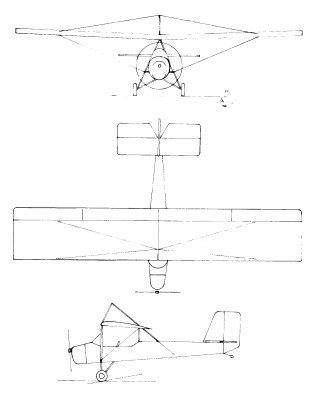
Tandem two seat single engined high wing monoplane with conventional three axis control. Wing has unswept leading and trailing edges, and constant chord; cruciform tail. Pitch control by elevator on tail; yaw control by fin mounted rudder; roll control by half-span ailerons; control inputs through stick for pitch/roll and pedals for yaw. Wing braced from above by kingpost and cables, from below by cables; wing profile Gardan (high lift airfoil); double surface. Undercarriage has three wheels in tail dragger formation; steel-spring suspension on tailwheel and rubber suspension on main wheels. Push right go -right tailwheel steering connected to yaw control. Optional brakes on main wheels. Aluminium tube framework, with optional pod. Engine mounted below wing driving tractor propeller. All aluminium airframe with Dacron covering.
For his first ULM, Yves Gardan opted for an all metal construction covered in Dacron in order to make industrial manufacture easier. With a high lift airfoil which he has designed himself, the wing of his GY 120 is also fitted with flaps covering most of the span, which are separate from the ailerons and have three positions: 10, 20 and 30 degree depression. It is worth noting that the load sheet for this aircraft complies to the FAR23 Utility category applicable to aircraft of less than 3.70 tonne (4.08 US ton, 3.64 Imp ton) according to international law.
Design work started in June 1982 and the building of the prototype in October of the same year, its first flight being programmed for the 15 May 1983. The motor on the prototype is a Hirth 270R 03E of 40hp, but the aircraft is designed to receive any engine usable as a tractor and developing 35 60 hp. Options include a fuselage fairing, complete dual control equipment, differential brakes on the main wheels, floats and skis specifically designed for the GY 120, an instrument panel and load carrying pods (agricultural or military).

Engine: Hirth 270R 03E, 40 hp at 7000 rpm.
Propeller diameter: 55 in (1.40m).
Toothed belt reduction, ratio 2.71-1.
Power per unit area 0.21 hp/sq.ft, 2.3 hp/sq.m.
Fuel capacity 7.9 US gal, 6.6 Imp gal, 30.0 litre in main tank; 7.9 US gal, 6.6 Imp gal, 30.0 litre in reserve.
Length overall 19.0 ft, 5.80 m.
Height overall 8.211, 2.50m.
Wing span 32.9ft, 10.00m.
Constant chord 5.9ft, 1.75m.
Dihedral 2 deg.
Sweepback 0 deg.
Tailplane span 9.2ft, 2.80m.
Fin height 4.3ft, 1.30m.
Total wing area 189 sq.ft, 17.5sq.m.
Total aileron area 20.5 sq,ft, 1.90sq.m.
Fin area 7.5 sq.ft, 0.70sq.m.
Rudder area: 7.0 sq.ft, 0.65sq.m.
Tailplane area: 15.3 sq.ft, 1.42sq.m.
Total elevator area: 14.0 sq.ft, 1.30sq.m.
Wing aspect ratio 5.711.
Wheel track 5.9 ft,1.80 m.
Wheelbase 14.9 ft, 4.50 m.
Tailwheel diameter overall 5 inch, 13 cm.
Main wheels diameter overall 16 inch, 40 cm.
Empty weight 320 lb, 145 kg.
Max take off weight 751 lb, 340 kg.
Payload 431 lb, 195 kg .
Max wing loading 3.97 lb/sq.ft, 19.4 kg/sq.m.
Max power loading 18.77 lb/hp, 8.503kg/hp.
Load factors design; +6.6, 3.3 ultimate.
Max level speed 75 mph, 120 kph.
Never exceed speed 87 mph, 140kph.
Max cruising speed 68mph, 110 kph.
Economic cruising speed 47mph, 75kph.
Stalling speed 24 mph, 38 kph.
Max climb rate at sea level 500 ft/min, 2.5 m/s.
Min sink rate 370 ft/min at 40 mph, 1.8 m/s at 65 kph.
Best glide ratio with power off 10/1 at 40mph, 65 kph.
Take off distance 130 ft, 40 m.
Land¬ing distance 115ft, 35m.
Service ceiling 8200ft, 2500m.
Range at average cruising speed 240 mile, 400 km.

Gardan GY-20 Minicab / GY-201 / GY-30 Supercab

GY.20

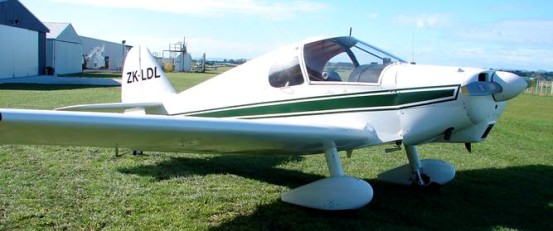
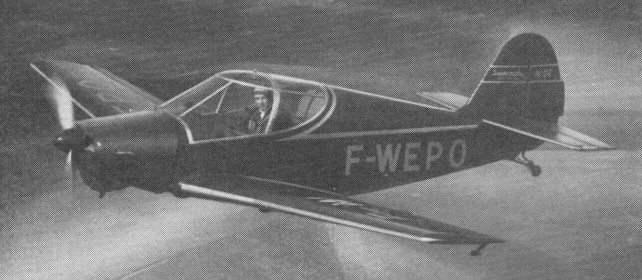
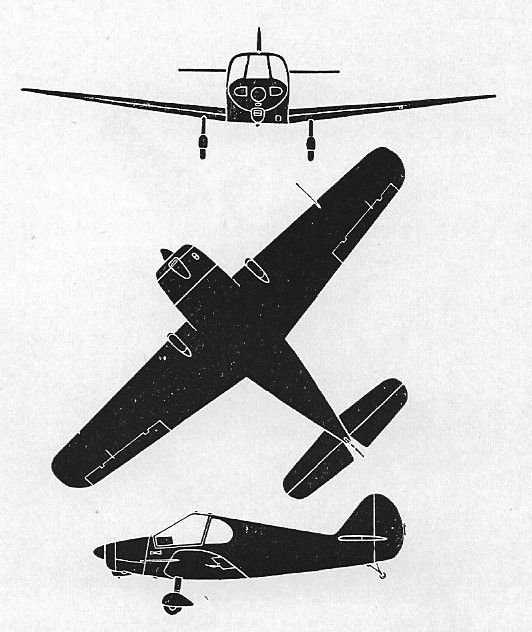
M. Yves Gardan designed the GY 201 Minicab in 1949 as a two seater with side by side seating and dual control, which first flew in 1949. The fuselage is a wooden open girder structure; the forward part around the cockpit being plywood lined, the remainder fabric covered. The fin is built integral with the fuselage. The tailplane is a single piece plywood covered structure, and the elevator and rudder have fabric covered wooden frames. The wing section is NACA 23015 at the root and 23010 at the tip. The wing structure consists of a laminated spruce and plywood main box spar, a diagonal drag spar and a rear false spar, with lattice type ribs. Forward of the main spar is plywood covered to form a torsion box, the remainder of the wing being fabric covered. Split flaps are installed. The two main undercarriage legs are mounted on the main spar with rubber in compression springing. An 11 Imp. gallon fuel tank is fitted just behind the firewall.

The GY-20 Minicab first flew in February 1949.

In 1949 his GY 20 Minicab won the world record for speed and distance in a straight line for an aircraft of less than 1102 lb (500kg) maximum gross weight, flying from Paris to Rabat in 10h of flight, 1135 mile being covered at 109mph average (1826km at 185kph) with a Continental 65hp motor. More than 100 Minicabs were made and it is still being built by US homebuilders under the name of Cavalier in 1983.

In 1952, the 90hp version of the Minicab appeared, with retractable undercarriage and called the Super Cab.
Continental engines from 65 to 100 h.p. may be installed.

GY.20

Production was entrusted to the Constructions Aernautiques du Bearn, which delivered the first aircraft in 1952, and support for this light type subsequently passed to SIPA (the Société Industrielle Pour l’Aeronautique). There were two production variants of the Minicab, the GY.20 and GY.201, these differing from each other only in details of equipment and other small features.

GY-30

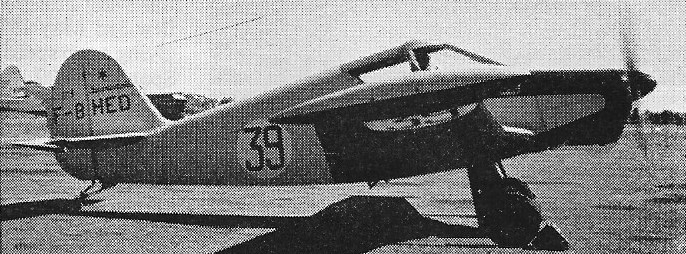
The GY-30 Supercab first flew in February 1954 with refinements including retractable undercarriage, fixed tip tanks and 90 hp Continental C-90. Two of a pre-production batch of five were ordered for evaluation by the Service de l’Aviation Legeres et Sportive.

GY-30 Supercab

One of the French G.A.B. Supercabs was undergoing fully-instrumented test flying at Villacoublay; Jacques Noetinger is the pilot.

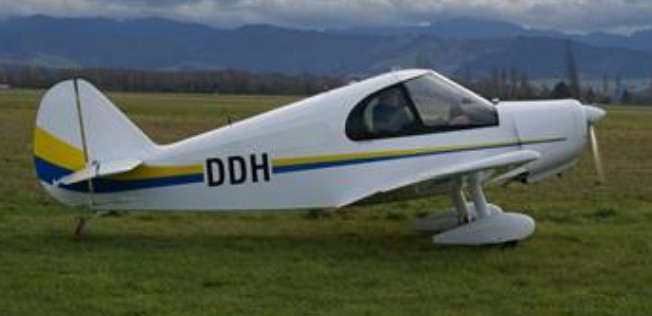
Produced in limited numbers between 1952 and 1958, the design was acquired by A.W. Ord-Hume in Britain, who anglicised the plans. Adjusted them for home builders, the aircraft has subesequently proved extremely popular. The aircraft is marketed in North America as the Hawk BM.4 by Miranda Aircraft of Canada.

Variation:
Barritault JB.01

Gallery

GY-20
Engine: Continental A65-8, 65 hp
Wingspan: 24 ft 11 in
Length: 17 ft 10.5 in
Height: 5 ft 5 in
Wing area: 107.6 sq.ft
Empty weight: 595 lb
Loaded weight: 1069 lb
Max speed: 124 mph
Cruise: 112 mph
ROC: 680 fpm
Range: 466 mi

Engine: l x Continental A65-8, 48.5kW (65hp).
Span: 7.59m (24ft 11 in).
Length: 5.45m (17 ft 10.5 in).
Max T/O weight: 485 kg (1,069 lb).
Max speed: 124 mph at sea level.
Operational range: 466 miles.
Seats: 2

Engine: Continental, 90 h.p.
Span: 25 ft 0 in.
Length: 17 ft 0 in.
Wing Area: 107 sq. ft.
Empty Weight: 750 lb.
Loaded Weight: 1235 lb.
Wing Loading: 11.5 lb/sq. ft.
Max. Speed: 124 mph.
Cruise Speed: 110 mph.
Stall Speed: 50mph.
Initial Climb: 680 fpm.
Range: 360 miles.

Engine: Continental O-200A, 100 h.p.
Cruise: 120 mph
ROC: 1000 fpm.
Span: 25ft
Length: l7ft l0in
Empty weight: 800lb
Gross weight: 1234 lb

Engine: Revmaster VW, 65 hp. Stall: 38 kt / 43 mph / 70 kmh
Cruise: 97 kt / 112 mph / 180 kmh
VNE: 107 kt / 123 mph / 198 kmh
Empty Weight: 270 kg / 595 lbs
MTOW Weight: 485 kg / 1069 lbs
Climb Ratio: 600 ft/min / 3 m/s
Take-off distance (50ft obstacle): 1150 ft / 350 m
Landing distance (50ft obstacle): 1080 ft / 330 m

GY-30 Supercab
Engine: Continental C90, 90 hp
Max speed: 170 mph
Cruise: 146 mph
ROC: 767 fpm
Service ceiling: 16,400 ft
Range: 746 mi
Empty weight: 880 lb
Loaded weight: 1348 lb
Wingspan: 26 ft 10 in
Length: 18 ft
Height: 5 ft 5 in

GY.20