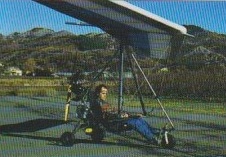
The Moster 185Paramotor is for solo flying or tandem. The structure of the engine Moster 185 is simple, streamlined and compact. The complete weight of the engine is 12.9 kgs in pull starter version. The thermic group is cooled with the air generated by the extraction flow of the propeller, with direct drive.
The motor develops 25 hp at 7800 rpm and is particularly suitable for pilot + paramotor or trike between weights 100 and 160 Kgs (200 to 350 pounds). The engine has not been tested for tandem use or for a take off weight over 160 kgs. The thrust is regular, smooth, gentle up to 75 kgs (165 pounds) with a 130 cms (51 inches) propeller or 70 kgs (155 pounds) with 122 cms (48 inches) propeller.
2010 Price: US $1,700 – 1,890
Vittorazi Moster 185, 25 hp at 7800 rpm Reduction drive: ratio 1/2.7 – PolyV belt. Ignition coil: Inductive IDI Spark-plug: NGK BR9ES Temperatures max: EGT 550° – CHT 230° Exhaust pipe: Hand-made with silencer – Optional silencer in carbon fiber Propeller rotation: Counter-clock Fuel: Unleaded gasoline – Synthetic oil 2.5 % Consumption: 3.0-3.5 liters/hour at 30kg of trust, propeller 125 cms Weight: 12.9 kg; pull starter version
In early 1993, Jim Rice and Tom Stark of the fledgling VisionAire Corporation visited Scaled Composites with conceptual designs for a new single-engine business jet. Rice, a successful entrepreneur and general aviation pilot, had a vision that such an aircraft would be a market success; Stark, an experienced aerospace engineer and manager, shared that vision, and got to work making it a reality.
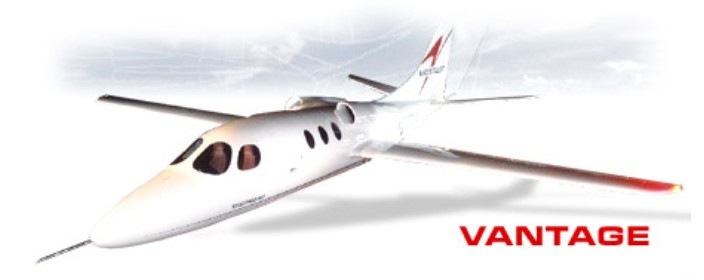
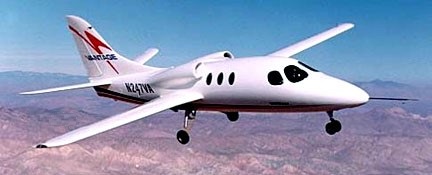
Following a design and feasibilty study performed by Scaled in late 1993, and a bit of time while Rice and Stark put together their financial backing, Scaled was given the go-ahead to build a proof-of-concept (POC) prototype on 8 March 1996. The Vantage differed from contemporary executive jets in that it was powered by a single engine, a Pratt & Whitney Canada JT15D turbofan buried in the rear fuselage, fed by twin air-inlets above the fuselage. It was of all-composite construction, and its wing was forward swept to reduce drag and to allow an unobstructed cabin by mounting the wing spar behind the cabin. It was planned to sell the Vantage for $1.65 million, compared with $3.3 million for the Cessna CitationJet.
Only one problem, though: they wanted to show photographs and films of the airplane flying at the 1996 National Business Aircraft Association (NBAA) convention, scheduled to begin on 19 November.
Under a $2.5 million fixed-price contract, Scaled rolled out the Vantage to a large group of customers and press just 8 months later (8 November), and performed a picture-perfect first flight on 16 November 1996 (piloted by Doug Shane). The photos made it to NBAA, and the Vantage POC got to work in flight testing.
VisionAire Vantage N247VA
Flight testing revealed several handling and aerodynamic problems, which resulted in a redesign of the aircraft in December 1998.
Delays to the program continued, while costs mounted, and in January 2003, with the company having already spent $110 million, requiring another $125 million to complete certification and owing $35 million, a Federal Judge ordered VisionAire liquidated to pay its debts in 2003.
The project was acquired by Eviation Jets, which planned to produce it as the redesigned EV-20 Vantage Jet. Eviation Jets acquired the Vantage technical drawings, trademarks and tooling from bankrupt VisionAire in October 2003 and established a subsidiary in São Paulo to lower its overheads. The Brazilian CTA authority has approved a formal application by Eviation Jets to participate in the certification of the EV-20 twin-turbo¬fan derivative of the VisionAire Vantage business jet. The US Federal Aviation Administration maintains a reciprocal agreement allowing the CTA to certificate aircraft in Brazil and receive dual certification in the USA. Eviation Jets do Brasil was responsible for attracting investment, and managing local subcontracts as well as company’s aerospace engineering team.
Following the purchase of the Vantage by Eviation Jets, the proposed EV-20 was envisioned as a twin-engine design with two 2,100lb-thrust (9.4kN) Williams FJ44-1AP turbofan engines, with a projected cruise speed of 424 knots (785.2 km/h) at 36,000 feet (10,972.8 m) with an approximate range of 1,300 nautical miles (2,407.6 km). In the executive configuration it would have provided room for eight passengers, or ten commuter passengers. It would incorporate Garmin G1000 avionics, and would be made entirely from composite materials. kBky 2006, initial review of the EV-20 design were completed and construction of a prototype aircraft was expected to begin, utilizing an outside fabricator for construction of the prototype.
The redesign of the Vantage from a single- to a twin-engine design proved troublesome; the company failed to progress with the development of the type, and in 2012 the EV-20 was repurchased by VisionAire; the aircraft’s design was returned to a single-engined configuration, and VisionAire stated in early 2013 that they planned to construct the Vantage in a factory in Newton, North Carolina, with the prototype scheduled to fly in 2014. However, at the end of 2015 no further progress has been announced; latest update on the company’s website is dated March 2013.
The Vantage Proof-of-Concept (POC) aircraft was stored at the VisionAire Jets facility at the Hickory Airport, Hickory North Carolina (2013). Only the one was ever built.
Specifications:
VisionAire Vantage Engine: 1 × Williams FJ44-3AP turbofan, 3,045 lbf (13.54 kN) thrust Length: 41 ft 1 1⁄4 in (12.529 m) Wingspan: 47 ft 6 in (14.48 m) Height: 14 ft 4 in (4.37 m) Wing area: 234.0 sq ft (21.74 m2) Aspect ratio: 10.2:1 Empty weight: 4,930 lb (2,236 kg) Max takeoff weight: 8,200 lb (3,719 kg) Fuel capacity: 240 US gal (908 l; 200 imp gal) Maximum speed: 431 mph (694 km/h; 375 kn) (max cruise) Cruise speed: 288 mph (250 kn; 463 km/h) (econ cruise) Stall speed: 80 mph (70 kn; 129 km/h) (power off, flaps down) Range: 1,150 mi (999 nmi; 1,851 km) (max fuel, six occupants) Service ceiling: 41,000 ft (12,497 m) Rate of climb: 4,000 ft/min (20 m/s) Crew: 1 Capacity: 5 passengers
USA Founded 1988 and developing the six-seat, single-turbofan VA-10 Vantage, said by the manufacturer to be the world’s first composite business jet. Proof-of-concept prototype built by Scaled Composites and first flown November 1996. Development prototypes now flying.


 All Aero