tandem two-seat military primary jet and electronic warfare trainer, also suited to other military tasks and for use as a civil sporting aircraft. Developed from the Bede Jet Corporation BD-10 prototype first flown July 1992, via the later Peregrine Flight International Peregrine PJ-2. Major design review undertaken, with original supersonic wing replaced by subsonic and simpler wing of greater strength and carrying more fuel.
1980->
Vortex Aircraft Company Llc
USA
Founded 1997 and developing the Phoenix Jet-TJ tandem two-seat military primary jet and electronic warfare trainer, also suited to other military tasks and for use as a civil sporting aircraft. Developed from the Bede Jet Corporation BD-10 prototype first flown July 1992, via the later Peregrine Flight International Peregrine PJ-2. Major design review undertaken, with original supersonic wing replaced by subsonic and simpler wing of greater strength and carrying more fuel.
Vortech Shadow
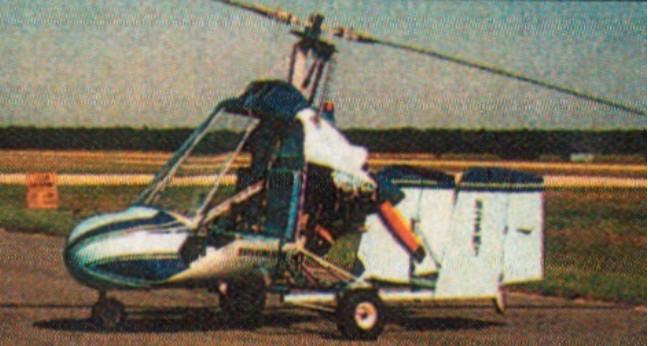
The Shadow Two-Seat Gyroplane’s features are: a durable, high-strength airframe, dependable, FAA-certified Lycoming engine, certified disc brakes for superb ground handling, rugged gearbox-driven prerotator, large, expandable instrument panel, and a full electrical system for avionics and lights. It also takes off and lands in very short distances and operates exceptionally well at high altitudes. It’s size is easily reduced for storage in a garage or transported by trailer. It’s maximum speed is 100 mph.and its cruising speed is 75 mph. Shadow kit minus engine and instruments in 2001: $15,750
Engine: Lycoming O-320, 150 hp
Disk span: 29 ft
Disk area: 660 sq.ft
Height: 8.5 ft
Length: 13 ft
Empty wt: 750 lbs
Gross wt: 1290 lbs
Fuel cap: 12 USG
Max speed: 100 mph
Cruise speed: 75 mph
Range: 100+ sm
ROC: 1500 fpm
Take-off dist: 125 ft
Landing dist: 25 ft
Service ceiling: 18,000 ft
Seats: 2
Vortech Skylark 1

Developed from the G-1 design, pilots have expressed amazement at this craft’s stability and manoeuvrability. The Skylark can be flown in the Experimental Aircraft category. Although this is one of the more affordable homebuilts, the airframe and all of its major components have been designed for quality, dependability and durability.
Full instrumentation Skylark kit minus engine and instruments: $19,995 in 2001.
Skylark construction plans in 2001:
Reduced-size prints (11″ x 17″ format): $75 (add $6 postage U.S. or $16 foreign)
Full size prints (18″ x 24″ format): $175 (add $7 postage U.S. or $22 foreign)
Features of the Skylark:
- Full helicopter flight: vertical take-offs & landings; forward, backward & sideward flight; hovering.
- Standard helicopter control system
-All-aluminum main- & tail-rotor blades - Aircraft-grade steel & aluminum airframe & major components, plus all AN hardware
- Full instrumentation

Engine Rotax 582, 65 hp
Main Rotor Diameter 19 ft
Disk area: 283 sq.ft
Tail Rotor Diameter 3 ft 6 in
Height 7 ft
Length 17 ft 6 in
Empty Weight 350 lbs
Gross Weight 725 lbs
Payload Weight 375 lbs
Fuel cap: 10 USG
Power Loading 10.8 lbs/hp
Disc Loading 2.5 lbs/sq ft
Maximum Speed 95 mph
Cruise Speed 70 mph
Rate Of Climb 1,000 fpm
Maximum Altitude 12,500 ft
Range: 120 sm
Seats: 1
Vortech G-1
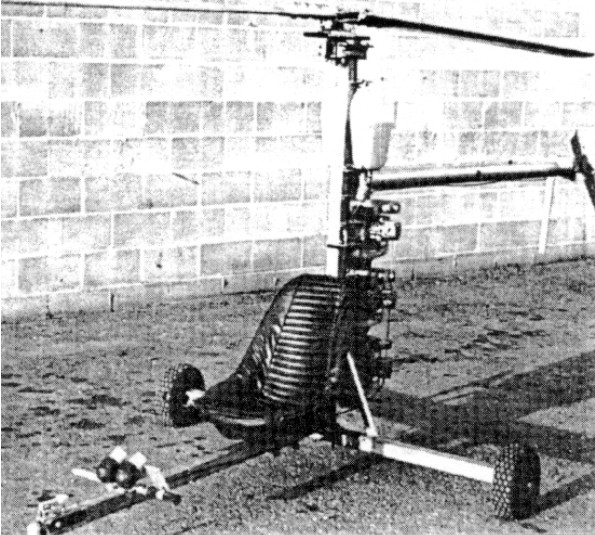
The G-1 Ultrtalight Helicopter, created in the early 1970s by Art Weilage, was tested and sold as low-cost kits by Compcop, Inc. Vortech offers the original construction prints to hobbyists curious about this design, or who want to study the concept as inspiration for a design of their own.
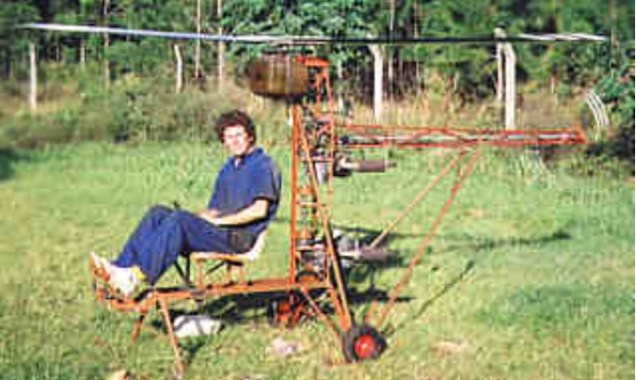
Developed, tested and sold in the 1970’s by Compcop, the G-1 was designed to fill the need for an affordable, easy-to-build ultralight helicopter. The entire helicopter can be built at home with ordinary tools at a low cost. No license is required to fly the G-1 because it is in the license-free “Ultralight Aircraft” category (see FAR Part 103). The construction manual provides all the details needed to build the G-1 with an engine of 40 h.p. or higher. The three McCulloch go-cart engines can be replaced with a single engine such as the Rotax 447. Aluminium construction.
Carries one person. Takes off and lands vertically. Flies forward, backward, sideward, & hovers.

Engines: 3 x McCulloch MC101 42 hp
Empty wt: 150 lb
Max wt: 420 lb
Rotor span: 12ft
Height: 5.5ft
Length: 12ft
Max speed: 80 mph
Cruise: 55 mph
Climb rate: 1,000 fpm
Range: 120 sm
Service ceiling: 10,000 ft
Seats: 1
Engine (typical) Kawasaki or Rotax, 40+ hp
Length 12 ft
Width 5.7 ft
Height 5 ft 6 in
Main rotor diameter 12 ft
Tail rotor diameter 2 ft
Empty weight 150 lbs
Gross weight 420 lbs
Useful payload 270 lbs
Fuel capacity 5 USgals
Fuel consumption 4 USgals/hour
Speed (max.) 80 mph
Altitude (max.) 10,000 ft asl
Engine: 3 x McCulloch, 9.5 hp
Rotor span: 3.66 m
MAUW: 190 kg
Empty weight: 66 kg
Fuel capacity: 19 lt
Max speed: 128 kph
Cruise speed: 80 kph
Fuel consumption: 12 lt/hr
Seats: 1
Plan price (1998): $34.95
Vortech
Offered the G-1B single-seat ultralight helicopter (plans or kit), Kestrel single-seat pressure-jet helicopter (plans or kit), MEG-2XH strap-on pressure-jet helicopter (plans or kit), Shadow two-seat autogyro (kit), and Skylark I single-seat helicopter (kit).
1996-7: PO Box 511-KD, Fallston, MD 21047, USA.
Vorta Vorta
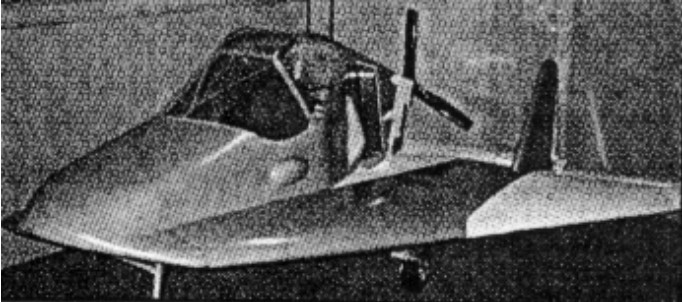
Composite construction.
Speed max: 110 mph
Cruise: 100 mph
Range: 300 sm
ROC: 800 fpm
Take-off dist: 400 ft
Landing dist: 75 ft
Service ceiling: 12,000 ft
Engine: Rotax 532, 42 hp
Fuel cap: 11 USG
Weight empty: 330 lbs
Gross: 600 lbs
Height: 5 ft
Length: 14.3 ft
Wing span: 13.7 ft
Wing area: 115 sq.ft
Seats: 1
Landing gear: nose wheel
Vorta
1995: PO Box 642, Batavia, NY 14021, USA.
Airplane builder
Volvo Aero
Volvo Aero
Nohab Flygmotorfabriker AB
Svenska Flygmotor AB
Nohab Flygmotorfabriker AB was founded in Trollhättan, Sweden, in 1930 to produce aircraft engines for the Swedish Board of Aviation. As the name of the company indicates it was a subsidiary to NOHAB. In 1937 it became a part of the newly founded SAAB but already in 1941 Volvo acquired a majority of the stock and the name was changed to Svenska Flygmotor AB (SFA), and later on Volvo Flygmotor.
Since the 1950s the company have been the major engine supplier to the Swedish Air Force. The Volvo Aero Group has 3,600 employees and in 2003 had total sales of 0.9 billion euros. Today Volvo Aero is a partner in more than ten commercial engine programmes. Components from Volvo Aero are installed in more than 90% of all large commercial aircraft engines sold.
On 6 July 2012 Volvo Aero was acquired by the British aerospace manufacturer GKN in a SEK 6.9 billion deal.
Volvo Aero was a supplier of single-engine systems for military aircraft. These have largely been in partnership with other engine manufacturers, such as the RM1 (de Havilland Goblin) for the Saab 21R, RM2 (de Havilland Ghost) for the Saab J29, RM5 and RM6 (Rolls-Royce Avon) for the Saab 32 Lansen, the RM6B for the Saab 35 Draken, and the RM8 (Pratt & Whitney JT8D) for the Saab 37 Viggen. The Saab JAS 39 Gripen’s RM12 engine is a derivative of the General Electric F404.
Svenska Flygmotor also designed the B42, horizontally-opposed four-cylinder engine, intended for the SAAB Safir. However, SAAB decided on using engines from de Havilland and Lycoming for the Safir. In the end the B42 came to power the Infanterikanonvagn 103 assault gun. A follow-up called B44 powered the Pansarbandvagn 301 armoured personnel carrier.
Volvo Aero delivered engine components, mainly complex engine structures like turbine exhaust casings, turbine mid frames, LPT cases, compressor housings, LPT shafts, vanes, and large rotating parts.
Volvo Aero also had a facility in Trollhättan where they did maintenance on aircraft engines and stationary gas turbines. The aircraft engines are Pratt & Whitney Canada PW100 and TFE-731 engines. The Stationary gas turbines is General Electric LM1600 engine, and the DR990, which Volvo bought the OEM responsibility from Dresser Rand.
Volvo Aero manufactured combustion chambers, nozzles and turbines for commercial launch vehicles.
The company have produced the F-series hydraulic motors under the Volvo Flygmotor and VOAC brands.
Volvo Aero subsidiaries were located in the United States and Norway, in addition to Volvo’s home country, Sweden. The Norwegian plant, in Kongsberg, is the former Norsk Jetmotor, itself formerly a part of Kongsberg Våpenfabrikk.
Volmer Aircraft
Volmer S. Jensen was born in Milwaukee in 1909. He began to design and build sailplanes in 1925 at age 16. using plans published in the Boy Mechanic Magazine. He built a second one the following year from additional plans from the same source, and in 1927 he built his first glider with aerodynamic controls, an enclosed cockpit and a wheeled landing gear. The latter was based on the MIT glider Eddie Allen had taken to Europe in the mid-20s to compete against the Germans.
Volmer had moved to Seattle in 1925 to serve an apprenticeship as a machinist, and in 1928 he built a cantilever wing glider for a wealthy sportsman named Thomas Stimson. Volmer called it his VJ-4 and would utilize that numbering system for the remainder of his long aircraft design and construction career.
Throughout the late 1920s and 1930s his designs consisted of a series of increasingly sophisticated gliders, including the VJ-10 he built in 1939 which was the first two-place, side-by-side sailplane in the United States. During this period, Volmer was employed by a succession of aircraft companies, including Boeing, Consolidated, and Northrop, so his glider design and building were done in his spare time.
1946: Acquired Jarvis Aircraft Co assets.
Plans and component kits marketed by Herr Engr Corp, Lakeland FL.
To EAA members he is best known as the designer of the Volmer VJ-22 Sportsman, the first amphibian made available for home construction. To sailplane enthusiasts, he is revered as one of the pioneers of U. S. glider design and construction, with his first original design dating back to 1928. Hang glider pilots are amazed to learn that he built his first weight-shift biplane glider in 1925 when he was 16 … and ultralight pilots recall that he added an engine to his Sunfun hang glider in 1975.
Produces plans to construct VJ-22 Sportsman two-seat amphibian (first flown 1958) and VJ-24W SunFun single-seat open microlight (earlier VJ-23 Swingwing is recognised as having been the first modern microlight).
1995-8: Box 5222, Glendale, CA 91201, USA.
Volmer Jensen was the builder of the model of the Starship Enterprise that was used in the filming of the TV series and movies! (although it was designed by cabin Waco owner, Matt Jeffries.)
Volmer Jensen,
Burbank CA.
USA
 All Aero