Jabiru Engines

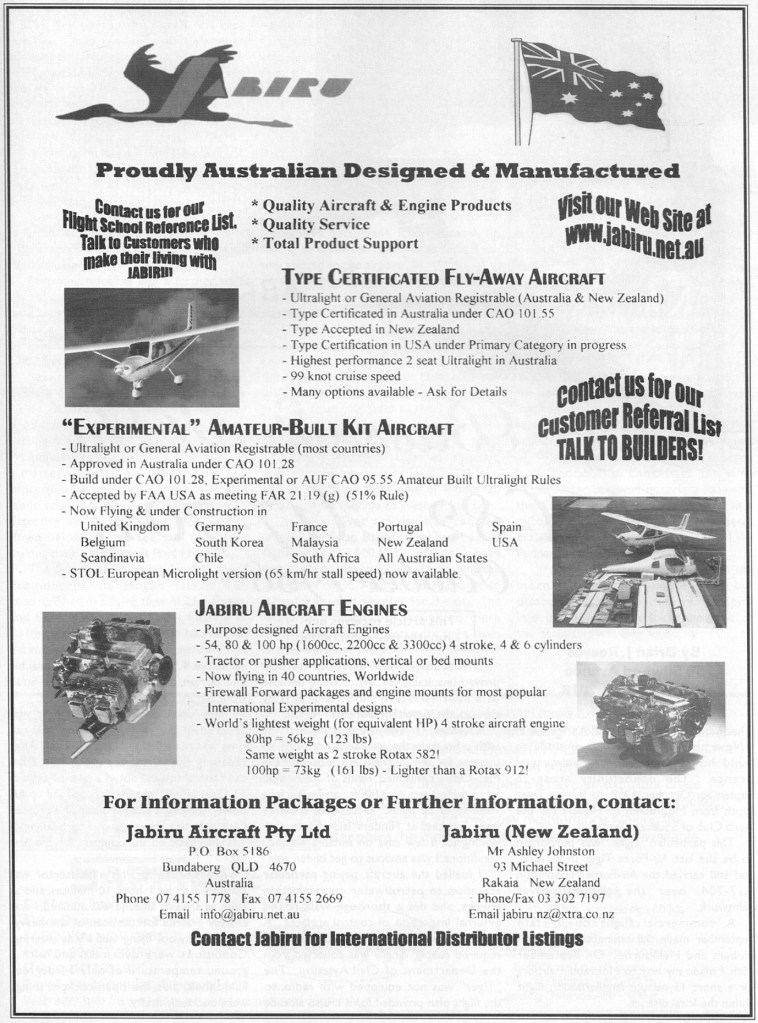
Jabiru engines are designed to be manufactured in small batch quantities using Computer Numerically Controlled (CNC) machine tools. The majority of the components are manufactured in Southern Queensland in a network of high technology small companies. The crankcase halves, cylinder, crankshaft, starter motor housings, gearbox cover (the gearbox powers the distributor rotors) and coil mounts together with many smaller components are machined using the latest CNC machine tools. The sump (oil pan) is the only casting.

The cylinders are machined from solid bar 4140 chrome molybdenum alloy steel, with the pistons running directly in the steel bores. The crankshaft is also machined from solid bar 4140 chrome molybdenum alloy steel, the journals of which are precision ground prior to being Magnaflux inspected. The camshaft is provided by a specialist camshaft manufacturer.

The engine is direct crankshaft driven and does not use a reduction gearbox. This facilitates its light-weight design and keeps maintenance costs to a minimum. The crankshaft features a removable propeller flange which enables the easy replacement of the front crankshaft seal and provides for a propeller shaft extension to be fitted, should this be required for particular applications.

Cylinder heads are machined from solid aluminium billet which is purchased directly from one of Australia’s largest aluminium companies, as is all alloy used in the engine, thereby providing a substantive quality trail to material source. Conrods are machined from 4130 alloy steel, the 45mm big end bearings are of the automotive slipper type.
Under a direct supply arrangement with Honda, various components of the engines are sourced. These items include camshaft followers, and the bendix gear in the starter motor. The ignition coils are also sourced from Honda, but are modified by Jabiru for their own particular application.

An integral alternator using rare earth magnets, provides alternating current for battery charging and electrical accessory drive. The alternator is attached to the flywheel and is driven directly by the crankshaft. The ignition system is a transistorised electronic system; two fixed coils mounted adjacent to the flywheel are energised by rare earth magnets attached to the flywheel. The passing of the coils by the magnets creates the high voltage current which is then transported by high tension leads to the centre post of two automotive type distributors (which are simply rotors and caps) before distribution to automotive spark plugs, two in the top of each cylinder head. The ignition system is fixed timing and, therefore, removes the need for timing adjustment. It is suppressed to prevent radio interference. The ignition system is fully redundant, self-generating and does not depend on battery power.

The crankshaft is designed with a double bearing at the propeller flange end and a main bearing between each big end; it therefore does not have flying webs. 48mm main bearings are also of the automotive slipper type. Thrust bearings are located for and aft of the front double bearing allowing either tractor or pusher installation.

Pistons are General Motors aftermarket made in Australia and are re-machined to include a piston pin circlip groove. They are fitted with 3 rings, the top rings being cast iron to complement the chrome molybdenum cylinder bores. Valves are 7mm (stem dia) which are purpose manufactured for the Jabiru engine in England.

The valve gear includes pushrods from the camshaft from the camshaft followers to valve rockers which are CNC machined from steel plate, induction hardened and polished on contact surfaces and mounted on a shaft through an aluminium bronze bush. Valve guides are manufactured from aluminium/bronze, as is found in larger aero engines and high performance racing engines. Replaceable valve seats are of nickel steel and are shrunk into the aluminium cylinder heads. The valve gear is lubricated from the oil gallery.

An internal gear pump, direct mounted on the camshaft and incorporating a small automotive spin-on filter, provides engine lubrication. An oil cooler adapter is provided. Most installations require an oil cooler to meet oil temperature limits.

The standard engines are supplied with two ramair cooling ducts, which have been developed by Jabiru to facilitate the cooling of the engine and direct air from the propeller to the critical areas of the engine, particularly the cylinder heads and barrels. The fitment of these obviate the need to design and manufacture baffles and the establishment of a plennum chamber, which is the traditional method of cooling air-cooled aircraft engines.
The engine is fitted with a 1 kw starter motor, which is also manufactured by Jabiru and provides very effective starting in all conditions. The engine has very low vibration levels, however it is also supported by four large rubber shock mounts attached to the engine mounts at the rear of the engine. An optional bed mount is available.

The fuel induction system comprises a Bing pressure compensating carburettor. Following carburation, the fuel/air mixture is transported to a small plennum chamber in the sump casting, in which the mixture is warmed prior to entering short induction tubes attached to the cylinder heads.

An effective stainless steel exhaust and muffler system is fitted as standard equipment, ensuring very quiet operations, which in the Jabiru aircraft have been measured at 62dB at 1000′ full power flyover (for 2200 engine).

For those owners wanting to fit vacuum instruments to their aircraft the Jabiru engine design includes a vacuum pump drive, direct mounted through a coupling on the rear of the crankshaft.

The Jabiru engine is manufactured within an Australian Civil Aviation Safety Authority (CASA) approved Quality Assurance System to exacting standards

As at October 2013, Jabiru Engines were offering:
2200 (4 cylinder)
3300 (6 cylinder)
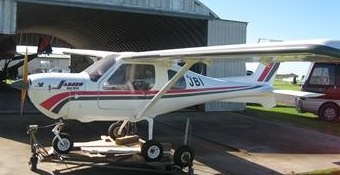
Jabiru Aircraft Jabiru

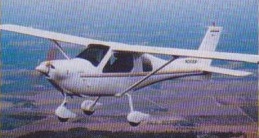
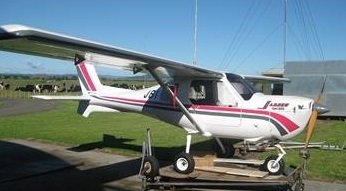
Jabiru SK80

The agents in the USA for the original Jabiru circa 1997 were Tiger Aviation. The SP 470 model is a combination of the best features of the SK and UL models. The longer fuselage and the standard SK wing.

Jabiru SK80

By 1998 sales were underway in the UK and worldwide 130 examples were flying.

Jabiru SK

Jabiru
Engine: Jabiru, 80 hp.
HP range: 60-80.
Height: 6.58 ft.
Length: 16.5 ft.
Wing span: 26.25 ft.
Wing area: 85 sq.ft.
Weight empty: 520 lbs.
Gross: 1060 lbs.
Fuel cap: 17 USG.
Speed max: 138 mph.
Cruise: 129 mph.
Range: 600 sm.
Stall: 46 mph.
ROC: 1200 fpm.
Take-off dist: 480 ft.
Landing dist: 300 ft.
Service ceiling: 15,000 ft.
Seats: 2.
Landing gear: nose wheel.

SK60
Engine: Jabiru 1.6lt, 60 hp.
Cruise: 75 % 90 kt.
Endurance: 4 hr.
Seats: 2

SK80
Engine: Jabiru 2.2lt, 80 hp.
Cruise: 75% 105 kt.
Endurance: 4.5 hr.
Seats: 2.

Jabiru SK
Engine: Jabiru 2200, 80 hp
Wing span: 8.34 m
Wing area: 7.9 sq.m
MAUW: 450 kg
Empty weight: 235 kg
Max speed: 215 kph
Cruise speed: 195 kph
Minimum speed: 74 kph
Climb rate: 6 m/s
Seats: 2
Kit price (1998): £24,675

SP 470
Engine: 2.2 Jabiru.
Stall speed 39 kts.

SP taildragger
Wing: UL.
Engine: Jabiru 2200.
Cruise: 90-95 kts @ 14 lt/hr.

ST3 UL
Stall: 35 kt / 40 mph / 65 kmh
Cruise: 85 kt / 98 mph / 157 kmh
VNE: 116 kt / 133 mph / 215 kmh
Empty Weight: 253 kg / 558 lbs
MTOW Weight: 450 kg / 992 lbs
Climb Ratio: 1000 ft/min / 5 m/s
Glide Ratio: 1:14
Take-off distance (50ft obstacle): 1180 ft / 360 m
Landing distance (50ft obstacle): 1180 ft / 360 m

Jabiru Aircraft

Jabiru Aircraft Pty, Ltd has been in the business of producing Light Sport aircraft in Australia since 1991. The fleet of Jabiru LSA aircraft around the world in flight schools and flight clubs had accumulated over a half million flight hours by 2010.

1998:
PO Box 5186
Bundaberg West
West Qld 4670
Australia

Produces a range of two-seat all-composite lightweight cabin aircraft which have been available as either factory built models or as fully comprehensive kitsets. Jabiru produce their own motive power for the aircraft. The engines are already found in a range of other kit manufacturers products.

March 1999

1995: Bundaberg West 4670, Queensland, Australia.

As at October 2013, Jabiru Aircraft were offering:
J120-C
J160-D
J170-D
J230-D

ITV Merak Bi

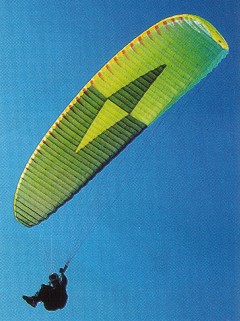
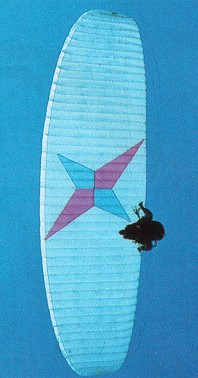
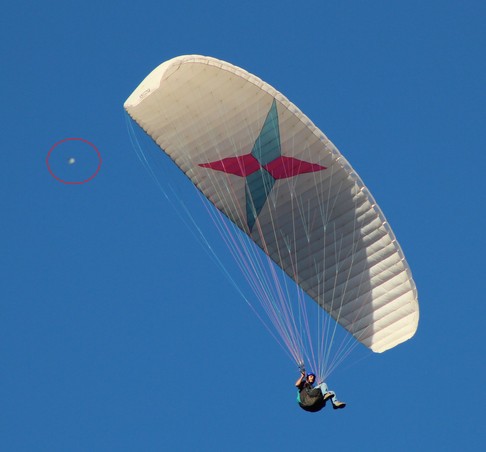
Paraglider circa 1998.

Merak Bi 38
Wing area: 38 sq.m
Certification: Afnor
Pilot weight: 110-160 kg
No. of cells: 53
Wing span: 13.9 m
Aspect ratio: 5.11
Max speed: 40 kph
Price (1998) £2299

Merak Bi 42
Wing area: 42 sq.m
Certification: Afnor
Pilot weight: 140-190 kg
No. of cells: 53
Wing span: 14.6 m
Aspect ratio: 5.11
Max speed: 40 kph
Price (1998) £2399

ITV Jade

Paraglider circa 1998.

Jade 22
Wing area: 23.8 sq.m
Certification: Afnor
Pilot weight: 58-70 kg
No. of cells: 28
Wing span: 10.1 m
Aspect ratio: 4.92
Max speed: 39 kph
Price (1998) £1799

Jade 25
Wing area: 26.5 sq.m
Certification: Afnor
Pilot weight: 65-80 kg
No. of cells: 28
Wing span: 10.70 m
Aspect ratio: 4.29
Max speed: 39 kph
Price (1998) £1799

Jade 28
Wing area: 29 sq.m
Certification: Afnor
Pilot weight: 65-78 kg
No. of cells: 30
Wing span: 11.45 m
Aspect ratio: 4.5
Max speed: 35 kph
Price (1998) £1849

Jade 30
Wing area: 30.9 sq.m
Certification: Afnor
Pilot weight: 95-115 kg
No. of cells: 30
Wing span: 11.8 m
Aspect ratio: 4.5
Max speed: 39 kph
Price (1998) £1949

ITV Equinox

Paraglider new in 1998.

Equinox 24
Wing area: 24 sq.m
Certification: Afnor
Pilot weight: 60-75 kg
No. of cells: 57
Wing span: 11.46 m
Aspect ratio: 5.45
Max speed: 47 kph
Price (1998) £2099

Equinox 26
Wing area: 26 sq.m
Certification: Afnor
Pilot weight: 73-91 kg
No. of cells: 57
Wing span: 11.98 m
Aspect ratio: 5.45
Max speed: 48 kph
Price (1998) £2199

Equinox 28
Wing area: 28 sq.m
Certification: Afnor
Pilot weight: 90-110 kg
No. of cells: 57
Wing span: 12.5 m
Aspect ratio: 5.45
Max speed: 50 kph
Price (1998) £2299

ITV Azimut

Paraglider circa 1998.

Santiago, Chile (Rafael Soto)

Azimut 24
Wing area: 24 sq.m
Certification: Afnor
Pilot weight: 55-70 kg
No. of cells: 46
Wing span: 10.51 m
Aspect ratio: 4.66
Max speed: 42 kph
Price (1998) £1799

Azimut 26
Wing area: 26,4 sq.m
Certification: Afnor
Pilot weight: 55-70 kg
No. of cells: 48
Wing span: 10.98 m
Aspect ratio: 4.6
Max speed: 42 kph
Price (1998) £1899

Azimut 28
Wing area: 28.1 sq.m
Certification: Afnor
Pilot weight: 83-100 kg
No. of cells: 48
Wing span: 11.44 m
Aspect ratio: 4.66
Max speed: 44 kph
Price (1998) £1999

Azimut 30
Wing area: 30.4 sq.m
Certification: Afnor
Pilot weight: 95-115 kg
No. of cells: 48
Wing span: 12.02 m
Aspect ratio: 4.66
Max speed: 43 kph
Price (1998) £2099

Issoire PIK-30 / Societe Siren PIK-30 / Eiri Avion PIK 30

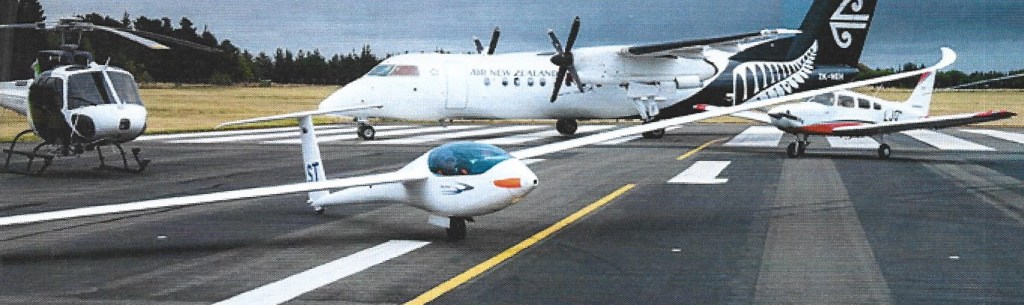
Issoire, part of the groupe Siren, acquired a license from Eiri Avion to build the 15 m. self- launching Finnish PIK 20E designed by Pekka Tammi and M.Moniot. The Pik 30 is a self- launching 17 m. development which first flew in 1984. It has the capability of being flown as a 15 m. sailplane or, with tip extensions, with 17 m. span. The PIK 30 has a mast mounted manually actuated retractable engine.
Construction of the wings and tail surfaces: GFRP sandwich with PVC core; carbon fiber spar caps and cockpit sides: GFRP monocoque structure reinforced with ribs of carbon fiber.

SIREN PIK-30 ZK-GST

Span: 17m / 55.8ft
Area: 10.63sq.m / 114.42sq.ft
Empty Weight: 340kg / 750lb
Payload: 120kg / 264lb
Gross Weight: 460kg / 1014lb
Wing Load: 43.27 kg
/sq.m / 8.86 lb/sq.ft
Water Ballast: 0
Aspect ratio: 27.2
L/DMax: 45 110 kph / 59 kt / 68 mph
MinSink: 0.54 m/s / 1.77 fps / 1.05 kt
Airfoil: Wortmann FX-67 K170, root, K150, tip
Engine: 32 kW/ 43 bhp Rotax 503
Seats: 1
No. Built: 10

Issoire Aviation

Societe Issoire Aviation was formed in 1978, following the bankruptcy of Wassmer Aviation, by President/General Director of Siren SA. In addition to subcontract work for the French aircraft industry and construction of sailplanes, offered IA 80 Piranha as a two-seat lightplane.

1995 saw the takeover of Issoire Aviation by the REXIAA Group. Alongside the subcontracting activities, launch of the LIONCEAU programme, the first “all carbon” aircraft with the participation of all the companies in the group.