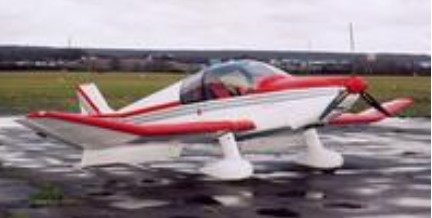
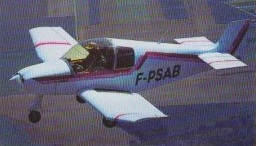
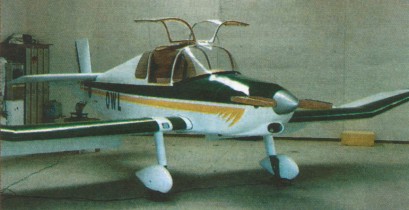
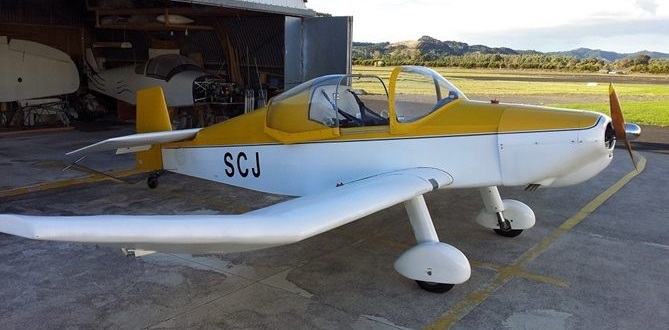
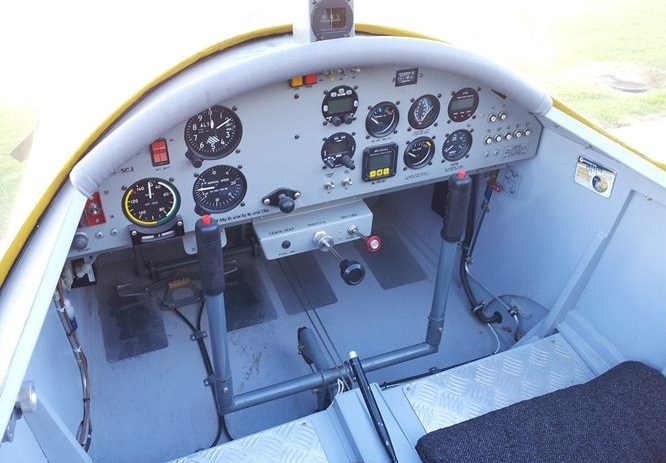
The Jodel D20 has the wing from the D19 married to a completely new fuselage resembling the shape of the Robin-Jodels. Plans for the D20 are not generally available. Instead S.A.B. do all the woodwork, and it can be bought from them in a ready-to-cover state. Designed from the outset to utilize a JPX 85hp engine, the little two-seater is a good a performer just as the D18 and 19. The aircraft is available in Normal and Microlight kit form, and is delivered in either trigear or taildragger configuration, depending on the customer’s preferences. Available in 2009 from AeroConsult in kit or as ready built.
D20 Wing span: 7.50 m Length: 5.80 m Height: 1.93 m Wing area: 9.93 sq.m Cabin width: 1,12 m Fuel capacity: 100 lt Seats: 2 Engine: JPX 4TX75, 85 hp @ 3000 rpm Empty weight: 250/260 kg Max weight: 500 kg Max speed: 240/250 km/h Cruise speed: 200/220 km/h Range: 1500 km
Jodel D20 UL Legende Stall: 32 kt / 37 mph / 60 kmh Cruise: 108 kt / 124 mph / 200 kmh VNE: 146 kt / 168 mph / 270 kmh Empty Weight: 250 kg / 551 lbs MTOW Weight: 450 kg / 992 lbs Glide Ratio: 13 Take-off distance (50ft obstacle): 490 ft / 150 m Landing distance (50ft obstacle): 300 ft / 90 m
Engine: JPX, 75 hp Wing span: 7.2 m Wing area: 9.93 sq.m MAUW: 560 kg Empty weight: 290 kg Fuel capacity: 100 lt Max speed: 220 kph Cruise speed: 20 kph Minimum speed: 69 kph Climb rate: 3 m/s Fuel consumption: 17 lt/hr Seats: 2 Kit price (1998): 149 900 Fttc
As the D18 has a classical undercarriage and many clubs like a nosegear for their planes, M. Delemontez came up with a variant of the D18 called the D19. Beside the nose wheel, the main difference to the D18 is the flap. The flap drawings contain information for putting a similar flap on the D18, and is a classical Jodel flap of narrow chord. It is not very effective as a high lift device, but a very useful brake on landing. The drag of the nosewheel does degrade the performance to some degree, but ground handling is made simpler. The D 18 and D 19 are small two seater homebuilts that are usually powered by converted Volkswagen engines. Plans are being sold to homebuilders, but they were never factory produced.
Plans for both planes are available through S.A.B. Same firm also sell parts for the aircraft, like hinges, horns, undercarriage assemblies, perspex cockpit canopy, controls and engine mounts. These are definitely home builts and not kit planes.
The Ultralight rules call for a MTOW of 450kg, and that should fit the D18/19 MTOW of 460kg. Same regulations say an ultralight should be able to fly at 65km/h. This is hard to attain with a D18 or 19, but should be possible with a high-lift flap. SAB also seems to have seen this as a new marketing niche. In late 1999 a brochure emerged telling about these recent Jodel developments. The new variants are called D185 and D195, and differ from their D18 and D19 forerunners by having:
an 8 cm wider, more comfortable fuselage.
the hood extended towards the rear, opening by sliding the rear part rearwards.
flap of increased area (which means increasing wing area as well) to lower the stall speed. The increase in area is simply done by stretching the trailing edge of the flap rearwards by 100mm, leaving the wing unchanged. The flap is also extended all the way to the root rib.
hydraulic springs (oléopneumatique) in the undercarriage.
gross weight reduced to 450kg. The rearwards extended hood makes installing the 65l fuel-tank behind the seat the only option left. The brochure lists the specs. of the planes to be very similar to their ancestors. A stall speed of only 60km/h sounds a little optimistic however – at least at gross weight. The engines that are used for the D18/D19 are also listed as suitable for the ultralight variants – VW1600 – 1800, Rotax 912, JPX, Limbach and Jabiru.
D19 Wing span: 7.50 m Length: 5,70 m Wing area: 10 sq.m Cabin width: 1,0 m Fuel capacity: 65 lt Seats: 2 Engine: JPX 1,835 lt, 70 hp Empty weight: 244 kg Max weight: 460 kg Climb (2p): 3-3,5 m/s
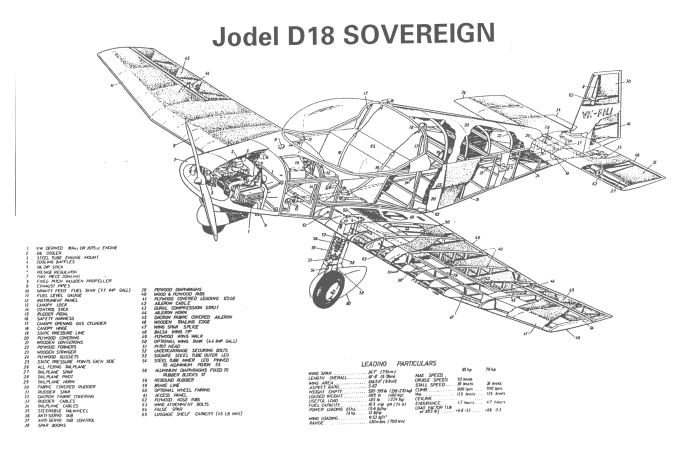
The success of the DC1 lead M. Delemontez to make a thorough revision, and the first D-18 took to the air in the spring of 1984. At first glance looking quite similar to the DC1, there is hardly a single point where Delemontez has not changed something. The prototype has a slightly bigger span than the DC1. An aircraft entirely of wooden construction and built from plans. No kit is available although some sub assemblies can be for control surfaces and undercarriage and perspex canopy can be bought. Douglas Fir is a major material but Australian Hoop Pine has been found very satisfactory. As a two seater the D18 has relevance as a local tourer. The one piece cantilever wing incorporates a sturdy box spar, wooden ribs and ply covered leading edge with dacron covering on the remainder. Flaps are optional. The fuselage is of rectangular cross section with a rounded top decking and made up of wooden longerons, bulkheads, plywood rear formers and is plywood covered. The perspex canopy is attached to a steel tube frame and hinged at the rear. The completed aircraft with some judicious construction will fit into the microlight category and becomes a very cost effective construction project.
As the Ultralight specifications changed during the 1990’s, many builders realised that it should be possible to register a D18 as an U/L with only minor modifications. SAB also seems to have seen this as a new marketing niche. In late 1999 a brochure emerged telling about these recent Jodel developments.
The new variants are called D185 and D195, and differ from their D18 and D19 forerunners by having:
an 8 cm wider, more comfortable fuselage.
the hood extended towards the rear, opening by sliding the rear part rearwards.
flap of increased area (which means increasing wing area as well) to lower the stall speed. The increase in area is simply done by stretching the trailing edge of the flap rearwards by 100mm, leaving the wing unchanged. The flap is also extended all the way to the root rib.
hydraulic springs (oléopneumatique) in the undercarriage.
gross weight reduced to 450kg. The rearwards extended hood makes installing the 65l fuel-tank behind the seat the only option left. The brochure lists the specs. of the planes to be very similar to their ancestors. A stall speed of only 60km/h sounds a little optimistic however – at least at gross weight. The engines that are used for the D18/D19 are also listed as suitable for the ultralight variants – VW1600 – 1800, Rotax 912, JPX, Limbach and Jabiru.
Plans are being sold to homebuilders, but they were never factory produced. In the 13 years that passed between the prototype’s first flight and the summer of 1997, SAB had sold approximately 470 plans.
D18 Sovereign Engine: VW 17l0cc, 58 hp Wing span: 7.50 m Length: 5,70 m Wing area: 10 sq.m Cabin width: 1,0 m Fuel capacity: 65 lt Seats:2 Empty weight: 245/255 kg Max weight: 460 kg Cruise speed: 175 km/h Climb (2p): 3,5 m/s
D18 UL Stall: 32 kt / 37 mph / 60 kmh Cruise: 94 kt / 109 mph / 175 kmh VNE: 134 kt / 154 mph / 248 kmh Empty Weight: 235 kg / 518 lbs MTOW Weight: 460 kg / 1014 lbs Climb Ratio: 700 ft/min / 3.5 m/s Take-off distance (50ft obstacle): 820 ft / 250 m Landing distance (50ft obstacle): 1450 ft / 443 m
Established at Beaune in March 1946, by Jean Delemontez and Edouard Joly, the former as business and technical manager, latter as test pilot. Initial activities concerned with repair of gliders and light aircraft of Service d’Aviation Legare et Sportive on behalf of French government. In parallel, Jodel designed and built D.9 Bebe single-seat light monoplane, first flown January 1948. After official tests with D.9, French government ordered two prototypes of two-seat D.11 (Salmson engine) and D.111 (Minie engine). Followed by D.112, and D.140 Mousquetaire. All built for private use in France and other countries. License built by other French companies including Alpavia, Societe Aeronautique Normande and Wassmer. Licences for building in Germany, Italy, Spain and other continental countries also granted. Delemontez left to join Pierre Robin at Centre Est Aeronautique CEA) in 1957. Various wood/fabric Jodel models remain available through supply of plans and/or kits/components via SAB in Beaune (also D.9 Bebe via Falconar in Canada), including D.9 Bebe single-seater, D.11 two-seater, D.18 two-seater (developed from Delemontez-Cauchy DC-01 and first flown 1984), D.19 nosewheel version of D.18, D.20 Jubilee two-seater of 1997 and the first SAB aircraft offered as a complete kitplane, and D.150 Mascaret two-seater (formerly commercially built by SAN in France).
Societe des Avions Jodel, 36, Route de Seurre, 21-Beaune, France.
Paradigme 30 Wing area: 30 sq.m Pilot weight: 75-100 kg No. of cells: 79 Wing span: 13 m Aspect ratio: 5.5 Min sink: 1.05 m/s Max speed: 45 kph Price (1998) 22000 Fr
Lagon 25 Wing area: 24.5 sq.m Pilot weight: 65-80 kg No. of cells: 48 Wing span: 11.3 m Aspect ratio: 5.2 Min sink: 1.1 m/s Max speed: 43 kph Price (1998) 19000 Fr
Lagon 27 Wing area: 27 sq.m Pilot weight: 75-100 kg No. of cells: 52 Wing span: 12.2 m Aspect ratio: 5.5 Min sink: 1.1 m/s Max speed: 43 kph Price (1998) 19000 Fr
Lagon 30 Wing area: 29.5 sq.m Pilot weight: 90-110 kg No. of cells: 56 Wing span: 13.1 m Aspect ratio: 5.8 Min sink: 1.1 m/s Max speed: 43 kph Price (1998) 19000 Fr
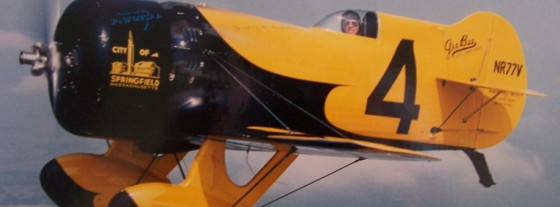
This is a full size, exact, replica of the Granville Brothers Gee Bee Model Z from 1931. The original airplane was victorious in 5 races at the 1931 National Air Races in Ohio after taking only 5 weeks and $5000.00 to construct. This replica was built over a 3.5 year period by Jeff Eicher and Kevin Kimball consuming nearly 6000 man hours of design and construction. The Aircraft in 1996 was part of the Fantasy of Flight colloection in Polk City, FL.