Empty weight: 27 kg
Engine: Lucky Motor, 16 hp
Reduction: yes
Prop diameter: 92 cm
Fuel capacity: 10 lt
Price 1998: L5,800,000
1980->
JPX Italia Flying Mastif
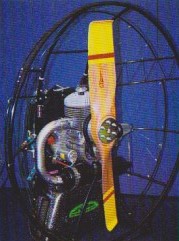
Flying Mastif
Empty weight: 30 kg
Engine: JPX, 19 hp
Reduction: yes
Prop diameter:123 cm
Fuel capacity: 10 lt
Price 1998: L6,800,000
JPX Italia Falcon
Falcon
Empty weight: 30 kg
Engine: Zanzotera, 26 hp
Reduction: yes
Prop diameter: 92 cm
Fuel capacity: 10 lt
Price 1998: L6,300,000
JPX Italia
1998:
Via Flli.Cervi 3
I-42025 Cariago Reggi Emilia
Italy
JPX Italia was the importer of the French JPX engine and began building their own chassis and offering it with engines of other manufacturers.
Paramotor builder
JPX 4T X 75A
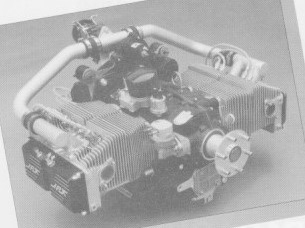
The 85 hp 4TX75/A engine is JAR certified and came with a 2 years or 1000 hr warranty. The magnetos fitted were Bendix.
4T X 75A
Cycle: 4 stroke
No cylinders: Flat 4
Bore: 95 mm
Stroke: 82 mm
Compression: 8.7
Displacement: 2325 cc
Cooling: Air
Ignition: Double magneto
Reduction: optional
Dimension: 755 x 680 x 520 mm
Weight: 78 kg
Max pwr: 85 hp at 3000 rpm
Max torque: 202 at 2900 rpm
Fuel consumption: 190/220 G/hp/hr
Price 1998: 70 940 Fttc
JPX D 320
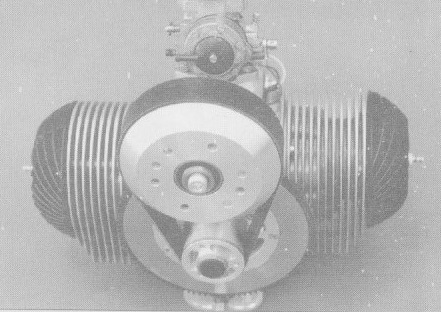
D 320 R
Cycle: 2 stroke
No cylinders: 2 opposed
Bore: 68 mm
Stroke: 44 mm
Displacement: 320 cc
Cooling: Air
Ignition: Electronic
Reduction: Poly-V belt 2.38/1
Weight: 9.5 kg
Max pwr: 18 hp at 6500 rpm
Price 1998: 18 452 Fttc
JPX PUL 425

The JPX PUL 425, also called simply the JPX 425, is a French twin-cylinder, horizontally opposed, two-stroke aircraft engine.
The engine was produced only until the company went out of business in the early 1990s. The company was re-formed but the engine remains out of production and unsupported for parts.
The engine has two cylinders in a horizontally-opposed configuration, with cooling fins on the cylinders. The single ignition system uses a coil and points. Fuel is metered by a single Tillotson butterfly-type carburetor. Starting is by a recoil starter system with electric start as an option.
The 425 has a redline rpm of 4600 and does not use a reduction drive. Its weight of just 38 lb (17 kg) gives the engine a high power-to-weight ratio.
Applications:
Latécoère 225
Lazair 2
Lazair SS
Lazair Series III
Zenair Zipper
Specifications
Type: twin-cylinder, two-stroke engine
Displacement: 424 cc (25.87 cu inches)
Dry weight: 38 lb (17 kg)
Fuel system: Tillotson butterfly-type carburetor
Oil system: premixed oil and fuel
Cooling system: air cooled
Power output: 26 hp (19 kW) at 4600 rpm
JPX
1998:
ZI Nord
F72320 Vibraye
France
Light sport engine builder
JPM 01 Médoc / Tanagra
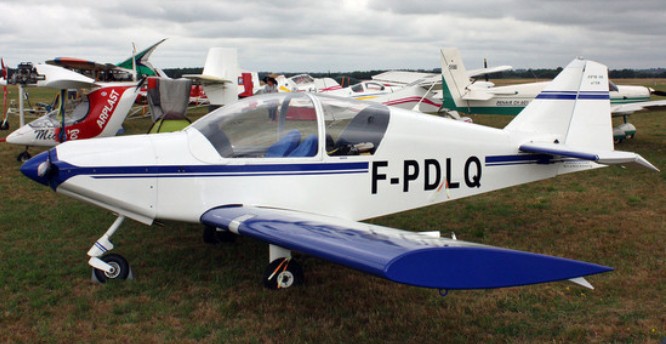
The JPM 01 Médoc is a French amateur-built aircraft that was designed by Jean-Pierre Marie in 1977 and produced by Les Avions Jean-Pierre Marie (JPM) of Le Mesnil-Esnard. The aircraft is supplied as plans for amateur construction, available in 2012 from Les Avions Jean-Pierre Marie (JPM).
The aircraft is named for the French community of Médoc.
The Médoc features a cantilever low-wing a two-seats-in-side-by-side configuration enclosed cockpit under a bubble canopy, fixed tricycle landing gear and a single engine in tractor configuration.
The aircraft is made from wood with its flying surfaces covered in doped aircraft fabric. Its 7.50 m (24.6 ft) span wing has an area of 9.30 sq.m (100.1 sq ft) and mounts flaps. Standard engines recommended are 60 kW (80 hp)-class Volkswagen air-cooled engines, including the 60 kW (80 hp) Limbach L2000 four-stroke powerplant.
The first example was completed by Pierre-Claude Guillem, and registered F-PGMB. It first flew on September 8, 1987. Originally fitted with a 65 hp JPX 4T-60A engine, it later received an 80 hp Limbach L2000 and the aircraft was winner of the 1988 SFACT Trophy for best multi place design. The JPM-01 built by the designer himself was first flown in August 1993, registered as F-PJPM.
A diesel engine powered version was designated JPM-01 Médoc Provence and the first example was completed by Didier Davenna in 2005. He had it registered as F-PDVN under the designation JPM-01 DDI. By mid-2012 at least fourteen Médocs has been built.
Almost forty years after its introduction the aircraft was redesigned and lightened, gaining slotted flaps to reduce stall speed.
JPM 01 Médoc / JPM-01 Tanagra
Engine: 1 × Limbach L2000, 60 kW (80 hp)
Length: 6 m (19 ft 8 in)
Wingspan: 7.50 m (24 ft 7 in)
Wing area: 9.30 sq.m (100.1 sq ft)
Empty weight: 286 kg (631 lb)
Gross weight: 496 kg (1,093 lb)
Fuel capacity: 60 litres (13 imp gal; 16 US gal)
Maximum speed: 210 km/h (130 mph; 113 kn)
Cruising speed: 175 km/h (109 mph; 94 kn)
Stall speed: 70 km/h (43 mph; 38 kn)
Never exceed speed: 247 km/h (153 mph; 133 kn)
Range: 700 km (435 mi; 378 nmi) with no reserve
Endurance: 4 hours plus 0.5 hour reserve
Service ceiling: 4,100 m (13,451 ft)
g limits: +3.5/–1.5
Rate of climb: 4 m/s (790 ft/min)
Wing loading: 53.3 kg/m2 (10.9 lb/sq ft)
Crew: one
Capacity: one passenger
Jordan Duet
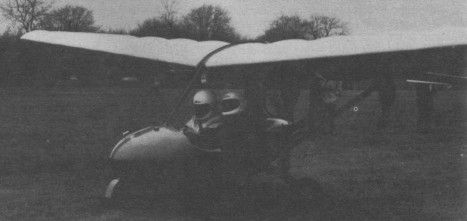
Side by side two seat single engined high-wing monoplane with conventional three axis control. Wing has swept back leading edge, swept forward trailing edge and tapering chord; conventional tail. Pitch control by fully flying tail; yaw control by fin mounted rudder; roll control by spoilerons; control inputs through stick for pitch/roll and pedals for yaw. Wing braced from below by struts; Wing profile 100% double surface. Undercar¬riage has three wheels in tricycle formation; glass fibre/carbon fibre suspension on all wheels. Push right go right nosewheel steering connected to yaw control. Glass fibre fuselage, partially enclosed. Engine mounted below wing driving pusher propeller. Aircraft quality materials are used for all structural and control fittings. The wing and tail are of composite construction.
The Duet was conceived by two professional aircraft designers, Dave Kent and Brian Cunnington, as a rugged composite construction machine for touring, training and commercial uses. Their company, Designability Ltd., is a design consultancy and not a manufacturer, so having built and test flown their first 430cc Cuyuna-engined prototype in July 1982, they found a buyer for the manufacturing rights.
Graham Andrews had just set up the company in conjunction with Barney Jordan and the two were looking for a suitable design when the Duct came on the scene. Since becoming the Jordan rather than the Designability Duet, the aircraft has undergone extensive development, particularly as regards power plant. The Cuyuna was rejected as not powerful enough and the big Rotax was substituted. This, coupled to a reduction drive and three blade propeller, gives greatly improved performance and allows the aircraft to be flown safely in conditions which might ground other micro¬lights; it can easily take off and land in a 12 mph (19 kph) crosswind, for example.
The concept of the design, however, remains the same a practical machine with 15 min rigging time from a trailer and suspension supple enough to allow it to cope with difficult fields. For pilot protection, a strong angled strut is mounted in front of the cockpit.
The prototype was designed to the same airworthiness standards as heavier aircraft. A second prototype, a pre production model, was flying in March 1983, dual rudder pedals will be fitted.
Engine: Rotax 503, 45 hp at 6500 rpm.
Prop¬eller diameter 46 inch, 1.16m (3 blade).
belt reduc¬tion, ratio 2.0/1.
Max static thrust 250 lb, 113 kg.
Power per unit area 0.28 hp/sq.ft 11 hp/sq.m.
Fuel capacity 6.0 US gal, 5.0 Imp gal, 22.7 litre.
overall 22.0 ft, 6.71 m.
Height overall 5.5ft, 1.68m.
Wing span 36.0ft, 10.97m.
Chord at root 6.0ft, 1.83m.
Chord at tip 3.0ft, 0.91m.
Dihedral 3 deg.
Sweepback 0 deg.
Tailplane span 10.0ft, 3.05m.
height 4.0 ft, 1.22 m.
Total wing area 162 sq.ft, 15.1 sq.m.
Fin and rudder area: 11.0 sq.ft, 1.02 sq.m.
Total elevator area 26.6 sq.ft, 2.47 sq.m.
Wing aspect ratio 8.0/1.
Wheel track 6.0 ft, 1.83 m.
Wheelbase 6.0 ft, 1.83 m.
Nose¬wheel diameter overall 10 inch, 254 mm.
Main wheels diameter overall 15 inch, 381 mm.
Empty weight 320 lb, 145kg.
Max take off weight 750 lb, 340kg.
Payload 430 lb, 195kg.
Max wing loading 4.63 lb/sq.ft, 22.6kg/sq.m.
Max power loading 16.6 lb/hp, 7.4kg/hp.
Load factors +4.4, 2.2 design; +6.6, 3.3 ulti¬mate.
Max level speed 70 mph, 113 kph.
Never exceed speed 90 mph, 145 kph.
Max cruising speed 60 mph, 97 kph.
Economic cruising speed 50 mph, 80 kph.
Stalling speed 28 mph, 45 kph.
Max climb rate at sea level 480 ft/min, 2.4 m/s.
Min sink rate 350 ft/min at 40 mph, 1.8 m/s at 64 kph.
Best glide ratio with power off 12/1 at 45 mph, 72kph.
Take off distance on tarmac 150ft, 45 m.
Landing distance 120ft, 35 m.
Service ceiling > 10,000 ft, >3050 m.
Range at average cruising speed 115 mile, 185km.

