
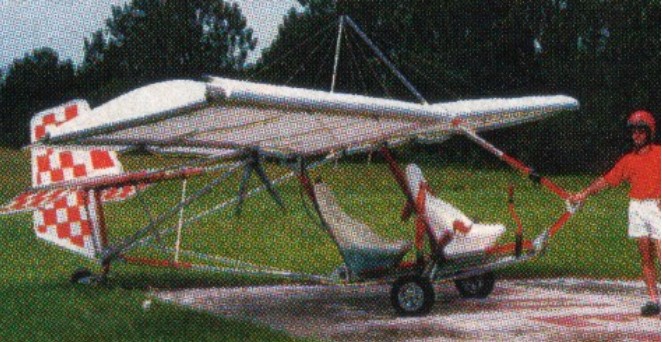
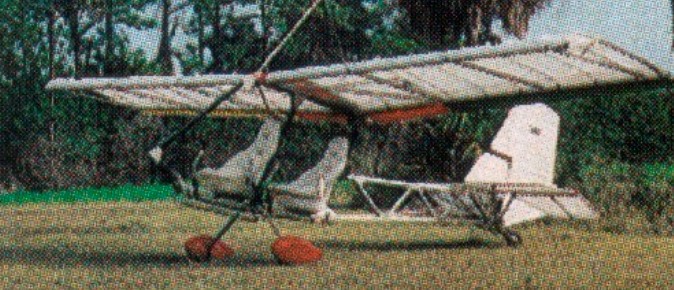
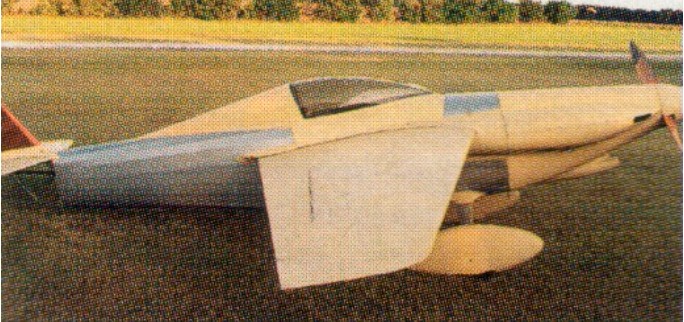
Single seat single engined high wing mono¬plane with two axis control. Wing has swept back leading and trailing edges, and tapering chord; no tail, canard wing. Pitch control by fully flying canard; yaw control by tip rud¬ders; no separate roll control, control inputs through stick for pitch/yaw. Wing braced from above by kingpost and cables, from below by cables; wing profile; double ¬surface. Undercarriage has three wheels in tricycle formation; suspension on nose¬wheel and glass fibre suspension on main wheels. Push right go left nosewheel steering independent from yaw control. Brake on nosewheel. Aluminium tube framework, without pod. Engine mounted below wing driving pusher propeller.
These aircraft are Germa¬nisations of the Fledgling designed by Klaus Hill. The Vulcan uses the Fledge in conjunction with a canard. This company, however, has instead of using a one piece canard, the Traveler uses two mobile surfaces articulated separately from the aircraft’s two main horizontal tubes. Acting as elevators, these two surfaces are operated from the stick via a push rod.
The frame has been completely redesigned by Vulcan. The wings used are Fledge II or Fledge III, but Vulcan modifies them by adding trapezoidal vertical surfaces acting as winglets, to reduce tip vortices. Travelers are available under the name of Traveller II or Traveller III, depending upon the wing used, deli-vered built but without power pack. This is either a Lloyd 22 hp or the Cuyuna 430R 30hp.
Two propellers were on offer, one a fixed pitch two blade and the other a three blade ground adjustable pitch. Only 20 examples had been produced by March 1983 and sold purely in West Germany.
Traveller II
Height overall 6.4ft, 1.95m
Wing span 32.5ft, 9.90m
Chord at root 5.5ft, 1.68m
Chord at tip 4.5ft, 1.37 m
Nose angle 144 deg
Main wing area 163 sq.ft, 15.1 sq.m
Wing aspect ratio 6.5/1
Engine: Lloyd LS400, 22 hp at 5500 rpm
Propeller diameter 36 inch, 0.91 m
Max static thrust 177 lb, 80kg
Power per unit area 0.13hp/sq.ft, 1.45hp/sq.m
Fuel capacity 5.3 US gal, 4.4 Imp gal, 20.0 litre
Empty weight 137 lb, 62 kg
Max take off weight 442 lb, 200 kg
Payload 305 lb, 138 kg
Max wing loading 2.71 lb/sq.ft, 13.2 kg/sq.m
Max power loading 20.1 lb/hp, 9.1kg/hp
Never exceed speed 56mph, 90kph
Max cruising speed 47mph, 75kph
Economic cruising speed 35 mph, 56 kph
Stalling speed 22 mph, 35 kph
Max climb rate at sea level 680 ft/min, 3.5 m/s
Best glide ratio with power off 9/1
Take off distance 100ft, 30 m
Landing dis¬tance 65 ft, 20 m
Range at average cruising speed 124 mile, 200 km
Traveller III
Height overall 6.4ft, 1.95m
Wing span 32.5ft, 9.90m
Nose angle 144 deg
Main wing area 157 sq.ft, 14.6 sq.m
Wing aspect ratio 6.7/1
Engine: Lloyd LS400, 22 hp at 5500 rpm
Propeller diameter 36 inch, 0.91 m
Max static thrust 177 lb, 80kg
Power per unit area 0.14hp/sq.ft, 1.50hp/sq.m
Fuel capacity 5.3 US gal, 4.4 Imp gal, 20.0 litre
Empty weight 143 lb, 65 kg
Max take off weight 468 lb, 220 kg
Payload 342 lb, 155 kg
Max wing loading 3.10 lb/sq.ft, 15.1 kg/sq.m
Max power loading 22.1 lb/hp, 10.0kg/hp
Never exceed speed 56mph, 90kph
Max cruising speed 44mph, 70kph
Economic cruising speed 32 mph, 52 kph
Stalling speed 19 mph, 30 kph
Max climb rate at sea level 790 ft/min, 4.0 m/s
Best glide ratio with power off 10/1
Take off distance 100ft, 30 m
Landing dis¬tance 65 ft, 20 m
Range at average cruising speed 124 mile, 200 km
 All Aero