Wichita
Kansas
USA
Built replica Cadet STF
Wichita
Kansas
USA
Built replica Cadet STF
Founder: Joe Laven
1980: LACO, Banning Municipal Airport, PO Box 415, Desert Hot Springs, CA 92240, USA.
Airplane builder
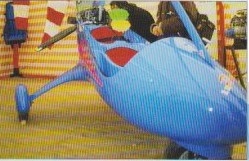
Totally faired in but tubular under the skin. The TL 22 is made in the Czech Republic and equipped with a Rotax 582, though it can be orderd with other power units.
Empty weight: 170 kg
Wing span: 10.38 m
Wing area: 10 sq.m
Fuel capacity: 30 lt
Engine: Rotax 582, 65 hp
MAUW: 400 kg
Seats: 2
Max speed: 120 kph
Cruise speed: 110 kph
Minimum speed: 55 kph
Climb rate: 7 m/s
Fuel consumption: 13 lt/hr
Price (1998): 28 000 000 L
1998:
Via Stortoletta
I-35020 Tribano (PD)
Italy
Trike builder
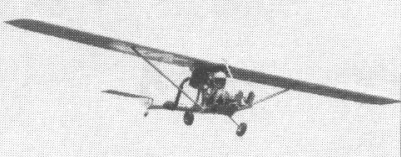
The Hitchiker is the third ultralight design from Robert Labahn and it is designed for cross-country and short field operations. With a rigid wooden wing sporting full span flaperons having both positive and negative selling, the light weight Hitchiker easily fits the bill. The pilot’s seating is reclining, glider like, to present the smallest possible frontal area. A streamlined pod will be fitted in the colder months for pilot protection.
Engine: Rotax 277 geared drive.
Prop: 127 cm x 96cm pitch.
Wing span: 8.05 m.
Weight: 100 kgs.
Fuel capacity: 27 ltr.
Econ cruise speed: 43 kts.
Stall: 23 kts.
Construction time: Ready to fly.
1985: Robert Labahn, 6 Victoria St, Seville, Vic 3139. Australia.
UL builder
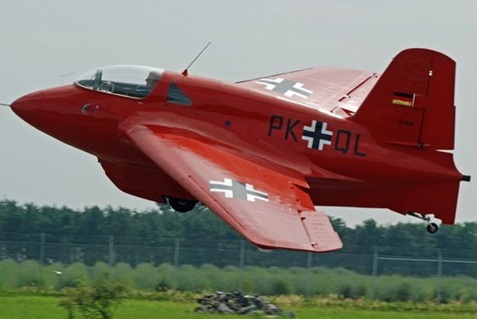
A flying replica Me 163B was constructed between 1994 and 1996 by Joseph Kurtz, a former Luftwaffe pilot who trained to fly Me 163s, but who never flew in combat. In 1944-1945 Josef Kurz was in training for Me 163B service, but the end of the war prevented him from flying the real thing.
Construction was started in 1994 in Germany. The replica is an unpowered glider whose shape matches that of an Me 163, although its construction completely differs – the glider is built of wood with an empty weight of 285 kilograms (628 lb), a fraction of the weight of a wartime aircraft. Maximum weight is around 400 kg.
Kurz used a microfilm set of 2500 drawings, which he printed on A3 size. From this set of drawings Kurz developped his own drawings. These are not really suitable for other builders, since they lacked many notes and details. Especially the fuselage was constructed completely different than the original (wood replaced metal). The external shape is similar however. One example were the fuselage frames. The real one has circular frames, covered with skins, to which fairings are added on the top and bottom and sides (wing root fairings). Kurz built frames incorporating these fairings. The new structure was designed and stressed by people of the Oskar Ursinus group. The wing section was Göttingen 765, just like the original. The trouble-prone skid was replaced by a single wheel, with a white skid painted on. The tail wheel is completely faired in, which is different from the original. The rear-view windows are omitted. The flight control system is an exact copy.
Kurz painted his replica Komet in the markings of the most famous Me 163- the Me 163B flown by Erprobungskommando 16 (EK16- an operational test unit) commander Wolfgang Späte on the Komet’s first operational combat mission in 1944. His crew chief had painted the aircraft red in honor of the Baron von Richtofen (the Red Baron). The paint added 40 pounds to the aircraft weight. Späte did not share his crew’s confidence in the aircraft’s performance and ordered it repainted in standard camouflage. No known photos exist of the red Me-163 but was described in detail in Späte’s memoirs. Kurz used the descriptions to replicate the paint job and markings.
Kurz first flew his Komet replica on 18 June 1996 from the airfield at Ziegenhain with the registration D-ESJK. Designating his glider the Me 163BS, Kurz made numerous short test flights before unveiling it at a vintage aircraft fly-in in September 1997. Its last flight in Kurz’s hands was at the Berlin ILA 2000 air show.
Kurz reported that the flying characteristics are excellent. This was also confirmed by another pilot present who had recently flown the aircraft. Stall is extremely gentle, without any rolling. Controls are very well harmonised. Kurz guessed the L/D was around 25 (compared to 17 of the original). Flaps are not installed.
With only five flight hours logged, Kurz sold the replica to EADS (European Aeronautic Defence and Space Company, which then had just been formed as the parent to Airbus Industrie and Eurocopter) in 2000 in a non-airworthy condition for display in the Flugmuseum Messerschmitt at Manching, Bavaria. The aircraft was registered as D-1634 instead of D-ESJK previously. The Komet replica is located at the EADS museum hangar at Ingolstadt-Manching in South Germany.
The Kurz Komet was exhibited at the Musée de l’air et de l’espace at Paris-Le Bourget in 2001. The museum’s agenda, which reports that the exposition opened on 26 October 2001, and is called ‘Exposition Willy Messerschmitt, Ingénieur et pionnier 1898-1977’. The agenda reports that the Museum organises the display with support of EADS. The display consists of two aircraft “that particularly illustrate the carreer of this great engineer, namely a Me 109G and a Me 163”.
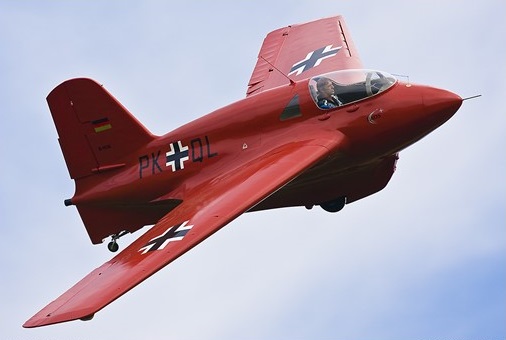
From the flight manual, the performance is not really exciting, and this is more or less confirmed by EADS. There were ideas to strenghten the structure, and re-certify it for at least basic aerobatics. A budget was not yet found at that point. EADS took steps to add the Me-163 to the museum’s heritage flight. Additional modifications were made to strengthen the internal structure. The landing skid was modified to allow for better ground handling. The original paint scheme was restored minus the Nazi Swastika that is banned from display in Germany. The aircraft was re-registered as a one-off glider with the civilian registration of D-1636. EADS performed an extensive overhaul and a lot of modifications from 2004 to 2006. The aircraft became quite a different one. Two visible differences are that the triangular rear view windows and Morane antenna have been added.
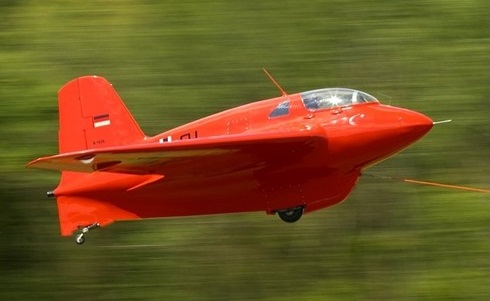
It made its second maiden flight on 20 June 2006 after which it joined the EADS Heritage Flight fleet at the Flugmuseum Messerschmitt. It appears the permit was obtained as at the 8 July 2006 EADS family day at Ingolstadt-Manching, it was towed into the air by a Do 27 and then made a free flight. Pilot was reported to be Captain Philipp. It was painted as PK+QL with D-1634 is small lettering on the vertical tail and in large lettering under the wing.
By the end of 2010 the replica Komet had flown forty hours. Two pilots with the EADS Heritage Flight were rated in the glider, using a Dornier Do 27 tow plane to get to altitude. Taking 10 minutes to reach 4,000 feet, the Komet is said to be most demanding on the tow line and is much easier to handle in free flight. As the aircraft was optimized for high speed flight, its gliding performance wasn’t on par of purpose-built sport gliders but has nonetheless been a hit at air shows in Europe.
As of 2011, it was still flying with the civil registration D-1636.
Josef Kurz was selected for the Me 163 Komet, did glider training on the Kranich and Habicht, up to the 6 meter Stummelhabicht, but then the war was over. The Stummelhabicht was very special, because the only thing to do after being released from the towplane was to get it down on the runway. Usually you were on the ground before the tow plane.
Josef Kurz doesn’t speak English, but French and Latin are the other options.
Mr Kurz (Josef, or ‘Sepp’) built 14 aircraft since 1982, including the following: Udet Flamingo, Habicht, Klemm 25, Reihe, Siebel 202 Hummel, Riesele (3) and SG 38. He built the Komet basically himself.
The Strekoza (Three axis) was a single seat single engined high wing mono¬plane with three axis control circa 1983. Constant chord wing; conventional tail. Pitch control by elevator on tail; yaw control by fin mounted rudder; roll control by full span ailerons. Engine mounted at wing height driving tractor propeller.
The Strekoza is a com¬pletely original design from the students at the polytechnic of Kuibychev and in concept of a mini aeroplane. Using a conventional tail supported by a metal framework, the Strekoza carries slotted ailerons along the entire trailing edge of its constant chord high wing. The engine, an air cooled Wichr 25 developing 25 hp, is placed in a nacelle on the leading edge of the wing, connected to a two blade 43 inch (1.10 m) propeller.
Length overall 19.9 ft, 6.07 m.
Wing span 23.6 ft, 7.20 m.
Constant chord 3.6 ft, 1.10 m.
Total wing area 105 sq.ft, 9.80 sq.m.
Engine: Wichr 25, 25 hp.
Propeller diameter: 43 in, 1.10m.
Power per unit area 0.24hp/ sq.ft, 2.6hp/sq.m
Empty weight 331 lb, 150 kg.
Max take off weight 507 lb, 230kg.
Payload 176 lb, 804.
Max wing loading 4.831b/sq.ft, 23.5kg/sq.m
Max power loading: 20.31b/hp, 9.2kg/hp.
Max level speed: 62mph, 100kph.
Landing speed 28mph, 45 kph.
Stalling speed 31 mph, 50 kph.
Take¬off distance 660 ft, 200 m.
Landing distance 590 ft, 180 m.
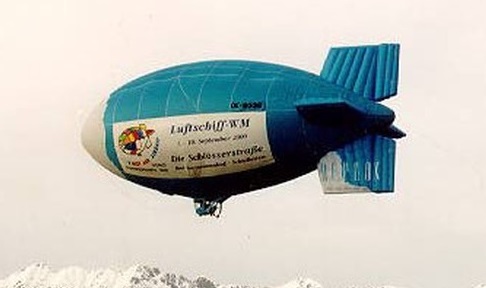
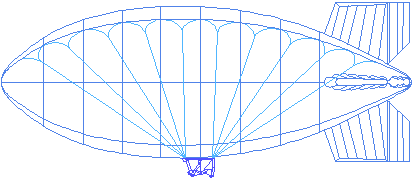
The Kubicek AV2 first flew on 26 May 1999 and attended the Kosice Balloon Meet the following month. It carried artwork for a Slovakian company, Reprox Kosice, which produces heat insulating materials.
Volume: 3,500 m3
Length: 38 m
Diameter: 14.2 m
Empty weight (envelope, gondola): 440 kg
MTOW: 870 kg
Weight of fuel cylinders: 190 kg
Number of cylinders: 3
Max weight of crew and load: 240 kg
Fuel tank: 30 lt
Max forward speed: 20 kph
Endurance: 60 – 120 min
Max envelope temperature: 120°C
Max envelope pressure: 150 Pa
Max wind speed: 3 m/s
Gondola length: 3 m
Gondola width: 1.7 m
Gondola height: 1.85 m