Lindstrand Balloons

Lindstrand Balloons is a manufacturer of hot air balloons and other aerostats. The company was started by Swedish-born pilot and aeronautical designer Per Lindstrand in Oswestry, England, after he left Thunder & Colt in 1978. Lindstrand Balloons is known for its leading-edge engineering, which includes sophisticated testing and production facilities.

Of note, Lindstrand Balloons designed and built all of the hot air balloons flown by Per Lindstrand and Richard Branson on their record breaking flights first across the Atlantic Ocean in 1987 and then the Pacific Ocean in 1990. Lindstrand’s then designed and built three Rozière balloons that Per Lindstrand and Branson (and others, including aeronautical engineer Alex Ritchie, and adventurer, Steve Fossett) used in their unsuccessful attempts to circumnavigate the Earth by balloon. Per Lindstrand played an instrumental role in making these flights possible, and was pilot for all of them.

In the late-1990s, Cameron Balloons and its owner Don Cameron acquired two-thirds ownership of Lindstrand Balloons. Cameron bought the majority stake in Lindstrand Balloons from Rory McCarthy, a British industrialist associated with Richard Branson, who had invested in Lindstrand to support Branson’s series of record-setting balloon flights. The remaining third of the company is owned by its founder Per Lindstrand.

Despite Cameron’s ownership, Lindstrand Balloons continues to operate as an independent company with separate management and its own distinct designs and products. Per Lindstrand also independently operates a separate company, Lindstrand Technologies, which designs and builds gas balloons, innovative buildings, specialized aerospace equipment (including an advanced parachute for the Beagle 2 Mars-lander) and inflatable structures including aircraft hangars, plugs for fire-containment for road tunnels and flood prevention systems.

In 2011 Lindstrand Hot Air Balloons Ltd, based in Oswestry, Shropshire in the UK, had been building lighter-than-air craft on the same site for over 25 years and had its designs certified in 48 countries.

Lindstrand Balloons design special shaped envelopes. Once approved, computer aided technology turns the visual into a full working drawing which manufacture uses. All these envelopes are fully EASA approved.
Limbach L-2400

Four cylinder, single & double ignition, four stroke engines for light & ultralight aircraft & motorgliders.

L-2400 DA3BX
Four cylinder, four stroke engines for light & experimental aircraft with double magneto ignition, with 92hp; produce 2400 EFI engine with liquid cooled cylinder heads, dual electronic ignition, 100hp take off power at 2900rpm; type certification per JAR-22 sub-part H; dev. turbocharged version of C-2400 EFI

L-2400 DE3 X
Cycle: 4 stroke
No cylinders: 4
Bore: 97 mm
Stroke: 82 mm
Compression: 8.5
Displacement: 2424 cc
Cooling: air/liquid
Ignition: Double magneto
Weight: 87.5 kg
Max pwr: 90 hp at 3200 rpm
Price 1998: 20 700 DM

Limbach L2000

The Limbach L2000 is a series of German piston aero-engines designed and built by Limbach Flugmotoren. First run circa 1980, they are four-cylinder, four-stroke, air-cooled horizontally opposed, piston engines with a power output of 75 to 80 hp (56 to 60 kW).

Variants:

L2000 DA
Certified in 1989 as a double-ignition tractor engine with carburettor in the back, top location, alternator in the front, starter in the front. 75 hp (56 kW)

L2000 E0
Certified in 1980 as a single-ignition tractor engine with carburettor in the back, bottom location, alternator in the back, starter in the back. 80 hp (60 kW)

L2000 EA
Certified in 1980 as a single-ignition tractor engine with carburettor in the back, top location, alternator in the front, starter in the front. 80 hp (60 kW)

L2000 EB
Certified in 1980 as a single-ignition tractor engine with two carburettors in the back, bottom location, alternator in the back, starter in the back. 80 hp (60 kW)

L2000 EC
Certified in 1980 as a single-ignition pusher engine with carburettor in the back, bottom location, alternator in the back, starter in the back. 80 hp (60 kW)

Applications:
Aeromot AMT-100 Ximango
AV Leichtflugzeuge Vagabund
Grob G 109
Hoffmann HK 36 Super Dimona
ICA IS-28
JPM 01 Médoc
Lucas L-6A
Scheibe SF 36A (EA)
Valentin Taifun
Weller UW-9 Sprint
Whisper Aircraft Whisper

Specifications:

L200 E0
Type: Four-cylinder, four-stroke air-cooled flat piston engine
Bore: 90 mm
Stroke: 78.4 mm
Displacement: 1.994 cc
Length: 627 mm
Width: 775 mm
Height: 415 mm
Dry weight: 70 kg
Fuel type: Mogas and 100LL Octane petrol
Cooling system: Air-cooled
Power output: 51 kW at 3,000 rpm (max continuous)
Compression ratio: 8:5 – 8:9:1

L-200 EA
Cycle: 4 stroke
No cylinders: 4
Bore: 90 mm
Stroke: 78.4 mm
Compression: 8.6
Displacement: 1994 cc
Cooling: air
Ignition: magneto
Weight: 69 kg
Max pwr: 80 hp at 3400 rpm
Price 1998: 16 400 DM

Limbach Flugmotoren

Limbach Flugmotoren (Limbach Flightmotors) is a German company that produces aircraft engines. The company is named after Peter Limbach who expanded his father’s engine repair business in the 1970s in Königswinter.

1998

By May 2006, Limbach had produced more than 6000 engines for light aircraft, ultralight aircraft and airships. Many Limbach engines are based on the Volkswagen flat-4 boxer unit with displacement of up to 2.4 litres, and up to 160 BHP in the turbocharged model.

In a letter dated 25th August 2011, the company announced that it would be closing by late 2011, saying “Years of ever increasing regulations and requirements have been choking us. Our efforts to operate in that environment were not successful because we cannot provide the necessary resources. Additionally there are government activities that hinder our current business and we cannot make plans for the future.”

In late 2012 it was announced that the Limbach assets had been sold to Mr. Chen Shuide.

1998-2012: Kotthausener Str. 5, Konigswinter, Germany, D-53639

Limbach produce 2-stroke and 4-stroke engines from 15 to 125 kW for paragliders to cruising aircraft.

The engines have electronic engine management with electronic fuel injection, no mixture control, no choke, and no carburettor preheating. With an electrically adjustable propeller, you only need to preselect the speed and accelerate.

Lightwing Rooster II

The Rooster2 is John Lee’s two seater and, although it looks totally different from the Rooster 1, it uses similar constructional techniques and materials, and its steering arrangements are also similar; braking, however, comes not from a nose skid but relies solely on the air resistance of the thick section wing. Along with its ‘boxy’ fuselage, the thick wing section (entirely a John Lee creation), the aircraft is fitted with a Robin EC44 engine which, because of the engine’s position, is mated to a smaller than ¬ideal prop. Conceived largely as a trainer, the Rooster 2 has a certain degree of flexibility built into its construction, to enable it to cope with bad landings by inexperienced pilots. The thick cantilever wing was chosen largely to simplify construction it eliminates the need for rigging wires. While the aircraft can be re rigged for trailer transport, portability is not a high priority. This aircraft does not in anyway pretend to be car toppable.
Tandem two seat single engined low wing with conventional three axis control. Wing has unswept leading edge, swept forward trailing edge and tapering chord; conventional tail. Pitch control by fully flying tail; yaw control by fully flying rudder; rod control by fully flying rudder; roll control by 40% span ailerons; control inputs through stick for pitch/roll and pedals for yaw. Cantilever wing; wing profile; 100% double surface. Undercarriage has two wheels with tailskid and nose-skid; no suspension on either wheel. No ground steering. No brakes. Wood fusel¬age, partially enclosed. Engine mounted above wing driving pusher propeller.

Engine: Robin EC44, 50hp at 6500rpm.
Propeller diameter 48 inch, 1.22 m.
Toothed belt reduction, ratio 2.0/1.
Max static thrust 180 lb, 82 kg.
Power per unit area 0.28hp/sq.ft, 3.0hp/sq.m.
Fuel capacity 13.2 US gal, 11.0 Imp gal, 50.0 litre.
Length overall 23.0 ft, 7.00 m.
Height overall 5.7ft, 1.75m.
Wing span 36.7ft, 11.20m.
Chord at root 6.0ft, 1.82 m.
Chord at tip 3.2ft, 0.97m.
Dihedral 2 deg.
Sweepback 0 deg.
Tailplane span 10.2 ft, 3.12 m.
Rudder height 5.1ft, 1.54m.
Total wing area 18. 1 sq.ft, 16.8 sq.m.
Total aileron area 12.9 sq.ft, 1.2 sq.m.
Rudder area 11.5 sq.ft, 1.07 sq.m.
Total elevator area 21.9 sq.ft 2.03 sq.m.
Wing aspect ratio 7.5/1.
Wheel track 6.6ft, 2.00m.
Main wheels diameter overall 11 inch, 28 cm.
Empty weight 3231b, 147kg.
Max take off weight 773 lb, 351 kg.
Payload 450 lb, 204 kg.
Max wing loading 4.27 lb/sq.ft, 20.9 kg/sq.m.
Max power loading 15.5 lb/hp, 7.0kg/hp.
Load factors +4.0, 2.0 design.
Max level speed 50 mph, 80 kph.
Never exceed speed 60 mph, 97kph.
Max cruising speed 50mph, 80kph.
Economic cruising speed 40 mph, 64 kph.
Stalling speed 25 mph, 40 kph.
Best glide ratio with power off 10/1 at 35 mph, 56 kph.
Take off distance 110ft, 35 m.
Landing dis¬tance 110 ft, 35 m.
Range at average cruising speed 100 mile, 161 km.

Lightwing Rooster I

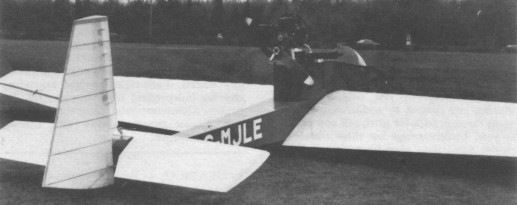
Rooster I sailplane

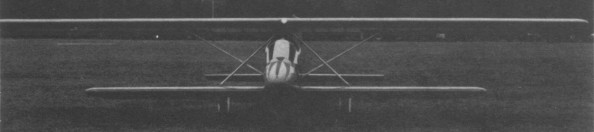
Single seat single engined biplane with con¬ventional three axis control. Wings have un¬swept leading and trailing edges, and constant chord; conventional tail. Pitch control by fully flying tail; yaw control by fin mounted rud¬der; roll control by two thirds span ailerons; control inputs through stick for pitch/roll and pedals for yaw. Wings braced by transverse struts; wing profile 100 % double surface. Undercarriage has two wheels with tailskid and nose-skid; no suspension on either wheel. No ground steering. No brakes. Wood/glass¬fibre fuselage, totally enclosed. Engine mounted between wings driving pusher prop¬eller.
Instead of alumi¬nium tube, Dacron and lots of rigging wires, he prefers simple traditional wooden construction, though as a concession to moderni¬ty the Rooster 1 does have a glass fibre nose.
The Rooster 1 was conceived in 1977 as a sailplane. As a sailplane it thermalled at 600 ft (185 m), was aero towed three times and made some 300 circuits. It also proved stronger than expected, landing without dam¬age across the furrows of a ploughed field.
Right from the start, however, John in¬tended to power the machine, simply because he wanted to go soaring without hordes of assistants. So once he was satisfied with the aircraft’s dynamic qualities, he fitted a Chrys¬ler engine. In 1982 he was replacing this with a Valmet unit. The undercarriage design uses only two wheels but has a skid at either end. The wheel track is large enough that the aircraft does not tip up when the pilot enters, yet narrow enough to permit ground man¬oeuvring using only the rudder. There are no wheel brakes; instead the pilot simply pushes forward the stick and lets the friction gener¬ated by the nose skid slow the aircraft.
There are no plans for manufacture, but depending on demand, John may produce plans for the aircraft.

Engine: Valmet, 10 hp at 6000 rpm.
Propeller diameter and pitch 52x27inch, 1.32×0.69m.
V belt reduction, ratio 4.0/1.
Power per unit area 0.07hp/sq.ft, 0.8 hp/sq.m.
Fuel capacity 6.6 US gal, 5.5 Imp gal, 25.0 litre.
Empty weight 320 lb, 145kg.
Max take off weight 570 lb, 259kg.
Payload 250 lb, 113kg.
Max wing loading: 3.99 lb/sq.ft, 19.5 kg/sq.m.
Max power loading 57.0 lb/hp, 25.9kg/hp.
Load factors +6.0, 4.0 design.
Length overall 17.9 ft, 5.45 m.
Height overall 4.9ft, 1.50m.
Wing span 30.2ft, 9.20m.
Constant chord 3.0ft, 0.91m (top wing).
Dihedral 0 deg
Sweepback 0 deg
Tailplane span 10.5 ft, 3.20 m.
Fin height 5.2 ft, 1.58 m.
Total wing area 143 sq.ft, 13.3 sq.m.
Total aileron area 13.2 sq.ft, 1.23 sq.m.
Fin area 4.6 sq.ft, 0.43 sq.m.
Rudder area 6.2 sq.ft, 0.58 sq.m.
Total elevator area 16.8 sq.ft, 1.56 sq.m.
Wing aspect ratio 10/1 (top wing).
Wheel track 6.2 ft, 1.88 m.
Main wheels diameter overall 11 inch, 28 cm.
Max level speed 65 mph, 105 kph.
Never exceed speed 75 mph, 121 kph.
Max cruising speed 60 mph, 97 kph.
Economic cruising speed 40 mph, 64 kph.
Stalling speed 30 mph, 48 kph.
Best glide ratio with power off 14/1 at 33 mph, 53 kph.
Range at average cruising speed 300 mile, 483 km.

Lightwing

1983: John Lee, Littleton Park Nursery, Laleham Road, Shepperton, Middlesex, Great Britain.
John Lee is one of Britain’s most prolific and individualistic homebuilders and since 1970 has built five aircraft, of which the two most recent (circa 1983), the Rooster 1 and Rooster 2 can be classified as microlights.

Lightning Bug Aircraft Lightning Bug / Reflex Fibreglass Works / RFW Lightning Bug / MaD Aviation Lightning Bug

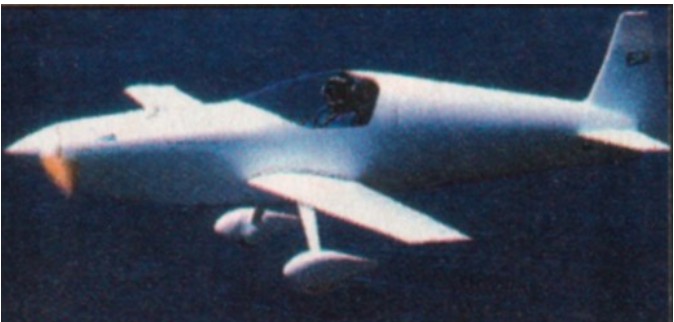
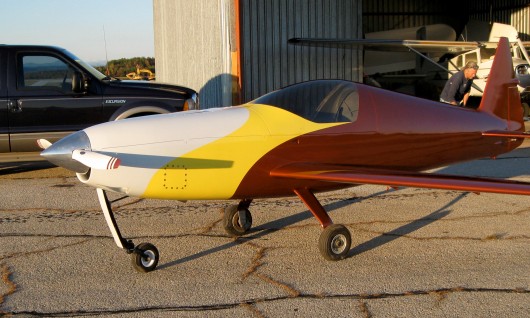
Designed by Howell C. “Nick” Jones Jr, single place composite. Aerobatics capable. The original production engine was the AMW808FIG.

In 2011, all rights, molds, tooling and spare parts inventory for the Lightning Bug was purchased by MaD Aviation LLC. An original Lightning Bug, N44XM is being re-engined with a 100hp Rotax 912ULS to test this engine/airframe combination with a view to making a new Lightning Bug kit available, using this reliable four stroke engine.

Engine: AMW808FIG, 100 hp.
Speed max: 250 mph.
Cruise: 225 mph.
Range: 800 sm.
Stall: 62 mph.
ROC: 1200 fpm.
Take-off dist: 800 ft.
Landing dist: 1000 ft.
Service ceiling: 20,000 ft.
Fuel cap: 23 USG.
Weight empty: 375 lbs.
Gross: 800 lbs.
Height: 5.08 ft.
Length: 17.46 ft.
Wing span: 17.83 ft.
Wing area: 40 sq.ft.
Seats: 1.
Landing gear: tail or nose, retractable wheel.