UK
David Lockspeiser attempted to develop LDA (land development aircraft) general utility aircraft over two decades up to mid-1980s, with rear-mounted main wings and large canards, and rear-mounted engine with pusher propeller. A 70 percent-scale prototype flew 1971 as LDA-01, and intended full-size LDA-500 Boxer and larger LDA-1000 Boxer were designed.
1980->
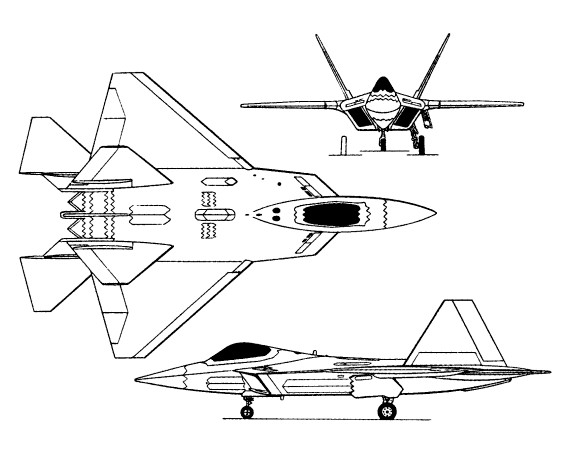
Lockheed Martin F-22 Raptor
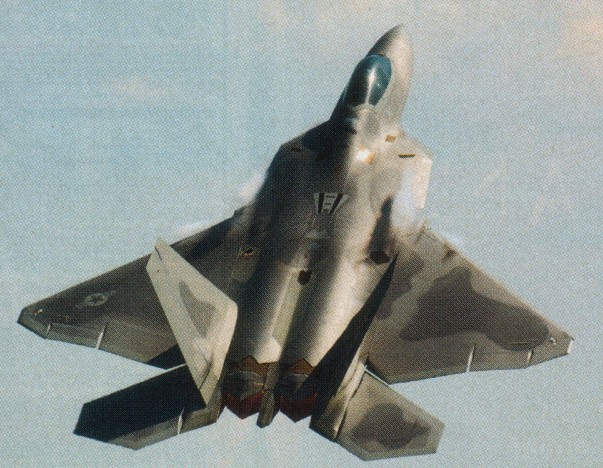
In the late 1970s, the US Air Force identified a requirement for 750 examples of an Advanced Tactical Fighter (ATF) to replace the F-15 Eagle. Flown by a single pilot, it must be able to survive in an environment filled with people, both in the air and on the ground, whose sole purpose is to destroy it. To test the concepts that would eventually be combined in the ATF, the US AF initiated a series of parallel research programmes. The first was the YF-16 control-configured vehicle (CCV) which flew in 1976-77 and demonstrated the decoupled control of aircraft flight path and attitude; in other words, the machine could skid sideways, turn without banking, climb or descend without changing its attitude, and point its nose left or right, or up or down, without changing its flight path. Other test vehicles involved in the ATF programme included the Grumman X-29, which flew for the first time in December 1984 and which was designed to investigate forward-sweep technology, and an F-111 fitted with a mission adaptive wing (MAW) – in other words, a wing capable of reconfiguring itself automatically to mission requirements.
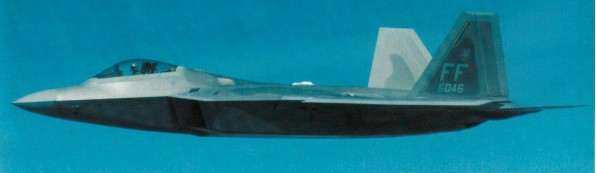
Flight testing of all these experimental aircraft came under the umbrella of the USAF’s Advanced Fighter Technology Integration (AFTI) programme. In September 1983, while the AFTI programme was well under way, the USAF awarded ATF concept definition study contracts to six American aerospace companies and, of these, two – Lockheed and Northrop – were selected to build demonstrator prototypes of their respective proposals. Each company produced two prototypes, the Lockheed YF-22 and the Northrop YF-23, and all four aircraft flew in 1990. Two different powerplants, the Pratt & Whitney YF119 and the General Electric YF120, were evaluated, and in April 1991 it was announced that the F-22 and F119 were the winning combination. The F119 advanced technology engine, two of which power the F-22, develops 155kN and is fitted with two-dimensional convergent/ divergent exhaust nozzles with thrust vectoring for enhanced performance and manoeuvrability.
Lockheed Martin F-22 Raptor Article
The Raptor is designed and built by Boeing, Lockheed Martin and Pratt & Whitney. Boeing supplies the F-22s 2,000-lb titanium and composite wings and aft fuselage, integrates and tests the advanced avionics and is responsible for the training and life-support systems.
Previously the designation for the Raptor was changed to F/A-22 to indicate the possible air-to-ground role of the aircraft. JDAM bombs can be carried in the internal weapon bay, while the optional external pylons offer a more flexible station for air-to-ground armament. However the U.S. Air Force changed the designation back to F-22 in December 2005, although it will still posses the secondary air-to-ground role.
The F-22 combines many stealth features. Its air-to-air weapons, for example, are stored internally; three internal bays house advanced short-range, medium-range and beyond-visual-range air-to-air missiles. Following an assessment of the aircraft’s combat role in 1993, it was decided to add a ground-attack capability, and the internal weapons bay is also capable of accommodating 454kg GBU-32 precision-guided missiles.
The F-22 is the first production aircraft with the ability to super cruise – flying at supersonic speeds without the use of afterburners. The F-22 is designed for a high sortie rate, with a turnaround time of less than 20 minutes, and its avionics are highly integrated to provide rapid reaction in air combat, much of its survivability depending on the pilot’s ability to locate a target very early and take it out with a first shot. The F-22 was designed to meet a specific threat, which at that time was presented by large numbers of highly agile Soviet combat aircraft, its task being to engage them in their own airspace with beyond-visual-range weaponry. It will be a key component in the Global Strike Task Force, formed in 2001 to counter any threat worldwide. The USAF requirement is for 438 aircraft.
The first definitive F-22 prototype was rolled out at the Lockheed Martin plant at Marietta, Georgia, on 9 April 1997.
The planned first flight of the F-22A, scheduled for 29 May 1997, was delayed by a small fuel leak in the F-1A tank just aft of the cockpit, together with an oil problem in the APU/auxiliary generator system area and software troubles.
The first flight was delayed to 7 September 1997. The second prototype first flew on 29 June 1998. The first two Raptor fighters, Nos. 4001 and 4002, have only 80% of the required strength, partly the result of an aggressive weight-cutting program, and the No. 4003 airframe has been strengthened to make it 100% capable. The third F-22 was delivered to Edwards AFB in March 2000. The aircraft was about eight months behind schedule. The empty weight is still low enough to beat the operational requirements.
Raptor 4001 has been doing high speed tests such as loads and flutter but could not fully clear the envelope because of the lower strength, although it and ship No. 4002 have both exceeded 7g loads. The Air Force will only say that the required F-22 limit exceeds 7g. Raptor 4003 will provide full high speed clearance for subsequent aircraft, but will first spend several months on the ground at Edwards AFB because the reworked structure requires new ground vibration tests and other evaluations.
The nonstop delivery from Marietta, Ga., was the fourth flight of 4003 and lasted 4 hr. 50 min., including four aerial refuelings. By late 2001, there were eight F-22s flying.
A YF-22 being tested at Edwards reacted unexpectedly when a go round initiated a changed in its fly-by-wire control laws. After a few cycles of PIO, the aircraft belly-flopped onto the runway.
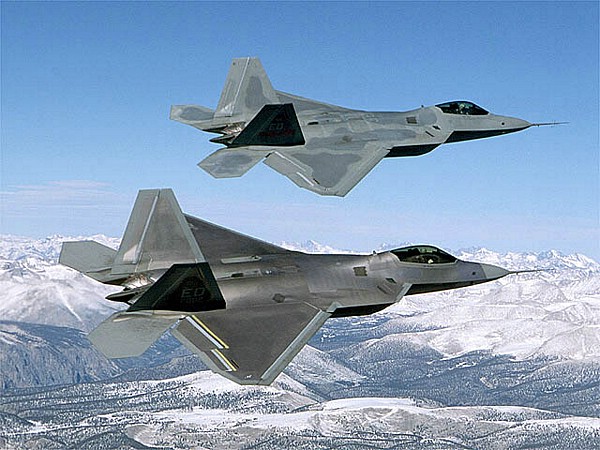
In January 2003, the Air Warfare Center at Nellis Air Force Base near Las Vegas, Nevada, received its first Raptor. It was the twelfth F-22 produced. The 422nd Test & Evaluation Squadron took on seven more F-22s for testing and training of the initial cadre of instructor pilots.
The 43rd Fighter Squadron became the first F-22 squadron when it received its first F-22 (then designated F/A-22) in the end of September in 2003. The unit of the 325th Fighter Wing carries out the training at Tyndall Air Force Base, Florida. In January 2004, the first pilot qualified at Tyndall AFB.
The 27th Fighter Squadron of the 1st Fighter Wing at Langley AFB became the first operational F-22 squadron when it received its first Raptor in January 2005. The squadron was declared operational (initial operational capability) in December 2005 with 12 F-22A Raptors. Also based at Langley AFB, the 94th Fighter Squadron received its first two Raptors in March 2006. On January 19, 2007, the last of 40 F-22A Raptor for the 1st Fighter Wing was delivered to the 94th FS, equipping both fighter squadrons with 20 Raptors each.
First prototype:
N22YF (GE YF120 engines) rolled out at Palmdale 29 August 1990; first flight/ferry to Edwards AFB 29 September 1990; first air refuelling (11th sortie) 26 October 1990; Mach 1.58 supercruise’ (later exceeded) on 3 November 1990; first thrust-vectoring 15 November 1990; anti-spin parachute fitted for high AoA tests with thrust-vectoring; last flight 28 December 1990 — total 43 sorties/52.8hr.
Second prototype: N22YX (P&W F119 engine) first flight Palmdale-Edwards 30 October 1990; launched first AIM-9M Sidewinder on 28 November 1990 and AIM-120 AMRAAM on 20 December 1990; achieved Mach 1.8 26 December 1990; last flight 28 December 1990 — total 31 sorties/38.8 hrs.
Summary demonstrated thrust vectoring, including 100deg/sec roll rate at 120kt (222km/h; 138mph); Mach 2 speed with afterburning. Aircraft in storage at Edwards AFB from January 1991.
Despite its $150 million unit cost and production run of only 195 aircraft, terminated early due to post-Cold
Its capabilities were partially demonstrated during deployments to Syria, where Raptors operated with impunity even in airspace covered by advanced Russian air defence systems.
The F-22’s main limitation is its age—designed before modern networked warfare concepts were fully developed, it lacks some of the connectivity features of newer aircraft.
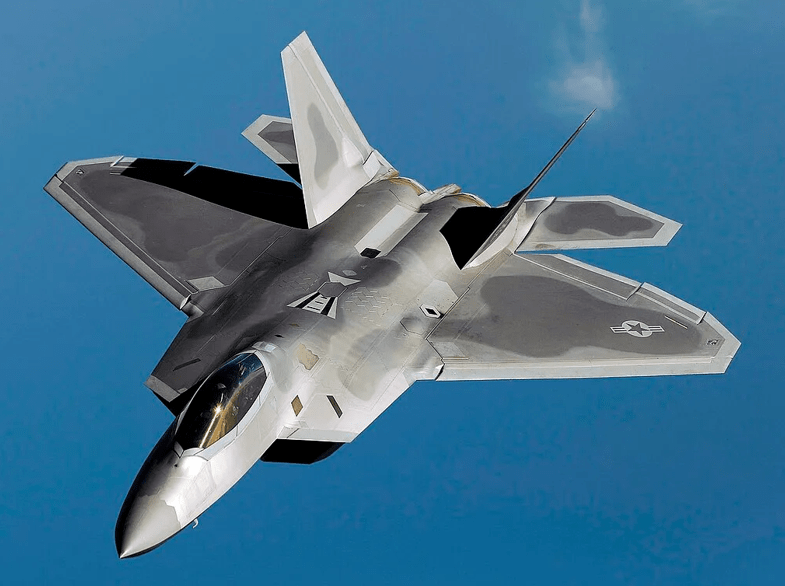
However, ongoing modernisation programs including upgraded processors, new datalinks, and integration with the latest AIM-260 long-range missiles will keep the Raptor at the forefront of air combat capability until its planned replacement by the sixth-generation NGAD (Next Generation Air Dominance) fighter.
YF-22
Wing span 43ft 0in (13.11m)
Length overall 64ft 2in (19.56m)
Height overall 17ft 8.875in (5.41m)
F-22A
Engines: two Pratt & Whitney F119-P-100 turbofan, 155.69 kN (35,000 lb st) with afterburning
Length 18.92m (62 ft 1 in)
Height 5.00m (16 ft 5 in)
Wing span 13.56m (44ft 6 in)
Empty weight: 13.608+ kg (30,000+ lb)
Max Take-Off Weight: 26.308 kg (58,000 lb)
Max level speed at optimum altitude: Mach 1.58 in supercruise
Max level speed at 30,000 ft (9145m) Mach 1.7 in afterburning mode
Service ceiling: 15,240+m (50,000+ ft)
G limit: +7.9
Armament: one 20mm M61A2 Vulcan six-barrel gun with 480 rounds; 2 AIM-9X Sidewinder IR-guided missiles in internal side bays. Up to 6 AIM-120C or 4 AIM-120A AMRAAM missiles in internal fuselage weapon bays or 2 AIM-120C AMRAAMs and 2 GBU-32 JDAM bombs or 2 GBU-30 JDAM bombs. Up to four fuel tanks and up to 8 missiles on optional external hardpoints.
Lockheed F-117 Nighthawk

Lockheed’s Advanced Development Projects organisation at Burbank (ADP), more commonly known as ‘The Skunk Works’, had stealth projects accelerated in 1977, and the Lockheed design was airborne from Groom Lake airfield, on the Nevada test range, by early 1978, flown by ADP chief test pilot Bill Park. Although only half the size of the F-117A, this aircraft’s configuration was broadly similar, and by the end of 1978, Lockheed had received a USAF contract to develop a full-scale production version. It contained warranties covering the aircraft’s range, weapons delivery accuracy and radar cross section.
Promising XST test results led to the development of two scaled-up YF-117A-LO prototypes which were followed by 57 production F-117As ordered in batches during the fiscal years 1980 to 1986 plus 1988. The first pre-production aircraft flew for the first time on 18 June 1981, and the first F-117A was handed over to the USAF in August 1982.
The programme was directed from AFSC’s Aeronautical Systems Division (ASD) by General Richard Scofield, who later moved on to become the B-2 programme director. According to Ben Rich, head of Lockheed’s ADP, the F-117A was developed in significantly less time and for less cost than comparable fighter aircraft. Using the streamlined management methods for which the Skunk Works is famous, ADP and ASD personnel “guided the programme through every step in a non-adversarial, problem-solving atmosphere”. At some stage of the process, the codename Senior Trend was adopted.

Although the F-117 is a radical design, every opportunity to minimise risk was taken. A number of components and systems were adopted from existing aircraft rather than designed from scratch, and this inspired programme managers to approve low rate production concurrent to full scale development. Most importantly, the quad-redundant digital fly-by-wire flight control system from the GD F-16 was incorporated. This allowed artificial stability and, therefore, much greater freedom to maximise the aircraft’s shape for stealth. The ejection seat also came from the F-16, while the environmental control system was from Lockheed’s own C-130 Hercules. Brake hydraulics were from the Gulfstream III business jet, while many avionics black boxes were purchased “off the shelf”. Finally, General Electric produced a non-afterburning version of the F404 designated the F1D2. This produces about 12,000 lb st (53,43 kN).
All the F-117s were manufactured at the Skunk Works’ Burbank headquarters before being trucked or flown in sections to Groom Lake for final assembly and test flights. On 15 June 1981, Skunk Works’ test pilot Hal Farley flew the first F-117A. This was a pre-production machine which was to crash a year later (21 June 1982) near Groom Lake while Ken Dyson was at the controls: he survived. The first aircraft destined for the customer was flying in early 1982, and deliveries to Tonopah began later that year. Lockheed received a second contract which increased the number of F-117s on order to 59, and these were completed at a rate of up to eight aircraft per year throughout the ‘eighties. The last aircraft was delivered on 12 July this year, two months ahead of the original schedule. The stealth fighter has been worth $6.265 billion to Lockheed and other contractors, of which $2 billion was spent on development. These are the actual dollar amounts that have been spent over the life of the programme to date, ie, the “then-year” dollar cost. The flyaway cost per aircraft is $42.6m.

The US Air Force formed the 4450th Tactical Group at Nellis AFB in 1980, and began recruiting pilots and groundcrew for the new aircraft. The pilots were nearly all drawn from the tactical fighter community (the 4450th reported direct to Tactical Air Command headquarters at Langley AFB until 1985). A minimum of 1,000 hours of mainly fighter time was required. The unit’s first aircraft were 20 LTV A-7D Corsair II attack aircraft which could be flown during daylight hours, unlike the “Black Jet”. They were to play an important role in maintaining pilot proficiency. In the first few years of operations, F-117 pilots were getting less than 10 hours per month in the aircraft. Despite this, an initial operational capability on the stealth fighter was achieved at Tonopah in October 1983 by the 4450th Test Squadron.
But on the night of 11 July 1986, an aircraft crashed outside the Nevada range, near Bakersfield, California, killing the pilot. In the first case, Major Ross Mulhare flew article number 792 into a hillside. Such was the extent of the security cordon thrown around the wreckage that most observers soon concluded that a stealth aircraft had crashed. Within a month, reports surfaced that about 50 “F-19 Stealth Fighters” were already fully operational at Tonopah. In fact, it was to be another three years before this number of the classified aircraft was to be in service, and the nature of the F-19 – if it exists – remains a mystery. The Pentagon has not explained the out-of sequence F-117 designation, six numerals beyond the last known previous allocation, F-111.
The second fatal crash in October 1987, may have been caused by pilot fatigue. In the second, Major Michael Stewart crashed 815 into gently sloping desert terrain near Tonopah on the night of 14 October 1987. No distress calls were made and accident investigators could find no mechanical cause. Both men were considered excellent fighter pilots. But there was little or no moonlight on either occasion and spatial disorientation may have been another factor. Despite the difficulties, the build-up continued. Tactics were constantly refined, although portions of the flying envelope were still being explored as late as 1989. A second unit, the 4451st Test Squadron, achieved operational status in January 1987, while a third unit, the 4452nd Test Squadron, was devoted to training.
After being operational for nearly six years, the US Air Force lifted, in April 1989, the veil of secrecy over the F-117 programme. The US Air Force had rotated its personnel in and out of the F117 operating unit on three-year tours throughout that time. Based at the remote Tonopah Airfield, at the edge of the Nevada Test Range, the stealth fighter was flown only at night to preserve secrecy. The USAF had spent over $295m developing the run-down Tonopah airstrip into a modern fighter base, complete with 12,000-ft (3 660-m) runway, 54 individual hangars for single aircraft and some of the most sophisticated security systems ever seen outside Fort Knox.
Officially, nothing had been said since the Pentagon’s brief admission, in 1980, that stealth aircraft were being test-flown.

Once the aircraft’s existence had been officially acknowledged – and a single, deliberately misleading photograph released – daytime flights began and new pilots no longer had to face the prospect of soloing on the aircraft at night. There are no two-seat conversion trainers, but a ground simulator has been in use at Tonopah for the last few years, built and operated by CAE Link. Now that daytime flying was possible, the unit was able to dispense with the A-7D Corsairs, trading them for eight Northrop T-38 Talons. These are used by instructor pilots in the training squadron who can now fly ‘chase’ as newcomers make their first flights in the F-117. The T-38s are also used for proficiency flying, but only a quarter of the unit’s pilots are dual qualified on both types. Once posted to one of the two operational squadrons, pilots begin night-flying in earnest. A combat-ready F-117 pilot still flies two-thirds of his sorties at night. He gets from 15 to 20 hours flying per month, with three to four sorties each week.
In October 1989, the F-117A unit received a regular TAC “number plate” when the 4450th Tactical Group was redesignated the 37th Tactical Fighter Wing. The three squadrons became the 415th TFS Nightstalkers (ex-4450th TS); 416th TFS Ghostriders (ex-4451 st TS) and 417th TFTS Bandits. (ex-4452nd TS). Having reported to the Tactical Fighter Weapons Center at Nellis AFB since 1985, the F-117A wing commander now takes his orders from TAC’s 16th Air Force at Bergstrom AFB, Texas. In December 1989, those orders included the wing’s first operational mission – against Panama during Operation Just Cause. Apart from this confirmed excursion, the unit is rumoured to have made training deployments to the UK and elsewhere.
The radar cross section (RCS) of an airframe varies greatly with the angle of observation. The wavelength of the radar is also a significant factor. The RCS of the F-117 when illuminated from certain key frontal and rear aspects may be as little as 0.1 sq ft equivalent to a medium-sized bird. Some of the energy from an air defence radar striking an F-117 is absorbed by its coating or structure, but most is reflected as ‘spikes’ in carefully-controlled directions. Most of these directions lead away from the transmitter/receiver in question, whether it be ground-based (eg, a SAM system) or airborne in a fighter. Those spikes of energy that are returned are very narrow.
The F-117, therefore, owes most of its extraordinary shape to the need to control these spikes. The entire fuselage surface consists of flat planes or ‘facets’ set in a limited number of alignments. These limitations also define the degree of sweep for both wing and V-tail, and the wingtip and trailing edge configuration. The wing and V-tail are also faceted, to a less obvious degree. No detail has been overlooked in the effort to produce an aircraft which is fully faceted. Undercarriage and bomb-bay doors, together with canopy and sensor port surrounds, all have serrated edges conforming to the required alignments. The faceting even extends to the edges where control surfaces meet the main structure. There are six control surfaces. The wing trailing edge consists of an elevon/flaperon arrangement for roll and pitch, while the all-moving tails are rudders with no influence on the pitch axis, unlike other V-tail designs.
On the F-117, the two powerplants are buried deep in the airframe and their intakes are ‘guarded’ against radar penetration by grilles. These grilles are made of composite material, and the grid size is an appropriate fraction of the main threat radar wavelengths. They cover a much larger intake area than those on other F404-powered aircraft. The larger area presumably compensates for the restriction in airflow to the compressor face caused by the grilles. Another compensation is evident when the aircraft is manoeuvering on the ground: auxiliary blow-in doors open in the intake area immediately aft of the grilles.
In a stealth aircraft, the cockpit transparency must also prevent radar energy from penetrating to the interior. It does so by shape (divided into five flat sections) and content (a conductive coating is laminated to the plexiglass to provide an effective barrier). To protect the ports in the nose and under the forward fuselage through which the aircraft’s two primary sensors view, a different solution was required. Here, unwanted electromagnetic energy is kept at bay by a screen mesh, which evidently does not interfere with the transmission of laser and infrared energy.
Apart from faceting, the F-117 also gains stealthiness from the almost complete absence of surface discontinuity. Apart from the faceted pitot heads projecting from the pointed nose, all the other protuberances usually associated with a combat aircraft are either eliminated by removal or retraction. There are no external weapons pylons or fuel tanks. Anti-collision lights are displayed on training missions, but removed and the gaps faired over before combat. Some other lights which remain have special lenses which reduce their radar return. Aerials for radio and IFF transmissions are retractable – strict radio silence is observed during combat missions. This super-smooth finish, therefore, eliminates the possibility of a discontinuity returning radar energy to the receiver, either directly from a corner type of reflection, or indirectly through the phenomenon known as ‘creep’. This consists of a certain amount of radar energy flowing around any surface that it strikes until reaching a discontinuity from which it is reflected.
Large fairings aft of the national insignia in the mid-fuselage area, and foot-long cylinders extending beneath the fuselage immediately aft of the undercarriage are radar reflectors which are carried when the aircraft is operating in controlled airspace so that air traffic control radars can actually track the “Black Jet”.
Contrary to some of the early speculation, the F-117 is not a “plastic” aircraft. During the Have Blue era the all composite Windeck Eagle light aircraft was modified and tested by Lockheed for stealth potential as the YE-5A. But the problem of shielding the remaining metal parts (engine, hydraulics, undercarriage) remained, although the YE-5A did contain internal radar absorbent material (RAM) for this purpose. In the mid ‘seventies, composite manufacturing technology had not matured sufficiently for it to be a viable option for the construction of a combat aircraft. The Skunk Works decided that the primary structure of their stealth fighter could be aluminium, although extensive use would be made of RAM inserts and coatings. Significant progress has been made in the manufacture and deployment of RAM since Lockheed’s first, failed attempt to use it successfully on the U-2 in 1956. The heavy weight and limited durability of RAM coatings made them unsuitable for application to airborne vehicles in those days. Also, the range of frequencies at which they were effective was limited.
“Stealth technology does not involve a single technical approach, but rather a complex synthesis of many. Even if 1 were willing to describe it to you, 1 could not do it in a sentence or even a paragraph”. Thus spoke the US Under Secretary of Defense for Research and Engineering, Bill Perry, when the stealth programme was first unveiled in 1980. In addition to radar signature reduction, therefore, the F-117 is also designed to present minimal infrared, acoustic, electromagnetic and visual signatures.
The engine exhaust slots are about six feet (1,83 m) wide and divided by vanes into 12 separate ports. They are shielded from the ground by an upturned lip – the rearward extension of the fuselage. This lip has a somewhat jagged edge and is believed to consist of ceramic tiles for greater dispersion of heat. Even before reaching the slots, exhaust from the non-afterburning F404s is already cooled by mixing with a proportion of cool air, which enters the intake, but by-passes the compressor face, before these unusual outlets promote further rapid mixing with ambient air. The exhaust plume therefore presents only a negligible infrared target for heat-seeking missiles. The buried engine and its inlet/exhaust configuration also serve to reduce jet noise the F-117 is noticeably quieter in an overhead pass than other combat aircraft.
It carries no radar or active jamming system. Navigation is by inertial platform targeting and attack is performed by passive means alone: FLIR and laser. As for visual signature, the F- 117 employs no exotic technology to defeat the power of observation. It goes to war under cover of darkness.
The pilot has no rearward visibility whatsoever from the cockpit: “it feels like you are flying at the tip of a spear,” said one F-117A pilot. The thrust to weight ratio is no better than 0.5, and wing loading is 55 lbs/ sq ft. It is capable of high subsonic speed only. Stealth fighter pilots say that it handles like an F-15 or F-16.

There are no curved surfaces and the underside is completely flat. The prismatic forward fuselage is actually taller at 12 ft 5 in (3,78 m) than the highly swept V-tail, which extends the aircraft’s length to 65 ft 11 in (20,09 m). An uncompromised and highly swept-back wing leading edge allows a 43 ft 4 in (13,21 m) span. Maximum gross weight is officially stated to be 52,500 lb (23814 kg) – slightly more than the F/A-18, which has similar dimensions.
The F117 is a one-mission airplane: the night attack of critical, high leverage targets with pinpoint accuracy. The aircraft carries “a sophisticated INS” which appears to be the prime means of navigation. Satellite navigation using GPS is a possibility, if a small, conformal antenna has been fitted. The two large turrets housed in recesses in the nose and under the cockpit contain combined infrared and laser targeting sensors. They are known as the FLIR and DLIR (Downward-Looking Infra Red) respectively, and are wide field of view sensors. The digital avionics suite is said to be “state-of-the-art”, and based upon those in the F/A-18 which has three CRTs surrounding an information control panel and a HUD.
The weapons payload is not very great – perhaps 5,000 lb/2 270 kg – since all ordnance is carried internally in a bomb bay measuring some 16 ft (4,9 m) in length and 6 ft (1,83 m) in width. “Smart” bombs appear to be preferred: two laser-guided Mk 84 Paveway II 2,000-pounders. The imaging infrared guidance version of the GBU-15 (also based on the Mk 84) may also be an option. A submunitions dispenser designated BLU-109 is also mentioned as F-117 ordnance.
The F-117 apparently does straight and level attacks at 5,000 ft. The F-117 would conduct an attack mission cruising at an economical 20,000 ft (6 100 m) or more, it descends when approaching the target area, but only as low as necessary for the FLIR to perform satisfactorily. The DLIR’s function is to continue the imaging and designation of the target as the aircraft passes overhead. Compared with conventional low-level attacks, the F- 117 method allows targets to be detected at greater range, allows the pilot to retain broader situational awareness, and gives a more vertical bomb impact (enhancing accuracy and penetration).
The aircraft’s first combat mission to Panama was an inconclusive demonstration of its capability. The decision to employ F-117s in Operation Just Cause was a strange one. Unlike the Libyan raid, for which the F-117 was also available, there were no air defence fighters, radars or SAMs to contend with. USAF commanders said that the F-117 was chosen simply because it was considered more capable than any other available aircraft for the precision nightime delivery of 2,000-1b (907-kg) bombs. Six aircraft made a 5,200-naut mile (9 650-km) round trip from Tonopah, with multiple aerial refuellings. There were two sets of targets, each to be attacked by a pair of aircraft (the other two aircraft were backups). In the event, the ground commander called for only one target to be attacked: two F-117s were each to drop a 2,000-lb bomb in fields some 150 ft (46 m) from two army barrack blocks at Rio Hato. These were intended to disorient the occupants and distract their attention from a parachute landing of US forces which would closely follow the bomb drop.
The lead pilot was to deliver his bomb near the barracks to the left of the flight path. Number two was to use the first bomb hit as a reference point to drop his bomb near to the right barracks. But during the approach to Rio Hato, the lead pilot determined that the prevailing left-to-right wind over target might cause debris and smoke from his bomb to obscure the right barracks. He therefore announced that he was switching his attack to the right barracks, and that number two should adjust accordingly and attack the left barracks. Since the barracks were obscured by low cloud, the pilots were not able to acquire them through the FLIR or DLIR until they descended into the clear with a short distance to run. At this stage, the lead pilot apparently mistook the left barracks for the right barracks. His bomb actually achieved the required accuracy, against the target that he had originally nominated for himself. But his number two was still working to Plan B, and he therefore offset his bomb to the left of the first explosion, and missed the target area by almost 1,000 ft (305 m).
Production of 59 F-117As ended with final delivery on 12 July 1990. By July 1997 the Lockheed company set-up then included Lockheed Martin Skunk Works which undertook advanced, secret and innovative design/development, work including support and improvement of the F-117.
In January 1991 with the Gulf conflict and a major proportion of the USAF fleet (42 out of the surviving 54) were eventually based in Saudi Arabia with 415th Tactical Fighter Squadron ‘Nightstalkers’, the 416th TFS ‘Ghostriders’ and the 417th Tactical Fighter Training Squadron ‘Bandits’, all comprising the 37th Tactical Fighter Wing, one of whose aircraft dropped the very first bomb of Operation Desert Storm on 17 January 1991.

After repeated sightings by civilians, in July 2025 the US Air Force has finally acknowledged that it still operates the F-117 Nighthawk for training purposes.
Despite officially being retired from active service in 2008, the F-117 Nighthawk stealth bomber has been continuously sighted by civilians flying in the Nevada desert. After a long period of silence, the US Air Force recently acknowledged that the service continues to fly the stealth bomber, in limited numbers, largely in a testing and training role.
Stationed at the Tonopah Test Range Airport in Nevada and Groom Lake, more famously known as Area 51, multiple F-117s remain in flyable condition. The flights, originally classified and rarely acknowledged, have become more public over the last decade or so, thanks to sleuthing civilians who have sighted the aircraft multiple times—forcing the Air Force to acknowledge the truth.
The Air Force continues to operate the F-117 for several reasons. The aircraft offers a low-observable capability, making it ideal for developing and evaluating new radar systems, infrared tracking technologies, and stealth countermeasures. The F-117 can allow the United States to fine-tune its defensive abilities against adversary stealth aircraft. The F-117’s radar-evading abilities are outdated, but can still serve as an asset during exercises, simulating enemy stealth aircraft. The F-117’s stealthy adversary role is especially important as hostile states, such as Russia and China, develop their own fifth-generation fighters.
Moreover, the F-117 is most likely being used as a testbed for new stealth systems, such as radar-absorbent coatings, sensors, and possibly autonomous systems—all without risking damage or expensive modifications to more relevant and expensive aircraft like the F-22 Raptor or the forthcoming B-21 Raider. The F-117 experiments are expected to continue into the late 2020s, before gradually being drawn down.
However, despite its groundbreaking design, the F-117 had limitations. Most notably, the aircraft could not be exposed to moisture or rain, which would degrade its radar-absorbent materials (RAM). That limited the situations in which the F-117 was deployable. The aircraft also lacked defensive countermeasures, relying instead on precise mission planning and support from other aircraft. And when an F-117 was shot down by a surface-to-air missile over Serbia in 1999, the world saw that the invisible aircraft was not invincible.
F-117A Nighthawk
Engines: 2 x General Electric F404-GE-F102 non-afterburning turbofan, 5400kg / 24 kN
Length: 65 ft 11 in (20.3 m)
Height: 12 ft 5 in (3.78 m)
Wingspan: 43 ft 4 in (13.2 m)
Wing area: 105.9 sq.m / 1139.90 sq ft
Empty weight est: 13.381 kg (29,500 lb)
Max take-off weight: 23814 kg / 52500 lb
Max level speed Mach 0.98 / 1.040 km/h (656 mph)
Service ceiling: 15,240m (50,000 ft)
Range: 1663 nm / 3080 km
Cruise speed: 0.9M
Air refuelling: yes
Armament: Internal 2268 kg (5,000 lb)
Unit Cost: US$45 million.
Crew: One.

Lockheed
Loughead Aircraft Manufacturing Company
Lockheed Aircraft Company
Of the Loughead three brothers Victor (the oldest), Allan and Malcolm, Allan started as a mechanic for a local aviation enthusiast who owned a Curtiss pusher, and he soon became a barnstormer and flight in-structor.
Allan and Malcolm Loughead built their first aircraft, the Model G seaplane, in 1913.
With Malcolm, he formed the Loughead Aircraft Manufacturing Company at Santa Barbara, California, in 1916,
With the help of designer Jack Northrop, Lockheed built the F1 twin-engined flying-boat in 1918, but it was turned down by the Navy. In 1923 Northrop left to take a job with Donald Douglas, and later founded his own corporation.
Loughead Aircraft Manufacturing Company survived until the end of World War 1, when thousands of surplus aircraft and engines flooded the market. Malcolm left to join the automobile industry. The original Lockheed Com¬pany built the moulded-plywood S-1 sports plane. It could not compete with cheap war-surplus aircraft, and the company suspended manufac¬ture in 1920 and was liquidated in 1921.
In 1926, Allan refounded the Lockheed Aircraft Company of Hollywood, and with a young designer, John K. Northrop, soon turned out a radical all wood, monocoque, cantilever monoplane the Lockheed Vega from 1925, a fast two-seater intended for airline work. 141 were built between 1925 and 1932.
Company moved to Burbank 1928. Vega gave rise to low-wing series of transports, the Altair/Orion/Sirius, differing in seating arrangements. Many records and notable flights performed on these aircraft.
In 1929, Lockheed came under the control of the Detroit Aircraft Corpora¬tion, then came the Depression. After the Great Crash Detroit Aircraft Corporation went bankrupt in 1931 and with it, Lockheed. The company went into receivership and, in partnership with Carl Squier a Lloyd Stear¬man, Robert Gross bought the assets in 1932 for $40,000.
Lockheed brothers had left the company, formed Lockheed Brothers Aircraft Corporation Company purchased by Robert E. Cross and Lloyd Stearman for a consortium, resumed trading under old name.
Launched a new series of twin-engined transports, starting with the Lockheed 10A Electra. To¬gether with Stearman and a young de¬signer, Hall Hibbard, Gross supervised development of the Lockheed 10 the original Electra. If the project failed, the company would surely collapse. Midway through the development, wind tunnel tests revealed that the plane had insufficient rudder control. Working in a wind tunnel at the University of Michigan, a young graduate student modified the design and added a twin tail. It solved the problem, and Gross, recognizing talent, immediately hired the student. His name was Clarence “Kelly” Johnson.
In 1934, the Lockheed 10 Electra flew.
In 1937 the L-14 Super Electra appeared, a smaller executive version of the L-10A. RAF bought 250 bomber variants of 14, called Hudson, in 1938. L-18 Lodestar flew 1939, a lengthened and more powerful Model 14.
The Lockheed P-38 Lightning of 1939, introduced as a high-altitude interceptor, had worldwide use, mainly as ground-attack and fighter-bomber aircraft.
In 1939 TWA formulated a requirement for a long-range transport and C. L. Johnson designed the 558km/h Constellation, which first flew in 1943. First 22 requisitioned as military transports. Built up to 1958 in increasingly powerful, larger-capacity and longer-range versions.
Ventura of 1941 was a bomber variant of Model 18. Naval PV-1 came in 1942 and the torpedo-carrying PV-2 Harpoon in 1943. Success of the Harpoon led to long-range Neptune, main equipment of patrol squadrons 1947-1962.
Lockheed was employing 94,000 people by June 1943, but by the end of 1944 were down to 60,000, and by the summer of 1945 they were down to 35,000 – fewer than 1939.
By April 1948 their employment was down to 13,800.
First flight August 1954 of C-130 Hercules tactical military turboprop transport, later also produced in commercial form; delivered from 1956 and remaining in production in 1999 in latest C-130J form with fully integrated digital avionics, advanced engines and propellers, and other improvements (well over 2,200 Hercules transports built).
Company also produced the four-turboprop Electra airliner (first flown December 1957) and derived P-3 Orion long-range maritime patrol/reconnaissance aircraft (first flown August 1958, and remaining in production in the U.S.A. until 1995, although Japanese Kawasaki-built examples continued in production).
Around 1960 Fokker was looking for and American partner. Lockheed turned down the proposal because they thought it could not be profitable, but Northrop agreed to by a twenty-one percent share.
C-130 followed by much larger strategic C-141 StarLifter transport (first flown December 1963) and C-5A Galaxy (first flown June 1968) which, at 348,810kg gross weight and with a span of 67.88m, was then the world’s largest operational aircraft; C-5B followed for USAF and two C-5As modified to carry outsized space cargoes as C-5Cs.
First U.S. jet fighter was Lockheed P-80 Shooting Star (first flown January 1944) which later saw service in Korea. F-104 of 1954 was smallest-span-ever American service aircraft (wings spanned 6.7m) and first fighter capable of sustained Mach 2.0. Saw widespread service as part of U.S. offshore arms and aid deals. Subsequent activities included CP-140 Aurora for Canada as a development of the Orion ;S-3 Viking carrier-borne anti-submarine aircraft (first flown January 1972 and later also used by the U.S. Navy in ES-3A electronic reconnaissance and signals/ communications intelligence, and US-3A carrier onboard delivery variants); and L-1011 TriStar widebodied airliner (first flown November 1970).
A secret “Skunk Works” at Palmdale, California, was responsible for the military U-2 Dragon Lady spyplane (first flown August 1955), A-12 Mach 3.6 strategic reconnaissance aircraft sponsored by the CIA (first flown April 1962) and developed into the YF-12 interceptor and fully operational SR-71A Mach 3+ strategic reconnaissance aircraft for the USAF, and the F-117A stealth fighter for subsonic night attack on priority targets (first flown June 1981), among other types.
In September 1977 Lockheed Aircraft Corporation took new name Lockheed Corporation.
The Tactical Military Aircraft division of General Dynamics bought by Lockheed Corporation in March 1993, becoming Lockheed Fort Worth Company. In March 1995 Lockheed Corporation merged with Martin Marietta to form Lockheed Martin Corporation. Intended merger with Northrop Grumman, announced in July 1997, did not take place. Company set-up then included Lockheed Martin Tactical Aircraft Systems in charge of F-16 production and updates and part of the F-22 program; Lockheed Martin Aeronautical Systems tasked with F-22, military transport and maritime patrol aircraft work, plus production and support of C-130 and P-3; and Lockheed Martin Skunk Works which undertakes advanced, secret and innovative design/development, work including support and improvement of F-117A, U-2 / TR-1, X-33 reusable launch vehicle and more. There are many other divisions.
1990 Lockheed Martin programs include continued production of the F-16 fighter and C-130 transport, development and production of the F-22 Raptor air dominance fighter (first flown September 1990, with first flight of an engineering and manufacturing development aircraft September 1997, and deliveries of full production to start to USAF in 2002 to allow initial operational capability in 2005); and development in association with Northrop Grumman and BAe of Joint Strike Fighter for U.S. forces.
Locke Mini-twin
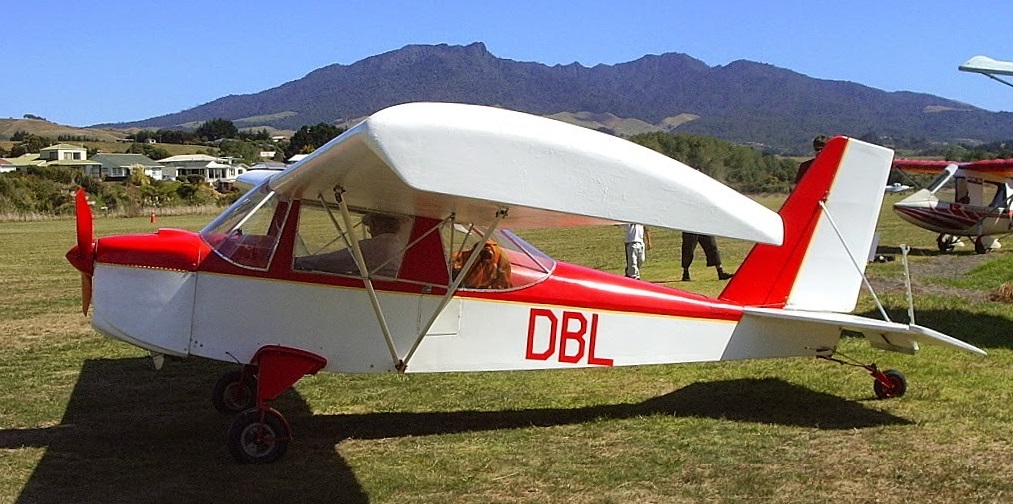
The two- seat Mini-twin was developed from the TEAM “Z” Hi-Max which was a single seater, with the width and wingspan both increased.
First registered ZK-JEB in 13 May 1996, David Locke test flew the aircraft in May 1996. ZK-JEB (c/n DBL 3) is officially a David Boehm Locke Hi Max Minitwin, and it took 1500 hours to construct over a period of 2 years. Powered by a 45 HP Zenoah engine it has a cruise of 65 mph. MAUW is 660 pound (299 Kg). It was a good aeroplane but not really fast enough for cross country flying so Dave Locke turned his attention to the Minitwin Mk II. On 15/1/01 ownership transferred to B StC C McKenzie of Auckland, then on 25/6/02 to S A Hyde, also of Auckland. It then headed to the South Island, to C G L Pennell of Rangiora with whom it had a forced landing following power loss on 8/12/05. It then went to A C Reid of Fairlie and finally to J D Simpson of Karamea.
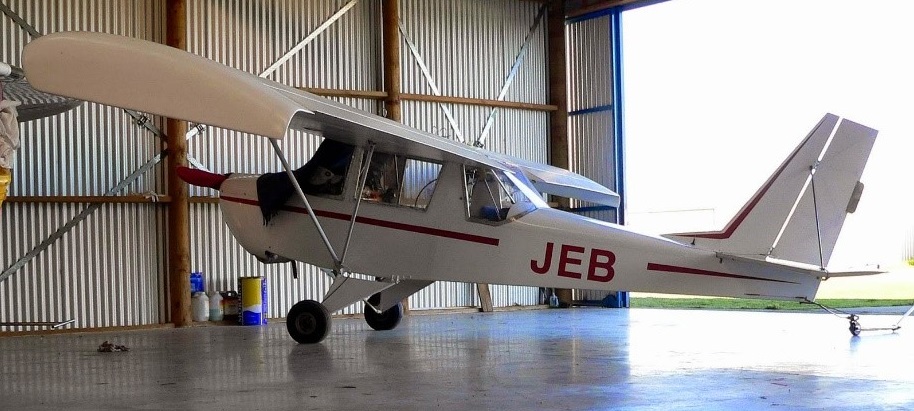
ZK-DBL (c/n DBL 4) is officially a D Locke Mintwin II. It took 2500 hours to construct and it is powered by a 63 HP 3 cylinder 657cc DOHC water cooled engine from a Suzuki Cappucino sports car. It has a 3:1 reduction gearbox that Dave designed and built himself. Cruise is around 85 to 90mph. Empty weight is 630 pounds (287 Kg) and MAUW is 1,070 pounds (485 Kg). It is still owned by Dave Locke.
Wingspan: 27 ft 3 in
Seats: 2.
Littner Whiskey IV / Asso Aerei Whiskey IV
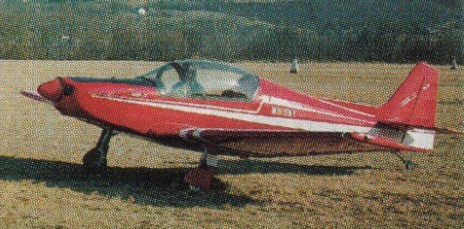
The Whisky IV is a tandem two seat, low wing aircraft designed by Giuseppe Vidor. Construction materials are wood & fabric. The landing gear is a fixed tailwheel configuration.
2009 Complete set of plans $400 (US$)
Engine: Limbach 2000, 80 hp
HP range: 75-100
Wing Span: 26.25 ft.
Wing Area: 120.5 sq. ft.
Length: 21 ft.
Height: 7 ft.
Cockpit Width: 28.3 in.
Aspect Ratio: 5.7
Dihedral Angle: 4°
Wash Out: 1.50°
Empty Weight: 622 lbs.
Gross Weight: 1058 lbs.
Wing Loading: 8.78 lbs./sq. ft.
Power Loading: 13.22 lbs./HP
C.G. Travel: 18.3 to 31% MAC
Fuel Capacity: 13.2 gal. / 79 lbs.
V.N.E: 175 mph.
Max Horizontal Speed: 160 mph.
Cruise 75% Power: 130 mph.
Max Maneuvering Speed: 115 mph.
Max Flap Speed: 84 mph.
Stall Speed Flaps Down: 37 mph.
Stall Speed Flaps Up: 43 mph.
Take-Off Distance: (Solo) 330 ft.
Landing Distance: (Solo) 490 ft.
Fuel Burn 75% Power: 3.17 gal./hr.
Max Range 75% Power: 535 nm
Rate Of Climb: 785 ft./min.
Service ceiling: 12,000 ft
Seats: 2 tandem
Landing gear: retractable tailwheel
Littner Champion V / Asso Aerei Champion V / Vidor Guiseppe Asso V
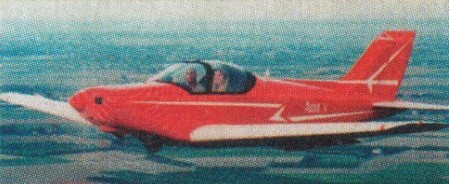
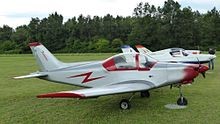
The Champion V is a side by side two seat, low wing aircraft designed by Giuseppe Vidor. Construction materials are wood & fabric. And the landing gear can be built in fixed trigear or retractable trigear configurations.
2009 Complete set of plans $400 (US$)
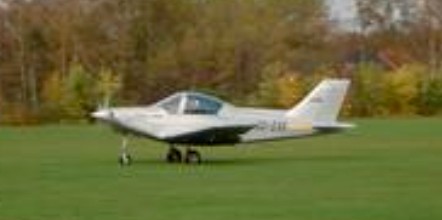
The Asso V Champion was built by Alpi Aviation with composite skin panels as the Pioneer 300.
Undercarriage: Fixed
Engine: Limbach 2000, 80 hp
Wing Span 27.3 ft.
Wing Area 120 sq. ft.
Length 20 ft.
Gross Weight 993 lbs.
Fuel 78 lbs.
G Loads (Ultimate) +5.7, -2.67
Horsepower Range 75 to 100
Empty Weight: 595 to 604 lbs.
Max Speed: 130 mph.
Cruise 75% Power: 107 mph.
Cruise 90% Power: 115 mph.
Stall Speed: 40 mph.
V.N.E: 160 mph.
R.O.C: 800 ft./min.
Take-Off Distance: 425 ft.
Landing Distance: 330 ft.
Range: 425 miles
Maneuvering Speed: 95 miles
Max Speed With Flaps: 70 mph.
Undercarriage: Retractable
Engine: Limbach 2000, 80 hp
Wing Span 27.3 ft.
Wing span: 27.3 ft
Wing Area 120 sq. ft.
Length: 20 ft.
Height: 7 ft
Gross Weight 1058 lbs.
Fuel 13 USG / 78 lbs.
G Loads (Ultimate) +5.7, -2.67
Horsepower Range 75 to 100
Empty Weight 617 lbs.
Max Speed: 140 mph
Cruise 75% Power: 103 kt / 118 mph / 190 kmh
Cruise 90% Power: 127 mph.
Stall Speed: 34 kt / 39 mph / 63 kmh
V.N.E: 139 kt / 160 mph / 258 kmh
R.O.C: 800 ft/min / 4 m/s
Take-Off Distance: 425 ft.
Landing Distance: 330 ft.
Range: 425 miles
Maneuvering Speed: 105 miles
Max Speed With Flaps: 70 mph.
Service ceiling: 12,000 ft
Seats: 2
2009 Price: 66000 EURO
Vidor Guiseppe Asso V
Engine: Rotax 912, 80 hp
Wing span: 8.3 m
Wing area: 11 sq.m
MAUW: 450 kg
Empty weight: 275 kg
Fuel capacity: 55 lt
Max speed: 245 kph
Cruise speed: 225 kph
Minimum speed: 62 kph
Climb rate: 4.5 m/s
Seats: 2
Fuel consumption: 13 lt/hr
Plan price (1998): 800 000 L
Kit price (1998): 12 172 000 L
Littner Junior IV / Asso Junior / Asso Aerei Junior IV / Asso Junior / Vidor Guiseppe Asso IV Wisky
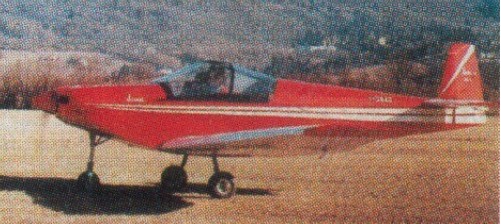
A wood and fabric design by Giuseppe Vidor. The side by side two seater is capable of modest aerobatics.
Top speed: 125 mph
Cruise: 100 mph
Stall: 38 mph
Range: 375 nm
Rate of climb: 600 fpm
Takeoff dist: 350 ft
Landing dist: 400 ft
Service ceiling: 10,000 ft
Engine: Limbach, 62 hp
HP range: 50-65
Fuel capacity: 15 USG
Empty weight: 530 lb
Gross weight: 950 lb
Height: 5.9 ft
Length: 20 ft
Wing span: 28.6 ft
Wing area: 123.7 sq.ft
Seats: 2
Landing gear: retractable nose wheel
Vidor Guiseppe Asso IV Wisky
Engine: Sterpha, 85 hp
Wing span: 8.1 m
Wing area: 11.2 sq.m
MAUW: 450 kg
Empty weight: 285 kg
Fuel capacity: 50 lt
Max speed: 245 kph
Cruise speed: 225 kph
Minimum speed: 63 kph
Climb rate: 5 m/s
Seats: 2
Fuel consumption: 12 lt/hr
Plan price (1998): $450
Kit price (1998): 15 000 000 L
Little Wing Autogyros Roto-Pup
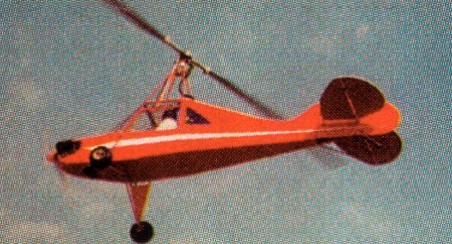
A single seat enclosed tractor gyrocopter.
Top speed: 80 mph
Cruise: 60 mph
Range: 100 sm
Rate of climb: 1000 fpm
Takeoff dist: 200 ft
Landing dist: 50 ft
Engine: 2si, 70 hp
hp range: 50-100
Fuel capacity: 10 USG
Empty weight: 450 lb
Gross weight: 750 lb
Height: 8.5 ft
Length: 18 ft
Disk span: 23 ft
Disk area: 415 sq.ft
Seats: 1
E Model
Engine: 70 hp TEC 4 cycle.
Prop: Pop’s Props 62×28.
Min speed: 15 mph.
Cruise: 70 mph.
Top speed: 85 mph.
Empty wt: 300-350 lbs.
Useful load: 300 lbs.
Gross wt: 650 lbs.
Width: 7’.
Height: 8’6”.
Length: 16’6”.
U Model
Engine: 72 hp McCulloch.
HP range: 50-100.
Prop: Tennessee 52×26.
Speed max: 70 mph.
Cruise: 55 mph.
Range: 50 sm.
ROC: 1000 fpm.
Take-off dist: 200 ft.
Landing dist: 50 ft.
Fuel cap: 5 USG.
Weight empty: 251 lbs.
Gross: 551 lbs.
Height: 8.5 ft.
Length: 18 ft.
Disk span: 23 ft.
Disk area: 411.8 sq.ft.
Seats: 1.
Landing gear: nose wheel.
Little Wing Autogyros Roto-Pup Ultralight
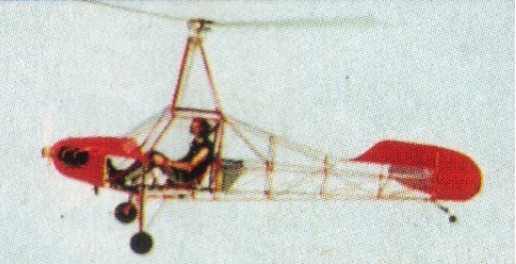
First flown in April 1995.
Top speed: 63 mph
Cruise: 60 mph
Range: 50 sm
Rate of climb: 800 fpm
Takeoff dist: 200 ft
Landing dist: 0-10 ft
Service ceiling: 10,000 ft
Engine: 2si, 45 hp
hp range: 40-70
Fuel capacity: 5 USG
Empty weight: 251 lb
Gross weight: 550 lb
Height: 8.5 ft
Length: 16 ft
Disk span: 23 ft
Disk area: 415 sq.ft
Seats: 1
Undercarriage: tailwheel

