1980-95: Gary Watson, Route 1, Box 50, Newcastle, TX 76372, USA.
LSA builder
1980-95: Gary Watson, Route 1, Box 50, Newcastle, TX 76372, USA.
LSA builder
Associated to Aeroprogress in Russia, initially to market T-411 Wolverine kits.
1995-7: 8535 Perimeter Rd. S., Seattle, WA 98108, USA.
1972-80: Bill Warwick, 5727 W. Clearsite, Torrance, CA 90505 USA.
Airplane builder

Considerations that influenced the layout of the Centaur concept included cabin volume, access, low take-off speed and boat handling duties.
The hull features no transverse step and no forebody chines. This hull accelerates to about seventy percent of take-off speed in displacement mode by which time the water is satisfactorily “hard” and aerodynamic lift takes more than half the weight of the aeroplane off the water. The Centaur encounters no drag hump. This leaves much more thrust available than conventional seaplanes for getting more useful load airborne in a respectable distance. This useful load advantage is further increased by the reduced structural content and weight in the hull, having typically half the beam and surface area of conventional seaplane hulls (floatplanes or flying boats).

The fine bow results in little rotation. Because of the narrow beam, any remaining rotation results in less rise, wave dispersion, spray and wasted energy. The Centaur can handle short steep waves typically twice the height tolerated by equivalent seaplanes.
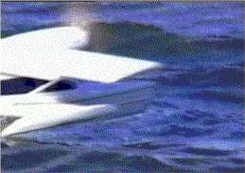
With the composite vinylester-epoxy laminating resins primary structure largely inset from a secondary shell, the Centaur will tolerate abuse which also aids repair without specialist facilities.
The Centaur’s low stub-wing uses ground-effect aerodynamics to aid low take-off speed. This is helped by a continuous flap through the wing center-section which provides much lift in the propeller slip-stream.
The flap and wings create down-wash on the tail. This down-wash substantially balances the pitching effects of changes in power and flap setting.
Using engineering content near identical to the undercarriage, the outer wing panels can be released and folded back to within the beam of the sponsons, so that the Centaur can be berthed or tied up against the side of a dock or ship, or in marinas. In preparing for flight, as they rotate forward to the locked position, a central stub spar mates with the spar in the wing panel, thus completely removing bending forces from the hinge. The aircraft cannot be flown unless locking is successful and the wings cannot be unlocked unless taxiing at low speed on the surface.
UK
Has been developing the Centaur six-seat amphibian, unveiled in 1998 as a project. Scale model tested, and prototype is expected to be built by CMC, allowing early production deliveries in about the year 2002 if program fully funded.
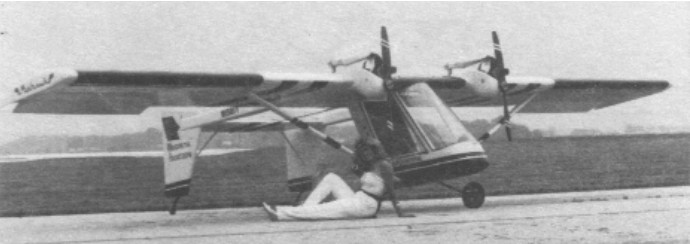
The Mohawk was a single seat twin engined high wing mono¬plane with conventional three axis control. Wing has unswept leading and trailing edges, and constant chord; two fin tail. Pitch control by elevator on tail; yaw control by fin mounted rudders; roll control by half span ailerons; control inputs through stick for pitch/roll and pedals for yaw. Wing braced from below by struts; wing profile; double surface. Undercarriage has two wheels side by side with two additional tail-wheels; steel spring suspension on tail-wheels and glass fibre suspension on main wheels. Ground steering by differential braking. Brakes on main wheels. Composite construction fuselage, totally enclosed. Engines mounted at wing height driving tractor propellers.
Warpath Aviation Mohawk Article
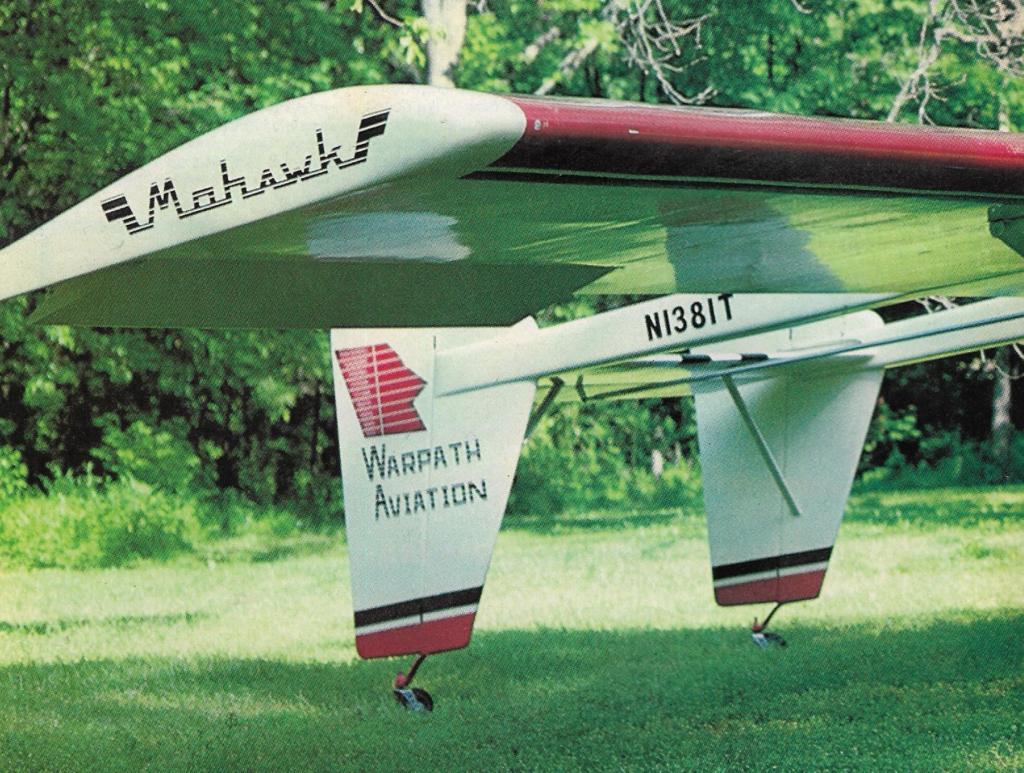
Conceived by Bobby Baker, the prototype of this composite construction machine made its first flight in November 1981. Using aluminium, foam and glass fibre in its construction, the Mohawk became available at the end of 1982 in the form of plans ($100) or a kit requiring 400h completion time, the kit costing $1750 without engines.
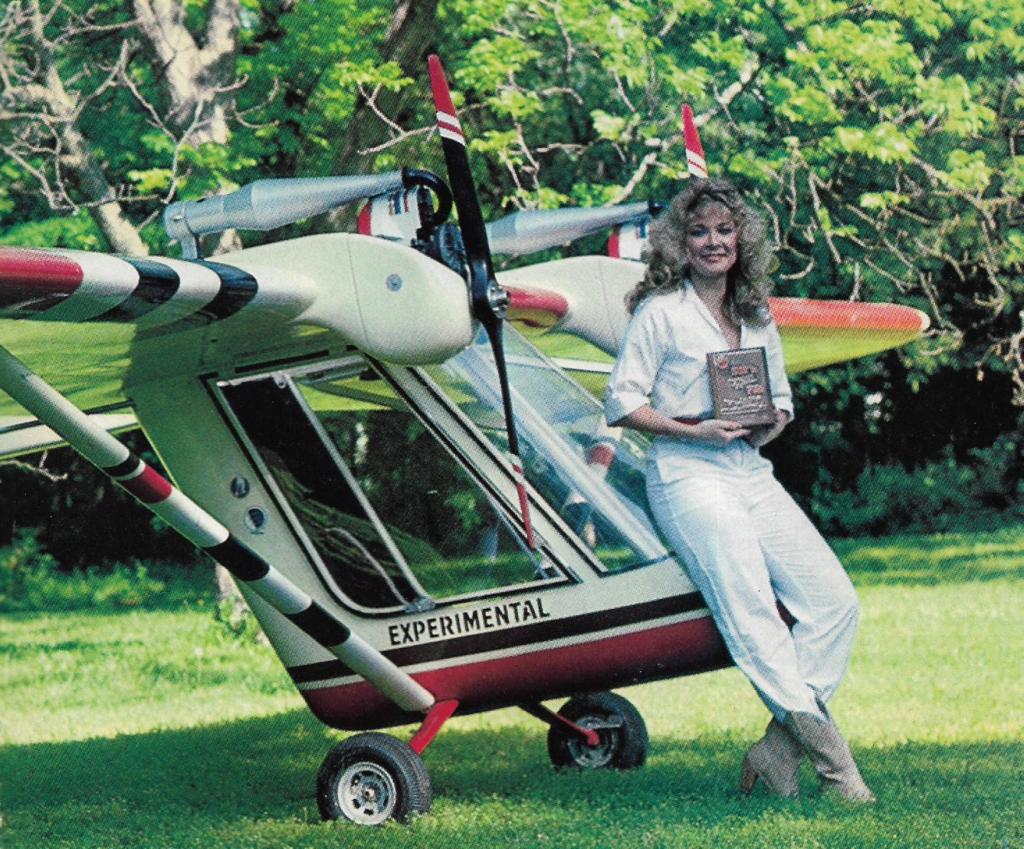
However, the company’s plans for this distinctive twin engined twin boom machine included marketing a factory built version and it is clear from the design of the single engined Mohawk X that it has been engineered with series production in mind. The Mohawk can be towed on its own undercarriage, allowing a set up and break¬down time of 20 min by two people.
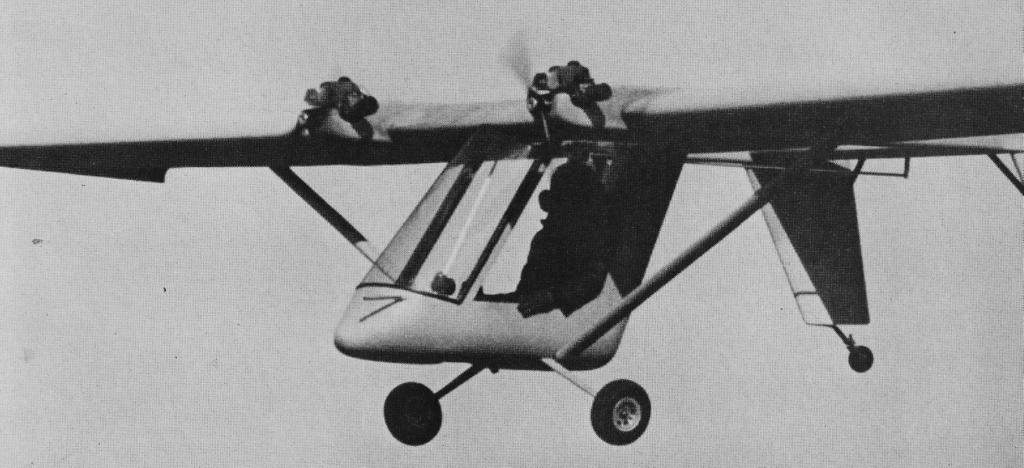
The Mohawk X is similar to the Mohawk except single engined and fitted with flaps. Undercarriage has three wheels in tricycle formation with two addition¬al tailwheels. Engine mounted at wing height driving pusher propeller.
This is basically a single ¬engine version of the original Mohawk with tricycle undercarriage. The X series has a 430 Cuyuna engine driving a larger pusher prop through a 3/1 reduction unit and short extension shaft. It also incorporates a retractable nosewheel and the cockpit well set forward of the original location to compensate for the aft engine. A conventional flap arrangement is incorpo¬rated in the inboard wing panels and the wings pivot and fold back along the booms for a 5 min assembly time requiring one person. Totally re engineered internally for faster production methods, the X uses wing spars and tail booms of aluminium tubing as opposed to the built up units in the prototype Mohawk. The craft is available in two forms from the factory, first shipments to dealers being scheduled for April or May 1983. The first option is a quick build kit requiring about 60 h assembly time; Bobby Baker says this is mainly a matter of pop riveting and bolting with little glueing or glass fibre work required. This price is estimated at $5800. Alternatively, an almost ready to fly aircraft is offered, requiring only that the tail boom assembly be bolted on and minor rigging done, a total time of less than 20 h. List price of the Mohawk X in this form is estimated at $6800.
Mohawk I
Engines: 2 x Cuyuna 215R, 20 hp at 5000 rpm
Propeller diameter and pitch 33 x 10 inch, 0.84 x 0.25 m
Belt reduction, ratio 2.1/1
Max static thrust 300 lb, 136kg
Power per unit area 0.31 hp/sq.ft, 3.3 hp/sq.m
Fuel capacity 5.0 US gal, 4.2 Imp gal, 18.9 litre
Length overall 16.3 ft, 4.95 m
Height overall 6.8ft, 2.08m
Wing span 30.0ft, 9.14m
Constant chord 4.5ft, 1.37m
Dihedral 0 deg
Sweepback 0 deg
Total wing area l30 sq.ft, 12.1 sq.m
Wing aspect ratio 6.9/1
Wheel track 5.0 ft, 1.52 m
Empty weight 240 lb, 109kg
Max take off weight 550 lb, 249 kg
Payload 310 lb, 141 kg
Max wing loading 4.23 lb/sq.ft, 20.6 kg/sq.m
Max power loading 13.8 lb/hp, 6.2kg/hp
Max level speed 64 mph, 103 kph
Never exceed speed 80 mph, 129 kph
Max cruising speed 50 mph, 80 kph
Economic cruising speed 40 mph, 64 kph
Stalling speed 22 mph, 35 kph
Max climb rate at sea level 500ft/min, 2.5m/s
Take off distance 250 ft, 75m
Mohawk X
Engine: Cuyuna 430, 35hp
Propeller diameter 60 inch, 1.52 m
Reduction ratio 3.0/1
Length overall 16.3 ft, 4.95 m
Height overall 8.0ft, 2.44m
Wing span 32.0ft, 9.75m
Wheel track 5.0ft, 1.52 m
Empty weight 250 lb, 113kg
Max take off weight 550 lb, 249kg
Payload 300 lb, 136kg
Max power loading 15.7 lb/hp, 7.1kg/hp
Max level speed 64 mph, 103 kph
1983: Warpath Aviation, Box 225, Piggott, Arkan¬sas 72454, USA.
UL builder

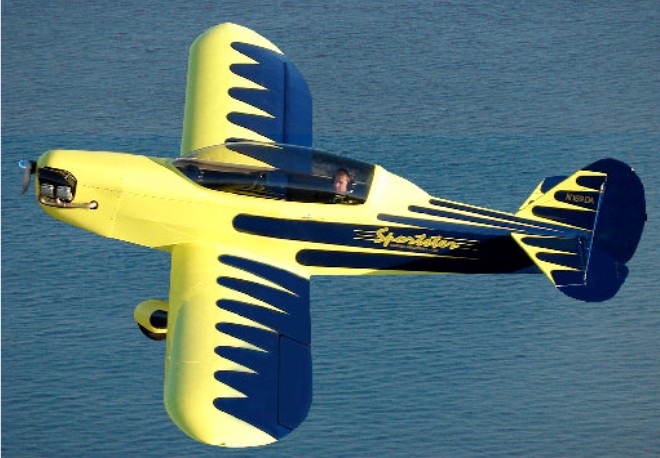
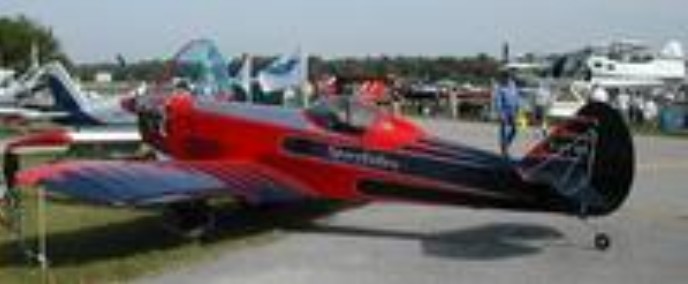
The Sportster was a new design, open cockpit 2 place tandem. Two versions were built (the first, N269U, first flew on 18 April 1999), one with both seats open, one with the front seat open or covered and the rear a removable canopy. The Sportsters flew over 250 hours, and completed several cross country trials, spin testing, mild aerobatic testing. The Sportster also underwent a design stress analysis. The Sportster was designed to offer the taller/wider pilots an alternative. It keeps the same look as all the Warner line of aerocraft but the fuselage is stretched and widened to allow 6’5″ tall pilots to fly in comfort. The Sportster was planned for kit only sales and no “plans only” option. 2009 kit price: US$16495. Engine options are 80-160hp.
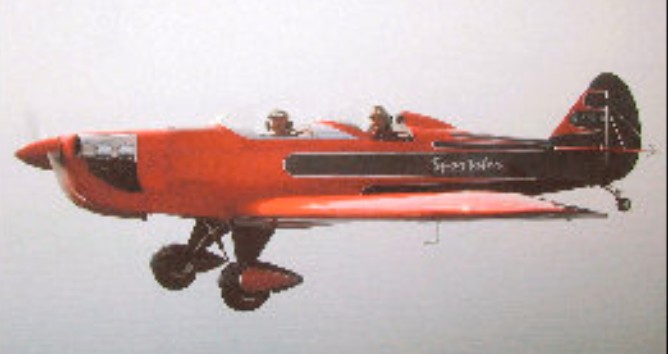
The convertible Sportster – 5 minutes to change from 1 or 2 seat enclosed cockpit to 2 seat open cockpit.
Engine: Continental O-200, 100 hp
TBO: 1800 hours
Propeller: Wood
Wing Span: 28’6″
Wing Cord: 55″
Length: 21’4″
Height: 66″
Fuselage Width: 29″
Empty Weight: 817 lbs.
Max. Gross Weight: 1,320 lbs.
Useful Load: 504 lbs.
Fuel Capacity with Standard Tank: 14.5 USgals. (14 USgals. usable)
Fuel Capacity with Optional Tank: 29 gals. (28.5 USgals. usable)
Baggage Capacity: 100 lbs
Limit Loading: +6, -4 g’s
Takeoff Distance: 350 ft
Landing Distance: 410 ft
Normal Cruise: 105-115 mph
Top Speed: 130 mph
VNE: 150 mph
Stall Speed: 48 mph
Rate of Climb, Sea Level: 1000 fpm
Fuel Consumption at Altitude: 6.3 USgph
Seats: 2, Tandem
LSA: yes
Engine: Lycoming O-290D, 120 hp
Wingspan: 26’0″
Length: 20’4″
Useful load: 650 lb
Cruise speed: 130 mph
Stall: 45 mph
Seats: 2, Tandem
First flown in 1988, construction is tube, wood and fabric. Plans and kits were marketed for home-builders.
HP: 65
Height: 5.4 ft
Length: 17 ft
Wing span: 26 ft
Weight empty: 500 lbs
Gross: 750 lbs
Fuel cap: 10 USG
Speed max: 115 mph
Cruise: 105 mph
Range: 300 sm
Stall: 38 mph
ROC: 800 fpm
Take-off dist: 300 ft
Landing dist: 500 ft
Service ceiling: 10,000 ft
Seats: 1
Landing gear: tail wheel
Made available plans and kits to build single-seat Revolution 1 and two-seat Revolution II low-wing monoplanes, based on former Country Air Space-Walker.
1995: 7801 N. Armenia Ave, Tampa, FL 33604-3824, USA.
1997: 9415 Laura Ct, Seminole, FL 33776-1625, USA.
 All Aero