
Parapower uses an epoxy-resin tank reinforced with carbonfibre.
P2-100
Empty weight: 18 kg
Engine: Solo, 12 hp
Reduction: 1:2
Fuel capacity: 8 lt
Price (1998): 4500 DM
P2-110
Empty weight: 18.5 kg
Engine: Solo, 13 hp
Reduction: 1:2
Parapower uses an epoxy-resin tank reinforced with carbonfibre.
P2-100
Empty weight: 18 kg
Engine: Solo, 12 hp
Reduction: 1:2
Fuel capacity: 8 lt
Price (1998): 4500 DM
P2-110
Empty weight: 18.5 kg
Engine: Solo, 13 hp
Reduction: 1:2
1998:
Pilchowo UL. Wies
PL-72004 Szczecin-Pilchowo
Poland
Paramotor builder
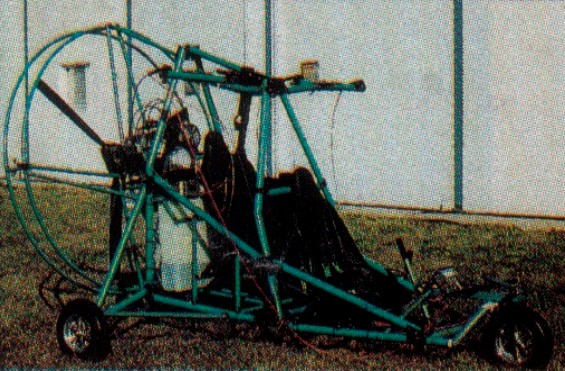
Manufactured in the USA and supplied as a completely assembled trike style powered parachute. The rectangular ram air parachute has a zero porosity silicon coating. Electric start was included, and powder coating optional. The Golden Eagle 2 has a patentd steering system.
Engine: Hirth 2706
Height: 6.7 ft
Length: 10.4 ft
Wing span: 39.5 ft
Wing area: 560- sq.ft
Empty weight: 340 lb
Gross weight: 850 lb
Fuel capacity: 10 USG
Cruise: 28 mph
Range: 52 sm
Rate of climb: 500 fpm
Takeoff dist: 150-200 ft
Landing dist: 0 ft
Service ceiling: 10,000 ft
Seats: 2
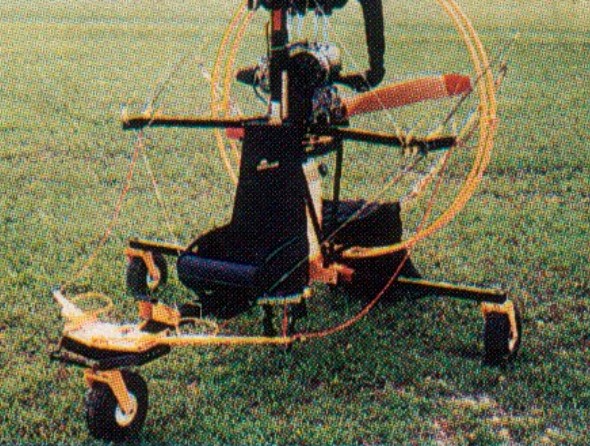
Manufactured in the USA and supplied as a completely assembled trike style powered parachute. The rectangular ram air parachute has a zero porosity silicon coating. Electric start was included, and powder coating optional.
Engine: Rotax 447, 42 hp
Height: 5.5 ft
Length: 6.5 ft
Wing span: 31.5 ft
Wing area: 370 sq.ft
Empty weight: 180 lb
Gross weight: 519 lb
Fuel capacity: 4 USG
Speed max: 26 mph
Cruise: 26 mph
Range: 26 sm
Rate of climb: 550 fpm
Service ceiling: 7,500 ft
Takeoff dist: 150 ft
Landing dist: 100 ft
Landing gear: nose wheel
Seats: 1

The PSE-1 was designed by Dan Thompson and was only sold to the military.
Scott Kelly (ParaPlane Corporation 1983-1994) designed the PSE-2 for ParaPlane Cooperation and put it into production.
PSE-SF was the Special Forces version of the PSE-2 and 12 were delivered for Operation Desert Storm.
PSE-WD was a highly modified version of the PSE-2 that was made exclusively for Disney World.
The PSE-2 (named Osprey) was advertised circa 1998 as manufactured in the USA and supplied as a completely assembled trike style powered parachute. The rectangular ram air parachute has a zero porosity silicon coating. Electric start was included, and powder coating optional.
Engine: Rotax 503, 46 hp
Height: 6.5 ft
Length: 6.5 ft
Wing span: 30.6 ft
Wing area: 370 sq.ft
Empty weight: 235 lb
Gross weight: 554 lb
Fuel capacity: 4.9 USG
Cruise: 28 mph
Range: 25 sm
Rate of climb: 650 fpm
Service ceiling: 7,500 ft
Takeoff dist: 150 ft
Landing dist: 100 ft
Seats: 1
Landing gear: nose wheel

Engine: 2 x Solo 210
Empty wt.: 180 lbs
Max wt.: 400 lbs
Wing span: 30ft 5in
Wing area: 400 sq.ft.
Wing loading lbs/sq.ft: 1
Power loading: 12.5 lbs/hp
Max speed: 26 mph
Cruise: 26 mph
Seats: 1
A ram air parachute connected to a trike unit.
Engine: 2 x 15 hp
Climb rate: 250 fpm
Rate of descent: 600 fpm
Max payload: 185 lb
Ceiling: 5000 ft

Single seat twin engined motorised parachute with constant chord. Control inputs through pedals for yaw. Pilot suspended below wing in trike unit. Undercarriage has three wheels in tricycle formation. Nosewheel steering. No brakes. Aluminium tube trike unit, without pod. Engines mounted below wing driving pusher propellers.
The ParaPlane, which is listed as an ultralight in the USA, is in fact a motorised parachute. Shown at Sun ‘n’ Fun in March 1983 at Lakeland, Florida, this amazing flying machine only flew once due to difficult weather conditions.
Designed by Steve Snyder, the ParaPlane uses as its ‘wing’ a 28.5 ft (8.69 m) parachute of constant chord giving 375 sq.ft (34.8 sq.m) of lifting surface. For pilots heavier than 185 lb (84kg), it can also be equipped with a 36.0ft ‘wing’ of 450sq.ft (10.97 m, 41.8 sq.m). The contraption is flown like a non powered parachute wing, its pilot steering via lines attached to foot pedals to give directional control. The rear wheels of the trike unit are free to castor and are unbraked, the structure being made of alumi-nium tubes with a hammock seat and shoulder harness. Behind the seat, the engine mount carries the two Solo 210cc 15hp engines driving two twin blade contra rotating prop¬ellers.
Weighing 79 lb (36 kg) empty, the trike unit is foldable down to 50 x 14 x 20 inch (127 x 35 x 51 cm). The aircraft is used like an ascending parachute and it collapses behind the trike unit when it lands. Take off is made at 25 mph (40 kph), which is also the landing speed. ParaPlane Corporation does not quote a stalling speed, though a figure of 8 10mph (13 16kph) is mentioned.
Price: from $3750 in 1983.
During the 1983 Oshkosh ParaPlane rook over 1000 orders for the craft.
Engine: 2 x Solo 215 (2 x 215cc) 33hp
Empty wt: 163 lbs
Wing span: 30’6”
Wing area: 400 sq.ft
Fuel cap; 4.5 USG
Construction: Aluminium, Nylon
Max wt: 360 lbs
Max speed: 26 mph
Climb rate: 250 fpm
Design limit: +9g
Glide ratio: 3-1
Wing loading: 0.9 lbs/sq.ft
Power loading: 11.0 lbs/hp
Engine: 2 x Solo 335, 15 hp each
Propeller diameter 50 inch, 1.27 m
Belt reduction
Power per unit area 0.08 hp/sq.ft, 0.86 hp/ sq.m
Fuel capacity 4.5 US gal, 3.8 Imp gal, 17.0 litre
Length overall 5.7ft, 1.73m
Height overall 5.6ft, 1.70m
Wing span 28.5ft, 8.69 m
Constant chord 13.0 ft, 3.96 m
Total wing area 375 sq.ft, 34.8 sq.m
Empty weight 140 lb, 64 kg
Max take off weight 355 lb, 161 kg
Payload 215 lb, 98 kg
Max wing loading 0.95 lb/sq.ft, 4.6 kg/sq.m
Max pow¬er loading 11.8 lb/hp, 5.4 kg/hp
Max level speed 30 mph, 48 kph
Never exceed speed 30 mph, 48 kph
Max cruising speed 30 mph, 48 kph
Economic cruising speed 25 mph, 40 kph
Best glide ratio with power off 3/1
Range at average cruising speed 41 mile, 66 km
Stephen Snyder and his ParaPlane Corp are credited with developing and marketing the genre, which began in the early 1980s with a single seat foldable powered tricycle that could fit in a car trunk.
During the 1983 Oshkosh ParaPlane took over 1000 orders for the craft.
1983-4: ParaPlane Corporation, 5801 Magnolia Ave¬nue, Pennsauken, New Jersey 08109, USA.
1995-8: 68 Stacey Haines Rd, Medford, NJ 08055, USA.
The Paramotor chassis design was a variation of Marbella’s PAP.
Circa 1998 the range was imported into the UK by Trekking.
M3
Empty weight: 21.5 kg
Engine: Solo, 16 hp
Reduction: 1:2.2
Prop diameter: 100 cm
Fuel capacity: 8 lt
Price (1998): 33 000 SEK
M3 ES
Empty weight: 23.5 kg
Engine: Solo, 16 hp
Reduction: 1:2.2
Prop diameter: 100 cm
Fuel capacity: 8 lt
Price (1998): 38 000 SEK

