Browns Valley CA.
USA
In 1980 Edward Popejoy built a monoplane registered NX2933.
Browns Valley CA.
USA
In 1980 Edward Popejoy built a monoplane registered NX2933.
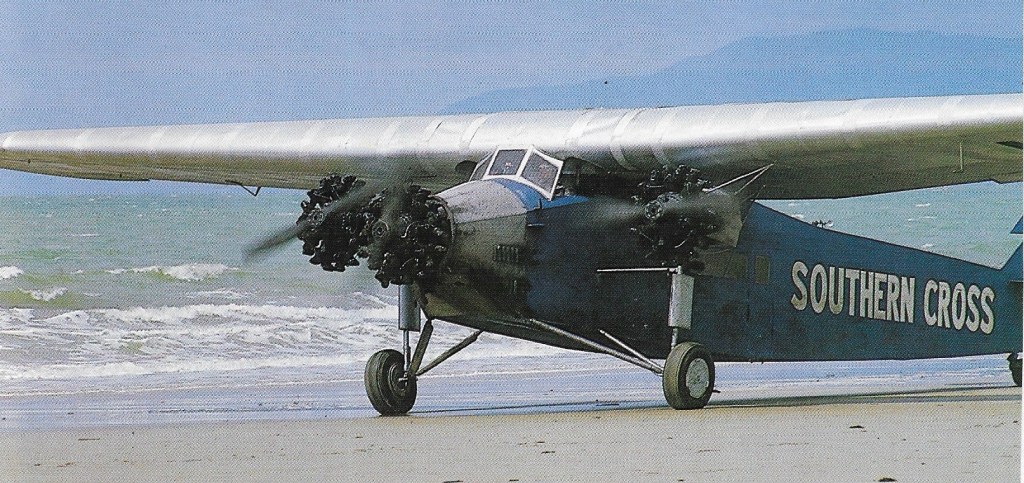
The plane’s replica was the project of South Australian flying instructor John Pope, who created the plane as a travelling history lesson that would fly around the country. Southern Cross is a flying close replica of the famous record breaking Southern Cross Fokker FV11B of Sir Charles Kingsford Smith from the 1920s and 1930s.
Built in South Australia in the period 1980 to 1987 as a tribute to Smithy, the aircraft toured Australia during the 1988 Bicentenary raising money for the Royal Flying Doctor Service registered VH-USU.
She is a faithful replica built to modern standards using the traditional aircraft construction of steel tubing and timber with doped Irish Linen for the fuselage and an all wooden (spruce and plywood) wing. She is the largest “exact replica” aircraft in the world and has the largest one piece wing ever made in Australia.
Aircraft Research and Development Unit was tasked to carry out the test flying of a replica of the 1926 Fokker Tri-Motor as flown by Australian aviation pioneer, Sir Charles Kingsford-Smith. The purpose of the test programme was, firstly, to ensure safe operation of the aircraft throughout its proposed flight envelope and, secondly, to provide data to allow the issue of a Certificate of Airworthiness or Permit to Fly. The trial included a cockpit and systems assessment as well as an evaluation of the aircrafts flight and ground handling characteristics. Airborne assessments covered stability and control characteristics, stall characteristics, general aircraft performance, asymmetric power characteristics and an evaluation of the aircrafts take-off and landing performance and handling. The flight characteristics of the test aircraft were found to be similar to those expected from an original Fokker VIIb-3M. Consequently, the aircraft could not meet some modern certification requirements. Notwithstanding this the aircraft was found to be generally safe and airworthy provided it was operated by experienced pilots in daylight Visual Meteorological Conditions and that the main recommendations of this report are adopted.

The aircraft first flew in 1987 and during the 1988 Bicentenary she toured around Australia as a fund raising exhibit for the Royal Flying Doctor Service. The aircraft was a major drawcard to the 1988 Bicentennial Air Show and many thousands of people saw her. In 1990 the aircraft even ventured to New Zealand for air show appearances.
After 555 hrs flying tine, on the 25th of May 2002 it had an accident at Parafield South Australia when she lost a main wheel on takeoff. Landing on the one good wheel and the tail, the pilot kept the damaged wheel off the ground by keeping its wing high in the air. When the aircraft stopped the high wing came down and snapped off around 3 metres from the wing tip. HARS bought the damaged plane in 2000.
After considerable negotiation HARS acquired the aircraft from the SA Government in 2010. It is being restored to full airworthy status.
Engines: 3 x Jacobs R-775 A2, 300 bhp
Wing span: 22.1 m
Length: 14.3 m
Height: 4.3 m
Maximum takeoff weight: 5,700 kg
Cruising speed: ~155 km/h (max ~185 km/h)
Ceiling: 8,500 ft
Endurance: 7.5 hr
Crew: 2 x pilots

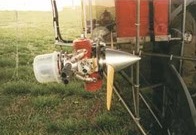
The Mirage 90 and Mirage 120 both had electric start and a polyurethane tank available.
Mirage 90
Empty weight: 20 kg
Engine: Lark, 13 hp
Reduction: 1:2.69
Fuel capacity: 8 lt
Price (1998): 4 800 00 L
Mirage 120
Empty weight: 23 kg
Engine: Lark, 13 hp
Reduction: 1:2.69
Fuel capacity: 8 lt
Price (1998): 4 800 00 L
Ponente Fly began producing power packs in 1997.
1998:
Via San Francesco 14
I-17024 Finale Ligure SV
Italy
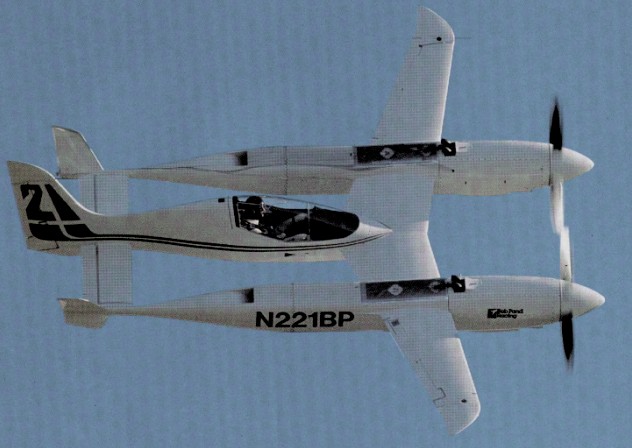
In 1988 Robert Pond (who derives a comfortable income from the manufacture of floor-cleaning products) contracted Burt Rutan’s Mojave, California, Scaled Composites, for the design and production of a prototype new-generation racing plane. Scaled engaged Nissan subsidiary Electramotive, a motorsport engine developer in Vista, California, to provide engines and gearboxes for the airplane. Rutan wanted to keep his pilot away from fuel, oil and hot coolant which meant a fuselage separate from the engine nacelles. The weight of the pilot’s pod is low, since it is supported at both ends and serves no structural purpose other than to hold up the pilot. The interference drag between the wing and the pod is nil. But most important, the pilot is as far away as he can be from the hazards of the powerplants. The airplane’s structure is mostly of graphite composites, often in the form of a sandwich with plastic foam cores. A special epoxy is used for compatibility with the engines’ methanol fuel. Despite its tiny size – 25-foot span and 20-foot length—and advanced materials, the Pond Racer is a dense little airplane, weighing 4,500 pounds ready to fly. Its useful load is only 650 pounds.
Liquid-cooled, with a single overhead cam, two valves per cylinder, and 3.2-liter (200-cubic-inch) displacement, the Electramotive VG30 engines are based on the Nissan V-6 block used in the 300ZX and Maxima automobiles. Though their blocks are very compact, the engines use up a lot of space once the turbochargers and radiators and associated ducting are included (in fact, the complete installed powerplant weighs around 700 pounds versus 350 for the basic engine). They are packed incredibly tightly into the two-foot-diameter, five-foot-long nacelles. The engines are mounted solidly to the airframe and the cowling skins are a load-bearing part of the engine mount, permitting the gap between spinner and cowling to be little more than a knife-slit.
More than a year was spent developing a gearbox to bring the engine’s 8,000-rpm operating speed down to a propeller-friendly 2,000.
The engines are electronically controlled. There are manual backups, but normally the throttle and prop controls move potentiometers, whose signals arrive, digitized, at each engine’s two Intel microcontroller chips along with temperature and pressure data from almost two dozen other sources. The microcontrollers consult schedules containing the desired boost and the duration and timing for the spark and injection, and adjust those parameters for each power stroke.
At the same time, airframe and powerplant data are recorded every two seconds, and can be dumped at the end of each flight to a computer and instantly displayed in graphical form. Technicians can then use the data drawn from each run to modify the laws governing engine operation until the optimum is achieved.
To deliver 1,000 hp, the engines must be boosted to 110 in. Hg and turn at 8,000 rpm. They must run continuously at that setting for the 15 minutes of a race, although they never gave more than about 600hp.
On March 22, 1991, the first flight was described as a “no-brainer”. It took several flights to get the engines working well at moderate power, and even late in August they were still chronically misfiring and undergoing constant readjustment. One source of difficulty is that the engine control computers don’t monitor one variable important to airplanes though not to race cars: air density. With a wing loading of over 70 psf, touchdown is at a hot 120 knots.
The original intention had been to remove some or all of the angled “butterflies” at the tips of the horizontal stabilizer after flight-test demonstrated sufficient directional stability. Now they may be moved to a horizontal position instead, since the airplane has so little static margin that it requires no trimming between 140 and 250 knots.
A major source of trouble during testing has been the methanol fuel. Not a petroleum product, methanol, like alcohol, is derived from plant fermentation. It has about half the specific impulse of gasoline, which means that twice as much of it must be burned to produce a given amount of power. But it also burns over a far wider range of mixtures, so that engine cooling can be supplemented simply by pumping a lot of excess methanol through the engine. What doesn’t burn in the cylinders emerges from the exhaust pipes as a roaring plume of flame familiar to drag-race buffs. Methanol also doesn’t detonate, and that is what allows it to run at the astronomical levels of boost necessary to pull 1,000 hp out of an engine having fewer cubic inches than that of a Cessna 152.
Methanol has very unfriendly relations with many materials. “It eats us alive,” Dick Rutan says. After repeated episodes of corrosion and oil contamination, it became standard operating procedure to drain the fuel systems after each flight and refill them with aviation gasoline in order to protect components from the methanol.
Even if Burt Rutan scored a bull’s-eye in flying qualities, there are still other major uncertainties waiting to be resolved. One is the reliability of the engines while being operated continuously at 1,000 hp. Another is handling qualities at top speed; because the engines can’t be opened up, the Racer has not yet been flown above 333 KIAS (357 knots true airspeed). Yet another unknown is the efficiency of the propellers. Four-blade and 80 inches in diameter, they are King Air props modified by Hartzell to specifications developed by John Roncz, a longtime consultant of Rutan’s who also designed the wing and tail airfoils for the Racer. Their knife-thin tips are designed to run at 98 percent of the speed of sound—not a regime in which propellers are routinely used.
The other question mark is airframe drag. Although the Racer is small, it is complex in shape, with many intersections and much internal cooling flow whose drag is difficult to estimate. At 460 knots, air will slam into it like cinder blocks, with a force of 600 pounds per square foot. At that speed a small surplus of drag could mean the difference between success and failure for the whole project.

Its bulky fuel load notwithstanding, the Pond Racer turned out to be a tiny airplane only 20 feet long, with a wing span of slightly more than 25 feet. It weighs 4,000 pounds when fully fueled. Scaled Composites, Rutan’s company in Mojave, Calif., finished the racer’s airframe in June 1989, but the engines and gearboxes took another year and a half to be completed. During that time the Rare Bear pushed the official speed record to 528 mph one mph faster than Rutan’s hoped for top speed.
At Reno 1991, a connecting rod punched through the left engine’s oil pan, dumping lubricant on the hot exhaust pipes and causing a fire. Race pilot Rick Brickert triggered the Pond Racer’s Halon fire extinguishing system, which smothered the blaze, then flew the craft to a one engine landing. After Reno, the racer was transferred from Mojave to Pond’s home airport at Palm Springs, Calif., to await further development.

N221BP appeared at Reno in 1991-93, qualified at 400mph.
Destroyed in a forced landing crash in 9/14/93, killing pilot Rick Brickert.
Engines: 2 x Electromotive-Nissan VG-30 GTP, 600 hp
Wingspan: 25’5″
Length: 20’0″
Useful load: 640 lb
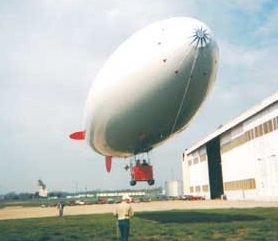
About 1997, Marvin Polzien decided he wanted a homebuilt blimp. There were no quick-build kits for homebuilt blimps, set of plans and a kit of materials for a homebuilt blimp. Marvin, along with friends Dennis Riley and Louie Remondino, decided to design their own. Marvin subleased part of a large military hangar on the Ardmore airport, Oklahoma, and the work began, with other volunteers pitching in.
Their first model was a cylindrical bag of aluminized plastic attached along the bottom to a welded-aluminum truss structure. A simple platform suspended from the truss provided a place for the pilot to sit (in a plastic patio chair) and a place to mount the power unit (a hot-air balloon inflator fan). About that model, Marvin says, “It was a total disaster– the material we used was no good – it leaked like a sieve. We took it out of the hanger once and I made one tethered trip around the ramp, but that was all. Then we deflated it and put it away.”
Using lessons learned from the first model, the team designed the second model. He says, “We just made it up as we went– we didn’t know what we were doing. Our learning curve was pretty wide, so we’ve got a lot of junk lying around that didn’t work.”
The first step was to select a better material for the envelope. Helium is a small molecule that can sneak its way through most materials, so low permeability was a primary requirement. They selected a .009”-thick white heat-sealable polyester plastic with good tear resistance.
To achieve the desired buoyancy, they decided to make the envelope 82 feet long and 20 feet in diameter, tapered to form a streamlined nose and tail– an estimated 18,000 cu. ft. capacity. A two-place welded-aluminum “car” for a pilot and passenger would be supported from the bottom of the envelope, supported by a “catenary curtain” of suspension lines inside the balloon.
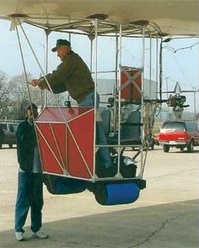
A 12-hp engine/propeller unit mounted on each side of the car would provide the main power. Each engine would be able to tilt up or down to vector thrust for climbing, cruising, or descending.
Pitch and yaw control would be provided by a third engine/propeller unit (24-hp) mounted on a gimbal at the extreme rear of the envelope and controlled from a control stick in the car. Fixed horizontal and vertical stabilizer panels would augment pitch and directional stability.
Inside the envelope would be two “balloonets” – smaller bags inside the large bag immediately forward and aft of the car– that could have air pumped in or out for trim control. Air would be provided from a compressor mounted on one of the engines.
A total of 13 gores of the 60” polyester would be required for the 20-ft diameter. In January 2002, the team laid out the gores on the hangar floor and cut them out. Then they began the monumental task of lapping and heat-sealing the gores together to form the envelope.
In February 2001, the envelope was fully sealed. After a preliminary filling with air (supplied ingeniously by a Shop Vac), the first filling with helium was an adventure. “We tried to fill from the middle first, but suddenly the helium all shifted to the front of the bag and up it went into the rafters! We were lucky we didn’t damage it. Now, we put sandbags across the envelope and fill from the back first. As it fills, the sandbags gradually roll toward the front,” Marvin said.
Of course, with the opportunity to fill with helium comes the necessity to empty it out now and then. But how does one keep from losing $1700 worth of helium? “Simple,” says Marvin, “We just built another storage bag bigger than the envelope and transferred it over!” But, how? “Shop Vac,” he says matter-of-factly. Marvin is a true innovator.
By March, the blimp had been taken outside for its first tethered flight. Finally, on August 3, 2002, the first free flight was accomplished. Watching video of the takeoff, Marvin said, “At that point, I didn’t know doodly about flying that blimp.”
After a short trip around the airport at about 200 feet at what appears to be about 30 mph, the video shows him approaching to land. He continued narrating, “About that time, I was asking myself how I was gonna land! I decided to rotate the engines down to pull me downward, but now I know I can just point the nose down a little to descend.”
Since then, Marvin has flown the blimp “five or six more times– I lose count.” On one flight he had an engine failure and, while trying to restart it, allowed the blimp to drift into some trees, punching a few holes in the envelope.
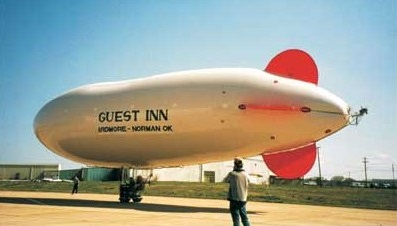
He has lost the lease on the big hangar and expects to be kicked out at any time. “I don’t know,” he says, “Sooner or later, I’ll have to deflate it, pack it up, and put it in my hangar.”
In December 2009 hundreds watched as a blimp piloted by 79-year-old Marvin Polzien flip flopped across the sky over Ardmore. He says he brought the blimp down near the freeway because a motor that helps steer the blimp failed. “I had three alternatives on how to land that thing. One was in the trees- that was not an option. Next one was in the median on the interstate, which is not good, and the third option which is to just take it up and let the wind blow me northwest of Ardmore,” Polzein said Thursday.
After the members of the FAA showed up wanting to see Polzien’s pilot’s license and medical certificate, which he couldn’t produce, his blimp could be grounded be for good. In order to operate an airship, it must first be certified with the FAA and its operator must have at least a private pilot’s license.
Also working against him is that fact this is not the first time he’s had to make an unscheduled landing. He crashed another home made blimp last May. That same blimp also floated away the next day and managed to make it all the way to North Texas with no one in it.
Marvin Polzien from Ardmore, Oklahoma, born 1930. Marvin’s interest in flying began early, in a little Iowa country school where he was fascinated with pictures of airplanes in the encyclopedia. His first flight was at age 12 when, defying his mother, he bought a $1 ride in a J3 Cub at a county fair. By 2001 he owned a Piper Malibu DLX, a couple of Bonanza’s, a powered parachute, and a hot air balloon.
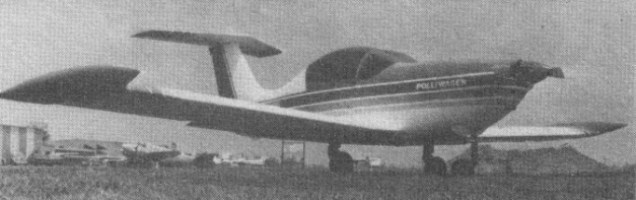
Designed by Argentine-born Joseph Alvarez in 1973, the Polliwagen derives its name from its appearance and its engine type. It is powered by a Revmaster R-2100-D turbocharged Volkswagen conversion. The Revmaster is closely cowled behind a two-position, constant-speed Maloof metal propeller of 59 inches diameter. The Polliwagen’s ex¬ceptionally clean lines give it an excellent speed-to-power ratio as well as fine aerodynamic handling characteristics. The wings are Wort¬mann FX-67-K-1 50 wing section with full-span trailing edge flaps and ailerons. Both the wings and fuselage make use of foam/epoxy com¬posite construction. Prefabricated parts are also offered in the Polliwagen kit including: molded windshield and canopy, landing gear, disc brakes, complete panels, composite structure wingtip fuel tanks, outward-breaking cabin structure, T-tail, etc.
First year built: 1978. Units delivered to June 1981: 300 kits, 65 flying. Price 1982: $5,500 (Excludes engine).

Engine 78-hp Revmaster VW
Gross Wt. 1250 lb
Empty Wt. 650 lb
Fuel capacity 25 USG
Wingspan 26 ft
Length 16 ft
Wing area: 90 sq.ft
Top 200+ mph
Cruise 180 mph
Stall 51 mph
Climb rate 925 fpm
Range 1000 fpm
Takeoff run 500 ft
Landing roll 500 ft
Seats: 2
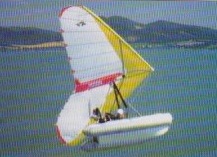
Amphibious trike
503
Engine: Rotax 503
582
Engine: Rotax 582
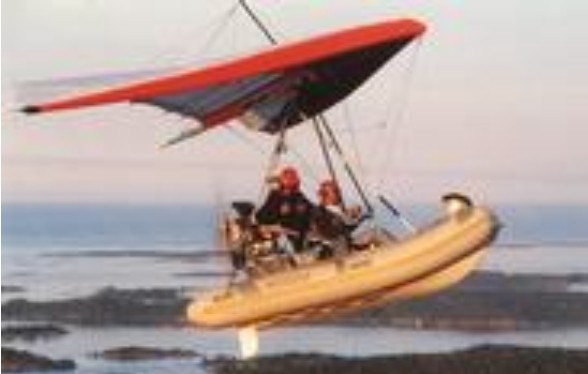
FIB – Flying Inflatable Boat
With Polaris made wings, the flexiwing seaplane is welded steel and uses a Rotax 503 or 582. Three sizes of wings are used: 14, 16, and 18 sq.m.
Stall: 26 kt / 30 mph / 48 kmh
Cruise: 38 kt / 43 mph / 70 kmh
VNE: 43 kt / 50 mph / 80 kmh
Empty Weight: 216 kg / 476 lbs
MTOW Weight: 406 kg / 895 lbs
FIB 503
Empty weight: 182 kg
Wing span: 11 m
Wing area: 21 sq.m
Fuel capacity: 35 lt
Certification: S; J
Engine: Rotax IV DCDI, 48 hp
MAUW: 362 kg
Seats: 2
Max speed: 85 kph
Cruise speed: 65 kph
Minimum speed: 54 kph
Climb rate: 1.8 m/s
Fuel consumption: 11 lt/hr
Price (1998): 27 200 000 L
FIB 582
Empty weight: 170 kg
Wing span: 10 m
Wing area: 14 sq.m
Fuel capacity: 50 lt
Engine: Rotax 582, 64 hp
MAUW: 368 kg
Seats: 2
Max speed: 115 kph
Cruise speed: 90 kph
Minimum speed: 45 kph
Climb rate: 3 m/s
Price (1998): 33 800 000 L

