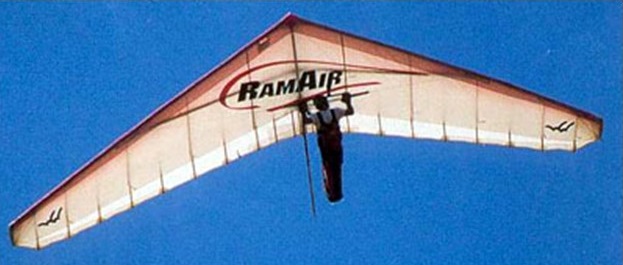
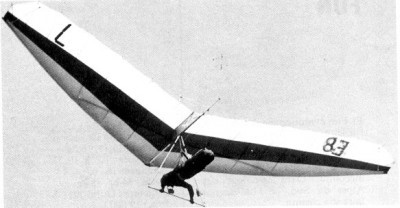
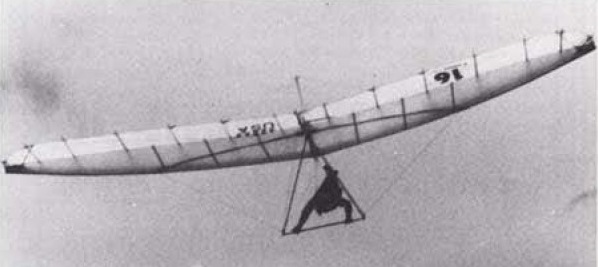
A 1986 hang glider for intermediate pilots. The trademark of the Super Sport is its lack of yaw stability. It is a bit much for newer pilots as it displays a lot of adverse yaw. No VG.
It’s not that easy to fly, and a tail fin is sometimes used with this glider to help the yaw stability, but it flies much better without it.
Super Sport 143 Wing area: 13.3 m² Wing span: 9.45 m Aspect ratio: 6.7 Hang glider weight: 26 kg Minimum pilot weight: 45 kg Maximum pilot weight: 85 kg Packed length: 5.4 m Packed length short: 3.6 m Number of battens: 25 Nose angle: 121°
Super Sport 153 Wing area: 14.2 m² Wing span: 10 m Aspect ratio: 7 Hang glider weight: 28 kg Minimum pilot weight: 69 kg Maximum pilot weight: 95 kg Packed length: 5.6 m Packed length short: 3.8 m Number of battens: 27 Nose angle: 121°
Super Sport 163 Wing area: 15.5 m² Wing span: 10.45 m Aspect ratio: 7.2 Hang glider weight: 30 kg Minimum pilot weight: 70 kg Maximum pilot weight: 122 kg Packed length: 5.8 m Packed length short: 4 m Number of battens: 27 Nose angle: 121°
Ramair 146 Wing area: 13.55 m² Wing span: 10 m Aspect ratio: 7.5 Hang glider weight: 30 kg Minimum pilot weight: 50 kg Packed length: 5.8 m Packed length short: 3.9 m Number of battens: 20 Nose angle: 127°
Ramair 154 Wing area: 14.3 m² Wing span: 10.4 m Aspect ratio: 7.5 Hang glider weight: 32 kg Minimum pilot weight: 65 kg Maximum pilot weight: 113 kg Packed length: 5.9 m Packed length short: 4 m Number of battens: 22 Nose angle: 127°
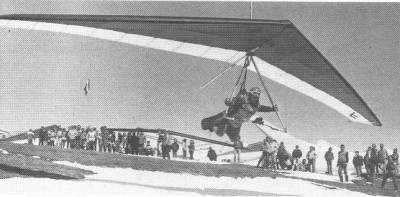
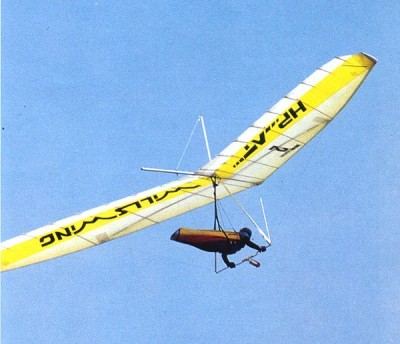
The 1984 Wills Wing HP has all the tubes shiny anodized and the bumpers have a respectable diameter, 50.8 cm or two inches. It uses for the mounting of the top of the trapezium a profile which prohibits the mounting on the ground of the apparatus, unless it is complicated gymnastics.Therefore you must climb on the trapezium, thread the top 20 slats, 8 lower and 4 intermediates The tension of the trailing edge is not ensured by an elastic but by pre-stretched nylon cords that ensure a better stability of the settings.
It is necessary to open the intrados, to mount a hoist and to set the transversal. Two cables coming from its joint are then fixed to the keel by bolt, butterfly and broken ring. The hoist is then dismantled and hidden in the intados. You attach the nose hood perfectly realized and finish by introducing in the intrados the cover that is fixed on the keel thanks to a strap studied for.
The take-off does not present any difficulty if care is taken during the first steps. A measurement of the roll rate of 45 ° to 45 ° shoulder against the trapezoid will give 5 seconds. It becomes very difficult to stay in the corner of the trapeze, especially since the sail is tense.
With the H.P. system, the small displacement of the keel acts as aerodynamic controls. The outer sail tightens as the inner sail relaxes causing a wing effect which can be seen by measuring in flight the heights of the sail above the sticks. This aerodynamic steering effect should be amplified by a less taut sail. Only the leading edge tension and pilot centering are adjustable. Each action in roll is associated with a movement of inverse yaw. This phenomenon combined with the low yaw stability common to all pendulum-controlled aircraft makes straight line flight difficult. The wing takes the inverse course of the roll correction. You get used to it but it is disconcerting.
The damping effect of the floating keel disappears and the vibrations caused by the heat bubbling of the thermal days are felt in the horizontal bar.
The bar is provided at its ends with two holes for adjusting the dihedron. At the inner or weak dihedron hole, H.P. is completely unstable spiral. At the outer hole, the stability becomes neutral beyond 30 ° of inclination. A surprise is the take-off speed: 33 and 35km / h on a buggy with 27 to 28km / h on the other wings.
The neutral booster is always present and grows linearly according to the displacement of the bar. The landing must be well prepared by raising the hands very high on the trapezium and pushing a little earlier than on other devices due to the higher speed.
The idea of removing the keel pocket is not new but Will Wings was the first one to return to this type. In maneuverability, it can not be said that there has been an improvement but the gain in finesse at intermediate speed is incontestable.
The HP 2 was also produced in 1984.
HP 2
The 1989 HP AT 158 for advanced pilots is regarded as an excellent flying glider. Launch is easy and effortless with a 10-12 knot wind. Pull VG on and it will stay banked in tight thermals with little effort while staying easy to control. It will fly fast when needed to get through turbulance and sink and slow when you want to maximize minimal lift. Landing is a bit difficult because of its small flare window that requires high authority.
HP AT
HP 170 1984 Wing area: 15.86 m² Hang glider weight: 31 kg Minimum pilot weight: 68 kg Maximum pilot weight: 113 kg
HP 2 170 1984 Wing area: 16.72 m² Hang glider weight: 35 kg Minimum pilot weight: 80 kg Maximum pilot weight: 130 kg
HP AT 145 1989 Wing area: 13.47 m² Wing span: 10 m Aspect ratio: 7.5 Minimum pilot weight: 50 kg Maximum pilot weight: 107 kg Nose angle: 127°
HP AT 158 1989 Wing area: 14.68 m² Wing span: 10.35 m Aspect ratio: 7.5 Hang glider weight: 31 kg Minimum pilot weight: 65 kg Maximum pilot weight: 115 kg Nose angle: 127°
The 1981 Wills Wing Harrier was for novice pilots. It was built in three models: 147, 177, and 187.
The Harrier was a great turning glider. Easy to launch and land with excellent energy retention for a single surface glider. It had great static balance, very light handling, a very good sink rate and was one of the best scracth soaring gliders of all time. It was difficult to land as flare timing was critical. The Harrier2 was supposed to land easier but was tough. The Harrier 177 was said to “climb on a beer fart. And turn? Power steering. But never, not once, landed well”.
The original 1981 Wills Wing Duck was built in four models: 130, 155, 180, and 200.
It has been described as launched well and had a good glide but trying to core a thermal always felt like dancing with a fat lady. It had heavy bar pressure and slow roll response. It landed like a brick. It was a pig. It does OK with a trike. The tips dig in during turns and is probably spirally unstable to some extent.
But others say a 155 was the lightest handling double surface glider I ever flew – scratching light inches from a cliff face was a pleasure. Unfortunately it also had the smallest flare window of any glider I ever flew, which led to some sound whacks and a shoulder that bothers me to this day. I would have flown it a lot longer if I wasn’t afraid to land it.
Duck 2
The 1984 Duck 2 was described as scary in turbulence and landing was not nice at all as it does not turn.
The Wills Wing Condor was a 1997 hang glider for novice pilots.
Condor 330 Wing area: 30.7 m² Wing span: 11.9 m Aspect ratio: 4.6 Hang glider weight: 24 kg Minimum pilot weight: 45 kg Maximum pilot weight: 90 kg Maximum speed: 51 km/h
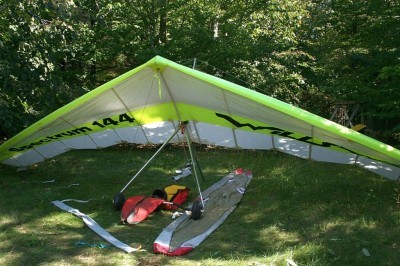
The 1991 Spectrum is an excellent wing easy to take off and fly. Good turning and behaves well at minimum drop rate in marginal condition. Its ability to penetrate is surprising.
Spectrum 144 Wing area: 13.37 m² Wing span: 9.44 m Aspect ratio: 7 Hang glider weight: 24 kg Minimum pilot weight: 50 kg Maximum pilot weight: 95 kg Packed length: 5.5 m Packed length short: 3.7 m Number of battens: 19 Nose angle: 120°
Spectrum 165 Sail Area: 165 sq. ft / 15.32 m² Wing span: 10.35 m Aspect ratio: 7 Glider Weight: 61 lbs / 28 kg Pilot Hook-in Weight: 140 – 240 lb / 63-108 kg Packed length: 6 m Packed length short: 3.9 m Number of battens: 19 Nose angle: 121° Skill Level: Novice SS/DS: Double Surface KP/TL: Kingpost VG: No
The 1997 Fusion is a topless model hang glider for advanced pilots.
The Fusion SP can be stiff to turn when VG is tight. Glide is great. Just be aware and allow for the extended glide when landing, it seems to go forever in ground effect. Flare window is reasonable. Try 1/4 VG for a clean break on flare.
Fusion 141 Wing area: 13 m² Wing span: 10 m Aspect ratio: 7.7 Hang glider weight: 35 kg Minimum speed: 30 km/h Number of battens: 30
Fusion 150 Wing area: 13.9 m² Wing span: 10.4 m Aspect ratio: 7.7 Hang glider weight: 36 kg Minimum pilot weight: 65 kg Maximum pilot weight: 110 kg Minimum speed: 32 km/h Number of battens: 28 Nose angle: 127°
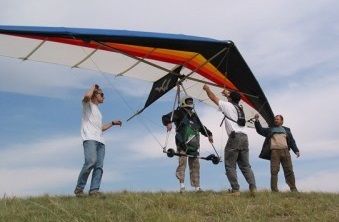
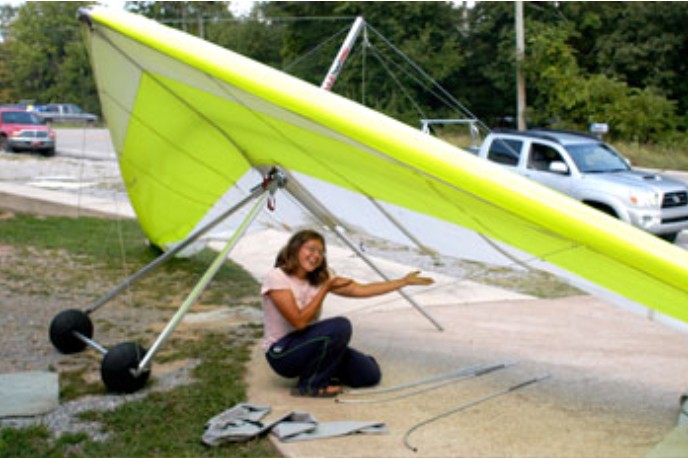
The Wills Wing Falcon has USHGMA certification, 7075 airframe for strength and light weight (19 23 kg). Fly prone or seated (with PG harness). The Falcon can be rigged both flat or on the A frame. Hang glider pilots are amazed at the manoeuvrability, superior climb and easy landings.
The Falcon 225 Tandem skyfloater can be used for tandems but is probably better suited for learner or solo pilot over 90kgs.
Shortening of the rear wires and keel suits motor harness.
One version of the Falcon primary single surface glider held the world record for cross country distance on a single surface glider at 205 miles (330 km).
The Falcon model line has gone through changes from the original Falcon, to the Falcon 2, to the Falcon 3. The Falcon 225 was rated for 185-440 pounds (meant to be tandem-capable), while the Falcon 2 225 was rated 185-300 pounds (meant for solo use). There is no Falcon 3 225 because the Falcon 3 195 is rated up to 275 pounds. The Falcon 3 Tandem was also approved for solo use by very large pilots.
The original 1995 Falcon for novice pilots is described as a breeze to land and handles superbly. It keeps at the top of the stack easily.
Falcon
The 2002 Falcon 2 has a cleaner leading edge and trailing edge (no bungees) than the Falcon 1, and carries more weight per size. Still for novice pilots, a great flier, and very light in weight. The only downside is that they don’t penetrate headwinds like a double-surface, so range is reduced.
The 170 Falcon 2, is 22kg single surface, low stall speed, simplicity, turns flat on narrow coastal soaring, easy landing but is a little bit tricky to start without assistance as the nose want to rise (no problem in weak winds).
The 195 Attack Falcon 2 with mylar sail and Slipstream control bar (airfoiled base bar) was a fine hang glider.
Falcon 2
Wills Wings Falcon 3 170
The Falcon 3 was a 2006 version. The Wills Wing Falcon 3 has improved handling and performance with full mylar leading edge inserts, and now short packs to approximately 2m. It was available in four sizes.
Falcon 140 Wing area: 13 sq.m Certification: USHGA / DHV 1 Pilot weight: 45-75 kg Wing span: 8.47 m Nose Angle: 118 degrees Aspect ratio: 5.5 Hang glider weight: 20 kg Minimum speed: 24 km/h Maximum speed: 85 km/h Number of battens: 13 Price (1998) £ 2195
Falcon 145 Pilot weight: 50-64 kg / 110-140 lb
Falcon 170 Wing area: 15.8 sq.m Certification: USHGA / DHV Pilot weight: 65-100 kg Wing span: 9.32 m Nose Angle: 118 degrees Aspect ratio: 5.5 Hang glider weight: 21 kg Minimum speed: 28 km/h Maximum speed: 85 km/h Number of battens: 13 Price (1998) £ 2195
Falcon 195 Wing area: 18.2 sq.m Certification: USHGA / DHV 1 Pilot weight: 70-125 kg Wing span: 10.5 m Hang glider weight: 23 kg Nose Angle: 118 degrees Aspect ratio: 5.6 Minimum speed: 24 km/h Maximum speed: 85 km/h Number of battens: 13 Price (1998) £ 2195
Falcon 225 Bi Wing area: 20.9 sq.m Certification: USHGA / DHV Pilot weight: 80-200 kg Wing span: 10.91 m Hang glider weight: 27 kg Nose Angle: 118 degrees Aspect ratio: 5.7 Maximum speed: 85 km/h Price (1998) £ 2650
Falcon 2 140 Wing area: 13 m² Wing span: 8.2 m Aspect ratio: 5.5 Hang glider weight: 20 kg Minimum pilot weight: 50 kg Maximum pilot weight: 64 kg Maximum speed: 67 km/h
Falcon 2 170 Wing area: 15.8 m² Wing span: 9.1 m Aspect ratio: 5.5 Hang glider weight: 22 kg Minimum pilot weight: 64 kg Maximum speed: 67 km/h
Falcon 2 195 Wing area: 18.1 m² Wing span: 10.1 m Aspect ratio: 5.6 Hang glider weight: 24 kg Minimum pilot weight: 77 kg Maximum pilot weight: 100 kg Maximum speed: 67 km/h
Falcon 2 225 Wing area: 20.9 m² Wing span: 10.7 m Aspect ratio: 5.7 Hang glider weight: 28 kg Minimum pilot weight: 100 kg Maximum pilot weight: 122 kg Maximum speed: 67 km/h
Falcon 2 Tandem Wing area: 20.9 m² Wing span: 10.7 m Aspect ratio: 5.7 Hang glider weight: 32 kg Minimum pilot weight: 100 kg Maximum pilot weight: 204 kg Maximum speed: 67 km/h
Falcon 3 170 Wing area: 15.8 m² Wing span: 9.1 m Aspect ratio: 5.5 Hang glider weight: 22 kg Minimum pilot weight: 64 kg Maximum pilot weight: 77 kg Minimum speed: 29 km/h Maximum speed: 77 km/h Packed length: 5.4 m Packed length short: 1.8 m
Falcon 3 195 Wing area: 18.1 m² Wing span: 10.1 m Aspect ratio: 5.6 Hang glider weight: 24 kg Minimum pilot weight: 77 kg Maximum pilot weight: 100 kg Minimum speed: 29 km/h Maximum speed: 77 km/h Packed length: 5.9 m Packed length short: 2.1 m
 All Aero