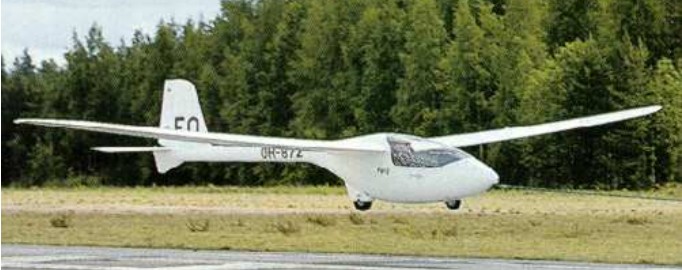
The PW-5 was the winning entry in the IGC/ OSTIV World Class design contest. The Polytechnika Warszawska design was available for license contruction both by manufacturers and homebuilders. PZL Swidnik is the first manufacturing licensee to reach production. It is flapless, has upper surface Schempp-Hirth airbrakes for approach control, and a fixed main wheel. PZL has announced that PW-5 production will be transferred to PZL Bielsko by the end of 1997. The structure is GFRP, with a fabric covered rudder.
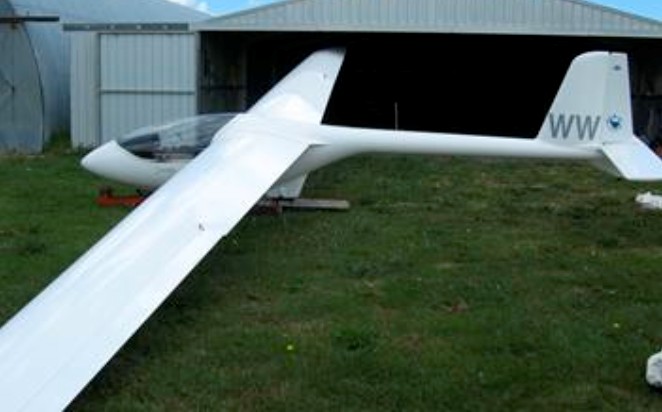
The SZD-59 was designed both as a contest aerobatic sailplane (+7/ -5 g) and, with wingtip extensions, as a 15 m. Standard Class sailplane. It has top and bottom surface Schempp-Hirth type airbrakes, retractable main wheel and provision for water ballast. The 15 m tip extensions come with optional winglets. Control connections are fully automatic.
Wing span: 13.2 m / 43.9 ft Wing area: 9.8 sq.m / 105.49 sq.ft Aspect ratio: 17.79 Airfoil: NN 8 Empty Weight: 265 kg / 584 lb Payload: 115 kg / 235 lb Gross Weight: 380 kg / 838 lb Wing Load: 38.82 kg/sq.m / 7.96 lb/sq.ft L/DMax: 36 115 kph / 62 kt / 71 mph MinSink: 0.77 m/s / 2.53 fps / 1.50 kt Seats: 1
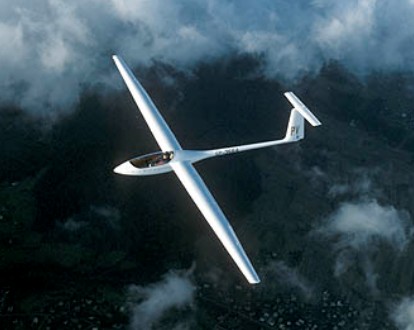
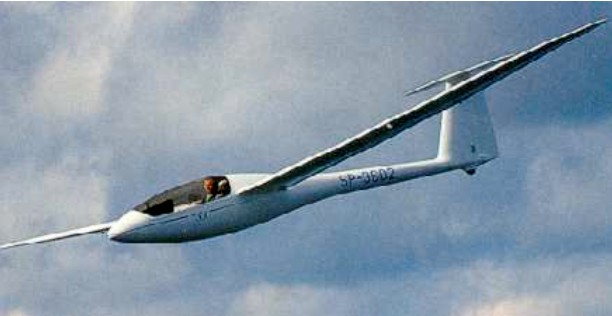
The Diana sailplane, designed by Borgumil Beres, is a flapped single place high-performance sailplane 15-meter with a mid- height wing and a “T”-tail arrangement. It uses carbon and aramide fibers exclusively to achieve an impressively low weight for a competitive sailplane of this type. The unique “sparless” wings can hold 160 litres (42.25 gallons) of water ballast, with a scant 46 kg (101.4 lb) weight for each wing panel. The structure of the Diana is exceeds the strength requirements of the JAR-22 Utility Category. The control stick is mounted on the right hand side of the cockpit rather than in the more customary center position. This arrangement brings the instrument panel closer to pilot. The adjustable backrest and headrest combine with the in-flight adjustable pedals for pilot comfort. The Diana has the capacity to carry up to 5.8 liters (1.5 gallons) of tail ballast to correct C.G. location. The ballast tanks are fitted with relief valves to relieve the pressure caused by ballast in a spin. Glidepath control is provided by top-surface air brakes. Roll rate (45 degrees to 45 degrees) is approximately 3 sec.
Wing span: 15 m / 49.21 ft Wing area: 8.16 sq.m / 87.84 sq.ft Aspect ratio: 27.5 Airfoil: NN-27-13 Empty Weight: 175 kg / 385.8 lb Payload: 115 kg / 253.5 lb Gross Weight: 410 kg / 904 lb Wing Load: 50.3 kg/sq.m / 10.3 lb/sq.ft Water Ballast: 160 kg / 353 lb L/DMax: 48:1 MinSink: 0.46 m/s / 1.51 ft/s / 0.89 kt Seats: 1
Designed by Tadeusz Labuc, this Standard Class sailplane first flew in 1988. Built from GFRP, epoxy and composites, the wing planform is of the Discus type. It has upper surface double segment Schempp-Hirth type airbrakes for approach control and a 9 kg./ 20 lb. Fin ballast tank in addition to wing tank. An SZD-55 placed second in the Standard Class at the 1991 World Championships at Uvalde TX, and another placed third at the 1993 Worlds at Borlange, Sweden.
Wing span: 15 m / 49.2 ft Wing area: 9.6 sq.m / 103.33 sq.ft Aspect ratio: 23.44 Airfoil: NN 27 Empty Weight: 210 kg / 463 lb Payload: 290 kg / 639 lb Gross Weight: 500 kg / 1102 lb Wing Load: 52 kg/sq.m / 10.65 lb/sq.ft Water Ballast: 220 kg / 441 lb L/DMax: 43 85 kph / 46 kt / 53 mph MinSink: 0.63 m/s / 1.6 fps / 1.17 kt Seats: 1
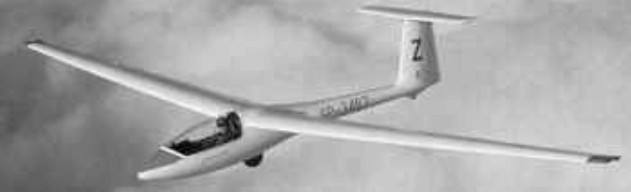
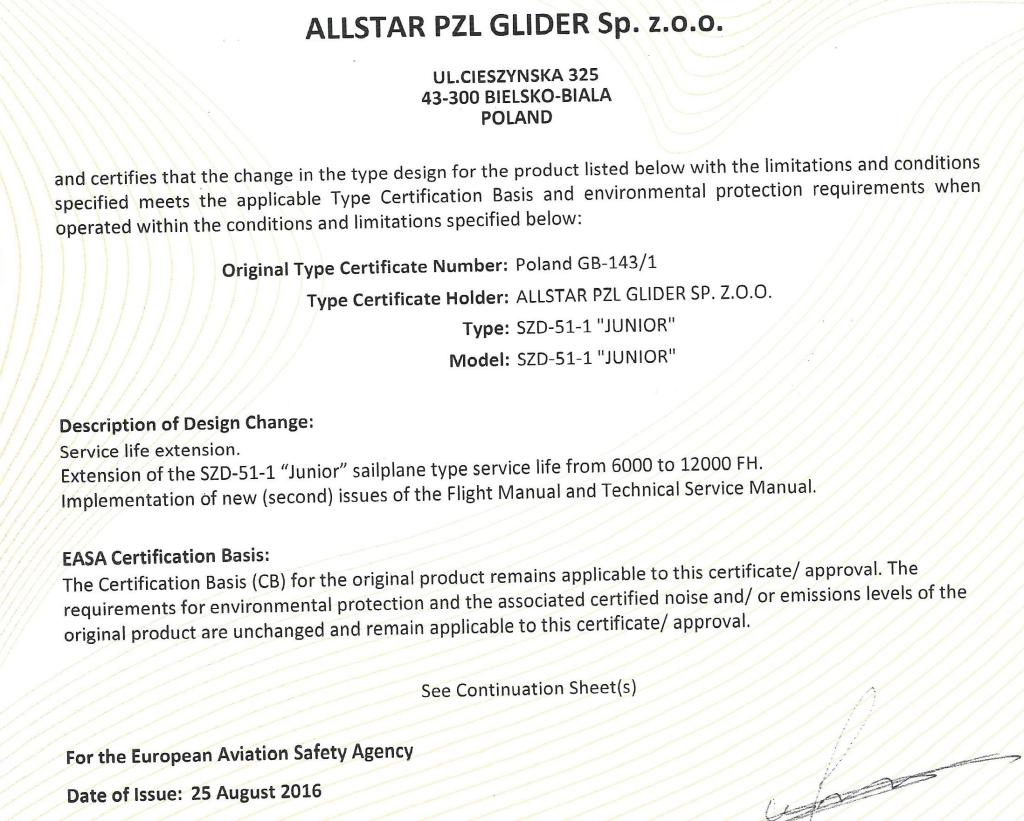
Designed by Stanislaw Zientek, this simple early solo/ club glider first flew in 1980. It has a fixed main wheel and top surface Schempp-Hirth type airbrakes. A simplified model 51-2 was a runner up in the IGC World Class design contest. The structure is GFRP, epoxy, and steel tube.
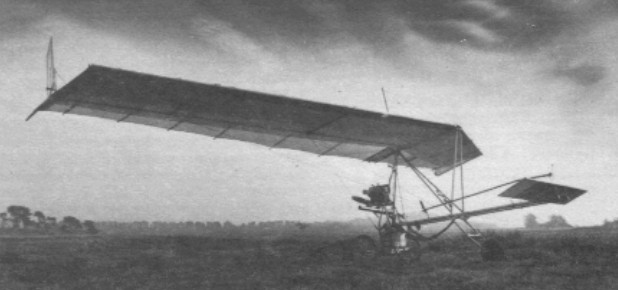
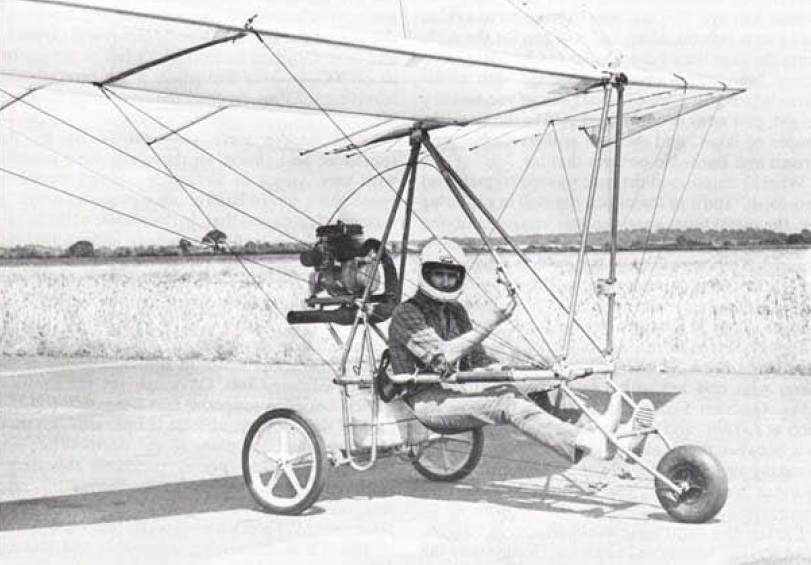
Single seat single engined high wing mono¬plane with two axis control. Wing has swept back leading and trailing edges, and tapering cord; no tail, canard wing. Pitch control by fully flying canard; yaw control by tip rudders; no separate roll control; control inputs through stick for pitch/yaw. Wing braced from above by kingpost and cables, from below by cables; wing profile Klaus Hill (Fledgling); double surface. Undercarriage has three wheels in tricycle formation; bungee suspension on all wheels. No ground steering. No brakes. Aluminium tube framework, without pod. Engine mounted below wing driving pusher propeller.
The Ptraveler is a Pfledgling 430D with a fully flying canard, and can be regarded as a ‘back to front’ Pfledgling NFL, with the elevator moved to the front. The two main horizontal lateral tubes of the Pfledgling frame are elongated towards the front to carry the extra control surface, creating a two axis control ultralight with a side mounted stick. This operates the canard via a pushrod with ball joints at the end, and acts on the tip rudders via control cables. However, the seat is still a simple band of cloth as in the earlier models and allows the Ptraveler pilot to adjust the aircraft’s centre of gravity in flight by weight shift.
Making its appearance in 1980, this single-seater retains the Cuyuna 430D engine with¬out reduction drive. Apart from the canard, the structure remains unchanged from the Pfledgling 430D and the performance is similar. Various options are, however, now available on the Ptraveler, of which the most important is a three axis conversion using large spoilerons mounted some 6 inch (15 cm) above the wing. These spoilerons deploy by rotating forward and down and, depending on the installation method chosen, can be moved either by the pedals or by the stick (the tip rudders being operated by the pedals in the latter case); the customer can thus choose unconventional or conventional three axis control.
Other options are nosewheel steering, both push right go right and push right go left arrangements being available, and a parachute system.
Price in kit form: $4926 in 1983.
Engine: Cuyuna 430D, hp at 5500 rpm Propeller diameter and pitch 36 x 16 inch, 0.91 x 0.41 m No reduction Max static thrust 165 lb, 75 kg Power per unit area 0.19hp/sq.ft, 2.0 hp/sq.m ¬Fuel capacity 2.5 US gal, 2.1 Imp gal, 9.5 litre Length overall 16.8 ft, 5.08 m Height overall 9.1ft, 2.77m Wing span 33.0ft, 10.06m Mean chord 5.5 ft, 1.65 m Chord at tip 4.5 ft, 1.34 m Total wing area 173 sq.ft, 16.1 sq.m Main wing area 162 sq.ft, 15.1 sq.m Canard area 11.0sq.ft, 1.0sq.m Main wing aspect ratio 6.7/1 Nosewheel diameter overall 14 inch, 36 cm Main wheels diameter overall 20 inch, 51 cm Empty weight 200 lb, 91kg Max take off weight 465 lb, 211kg Payload 265 lb, 120kg Max wing loading 2.87lb/sq.ft, 13.9 kg/sq.m Max power loading 15.5 lb/hp, 7.0kg/hp Load factors; +4.4, 3.3 ultimate Max level speed 55 mph, 88 kph Never exceed speed 55 mph, 88 kph Max cruising speed 40 mph, 64 kph Economic cruising speed 35 mph, 56 kph Stalling speed 24 mph, 38 kph Max climb rate at sea level 400 ft/min, 2.0 m/s Min sink rate 400ft/min, 2.0m/s Best glide ratio with power off 8/1 Take off distance 125 ft, 38 m Landing distance 50 ft, 15 m Service ceiling 15,000 ft, 4570 m Range at average cruising speed 120 mile, 193 km
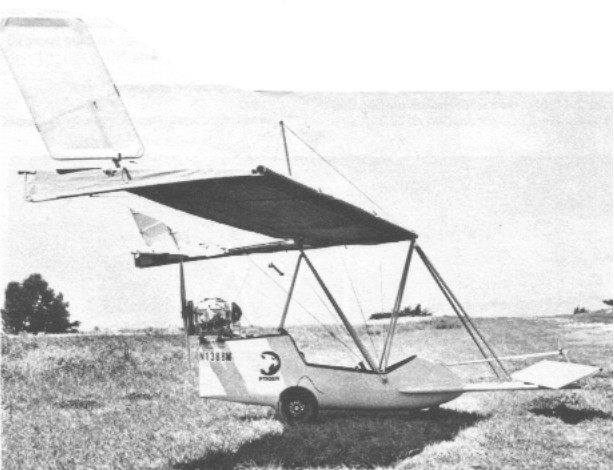
Single seat single engined high wing mono¬plane with conventional three axis control. Wing has swept back leading and trailing edges, and tapering chord; no tall, canard wing. Pitch control by fully flying canard; yaw control by fin mounted rudders; roll control by spoilers; control inputs through stick for pitch/roll and pedals for yaw. Wing braced from above by kingpost and cables, from below by cables; wing profile Klaus Hill (Fledgling); double surface. Undercarriage has three wheels in tricycle formation; glass¬fibre suspension on all wheels. Ground steer¬ing by differential braking. Brakes on main wheels. Aluminium tube/glass fibre/foam fuselage, partially enclosed. Engine mounted below wing driving pusher propeller.
The Ptiger is basically an up market Ascender II, from which it princi¬pally differs by the addition of three axis control and the complete fairing in of the lower fuselage with a polyurethane foam/glass fibre structure having an open cockpit. It also has a smaller wing. Shown at Oshkosh in August 1982, the Ptiger is the most recent variation on the Pfledge theme and is the top of the Pterodactyl range.
Although the Ptiger can be fitted with the spoilerons (as described under Ptraveler), it normally gets its roll control from smaller spoilers. In either case, it is a conventional three axis control ultralight, with the stick operating spoilers or spoilerons and the fully flying canard. Pedals operate the tip rudders, which may be deployed together to act as air brakes, and also control individual main¬wheel brakes to provide ground steering. Under American legisation, the Ptiger is too fast to be an ultralight and is classified as an experimental aircraft, with its pilot need¬ing a licence to fly it. For this reason, Pterodactyl deliver it as a single kit, which according to the company requires around 100 h for assembly. Mainwheel fairings are an option. The price in January 1983 was $5460.
Engine: Cuyuna 430RR, 30 hp at 5500 rpm Propeller diameter and pitch 54 x 27 inch, 1.37 x 0.69 m V belt reduction Fuel capacity 5.0 US gal, 4.2 Imp gal, 18.9 litre Length overall 14.0 ft, 4.26 m Height overall 9.0 ft, 2.74 m Wing span 29.0 ft, 8.84 m Total wing area 150 sq.ft, 13.9 sq.m Nosewheel dia¬meter overall 11 inch, 28cm Main wheels diameter overall 13 inch, 33cm Empty weight 240 lb, 109 kg Max take off weight 550 lb, 249kg Payload 3101b, 140kg Max power loading 13.5 lb/hp, 8.3kg/hp Max level speed 65 mph, 104 kph Max cruising speed 55 mph, 88 kph Economic cruising speed 40 mph, 64 kph Stalling speed 30 mph, 48 kph Max climb rate at sea level 600 ft/min, 3.0 m/s Min sink rate 400 ft/min, 2.0 m/s Best glide ratio with power off 10/1 Take off distance 150 ft, 45 m Landing distance 120 ft, 36 m Service ceiling 18,000 ft, 5490 m Range at average cruising speed 130 mile, 209 km
Fledgling, a name which rapidly became abbreviated to Fledge. In 1978, Jack McCornack adapted this wing for powered flight and formed the Pterodactyl company to sell the aircraft thus modified. Wanting to link the product unmistakably with his company, he added a silent ‘P’ to the model name, and the Pfledgling was born.
The Pfledge, as this aircraft is usually known, is the basic model from which all the Pterodactyl range is derived, apart from the Light Flyer.
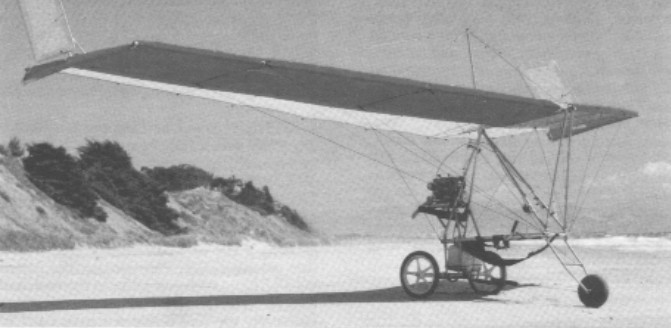
Single seat single engined high wing monoplane with hybrid control. Wing has swept back leading and trailing edges, and tapering chord; no tail. Pitch control by weight shift; yaw control by tip rudders; no separate roll control; control inputs through weight shift for pitch and stick for yaw. Wing braced from above by kingpost and cables, from below by cables; wing profile Klaus Hill; double surface. Undercarriage has three wheels in tricycle formation; bungee suspension on nosewheel and glass fibre suspension on main wheels. No ground steering. No brakes. Aluminium tube framework, without pod. Engine mounted below wing driving pusher propeller.
This aircraft owes its existence to Klaus Hill, who was tragically killed on 10 October 1978 while testing the Voyager, a hang glider of his own design which he had just motorised.
Klaus had earlier designed a rigid tip-rudder hang glider with hybrid control called the Fledgling, a name which rapidly became abbreviated to Fledge. In 1978, Jack McCornack adapted this wing for powered flight and formed the Pterodactyl company to sell the aircraft thus modified. Wanting to link the product unmistakably with his company, he added a silent ‘P’ to the model name, and the Pfledgling was born.
The Pfledge, as this aircraft is usually known, is the basic model from which all the Pterodactyl range is derived, apart from the Light Flyer. In February 1979, Jack McCornack and Dan White made a flight of 50 mile (80 km) in a straight line between Watsonville and Morgan Hill to get to the Great Barnstorming Airshow. One of the first ultralight cross-countries, this was acknowledged as a veritable exploit and the Pfledge received the best new design award and several glowing reports in the specialised press.
That August, Jack, with Keith Nicely, completed in 71 flying hours the trip from Watsonville in California to Oshkosh in Wisconsin. There they teamed up with Jack Peterson and Pat Hirst, who had already flown to Oshkosh with their own Pfledges from Los Angeles on the West coast, and flew on to Kitty Hawk on the East Coast the first transcontinental flights in the history of ultralights. The destination was chosen in honour of Orville and Wilbur Wright, who took off from Kitty Hawk in their famous Flyer back in 1903. This first transcontinental Pfledgling is now on show in the Smithsonian National Air & Space Museum in America. The Pfledge prides itself on being the first American ultralight with ‘all terrain’ capabil¬ity, thanks to its tricycle undercarriage with large wheels and efficient suspension. Initial¬ly fitted with a Zenoah engine, the airframe underwent various modifications during the course of summer ’79, acquiring a Sachs 340 cc engine, the resulting machine being dubbed Pfledgling OR (Oshkosh Replica) , a high performance, double surfaced beast based on the Fledgling rigid-wing hang glider. It was this variant that Jack McCornack and Keith Nicely used on their transcontinental flight.
The next modification was to fit a twin-cylinder Cuyuna 430D (without reduction drive), this model coming out the same year with the name Pfledgling 430D. The wing used was the Manta Fledge II B.
A hybrid control machine, the Pfledge has a swing seat which allows the pilot to control pitch by weight shift. The original aircraft and its OR derivative used a twist grip for each rudder, one either side of the pilot on each main horizontal tube, but for the 430D Pterodactyl substituted a single side mounted stick.
Although the Pfledgling OR was still available in 1983, the company is not actively marketing it and does not quote a price. The mainstream Pfledge now is the 430D which is sold as a kit, a 40 60 h assembly time being claimed. In addition to power pack and airframe, the kit comprises seat, shoulder harness, storage covers (the aircraft is cartoppable), ASI and altimeter. Price: $4547.
The Pfledgling NFL was produced at a time when US law required all ultralights to be foot launchable (theoretically at least!), the NFL was as its title suggests Not Foot Launchable and was aimed at the experimental aircraft market. It consisted of a Pfledgling 430D with an elevator added, carried on two booms behind the frame, where it was exposed to the propwash. A fixed seat replaced the swing seat of the ffledgling 430D, the NFL thus becoming the first Pterodactyl with two axis rather than hybrid control. Though not many of this now obsolete model were sold, the NFL is significant because it paved the way for the Ptraveler. The Acro Dactyl is the result of development work carried out in the summer of 1981, when Pterodactyl undertook trials on two specially reinforced Pfledglings, designed for elementary aerobatics.
Pfledgling 430D Engine: Cuyuna 430D, hp at 5500 rpm Propeller diameter and pitch 36 x 16 inch, 0.91 x 0.41 m No reduction Max static thrust 165 lb, 75 kg Power per unit area 0.19hp/sq.ft, 2.0 hp/sq.m ¬Fuel capacity 2.5 US gal, 2.1 Imp gal, 9.5 litre Length overall 10.0 ft, 3.05 m Height overall 9.1ft, 2.77m Wing span 33.0ft, 10.06m Chord at root 5.5ft, 1.65m Chord at tip 4.5 ft, 1.34 m Total wing area 162 sq.ft, 15.1 sq.m Wing aspect ratio 6.7/1 Nosewheel diameter overall 14 inch, 36 cm Main wheels diameter overall 20 inch, 51 cm Empty weight 165 lb, 75 kg Max take off weight 425 lb, 193kg Payload 260 lb, 118 kg Max wing loading 2.62 lb/sq.ft, 12.8 kg/sq.m Max power loading 14.2 lb/hp, 6.4kg/hp Load factors; +4.4, 3.3 ultimate Max level speed 55mph, 88kph Never exceed speed 55mph, 88 kph Max cruising speed 45 mph, 72 kph Economic cruising speed 35mph, 56kph Stalling speed 23 mph, 37 kph Max climb rate at sea level 400 ft/min, 2.0 m/s Min sink rate 400ft/min, 2.0m/s Best glide ratio with power off 9/1 Take off distance 125 ft, 38 m Landing distance 100 ft, 30 m Service ceiling 15,000 ft, 4570 m Range at average cruising speed 125 mile, 201 km
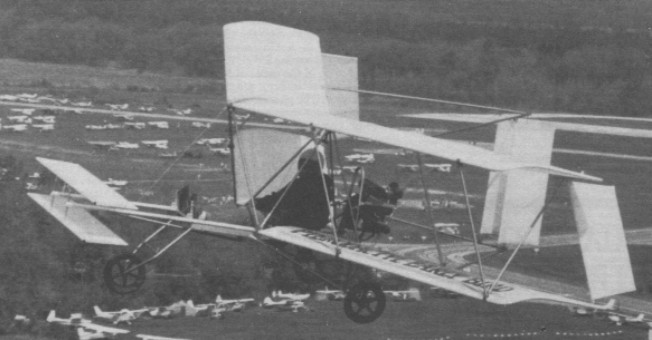
Single seat single engined biplane with con¬ventional three axis control. Wings have swept back leading and trailing edges, and constant chord; two fin tail and canard wing. Pitch control by double fully flying canard; yaw control by tip rudders between wings and twin fully flying tail rudders; roll control by ailerons on lower wings; control inputs through stick for pitch/roll and pedals for yaw. Wing braced from above by struts and transverse X cables; wing profile; double ¬surface. Undercarriage has three wheels in tricycle formation; bungee suspension on nosewheel and glass fibre suspension on main wheels. No ground steering. No brakes. Aluminium tube framework, without pod. Engine mounted between wings driving pusher propeller.
The prototype Pterodactyl caused a sensation at Sun ‘n’ Fun in March 1983 at Lakeland. Florida, where it was shown publicly for the first time. With the Light Flyer, Pter¬odactyl has moved away from their earlier productions. Structurally, the only points in common between them and the new design are the undercarriage construction and the canard configuration.
One of the first photographs of the Light Flyer, showed it with two rudders mounted behind the wings, in the propwash. More recent literature shows that the aircraft now also has tip rudders which are hinged on the interplane struts near the wing tips. The Light Flyer is sold as a kit requiring around 125 h assembly for a price of $5420 in 1983.
Engine: Cuyuna 430R, 30 hp at 5500 rpm Propeller diameter and pitch 54 x 27 inch, 1.37 x 0.69 m V belt reduction, ratio 2.0/1 Power per unit area 0.7 hp/sq.ft, 1.9 hp/sq.m Fuel capacity 5.0 US gal, 4.2 Imp gal, 18.9 litre Length overall 15.7 ft, 4.78 m Height overall 7.0 ft, 2.13 m Wing span 26.0 ft, 7.92 m Total wing area 174sq.ft, 16.2 sq.m Empty weight 240 lb, 109kg Max take off weight 500 lb, 227kg Payload 260 lb, 118kg Max wing loading 2.87 lb/sq.ft, 14.0kg/sq.m Max power loading 16.7 lb/hp, 7.6kg/hp Max level speed 55 mph, 88 kph Never exceed speed 55 mph, 88 kph Max cruising speed 45 mph, 72 kph Economic cruising speed 35 mph, 56 kph Stalling speed 24 mph, 39 kph Max climb rate at sea level 800 ft/min, 4.1 m/s Take off distance 110ft, 34 m Landing distance 50 ft, 15 m Service ceiling 18,000 ft, 5490 m Range at average cruising speed 100 mile, 160km
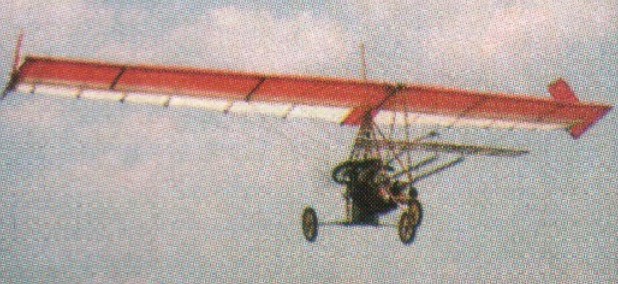
This canard (tail-first) microlight is based on the Manta Fledge hang-glider and several versions have been developed in the United States by Pterodactyl Limited. The latest version to be developed, is the Ascender. The Ascender differs from the earlier Ptraveler in that the engine drives the propeller through a belt-drive reduction system. The Pterodactyl gives the impression of a large size because of the high wing and larger wheels than other types. First built in 1981. A monowing with an all-flying canard control surface and wingtip winglets. All control surfaces are movable. Control features are similar to Ptraveler. Weight shift is not necessary but can affect trim. Sink rate can be increased by using the canard as an air brake in the full-up position. A mixer stick deploys the winglets and canard. Construction con¬sists of aluminum tubing, with stainless steel cable and aircraft hardware used throughout. Dacron sailcloth covers the wings and winglets. Stitts Poly-fiber covers the canard. With optional bridle and release, the No Pturkey can be used to air-tow gliders.
In 1982 it was succeeded by the Ascender II, which has the benefits of a wider track, shock absorbers of laminated glass fibre in the main axles and a nosewheel increased in diameter from 14 to 16 inch (36 41 cm). The price in May 1983 is $5242.
Another version, the Ascender II+, has an enlarged framework for the heavier pilot and appeared the same year. It has a reinforced structure and makes use of larger diameter tubing. In addition, it has as standard the double capacity fuel tank, which is only an option on the Ascender II. Price for the Ascender II+ in May 1983 is $5536, as a kit requiring some 75 h assembly time.
August 1983
Three axis, nosewheel steering and para¬chute options are available as on the Ptravel¬er, and in addition the Ascender buyer is offered an optional rigid seat, made of glass fibre and weighing some 5 lb (2.3 kg) more than the swing seat it replaces.
The Ascender II+2 is the same as the Ptraveler except: Side by side two seater. Bungee suspension on nosewheel and glass fibre suspension on main wheels. Given the increased strength of the Ascender II+ airframe com¬pared to that of the standard single seaters, it was inevitable that the Watsonville company would sooner or later use it as the basis of a two seater, and this duly appeared in October 1982 as the Ascender II+2. Before putting the Ascender II+2 into production, Jack McCormack and Robyn Solair from Ultralight Flyer magazine set off on the by now traditional proving trip in the Ascender II+2 prototype, this time travelling 1025 mile (1649 km) to the Mexican frontier and back.
In the US, the Ascender II+2, like all other two seaters, is classified as an experimental aircraft rather than an ultralight, though Jack prefers to play down the legal restraints by describing it as a single seater with a sidecar. Kits are available to convert an Ascender II+ into an Ascender II+2, the modification being extremely simply by virtue of the II+’s already enlarged frame, which allows the change to be made by simply adding the second seat (six bolts) and repositioning the throttle centrally. In all other respects the two aircraft are identical and, like the single¬-seater, the II+2 can have optional three axis control, nosewheel steering and a parachute system.
By August 1983 the FAA had inspected the Pterodactyl Ascender II+2 and approved it as an amateur-built aircraft kit. Prior to this, builders needed local approval for amateur registration.
A prototype two seater known as the Double Dactyl had appeared, but that particular dual machine never got into production.
Production was taken over by Freedom Fliers and by 1995, DFE Ultralights.
Ascender Engine: 430 cc / 30 hp Cuyana 2-cylinder Two-stroke Wing Span: 33 ft Wing Area: 162 sq. ft. (canard: 11 sq.ft.) Aspect ratio, 6.5 Overall length, 14 ft Cruise Speed: 36-45 mph Stall speed: 23mph Max. Rate of climb: 1,000 fpm Empty weight: 215 lbs Max. pilot weight: 230 lb Usable payload (include fuel), 265 lb Wing loading, 2.75 lbs/sq.ft L/D power-off glide ratio, 9:1 Takeoff roll distance, 75 ft Fuel capacity, 5 Usgal Range at cruise, 100 mi Range: 130 miles
Ascender II Engine: Cuyuna 430R, 30 hp at 5500 rpm Propeller diameter and pitch 54 x 27 inch, 1.37 x 0.69 m V belt reduction, ratio 2.0/1 Power per unit area 0.19hp/sq.ft, 2.0hp/sq.m Fuel capacity 5.0 US gal, 4.2 Imp gal, 18.9 litre Length overall 16.8 ft, 5.08 m Height overall 9.1ft, 2.77m Wing span 33.0ft, 10.06m Mean chord 5.5 ft, 1.65 m Chord at tip 4.5 ft, 1.34 m Total wing area 173 sq.ft, 16.1 sq.m Main wing area 162 sq.ft, 15.1 sq.m Canard area 11.0sq.ft, 1.0sq.m Main wing aspect ratio 6.7/1 Nosewheel diameter overall 16 inch, 41 cm Main wheels diameter overall 20 inch, 51 cm Empty weight 218 lb, 99 kg Max take off weight 465 lb, 211kg Payload 247 lb, 112kg Max wing loading 2.87 lb/sq.ft, 13.9 kg/sq.m Max power loading 15.5 lb/hp 7.0 kg/hp Load factors; +4.4, 3.3 ulti¬mate Max level speed 55mph, 88kph Never exceed speed 55 mph, 88 kph Max cruising speed 45mph, 72kph Economic cruising speed 35mph, 56kph Stalling speed 24 mph, 39 kph Max climb rate at sea level 1000 ft/min, 5.1 m/s Min sink rate 425ft/min, 2.2 m/s Best glide ratio with power off 8/1 Take off distance 80 ft, 25 m Landing distance 50ft, 15 m Service ceiling 21,000ft, 6400 m Range at average cruising speed 120 mile, 193 km
Ascender II+ Engine: Cuyuna 430R, 30 hp at 5500 rpm Propeller diameter and pitch 54 x 27 inch, 1.37 x 0.69 m V belt reduction, ratio 2.0/1 Power per unit area 0.19hp/sq.ft, 2.0hp/sq.m Fuel capacity 10.0 US gal, 8.3 Imp gal, 37.9 litre Length overall 16.8 ft, 5.08 m Height overall 9.1ft, 2.77m Wing span 33.0ft, 10.06m Mean chord 5.5 ft, 1.65 m Chord at tip 4.5 ft, 1.34 m Total wing area 173 sq.ft, 16.1 sq.m Main wing area 162 sq.ft, 15.1 sq.m Canard area 11.0sq.ft, 1.0sq.m Main wing aspect ratio 6.7/1 Nosewheel diameter overall 16 inch, 41 cm Main wheels diameter overall 20 inch, 51 cm Empty weight 235 lb, 107 kg Max take off weight 535 lb, 243kg Payload 300 lb, 136kg Max wing loading 3.30 lb/sq.ft, 16.1 kg/sq.m Max power loading 17.8 lb/hp 8.1 kg/hp Max level speed 60mph, 97kph Never exceed speed 65 mph, 105 kph Max cruising speed 50mph, 80kph Economic cruising speed 40mph, 64kph Stalling speed 27 mph, 43 kph Max climb rate at sea level 900 ft/min, 4.6 m/s Min sink rate 475ft/min at 30mph, 2.4 m/s at 48 kph Best glide ratio with power off 8/1 Take off distance 90 ft, 27 m Landing distance 50ft, 15 m Service ceiling 18,000ft, 5490 m Range at average cruising speed 200 mile, 322 km
Ascender II+2 Engine: Engine: Cuyuna 430R, 30 hp at 5500 rpm Propeller diameter and pitch 54 x 27 inch, 1.37 x 0.69 m V belt reduction, ratio 2.0/1 Power per unit area 0.19hp/sq.ft, 2.0hp/sq.m Fuel capacity 5.0 US gal, 4.2 Imp gal, 18.9 litre Length overall 16.8 ft, 5.08 m Height overall 9.1ft, 2.77m Wing span 33.0ft, 10.06m Mean chord 5.5 ft, 1.65 m Chord at tip 4.5 ft, 1.34 m Total wing area 173 sq.ft, 16.1 sq.m Main wing area 162 sq.ft, 15.1 sq.m Canard area 11.0sq.ft, 1.0sq.m Main wing aspect ratio 6.7/1 Nosewheel diameter overall 16 inch, 41 cm Main wheels diameter overall 20 inch, 51 cm Empty weight 250 lb, 113kg Max like off weight 750 lb, 340kg Payload 500 lb, 227kg Max wing loading 4.63 lb/sq.ft, 2.1 kg/sq.m Max power loading 25.0 lb/hp, 11.3 kg/hp Max level speed 60 mph, 97 kph Max cruising speed 50 mph. 80kph Economic cruising speed 40mph. 64kph Stalling speed 32mph, 51 kph Max climb rate at sea level 400ft/min, 2.0m/s Take off distance 200ft, 60m Landing dis¬tance 50ft, 15m Service ceiling 12,000ft. 3660 m Range at average cruising speed 82 mile, 132 km
Ascender III-A Engine: Zenoah G25, 22 hp Height: 9.1 ft Length: 12.3 ft Wing span: 33 ft Wing area: 162 sq.ft Weight empty: 165 lb Gross: 425 lb Fuel cap: 5 USG Speed max: 55 mph Cruise: 40 mph Range: 150 sm ROC: 400+ fpm Take-off dist: 125 ft Landing dist: 50 ft Service ceiling: 18,000 ft Seats: 1 Landing gear: nose wheel
Ascender III-B Engine: Cuyuna 430, 32 hp HP range: 25-45 Height: 9.1 ft Length: 16.8 ft Wing span: 33 ft Wing area: 173 sq.ft Weight empty: 215 lb Gross: 425 lb Fuel cap: 5 USG Speed max: 55 mph Cruise: 40 mph Range: 150 sm ROC: 1000 fpm Take-off dist: 80 ft Landing dist: 50 ft Service ceiling: 18,000 ft Seats: 1 Landing gear: nose wheel
DFE Ascender III-B Engine: Rotax 277, 28 hp Wing span: 10 m Wing area: 16 sq.m Weight empty: 108 kg Gross: 210 kg Fuel cap: 19 lt Speed max: 90 kph Min speed: 45 kph ROC: 5 m/s Seats: 1 Kit price 1998: US$6750
Ascender III-C Engine: Cuyuna 430, 32 hp HP range: 25-65 Height: 9.1 ft Length: 16.8 ft Wing span: 33 ft Wing area: 173 sq.ft Weight empty: 235 lb Gross: 535 lb Fuel cap: 5 USG Speed max: 55 mph Cruise: 40 mph Range: 150 sm ROC: 1000 fpm Take-off dist: 90 ft Landing dist: 50 ft Service ceiling: 18,000 ft Seats: 1 Landing gear: nose wheel