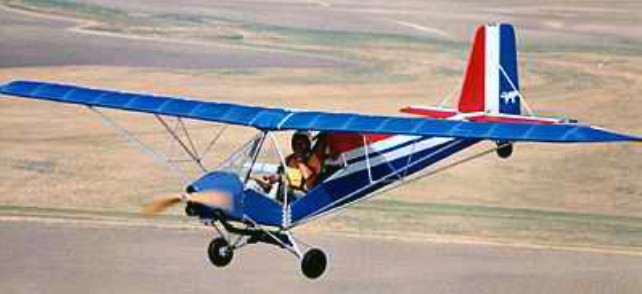
RANS S-4 Coyote

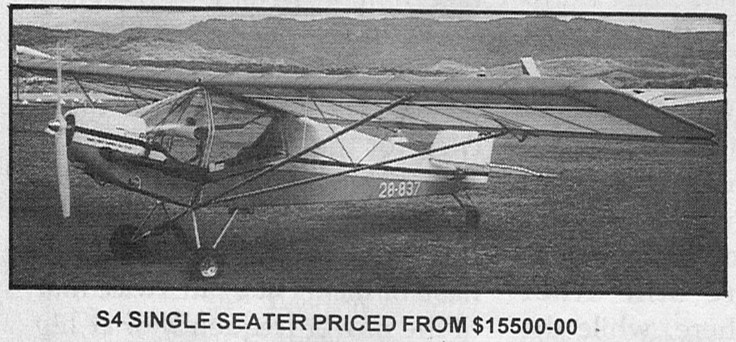
Construction began in November 1982, with the first flight being in November 1982. Single seat single engined high wing mono¬plane with conventional three axis control. Conventional tail. Control inputs through stick for pitch/roll and pedals for yaw. Wing braced from below by struts; wing profile; double surface. Undercarriage has three wheels in tail dragger formation. Push right go right tailwheel steering connected to yaw control. Aluminium tube framework, totally enclosed. Engine mounted below wing driving tractor propeller.
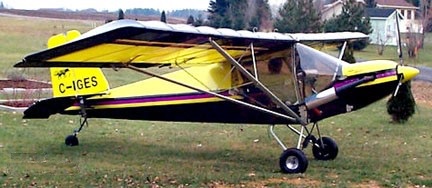
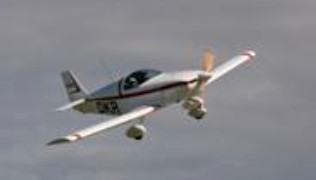
Rans S-4 Coyote C-IGES

The cockpit is fully enclosed and there is only one seat. Equipped with doors, 4 position flaps, elevator trim, bungee suspension landing gear, steerable tailwheel, brakes, radio and headset. Rotax 503 with electric start gives a 70 mph cruise.

The Coyote S 5 is a nosewheel version.
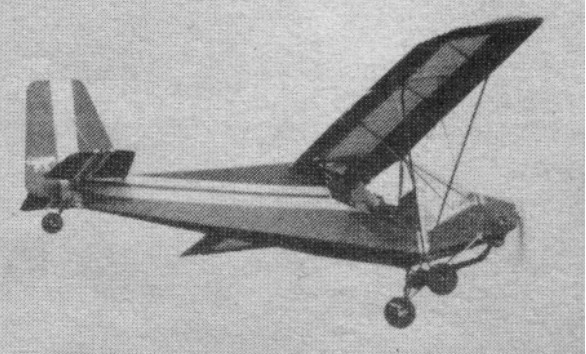
June 1997

Gallery

Engine: Rotax 277 (268 cc), 28 hp
Static thrust: 220 lbs.
Empty wt: 240 lb
Wing span: 32ft.
Wing area: 138 sq.ft
Height: 5ft 6in
Length: 17ft
Fuel cap: 5 USG.
Construction: Aluminium, Dacron
Max wt: 535 lbs.
Stall: 25 mph
Max speed: 63 mph.
Vne: 75 mph
Climb rate: 800 fpm @ 30 mph.
Design limit: +6, -3g
Glide ratio: 11-1.
Wing loading: 3.88 lbs/sq.ft
Power loading: 19.11 lbs/hp.
Seats: 1.

RANS S4 single seat
Engine: Rotax 503
Fuel burn: 12 lt/hr
Fuel capacity: 60 lt
VSO: 28mph
VSI: 31mph
VFE: 50mph
VNO: 70mph
VNE: 94mph
RANS

Randy Schlitter began building “sailtrikes” (better known to us as land yachts) in 1974 in Kansas before moving on to pushbikes and microlights. His first flying machine was the Coyote, which first flew in March of 1983 under the Aeromax name. This was soon changed to the RANS name. RANS standing for Research and Natural Systems.
1982: Aero Max Inc, 1104 E Highway 40 By Pass, Hays, Kansas 67601, USA.
1984: 1104 E. Highway 40 By-Pass, Hays, KS 67601, USA.
1997-8: 4600 Highway 183 Alternative Hays, KS 67601, USA. Ph 785/625 6346, fax 785/625 2795.

Rand KR-3

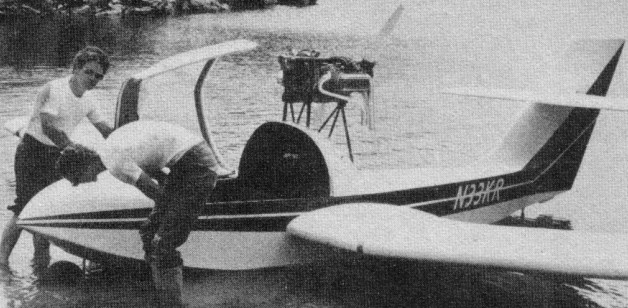
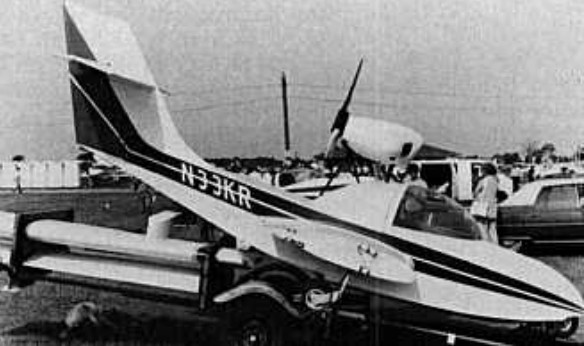
The KR-3 amphibian was originally designed and built by Ken Rand and Stu Robinson in 1976. The prototype was first tested in June 1977. Following Ken’s tragic death in a plane crash, the improved prototype was completed in February 1981, and was undergoing FAA certification as an Amateur-Built aircraft.

The KR-3’s wings are removable and the aircraft is trailerable. The new fuselage is 9” longer than the original, with the C of G moved forward 8” and the airfoil changed from GA(W)-1 to basically a Clark Y 4418 tapering to 4412. Following the trend-setting construction techniques of the KR-1 and KR-2, the KR-3 amphibian is quick and easy to build from wood, foam, Dynel and epoxy resin. The engine is a 2100cc Revmaster VW conversion with a three bladed Rand-Robinson propeller. The tricycle gear is hydraulically actuated. Retraction and extension are a matter of flipping a micro switch to the appropriate position and pumping a light handle located between pilot and passenger. Turbocharging permits the KR-3 to operate efficiently at altitudes up to 15,000 feet.

Engine: 2100cc Turbo Revmaster VW
Span 25’
Length 17’9”
Wing Area 83.17 sq.ft
Seats 2
Gross Weight 1000 lb
Empty Weight 630 lb
Fuel 17 USgal
Cruise 115 mph
Ceiling 15,000’
Range three hours + 45 min res

Rand KR-2S

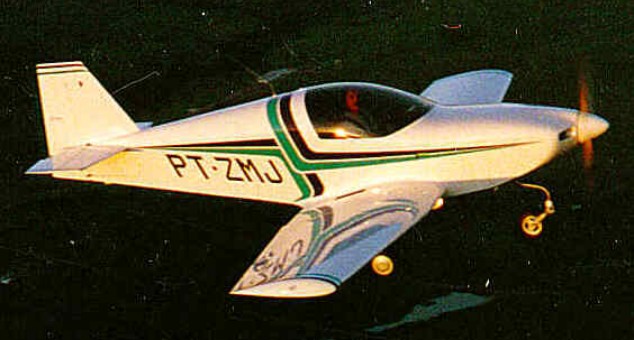
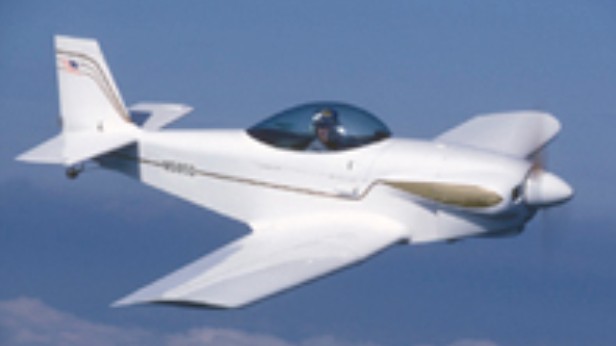
The KR-2S includes a 16 inch stretch in the fuselage over the standard KR-2, 3 inches more head and leg room and pre-molds made of the latest oven-cured, vacuum-bagged pre-pregs. Its raked canopy and fixed landing gear give it a racy appearance and the KR-2S will accommodate engines including VW’s, Subaru derivatives, Continental C-85’s, and O-200’s.

Gallery

Engine: VW 2180, 76 hp
Length: 16 ft
Wing Span: 23 ft
Height: 6 ft
Wing area: 82 sq.ft
Weight empty: 520 lb
MTOW Weight: 445 kg / 980 lbs
Baggage capacity : 35 lb
Fuel cap: 12 USG
VNE: 174 kt / 200 mph / 322 kmh
Stall: 45 kt / 52 mph / 84 kmh
Cruise: 156 kt / 180 mph / 290 kmh
Rate of Climb (light) 1200 fpm
Rate of Climb (gross): 800 fpm / 4 m/s
Service ceiling: 15,000 ft
Take off distance: 350 ft / 107 m
Landing distance: 600 ft / 183 m
Landing Speed: 60-70 mph
Range: 1080 sm
Landing gear: nose or tail wheel
Seats: 2
Width at Hips: 39.5 in
Width at Hips: 36 in

Engine: VW
Wing span: 7 m
Wing area: 7.54 sq.m
MAUW: 445 kg
Empty weight: 236 kg
Fuel capacity: 45 lt
Max speed: 322 kph
Cruise speed: 290 kph
Minimum speed: 84 kph
Climb rate: 6 m/s
Seats: 2
Plan price (1998): $240
Kit price (1998): $7800

Rand KR-2

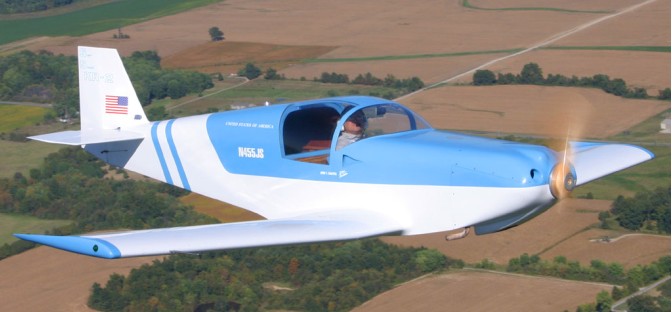
The KR-2 is a two-place version of the KR-1 and is generally similar in construction. The low wings are removable, the main gear is retractable and the tailwheel is steerable. With a stock 1600-cc engine, cruise speed is 140 mph. With a 2100-cc turbocharged VW conversion, cruise is 180 mph at 3200 rpm. To achieve simplicity of construction, the airplane is designed so that no machining or welding is required in building the airframe. The cost and construction time is minimized by using a combination of wood, polyurethane foam, fiberglass cloth and epoxy resin. The result is a structurally strong, clean, hard surface and an exceptionally fast airplane for the power used. All new premolded fiberglass parts have been developed to speed the building time for the KR-2. Luxury upholstery kits are also available and can be simply snapped into position.

First flown in July 1974.

Ken Rand, in 1974, commenced marketing plans and kits for the single seat KR-1 and two-place KR-2. Instant acceptance saw 9000 plans and kitsets sold within the first five years.

Rand KR-2 Builds

As with all KR’s, the KR-2 is equipped with removable wings, and choice of retractable, fixed conventional, or tricycle gear.

Variation:
Boshoff SB2

Gallery

Engine: VW 2100, 76 hp
Length: 14′ 6″
Wing Span: 20′ 8″
Total Wing Area: 80 sq. ft.
Empty weight: 480 lbs.
Gross weight: 900 lbs.
Useful load: 420 lbs.
Baggage capacity: 35 lb
Take off distance: 350 ft.
Landing distance: 900 ft.
Stall Speed: 52 mph / 42 kt
Maximum Speed, Vne: 200 mph / 160 kt
Cruise Speed: 180 mph
Max flap speed: 96 kt / 120 mph
Range: 1600 miles (35 gal. fuel)
Rate of Climb (light): 1200 fpm
Rate of Climb (gross): 800 fpm @ 60 kt / 75 mph
Service ceiling: 15,000 ft.
Fuel: 12-60 US gal.
Fuel consumption: US3.8 gph
Seats: 2
Width at Hips: 38 in
Width at Hips: 36 in
Landing gear: Fixed conventional or trigear, or retractable conventional

Engine: VW 1834
Length: 14ft 4in
Span: 20ft 2in
Wing area: 82 sq.ft.
Empty wt: 480 lb
Gross wt: 900 lb
Top speed: 180 mph
Cruise speed: 170 mph
Stall speed: 42 mph
Seats: 2 side-by-side

Engine: VW 1600
Empty wt: 420 lbs
Max wt: 800 lb
Fuel cap: 12 USG
Top speed: 150 mph
Cruise speed: 140 mph
Stall: 42 mph
Seats: 2
Length: 14 ft 4 in
Wing span: 20 ft 2 in

Rand KR-1B

The KR-1B motorglider is essentially a stock KR-1 with longer wings and a bigger tail. For a wing curve, an RAF-48 standard KR-1 airfoil was used for the center section and the GA(W)-2 airfoil for the replacement outer panels. The outer wing section provides a clean and responsive curve for use with a spoiler/flap control, permitting deadstick landings at 70 mph TAS. Where the stock KR-1 wingspan is 172″, the motorglider wingspan measures 27′ from tip to tip, thereby increasing square footage from 64 to 91.

Power is supplied by a 60-hp VW engine. Maximum cruise is 130 mph, and with 33 gallons of fuel, range is 950 miles while getting 29 mpg. At the standard 4-gph burn rate, 33 gallons should deliver 8.25 hours of flying at 120 mph for a range of 1,020 miles.

Engine: 60-hp VW
Wing span: 27 feet
Wing area: 91 sq.ft
Maximum cruise: 130 mph
Fuel capacity: 33 USgallons
Range: 950 miles
At 120 mph Endurance: 8.25 hours
At 120 mph Range: 1020 miles
Airfoil centre: RAF-48
Airfoil outer: GA(W)-2

Rand KR-1

Ken designed the KR-1 in 1972 using cutting edge building techniques that would later become the standard for modern aviation.

Rand KR-1 Article

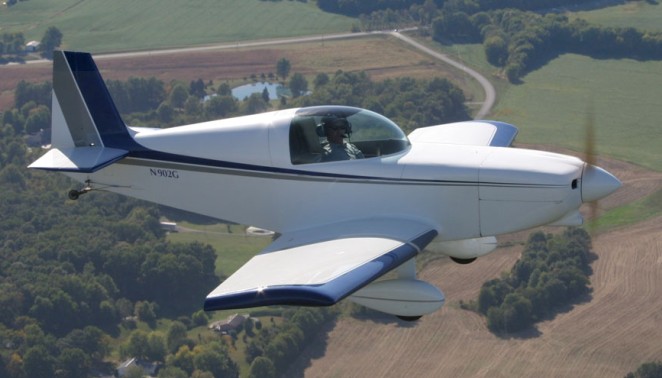
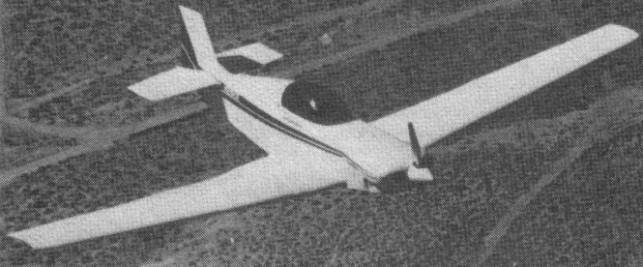
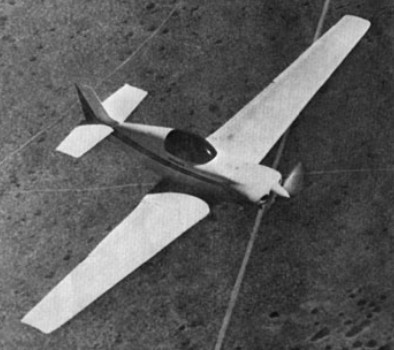
The KR-1 is the single seat low wing retractable monoplane which is typically powered by smaller VW engines, up to the VW 2100. The KR-1B motorglider is a standard KR-1 with modified outer wing sections. With this simple wing conversion, the original KR-1 becomes an excellent self-powered glider.

Ken Rand, in 1974, commenced marketing plans and kits for the single seat KR-1 and two-place KR-2. Utilising spruce, foam and Dynal cloth in construction, these designs could be built in as few as 800 hours sparetime work. The clean lines and smooth finishes attainable with this technique meant reduced drag, resulting in higher speeds on less power. Retractable gear adds to its performance. The prototype KR 1 (first flown in February 1972) reached 150 mph in level flight, powered by a 36 hp converted VW car engine. Instant acceptance saw 9000 plans and kitsets sold within the first five years.

Gallery

Engine: VW 1834, 60 hp
HP range: 60-80
Length: 12′ 9″
Wing Span: 17′ 0″
Total Wing Area: 62 sq. ft.
Empty weight: 375 lbs.
Gross weight: 750 lbs.
Useful load: 375 lbs.
Baggage capacity: 20 lbs. max
Take off distance: 350 ft.
Landing distance: 900 ft.
Stall Speed: 52 mph
Maximum Speed: 200 mph
Cruise Speed: 180 mph
Range: 1400 miles
Rate of Climb (light): 1200 fpm
Rate of Climb (gross): 800 fpm
Service ceiling : 15,000 ft.
Fuel: 8-30 USgal.
Fuel consumption: 3.8 USgph
Landing gear: Fixed conventional or trigear, or retractable conventional
Seats: 1
Width at Hips: 21 in
Width at Hips: 19 in

Engine: 1835 VW
Span: 17’6″
Length: 15’9″
Empty Weight: 410 lb
Useful Load: 340 lb
Wing Area: 75 sq.ft
Seats: 1
Take Off Distance: 600 ft
Stall: 45 mph
Landing Speed: 58 mph
Cruise: 140 – 160 mph
Rate of Climb: 900 fpm

Rand Robinson

1997-8: 15641 Product Lane, Ste A5 Huntington Beach, CA 92649, USA.
2008-9: 7071 Warner Ave. #F, PMB 724, Huntington Beach, CA 92647, USA.

On September 7th, 2009 Jeanette Rand, President of Rand Robinson Engineering, officially announced that nV Aerospace will be the exclusive Manufacturer and Distributor for the KR line of aircraft and related components.
Rand Robinson retained the rights to the design but all inventory and tooling was acquired by nV|Aero to produce the KR kits. Plans for a fast build fuselage, improved wing and empennage airfoils and several other design improvements are under way.