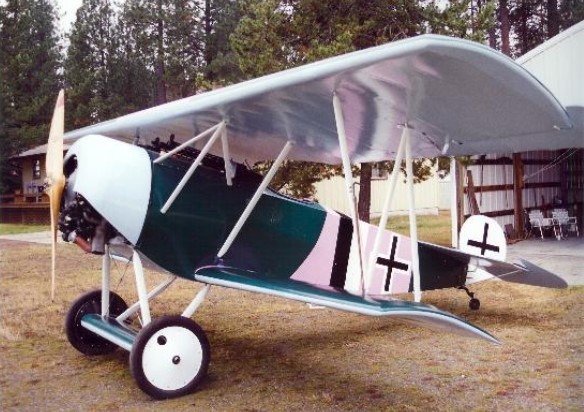
Redfern Fokker D.VI

Engine: Kinner B5, 125 hp
HP range: 125-150
Height: 9.5 ft
Length: 25.21 ft
Wing span: 28.25 ft
Wing area: 266 sq.ft
Fuel cap: 30 USG
Weight empty: 1081 lb
Gross: 1441 lb
Speed max: 93 mph
Cruise: 75 mph
Range: 275 sm
Stall: 45 mph
ROC: 700 fpm
Take-off dist: 75 ft
Landing dist: 300 ft
Service ceiling: 14,000 ft
Seats: 1
Landing gear: tail wheel
Walt built his first airplane in 1949, a Knight Twister from Vernon W. Payne’s plans. It was one of only ten at that time. Walt built 15 aircraft before his death in 1996. Five of these were the Fokker DR1, a favourite with many and still one of the most requested set of plans sold. His first triplane (white) can be found in the EAA museum in Oshkosh, Wisconsin donated by Robert Fergus. Walt was able to build and test fly all his aircraft except for the last one, a Fokker DVI. Walt’s good friend, Steve Wolf, flew this aircraft for the family in September, 1996. This aircraft will be displayed in a museum in the Pittsburgh area.
His great love was WWI aircraft but he had many problems locating plans. His greatest find was Reinhold Platz, who would go on to be his most valued mentor. Reinhold’s knowledge of the DRI, as one of the original designers, was a wealth of information that Walt relied on until his death. Plus he sent the original DRI plans, in German, to Walt to ensure his dream of building the DRI would come true. They continued to correspond with the help of a local high school teacher who spoke German until Reinhold’s death.
During Walt’s life he was able to build 13 additional aircraft and founded Redfern & Son’s Custom Aircraft, Inc. He constructed four additional DRI’s, two Great Lakes (for family fun), a French Nieuport 24 BIS, Starduster 2, de Havilland DH2, Sopwith Camel, Bucher Jungmeister, Albatros DVa, and a Fokker DVI (only aircraft that Walt was not able to test fly).
Per Walt’s request, the family continues to provide two sets of blueprints to the public. Walt also was a great supporter of the EAA. His membership number was 143, showing his early interest in the organization.
1980: Redfern & Sons, Inc., Route 1, Athol, ID 83801, USA.
1995: S-211 Spencer, Post Falls, ID 83854, USA.
A two-seat amphibian (first flown 1994), produced by Pony JSC.
Russia
Established 1991. Developed the two-seat Pony amphibian (first flown 1994), produced by Pony JSC. Four seat Prize, based on Pony but with twin engines, under development.
Raytheon Aircraft Company
In 1993 British Aerospace sold its corporate jets business (builders of the BAe 125-800 and -1000) to Raytheon.
Founded in 1994 as a division of Raytheon International Inc, bringing together the activities of the Beech Aircraft Corporation and Raytheon Corporate Jets, the latter having been British Aerospace Corporate Jets, producing Hawker bizjets, before the August 1993 acquisition.
Continued to market a range of Beech lightplanes (including Bonanza A36 and B36TC, Baron 58, King Air C90, and Super King Air B200 and 350), Beechjet 400A business aircraft and the 1900 Airliner (current 1900D Airliner version first flown March 1990)
Also continued to market the Hawker 800XP corporate jet (Hawker 1000 production ended in 1998), while its latest bizjetto fly is the Premier I (December 1998), and the Hawker Horizon will follow in 1999.
Also manufactures a variant of the Swiss Pilatus PC-9 as the Beech PC-9 Mk II, which is being produced for the USAF and U.S. Navy as the T-6A Texan II primary undergraduate flight trainer and undergraduate navigator trainer. Other activities include the production of missile targets.
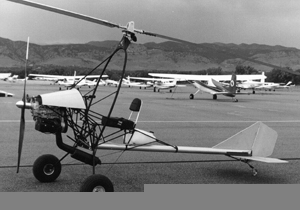
First flown in 1996, development/testing continued into 2008. With ongoing changes in the Ultralight/Light Sport arena, development of both the FAR Part 103 legal Ultralight gyro and the 2-3 seat cargo twin-engine gyro were put on hold.
Taildragger landing gear with large “tundra tires”, cable braced tempered aluminum main gear, and steerable tailwheel for superior handling off runway on rough terrain.
Conventional elevator control in the pitch axis are to minimize “porpoising” and “bunt-over”. A chrome-moly roll cage construction with pilot enclosure and lexan windshield are provided.
An optional pre-rotator assembly is available for reduced take off distance.
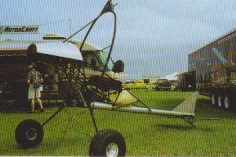
Engine: Geo Metro 4-stroke, 993cc, 60 hp
Propeller: 72″ two blade Ivoprop
Rotorblades: 23′ bonded aluminum skin
Min. speed: 22-25 mph
Cruise: 55-65 mph
Range: 150 miles
Empty Weight: 254 lbs.
Useful Load: 310 lbs.
Gross Weight: 564 lbs.
Width: 6 feet 6 inches
Height: 8 feet 2 inches
Length: 15 feet
Engine: AMW Cuyuna 460F, 45 hp
hp range: 45-55
Height: 8.2 ft
Length: 15 ft
Disk span: 23 ft
Fuel capacity: 5 USG
Empty weight: 254 lb
Gross weight: 489 lb
Max speed: 65 mph
Cruise: 60 mph
Range: 100 sm
Takeoff dist: 150 ft
Landing dist: 0-20 ft
Seats: 1
Engine: 2si, 50 hp
Rotor dia: 7.02 m
Max weight: 306 kg
Empty weight: 113 kg
Max speed: 105 kph
Cruise: 85 kph
Min speed: 24 kph
Seats: 1
A conversion of the Suzuki 1300cc auto engine circa 1998.
1300 GS
Cycle: 4 stroke
No cylinders: 4
Bore: 73.9 mm
Stroke: 76.9 mm
Displacement: 1298 cc
Cooling: Liquid
Ignition: Electronic
Reduction: toothed belt 2.00/1
Weight: 77 kg
Max pwr: 80 hp at 5700 rpm
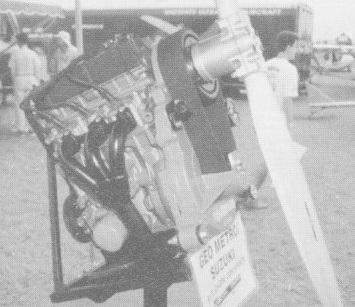
A conversion of the Suzuki 1000cc auto engine circa 1998.
1000 RS
Cycle: 4 stroke
No cylinders: 3
Bore: 73.9 mm
Stroke: 76.9 mm
Displacement: 993 cc
Cooling: Liquid
Ignition: Elctronic
Reduction: toothed belt 2.00/1
Weight: 66 kg
Max pwr: 65 hp at 5700 rpm
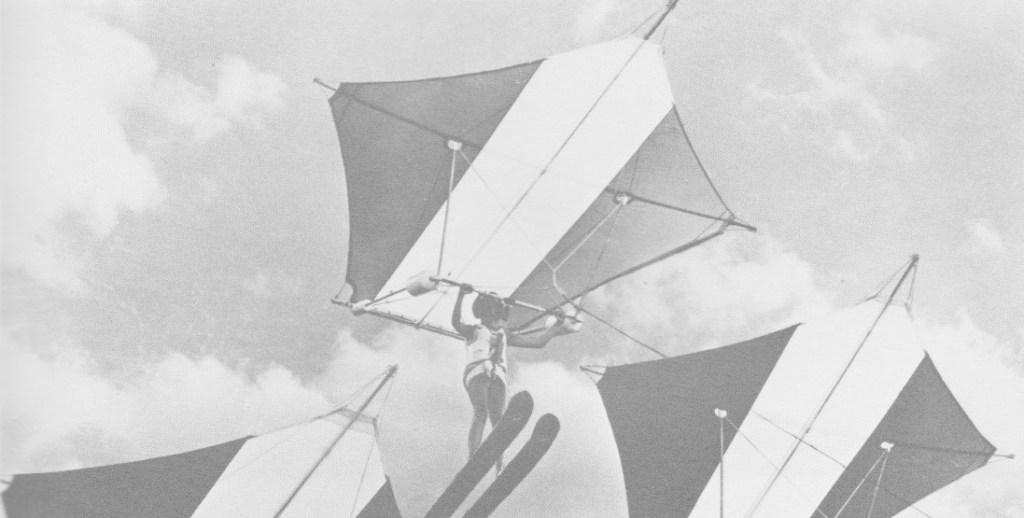
The Aqua Kite featured a harness for support freeing the pilots’ arms for control. A floatation system makes the kite unsinkable and insures deep water starts.
The airframe is made from seamless aluminium alloy tubing, with cast aluminium alloy joints. Provided was a boat safety quick release for fast towline detachment.
The rigid trapeze assembly has an extra wide form fitted (then available in 4 sizes), a double strap was available for tandem flying.
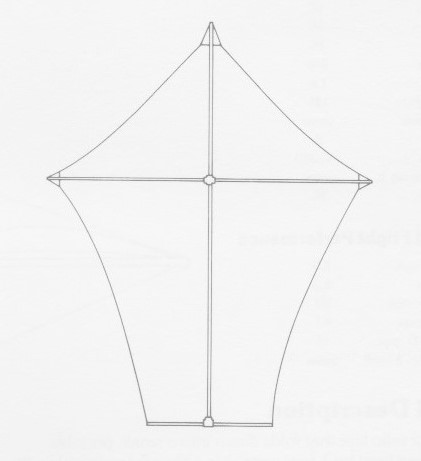
12 x 14
Keel length: 14.5 ft
Wing span: 11.6 ft
Wing area: 86 sq,ft
Nose angle: 90˚
Weight: 40 lb
Pilot weight: 94-170 lb
14 x 16
Keel length: 15.75 ft
Wing span: 13.6 ft
Wing area: 117 sq,ft
Nose angle: 90˚
Weight: 90 lb
Pilot weight: 160-225 lb