Schwerdtfeger & Zimmermann Air Swing

Single seat single engined high wing mono¬plane with conventional three axis control. Wing has unswept leading and trailing edges, and constant chord; cruciform tail. Pitch control by elevator on tail; yaw control by fully flying rudder; roll control by ailerons; control inputs through stick for pitch/roll and pedals for yaw. Wing braced from above by kingpost and cables, from below by cables; wing profile double surface. Undercarriage has three wheels in tricycle formation with tailskid; suspension on all wheels. Push right go left nosewheel steering connected to yaw control. Brakes on main wheels. Aluminium¬-tube/steel tube framework, without pod. En¬gine mounted below wing driving pusher propeller.

Publicly shown for the first time at Aero 83 exhibition at Friedrichshafen, the Air Swing first flew in April 1983. Two prototypes were built, powered by a Lloyd 22 hp engine.

The Air Swing uses a double triangular frame whose front tube is extended above the wing where it is supported with a second strut, the two acting as a kingpost and forming an inverse V above the wing. The aircraft has an additional peculiarity in that it uses the large diameter boom which carries the empennage as the axis of rotation for its three bladed propeller.

Engine: Lloyd LS400, 22 hp at 5500 rpm
Propeller diameter 50 inch, 1.28 m
Toothed belt reduction, ratio 2.0/1
Max static thrust 177 lb, 80kg
Power per unit area 0.17hp/sq.ft, 1.8 hp/sq.m
Length overall 18.0 ft, 5.50 m
Height overall 7.2ft, 2.20m
Wing span 33.5ft, 10.20m
Constant chord 3.9 ft, 1.20 m
Sweepback 0 deg
Tailplane span 9.0ft, 2.75 m
Total wing area 132 sq.ft, 12.2 sq.m
Wing aspect ratio 8.5/1
Wheel track 5.2 ft, 1.60 m
Fuel capacity 5.3 US gal, 4.4 Imp gal, 20.0 litre
Empty weight 221 lb, 100 kg
Max take off weight 508 lb, 230kg
Payload 287 lb, 130kg
Max wing loading 3.85 lb/sq.ft, 18.8 kg/sq.m
Max power loading 23.1 lb/hp, 10.5kg/hp
Load factors; +6.0, 3.0 ultimate
Never exceed speed 71mph, 115kph
Economic cruising speed 50mph, 80kph
Stalling speed 29mph, 47 kph
Max climb rate at sea level 240 ft/min, 1.2 m/s

Schweizer SA 2-38 Condor / SA 3-38 Condor / RU-38 Twin Condor

In the mid-1990s the Coast Guard decided that the RG-8 aircraft would be more useful if their capabilities were improved to include night operations by the addition of more mission sensor equipment. Discussions with Schweizer Aircraft resulted in a plan to upgrade two RG-8As and build one new aircraft to provide a total of three.

The RU-38 was intended to fulfill both the low altitude, quiet, over water/hostile terrain reconnaissance role and also the high altitude standoff surveillance role. Based on the Schweizer SGM 2-37 motor glider, a total of five RU-38s were produced between 1995 and 2005.

In converting to the new RU-38A configuration, the conventional RG-8A airframe was greatly modified by:
Removing the single 235 hp (175 kW) Lycoming O-540-B powerplant
Installing two Teledyne Continental Motors GIO-550A engines with a 3:2 gear reduction to 2267 operating rpm. The engines are mounted one in the nose and the other in the rear of the fuselage.
Enlarging the crew compartment
Improving the engine mufflers
Increasing the wingspan from 56.5 ft (17.22m) to 84.13 ft (25.65 m)
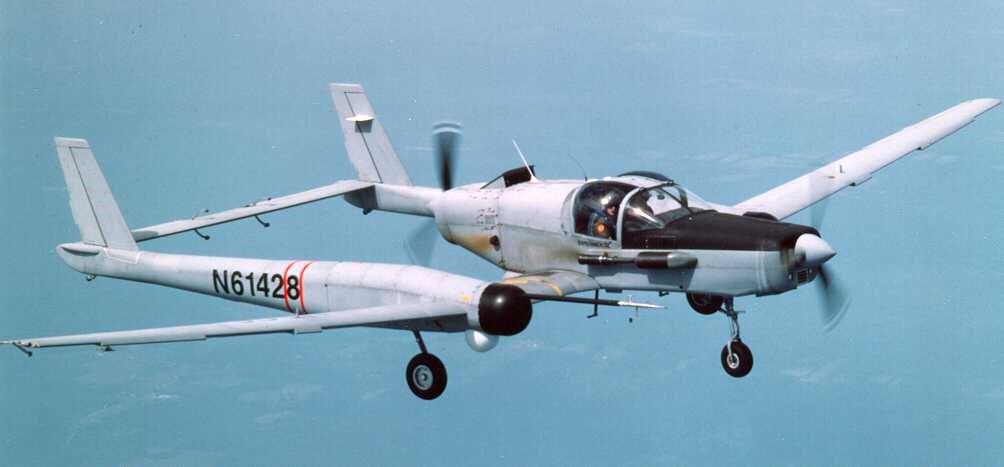
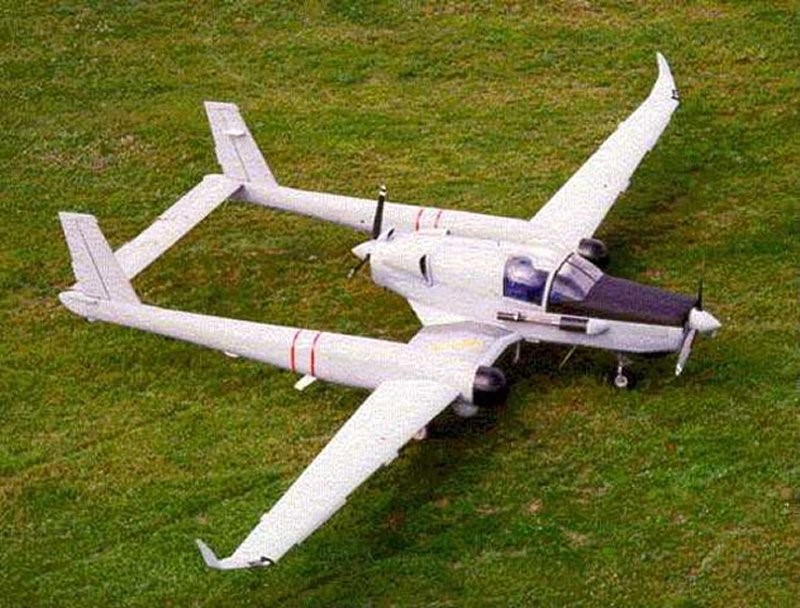
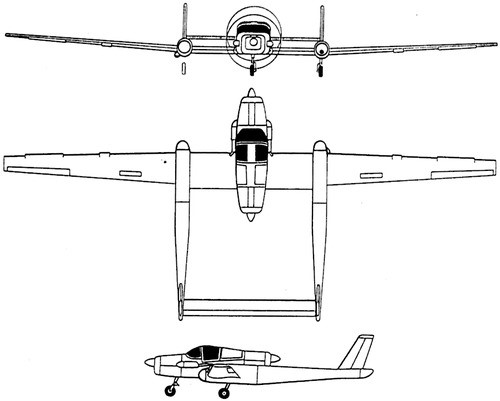
Changing the single tail fin to a twin-boom configuration with two fins
Greatly enlarged sensor bays
Improved noise signature reduction
Tricycle landing gear replacing the conventional landing gear

The resulting aircraft bears little resemblance to the original TG-8. Installation of the twin-boom pods permits the carriage of more sensors. The left-hand pod houses an AN/APN-215(V) color multi-function X-band sea search radar with mapping capabilities. The right-hand pod houses the AN/AAQ-15 forward looking infrared (FLIR) and Low-Light TV enhanced vision systems.

Schweizer RU-38A

For navigation the RU-38A originally carried both OMEGA and GPS receivers, although the Omega has since been removed with that system’s withdrawal from service in 1997. The aircraft also has HF, VHF and UHF radios for voice and encrypted voice communications, plus direction finding. The crew may also use night vision goggles.

The aircraft has no flaps and instead retains the top and bottom surface divebrakes of its sailplane ancestors.

The RU-38A is designed to transit to its operational area with both engines operating. Once in the surveillance area the rear engine would normally be shut down and the aircraft operated in “quiet surveillance mode”. The second engine would be available for use in an emergency and for return to base at faster speed.

The first Coast Guard RG-8A was returned to Schweizer for conversion to RU-38A status on 24 January 1994. The initial plan called for the conversion of two RG-8As and then fabrication of one new RU-38A.

The first flight of the converted aircraft took place on 31 May 1995. The second USCG RG-8A aircraft that was earmarked for RU-38A upgrade crashed near Puerto Rico in 1996. As a result, the program was reduced to provide only two RU-38As to the USCG. The loss of the RG-8A delayed the program for many months and it was not completed until May 1997.

The first RU-38 was tested by the Air Force 445th Flight Test Squadron at Edwards AFB on behalf of the Coast Guard, starting in July 1998. The airplane flew some 100 test flights during the four-month program.

By September 1999 the two converted RU-38As had been delivered to the Coast Guard in Miami, Florida for operational employment. The RU-38As were flown in drug interdiction missions over the Gulf of Mexico and the Caribbean Sea, but they were reportedly grounded during 2000, due to problems with the aircraft meeting mission requirements or serviceability.

The company further improved the aircraft by replacing the two piston engines with two Rolls Royce Allison 250-B17F turboprop engines which allowed raising the gross weight to 7200 lbs (3265 kg). The new aircraft carries the military designation of RU-38B.

The RU-38B has 140 cubic feet (4.0 cu m) of payload space with a payload weight of 800 lbs (363 kg) available. The payload bays all have large access doors and are located both in the tailbooms and also behind the pilot and co-pilot seats in the fuselage. The latter space can also accommodate a third crew member, if required. Using pallet-mounted sensor packages the aircraft can be quickly changed from one mission to another.

The RU-38B is able to achieve quiet operation while loitering by using a propeller speed as low as 1000 rpm. This is possible because the sailplane-derived wing is efficient and flight at low airspeed can be sustained with low power. Exhaust from the front engine is routed overwing, reducing the noise footprint.

Two RU-38Bs were delivered to the US Department of Justice, one in 2004 and one in 2005.

The aircraft remains in production by Sikorsky Aircraft after acquiring Schweizer and was still being actively marketed by Schweizer in 2011. Neither the RU-38A or B was certified by the Federal Aviation Administration. Instead all aircraft operate as experimental aircraft in the Research and Development category.

RU-38 is the US military designation for the aircraft, indicating Utility, Reconnaissance. The Schweizer company model number is Schweizer SA 2-38A Condor and, in its three-seat configuration, Schweizer SA 3-38A Condor

Gallery

RU-38
Engines: 2 x Continental GIO-550, 350hp
Wingspan: 64’0″
Useful load: 900 lb
Cruise speed: 157 mph
Loiter speed: 104 mph
Seats: 1

RU-38A
Maximum take-off weight: 5300 lb (2404 kg)
Number built: 2

RU-38B
Engines: 2 × Rolls Royce Allison 250-B17F
Props: Constant Speed, Full Feather
Wingspan: 84.13 ft (25.64 m)
Wing area: 334.2 ft2 (31.05 m2)
Airfoil: Wortmann Fx 61-163
Length: 35.1 ft (10.7 m)
Empty weight: 4265 lb (1934 kg)
Useful load: 2935 lb (1331 kg)
Loaded weight: 7200 lb (3265 kg)
Max. takeoff weight: 7200 lb (3265 kg)
Maximum speed: 168 knots (312 km/h)
Cruise speed: 83 knots (mission speed) (155 km/h)
Stall speed: 62 knots with divebrakes closed (116 km/h)
Never exceed speed: 168 knots (312 km/h)
Service ceiling: 30,000 ft (9144 m)
Wing loading: 21.5 lb/ft2 (105.1 kg/m2)
Crew: two in side-by-side or three, with two pilots side-by-side and one sensor operator in the rear
Number built: 3

Schweizer SGM 2-37 / TG-7A / RG-8A

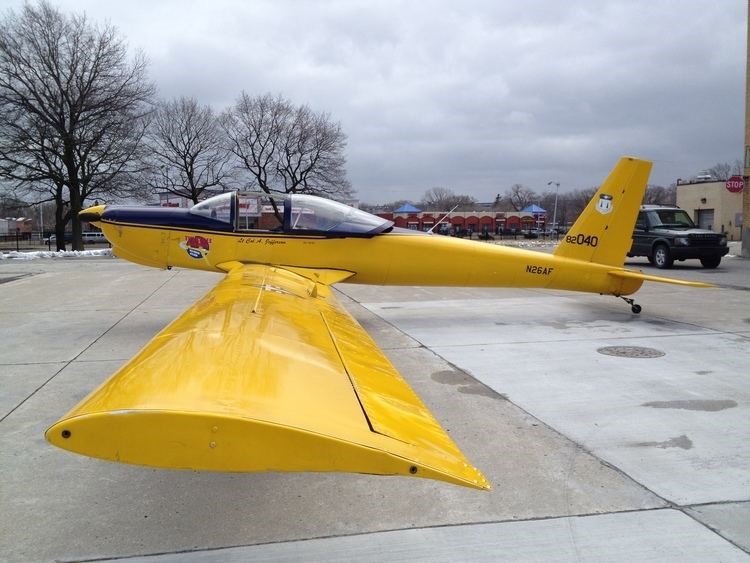
The SGM 2-37 self-launching two-place, side-by-side, fixed gear, motorglider designed by Leslie Schweizer at the request of the USAF for use at USAFA.

To save both money and development time the aircraft used a number of existing aircraft components:
Nose, cowling and engine installation adapted from the Piper PA-38 Tomahawk
Wings adapted from the Schweizer SGS 1-36 Sprite, including extensions to bring it from the Sprite’s 46.2 feet (14.1 m) to 59.5 feet (18.1 m) and leading edge cuffs to improve stall characteristics
Tail from the Schweizer SGS 2-32

The design was intended to be available as a civil aircraft as well as a military aircraft. The USAF version was delivered with a Lycoming O-235-L2C 4-cylinder aircraft engine of 112 hp (84 kW). The civil version offered the same engine or an option of a Lycoming O-320 of 150 hp (112 kW) or a Lycoming O-360 of 180 hp (134 kW).

The aircraft is of all-metal aluminum monocoque construction. The engine cowling is made from fiberglass and plastics are employed in some of the nonstructural components.

The 2–37 features a 27 cu ft (760 L) baggage compartment behind the side-by-side seating. The aircraft does not have flaps, but instead has top-and-bottom wing-mounted balanced divebrakes, similar to other Schweizer glider designs, and has the capacity to operate as a towplane for other gliders.

First flying in 1982, a total of twelve were produced between 1982 and 1988, including nine for the United States Air Force Academy, which designated it the TG-7A. The TG-7A was retired from USAFA service in April 2003.

USAFA TG-7A

The SGM 2–37 was certified by the Federal Aviation Administration under type certificate G1NE on 22 March 1983. The 2–37 type certificate was later held by K & L Soaring of Cayuta, New York. K & L Soaring provided all parts and support for the Schweizer line of sailplanes.

Soaring, the journal of the Soaring Society of America, described the SGM 2–37 as: “Very versatile, very promising, very expensive”. The publication’s review noted that the $70,000 base price did not include a feathering propeller, gyro instruments, wheel fairings, long range fuel tanks or other optional extras.

Examples of the TG-7 were used by the US Army from 1985 on covert surveillance duties under the Grisly Hunter project. The two aircraft were then transferred to the US Coast Guard by mid 1989, were modified and were re-designated RG-8A. The aircraft were used on coastal patrols from the US Coast Guard base at Miami wearing a grey low visibility color scheme in 1989.

RG-8A surveillance aircraft of the US Coast Guard at Opa Locka, Miami, in 1989.

There were nine aircraft still registered in the US in April 2008. Current owners include the Tuskegee Airmen National Historical Museum and designer Leslie E. Schweizer.

The SA 2-37A is a two-seat special-mission surveillance aircraft built for the Central Intelligence Agency and US Army and equipped with a Lycoming O-540-B powerplant of 235 hp (175kW) and first flown in 1982 and eight. The US aircraft register records six SA-2-37As, including four belonging to Vantage Aircraft Leasing with serial numbers as high as 8. All are in the experimental exhibition category.

The SA 2-37B is a development of the 2-37A equipped with a Lycoming TIO-540-AB1AD powerplant of 250 hp. The aircraft is optimized for covert surveillance missions and carries FLIR and electronic sensors. It has a 500 lb (231 kg) sensor payload in a 70-cubic-foot (2,000 L) fuselage bay. With a fuel capacity of 99 US gallons (370 L) it can remain on station for up to 12 hours. Gross weight is 4300 lb (1950 kg). The US aircraft registry records four SA 2-37Bs, all owned by Schweizer Aircraft. All are in the experimental Research and Development category.

Operators also included the Colombian Air Force and Mexican Air Force.

SA2-37B of the Aerial Surveillance Squadron, 3rd Air Group, Mexican Air Force at Santa Lucia Air Force Base

The 2–37 was later developed into the SA 3–38, known in military service as the Schweizer RU-38 Twin Condor.

SGM 2–37 / TG-7A
Engine: 1 × Lycoming O-235-L2C, 112 hp (84 kW)
Prop: aluminum fixed pitch
Wingspan: 59 ft 6 in (18.14 m)
Wing area: 195.7 ft2 (18.18 m2)
Airfoil: Wortmann Fx 61–163
Aspect ratio: 17.9
Length: 27 ft 6 in (8.5 m)
Height: 7 ft 8 in (2.4 m)
Empty weight: 1200 lb (544 kg)
Useful load: 650 lb (295 kg)
Loaded weight: 1850 lb (839 kg)
Max. takeoff weight: 1850 lb (839 kg)
Never exceed speed: 135 mph (219 km/h)
Maximum speed: 135 mph (181 km/h)
Cruise speed: 112 mph (181 km/h)
Stall speed: 48 mph with divebrakes closed (78 km/h)
Range: 230 mi (372 km)
Service ceiling: 14,000 ft (4300 m)
L/DMax: 28
MinSink: 0.96 m/s / 3.16 fps / 1.87 kt
Glide ratio: 19.3:1 – 19.7:1
Wing loading: 9.45 lb/ft2 (46.15 kg/m2)
Power/mass: 16.51 lb/hp (0.100 kW/kg)
Baggage compartment: 27 cu.ft / 760 lt
Crew: two side-by-side

SA 2-37A
Engine: 1 × Lycoming TIO-540-B, 235 hp (175kW)
Crew: two side-by-side

SA 2-37B
Engine: 1 × Lycoming TIO-540-AB1AD, 250 hp
Gross weight: 4300 lb (1950 kg)
Fuselage bay: 70-cubic-foot (2,000 L)
Sensor payload: 500 lb (231 kg)
Fuel capacity: 99 US gallons (370 lt)
Time on station: 12 hr

Schweizer Aircraft Corp

The Schweizer Aircraft Corporation was an American manufacturer of sailplanes, agricultural aircraft and helicopters located in Horseheads, New York. The company grew out of the Mercury Glider Club which produced the first two Schweizer gliders in the Schweizers’ barn. The company was originally called the Schweizer Metal Aircraft Company. Attorney Bob McDowell indicated to the Schweizers that they should move their manufacturing operation out of their father’s barn and relocate to the Elmira, New York area. The Schweizers received the suggestion positively as they needed more space to produce gliders, but they had no money with which to make the move.

It was incorporated in 1939 by three Schweizer brothers (Paul, William, and Ernest), who built their first glider in 1930.

McDowell convinced Elmira Industries Inc, the local business development corporation, to provide space for the Schweizers on the second floor of the Elmira Knitting Mill Building in return for stock in the company. This resulted in the Schweizer Metal Aircraft Company becoming the Schweizer Aircraft Corporation in 1939, with a sale of shares to Elmira Industries, local businessmen and soaring pilots.

Schweizer primarily produced light, piston-engined helicopters for use in utility and flight-training roles. The Schweizer 300CBi, originally designed and manufactured by Hughes aircraft as the Hughes 269 for the United States Army, is one of the most widely used training helicopters in the world. In 1986, Schweizer acquired all rights to the helicopter from McDonnell Douglas, who had purchased Hughes Helicopters in 1984. After Schweizer acquired the FAA Type Certificate, the helicopter was known for a short time as the Schweizer-Hughes 300C and then simply, the Schweizer 300C.

Schweizer is perhaps known best for its popular line of gliders (sailplanes), the earliest of which (the model SGP 1-1) was produced in 1930. Although very few of the early gliders were built, later models gained popularity, such as the SGS 2-8 and 2-12, which were adopted by the U.S. Army Air Corps for training as the TG-2 and TG-3, respectively.

The Schweizer SGS 1-23 was a world class competition and record setting glider between its first flight in 1948 and the end of its production in 1967.

In the 1950s and 60s the Schweizer Aircraft Corporation designed and manufactured the very popular SGS 1-26 and SGS 2-33 gliders. They are easy to fly, with simple construction, and are quite rugged and forgiving. A powered light aircraft, the Schweizer SA 1-30 was tested, but did not go into production.

The 2-33 was adopted by the United States Air Force Academy as the TG-4, for use in introductory airmanship training. The Academy used over a dozen such gliders until 2002 when they were replaced by more modern sailplanes. The Royal Canadian Air Cadets continue to operate a fleet of over seventy 2-33As.

Other popular Schweizer gliders include the single-seat SGS 1-26 and the two or three-seat 2-32, both of which can be found in many soaring clubs and in private ownership across the United States.

Primarily designers and makers of sailplanes, one of which (SGS 2-32) fitted with piston engine was tested by Lockheed Aircraft Corporation as Q-Star for ‘quiet reconnaissance’ in Vietnam. On Q-Star was based the Lockheed YO-3A, using Schweizer wings and tail, new fuselage and muffled engine.

Company also built for Grumman the Ag-Cat agricultural biplane, later for Gulfstream, before acquiring the rights in 1981 (Ag-Cat subsequently produced by Ag-Cat Corporation).

Schweizer produced the Grumman G-164 Ag Cat, a single-engine biplane agricultural aircraft originally developed by Grumman in the 1950s. Under the contract with Grumman the airplane was built almost continuously between 1957 and 1981. During this period of time Schweizer built 2,455 of the airplanes.

In 1981 Schweizer bought the rights to the design and continued production under the name Schweizer Ag Cat. In 1995 Schweizer sold the rights to the Ag Cat to Ag-Cat Corp. of Malden, Texas. In February 2001 the design was sold to Allied Ag-Cat Productions Inc. of Walnut Ridge, Arkansas. Allied Ag-Cat is not producing new aircraft although a related company operates a large fleet of Ag-Cats.

The basic airframe incorporates many safety innovations, including a pressurized cockpit to keep pesticides out, air conditioning and a fuselage structure that is designed to progressively collapse in the event of a collision.

The basic designof Schweizer S269C remained unchanged over the years. Between Hughes and Schweizer, nearly 3,000 copies of the Model 269/300 have been built and flown over the last 50 years. Schweizer continued to develop the Model 300 by adding a turbine and redesigning the body to create the Schweizer 330, and then further developments led to the development of the Schweizer 333.

An improved version in the series, the Sikorsky S-434, was released in 2008.

In 1972 Schweizer hired David Thurston and production of his Thurston Teal was part of the agreement to work at Schweizer. The company produced three Schweizer TSC-1A1 Teals and nine TSC-1A2 Teal IIs before production was moved to Teal Aircraft in 1976.

The development of the Schweizer SGM 2-37 two-place motor glider for the United States Air Force Academy in 1982 led to a new area of expertise for the company. In the mid-1960s Lockheed had used the Schweizer SGS 2-32 sailplane as the basis for its YO-3 quiet reconnaissance aircraft. Schweizer decided to develop the SGM 2-37 into a similar concept aircraft as the YO-3. The result was the SA 2-37A and B, known as the RG-8A in military use.

The RG-8A was later developed by the company into the twin piston-engined and twin-boom SA 2-38 Condor with the US military designation of RU-38A Twin Condor. This design was further refined into the turboprop-powered RU-38B Twin Condor. The RU-38 was still in production in 2008.

It is believed the US Drug Enforcement Administration purchased aircraft designated Shadowhawk from Schweizer. The aircraft had a poor operational history. They may be designated SA 38B.
Other projects

In partnership with Northrop Grumman (formerly Ryan Aeronautical), Schweizer is developing the MQ-8 Fire Scout helicopter UAV.

Schweizer is currently participating in development of Sikorsky’s X-2 Demonstrator, a prototype aircraft using co-axial rotor blades with a pusher propeller for extra forward thrust.

Makes fuselage assemblies for Piper Aircraft Corporation and structures for Bell Helicopters. Became license-holder for Hughes 300 helicopter in 1983, producing piston-engined three-seat Model 300C from 1984 to present day and developing new 3/4-seat Model 330 turboshaft-powered helicopter (first flown June 1988); also supports Hughes Model 269s.

In 1986 flew the SA 2-37A low-noise special-missions aircraft suited to surveillance and other roles, followed in May 1995 by a radical twin-boom SA 2-37A conversion known as SA 2-38A. Two joined the U.S. Coast Guard as RU-38A Twin Condors for covert patrol and surveillance (one by conversion, one built as new).

In December 1999, Schweizer Aircraft celebrated its 60th Anniversary, and had built more than 2,160 sailplanes. Schweizer was a major U.S. aerospace contractor and no longer manufactured gliders.

Helicopter products offered by the company as of February 2009 included the 300C, 300CBi, and 333.

Previously the oldest privately owned aircraft company in the United States, Schweizer was acquired by Sikorsky Aircraft Corporation of Stratford, Connecticut, in 2004, and became a diversified aerospace company.

In 2011 and 2012 Sikorsky Aircraft Corporation laid off all the workers and closed the plant.

Schutte Sails MIG / Pacific Kites MIG / GygaxMIG

The Mig was produced by Schutte Sails in New Zealand in 1983 and 1984. It was a 70% double surface floating crosstube glider with curved fibreglass tips rather like the Moyes GT. The usual size was 172 sq.ft but there may have also been a 190 sq.ft version.

MIG 172

Not suitable for a learner pilot.

One hundred of these models were built in Europe by Hans Gygax around 1984. Gygax imported the ready made canvas of New Zealand and Gygax built the aluminum structure.

Schönleber Metallbau Focus

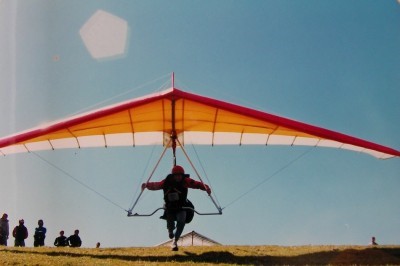
A 1983 hang glider.

Focus 16
Wing area: 16 m²
Wing span: 10.6 m
Hang glider weight: 31 kg
Minimum pilot weight: 50 kg
Maximum pilot weight: 125 kg
Packed length: 6 m
Packed length short: 3.9 m
Number of battens: 32
Nose angle: 126°

Focus 17
Wing area: 17 m²

Focus 18
Wing area: 18 m²
Wing span: 10.9 m
Hang glider weight: 36 kg
Minimum pilot weight: 70 kg
Maximum pilot weight: 200 kg
Packed length: 6.2 m
Packed length short: 3.9 m
Number of battens: 32
Nose angle: 126°