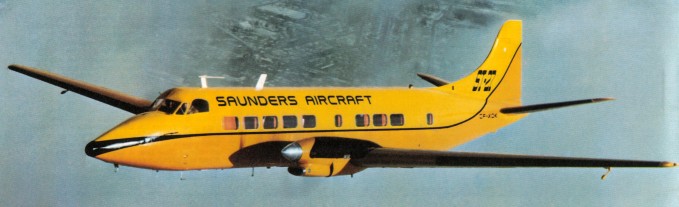
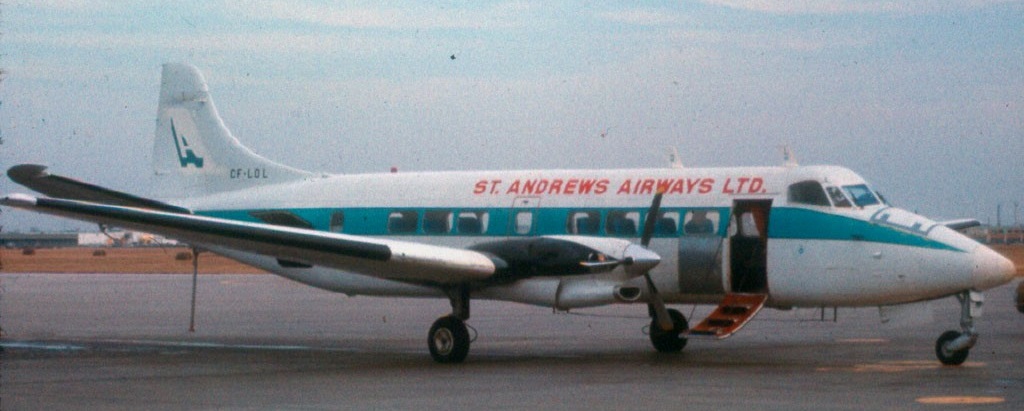
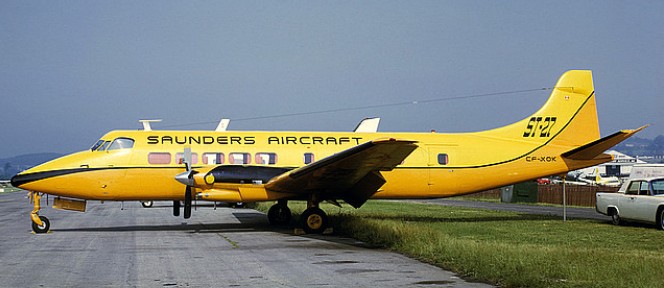
Saunders Aircraft Corporation in Canada flew the ST-27A prototype (CF-FYBM-X) for the proposed ST28 on 18 July 1974. The ST-27A was a lengthened fuselage conversion of the de Havilland D.H.114 Heron with turboprop powerplant, but production ST-28s were intended to be newly-built; because of financial problems no series aircraft were manufactured. Saunders Aircraft Corporation produced 13 completed ST 27s.
The Heron has been stretched by 8 ft 6 in (2.59 m) to carry 24 passengers, and re engined with two PT6A 27 turboprops instead of four Gipsy Queen piston engines.
Saab’s experience with the S340 commuter airliner turned its attention to the future needs of regional and ‘feeder’ carriers. Having forged a market with its smaller aircraft, Saab used the S340 as a baseline from which to develop a new, high-speed turboprop airliner which was to be called the Saab 2000, with a max payload of 5900 kg or up to 2 crew and 58 passengers. The go-ahead came with a launch order from Moritz Suter’s Crossair, already a firm Saab customer, which signed for 25 aircraft with a further 25 on option, on 15 December 1988.
By late 1989 project definition for the Saab 2000 had been completed, with the contracting out of major portions of the aircraft’s construction. CASA of Spain was responsible for the wing design and production, though Saab defined the basic airfoil structure. Valmet of Finland was to build the entire tail unit and elevators, while in England, Westland is responsible for the rear fuselage. For the cockpit, a Collins Proline 4 avionics suite was selected, while a radical reduction in cabin noise levels over existing aircraft was also promised. The concept of ‘hub bypass’ was central to Saab’s sales efforts for the aircraft. To achieve this, Saab planned to build an aircraft capable of 665km/h over a 1850km sector, a speed comparable with the BAe 146 (Avro RJ). A jet-like climb performance was also essential, with figures of 0-6096m in less than 11 minutes assured. The original choice of engine fell between General Electric’s GE38, then under development for the US Navy’s projected LRAACA maritime patrol aircraft, and the Pratt & Whitney PW300 turbofan. In the event, and in conjunction with Crossair, Saab opted for the Allison GMA 2100 turboprop, driving six-bladed, low-noise Dowty propellers. As part of the deal Allison was contracted to build the engine nacelles.
Production of the first prototype began at Linkoping in February 1990. Several European aerospace firms participated in the Saab 2000 manufacturing program including CASA, Westland and Valmet of Finland.
The prototype’s (SE-001) maiden flight occurred on 26 March 1992. A four-aircraft test programme was established with aircraft No. 2 (SE-002) involved in stability and control certification. Much of the high-temperature and adverse weather flying was undertaken by the No. 2 Saab 2000, which completed two visits to Spain. The first full production-standard aircraft was SE-003, with which all the systems certification was achieved, only the autopilot certification being outstanding in mid-1993. Certification in Europe was granted in March 1994 and by the FAA in April 1994. Functional reliability flights were undertaken by aircraft No.4 (SE-004), as part of the ongoing test programme which exceeded 1,200 hours across the fleet.
All Saab’s performance guarantees have been met or exceeded. Take-off and landing distances were bettered by 100-200m. Time from brake release to 6096m is less than eight minutes, and in proving this the Saab 2000 easily broke the existing time-to-climb record for an aircraft in its class (previously held by a Grumman E-2 at 10 minutes). Range and weights have all been better than expected on the production standard aircraft, and the promised cruise speed of 665km/h at 8534m is, on average, 15km/h better. In a dive the Saab 2000 has reached 794km/h with no ill effects. International noise requirements have been bettered by 9.1 decibels.
The fuselage diameter is 91 inches, allowing for a single row of passenger seats on the left side and double row on the right. The gear up limiting speed is 175 kt, with extension being 220 kts and a cruise speed of over 665km/h.
Reducing cabin noise was a cornerstone of the Saab 2000 design philosophy and Saab has developed a so-far unique anti-noise system that has been test flown on a Saab 340, ready for inclusion on its larger sibling. This involves a series of microphones, located around the interior, which monitor cabin noise and then re-broadcast an equal opposite; wave, thus effectively ‘switching off’ background noise and vibration.
August 1994 saw the first delivery to Crossair and September 1994 the first revenue service. Saab originally foresaw a market for 1,400 new 40- to 50-seat regional airliners by the end of the century, and sales of 400 Saab 2000s were anticipated. While the manufacturer held well over 100 paid options, only 36 firm orders had been received by July 1993. The seventh aircraft and the first for Deutsche BA (formerly Delta Air) flew on 24 June 1993.
Lack of sales and profitability forced Saab to cease the 2000 production with just 63 aircraft built. The last SAAB 2000 was delivered to Crossair in April 1999.
Engines: 2 x Allison AE2100A turboprop, 4152 shp / 3096kW Props: Dowty 6 blade Wingspan: 24.76 m / 81 ft 3 in Length: 27.03 m / 89 ft 8 in Height: 7.73 m / 25 ft 4 in Max take-off weight: 22000 kg / 48502 lb Loaded weight: 13500 kg / 29763 lb Max. speed: 680 km/h / 423 mph Cruise: 360 kt Ceiling: 9450 m / 31000 ft Range w/max.payload: 2557 km / 1589 miles Pax cap: 50-58
For several years, Saab-Scania had been working on a project known as Aircraft 108 (later renamed the Transporter), calculation and design work on the later versions of which (1083 and 1084) had advanced to the stage at which production was feasible. The scope of the project was such that the initial costs and the risks involved were substantial, added to which Saab-Scania had no recent experience in marketing an airliner. As a result SAAB sought a partner in the venture. Negotiations were initiated in 1979 with Fairchild Industries.
This resulted in a 65/35 co-operation agreement being signed on January 25 1980. In this agreement, Fairchild would manufacture the wing and tailplane surfaces and the engine housings at its Republic factory on Long Island, and Saab would manufacture the fuselage and be responsible for final assembly at its new plant in Linkoping, Sweden. SAAB was also responsible for the systems integration, and flight-testing.
Initial project name was ‘3000’ but in July 1980, it was officially named Saab-Fairchild SF-340. In June 1980 General Electric was selected as the engine supplier with its new CT-7 engine derived from the T-700 helicopter unit. Meanwhile Saab had placed a group of engineers with Fairchild to design the aircraft following 15 September 1980. Most of 1980 went to define the aircraft and build a wooden mock-up in Linkoping.
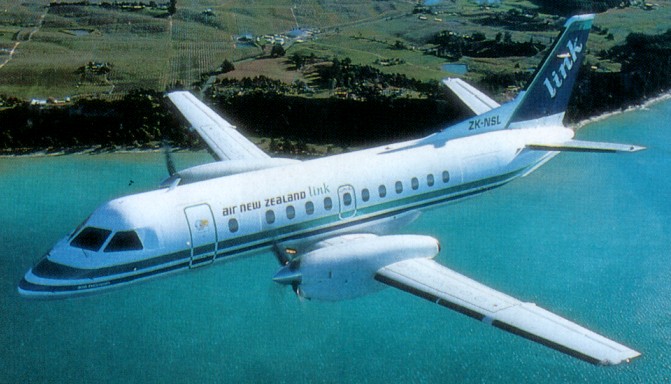
A cantilever low-wing monoplane of basic all-metal structure with the selective use of composite materials, the aircraft is of conventional configuration; it has a fail-safe pressurised fuselage structure, retractable tricycle landing gear with twin wheels on each unit, and is powered by two turboprop engines in wing-mounted nacelles.
The aircraft comprises a round-section fuselage seating up to 35 passengers with a flight attendant and two-person crew. The wing uses NASA-developed low-drag airfoil technology, and two General Electric CT7 turboprops were chosen as powerplants.
Marketing of the aircraft began immediately and early customers were Crossair in Switzerland, Swedair in Sweden and Comair and Air Midwest in USA. In late 1981 production began in the brand new facilities in Linkoping adjacent to the military factory, By early 1982 major sub-assemblies were finished and the first wing was lifted out of the jig in April. The fuselage and wing were mated in August. The rolling out the prototype came on 27 October 1982 in the presence of the Swedish King.
The first Saab-Fairchild 340 prototype (SE-ISF) flew on 25 January 1983, three years to the day after the agreement had been signed with Fairchild. This, plus a second prototype (SE-ISA) and the first production aircraft (SE-ISB flown on 25 August 1983) participated in the certification programme. After a flight test period lasting 16 months involving four aircraft, the SF-340 received its JAR type-certificate on May 30 1984 and FAA approval granted by 29 June 1984. The 340 was the first aircraft to be certified under the new JAR rules in which Belgiurn, Finland, France, Germany, Holland, Norway, Sweden, Switzerland and the UK participated. Australia followed on October 30. The prototype was subsequently mounted on a pole outside Linkoping when the city celebrated its 700 anniversary.
The second prototype has been retained for the subsequent flight-testing including the 340B certification. It was being used in preparation for the Saab 2000 flight test programme.
The third 340, was a pre-production aircraft. It was subsequently modified by Fairchild to incorporate an APU. It was later cut up, and various pieces used for the Saab 2000 programme. The last aircraft was the first production standard, and was later delivered to Comair.
The first production aircraft, s/n 003 SE-ISB, was flown on 25 August 1983.
SAAB SF340A s/n 005 was the first delivered, and it went to Crossair on 6 June 1984. This was placed into service on June 15 flying from Basle to Paris.
Initially two versions were on offer: the basic air transport configuration and an executive version. The first of these ‘biz-props’ was sold to Pittsburgh’s Mellon Bank. The type suffered a setback in 1984 when it was temporarily grounded, after Crossair suffered inflight engine shut downs, but these teething troubles were soon rectified and Saab pressed on with the next stage in the aircraft’s development. In 1985, at the Paris air show, Saab launched a 340 with uprated CT7 engines driving larger Dowty propellers. Maximum take-off weight was increased from the original 11,793kg to 12,872kg. Existing SF-340s were offered the improvement as a modification programme.
Saab attempted to sell the 340 as a corporate aircraft, but only sold four 340As. For this marketing campaign the Saab office in USA actually operated a corporate demonstrator (N340SF) during 1985 and 1986. As the sales-result could not warrant an exclusive demonstrator, it was sold and later converted to airliner standard for Comair.
Fairchild entered economic problems partly due to the increased costs of starting up the 340 programme and partly because of the cancelled T-46 programme. Fairchild withdrew from the aircraft business altogether. Swearingen in Texas was sold and an agreement was reached with Saab to withdraw from the 340 programme. As of 1 November 1985, Saab took over the responsibility for the 340 and renamed it the ‘Saab SF-340’. In 1987 it became simply the ‘Saab 340’ and the factory in Linkoping was expanded to take over the wing- and tail-production, completed in June 1986. SAAB initially retained the SF340 designation but later changed it to 340A.
Next version to be offered was the freighter S340QC which was a quick-change cargo aircraft, the first of which was delivered to Finnaviation in 1987. In that same year, as Saab severed its final links with Fairchild, the family was renamed the S340.
The 100th 340 was delivered in September 1987.
1987 saw the launch of the Saab 340B, first flying on April 21 1989, which features higher power output CT7-9B engines, a larger span tailplane, and a further increased maximum takeoff weight of 12,928kg. Crossair was again the launch customer for this version. From aircraft number 160, all 340s were ‘B’ models. The last SF340A, of 159, was delivered in August 1989. The SF340B has two 1750 shp (1 305 kW) GE CT7-9B turboprops for hot and high use.
Announced improvements to the Saab 340 will enhance the aircraft’s hot-and-high performance and short field capability, through a 0.6m wingtip extension. This increases the Saab 340’s takeoff weight by 544kg, equivalent to six/seven passengers. A third-generation cabin interior, common to the Saab 2000, was also being introduced, along with modifications to the APU and optional low-pressure tyres.
In 1987 and 1988 44 340s were sold each year. In 1989 Saab sold 123 aircraft, the 300 mark was reached in 1990. By mid-1993 Saab 340 orders had exceeded 400, with over 340 delivered, to 28 airlines and four corporate clients.
SF340AEW
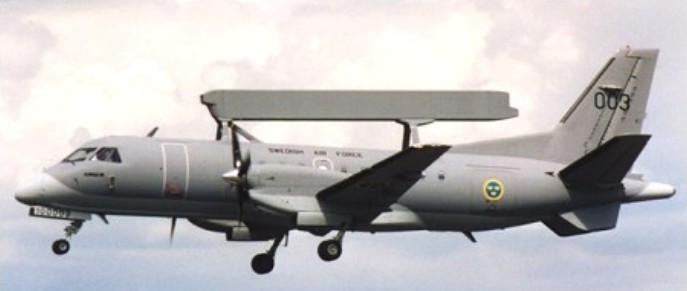
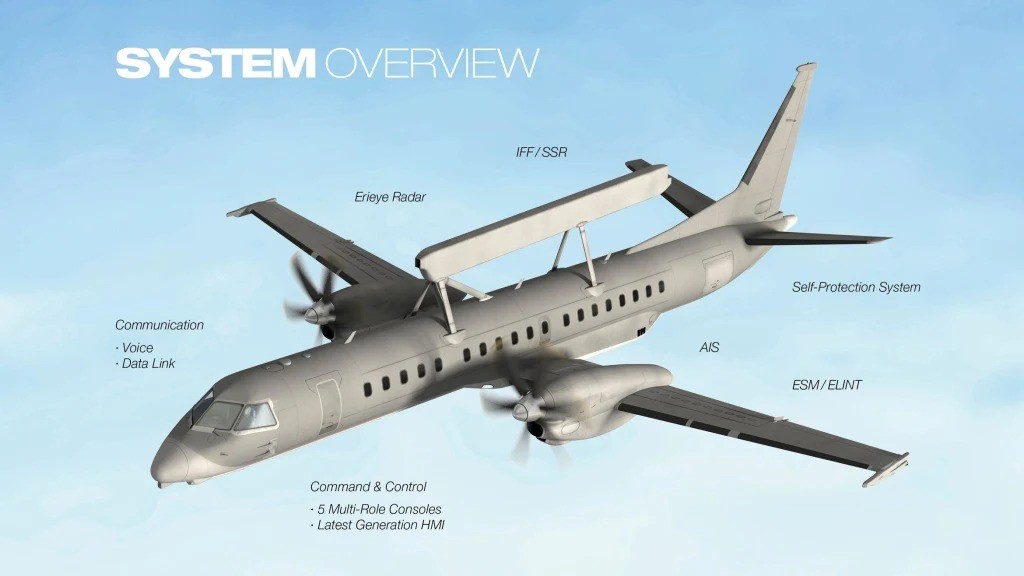
For the Swedish military the SAAB-340AEW Erieye airborne early warning version was developed, the contract for which was signed by the Swedish air force on 3 February 1993.
This version features an Ericsson phased array surveillance radar above the fuselage, with three operators in the cabin and a mission endurance of up to seven hours. Six aircraft were anticipated lor Swedish service with an initial in-service date of 1995.
Saab 2000 Erieye AEW&C
The last development of the 340 was the 340B Plus, that introduced changes developed for the larger SAAB 2000. The first 340B Plus was delivered in March 1994. Production of the 340 ended in 1999 with a total of 459 airframes built.
340A Engines: 2 x General Electric CT7-5A2, 1735 hp Accommodation: 30-37 Wing span: 21,44 m (70 ft 4 in) Wing area: 41.81 sq.m (450 sq.ft) Length: 19.72m (64ft 8in) Height: 6.87 m (22 ft 6 in) Max. t/o weight: 12400 kg / 27337 lb Max. land, weight: 27,200 lb Max. payload: 8,085 lb OEW: 17,6151b Typical cruis. speed: 275 kt Maximum/cruising speed: 507 kph / 315 mph Landing speed: 154 kph / 96 mph Range: 805 nm / 1500 km / 930 miles T/o field length: 3,900 ft Max, ceiling: 8500 m / 27890 ft Max, ceiling Exec. version: 25,000ft Max. SL cabin altitude: 3650 m / 11975 ft
340B Engines: 2 x General Electric CT7-9B, 1750 shp (1305 kW) Wing span: 21.44 m (70 ft 4 in) Wing area: 41.81 sq. m (450 sq. ft) Length: 19.73 m (64 ft 9 in) Height: 6.87 m (22 ft 6 in) Max. t/o weight: 13000 kg / 28660 lb Max. land. weight: 28, 000 lb Max. payload: 8,285 lb OEW: 8035 kg / 17714 lb Typical cruise speed: 285 kt / 522 km/h / 324 mph Range (35 pax): 980 nrn / 1807 km / 1123 miles T/o field length: 4,050ft Max ceiling: 25,000 ft / 7620 m Accommodation: 30-37
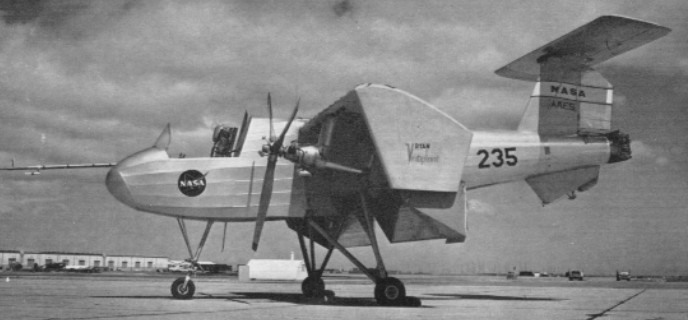
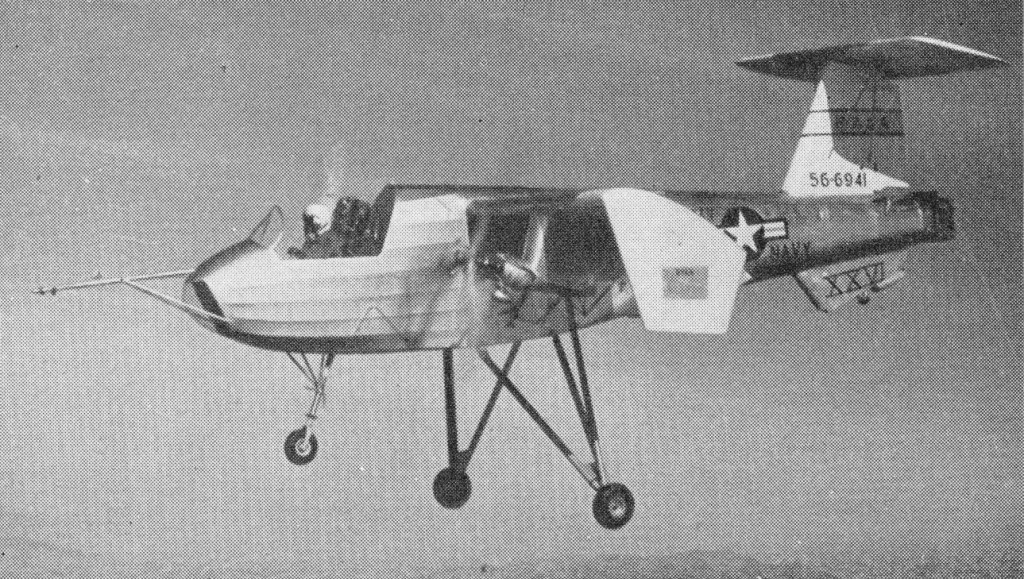
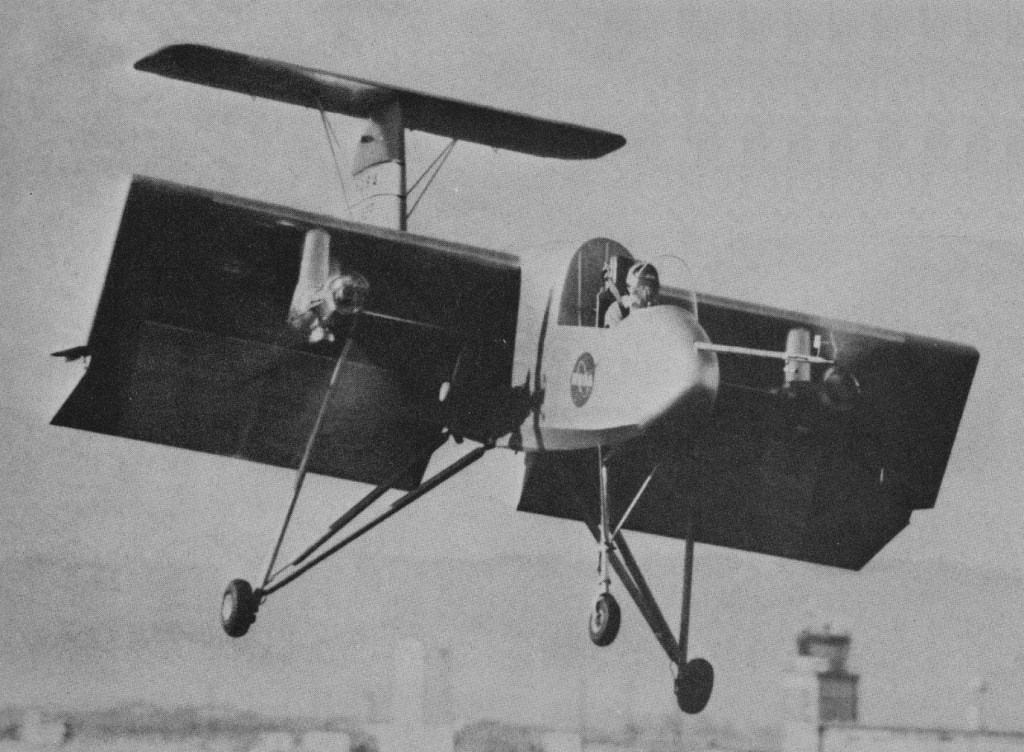
Ordered by the Army in 1956, the VZ 3 or Ryan Model 92 Vertiplane makes use of the deflected slipstream principle which was first proposed in the U.S. as early as 1921 by Dr. Albert F. Zahm. The principle consists of using a conventional wing and propellers for cruising flight and having large flaps on the wing trailing edge which, when extended, deflect the propeller slipstream down¬ward to obtain vertical lift.
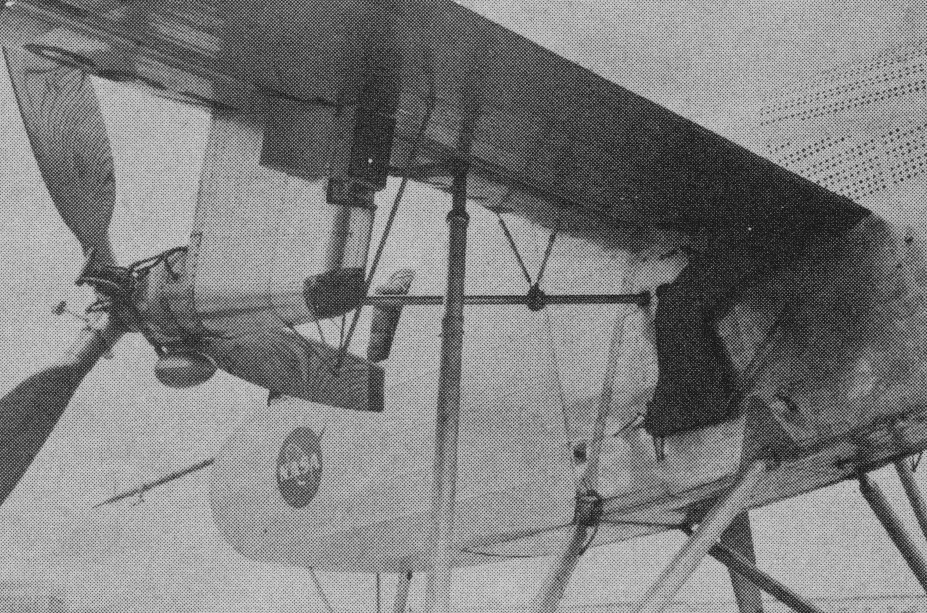
The VZ 3 is basically a high wing monoplane with a 1,000 hp Lycoming T53 L 1 turboshaft engine in the fuselage driving two 9 ft. diameter slow running propellers. The wing tips were turned down to prevent spanwise flow and power loss when the flaps were down. For control at low, speeds, engine exhaust was directed to a swivel nozzle at the end of the fuselage, giving pitch and yaw control; roll control came from differential pitch applied to the propellers.
Ryan test pilot Peter Girard made the first taxying trials of the VZ 3 (56 6941) on February 7th, 1958.
Subsequently, it spent three months in the full scale low speed wind tunnel at the N.A.S.A. Ames Laboratory at Moffet Field. At this stage it had a tail down undercarriage, but a nosewheel was added, as well as a large ventral fin, before the first flight was made on January 21st, 1959, at Moffet Field.
On the thirteenth test flight, on February 13th, 1959, the VZ 3 was damaged in a landing mishap caused by a malfunction in the propeller control system. Trials were resumed later in the summer and Ryan completed a test programme in which a speed range of 110 knots to 26 knots was covered, and flights were made up to 5,500 ft. For this second series of trials the cockpit canopy was removed.
In February 1960, after being handed over to NASA, the VZ 3 was almost completely de¬stroyed on a pilot familiarization flight. Operating outside the approved envelope for safe flight, it pitched up and completed most of a loop at 5,000 ft. The pilot ejected safely at 1,000 ft.
After it crashed in 1960 the VZ-3RY was rebuilt with lengthened nosewheel strut, 9 degree lower thrust axis and the LW-1 lightweight ejection seat. Utilising a deflected slipstream principle, the 785 shp Lycoming T53-L-1 turbine, located centrally in the fuselage, drives two wing-mounted Hartzell 3-bladed wood props whose slipstream covers the full wing span. For V/STOL and hover, double wing flaps are fully extended; for transition to horizontal flights, flaps are retracted as the plane picks up speed and the slipstream then flows horizontally.
70 degrees level flight with full flap, 29 mph
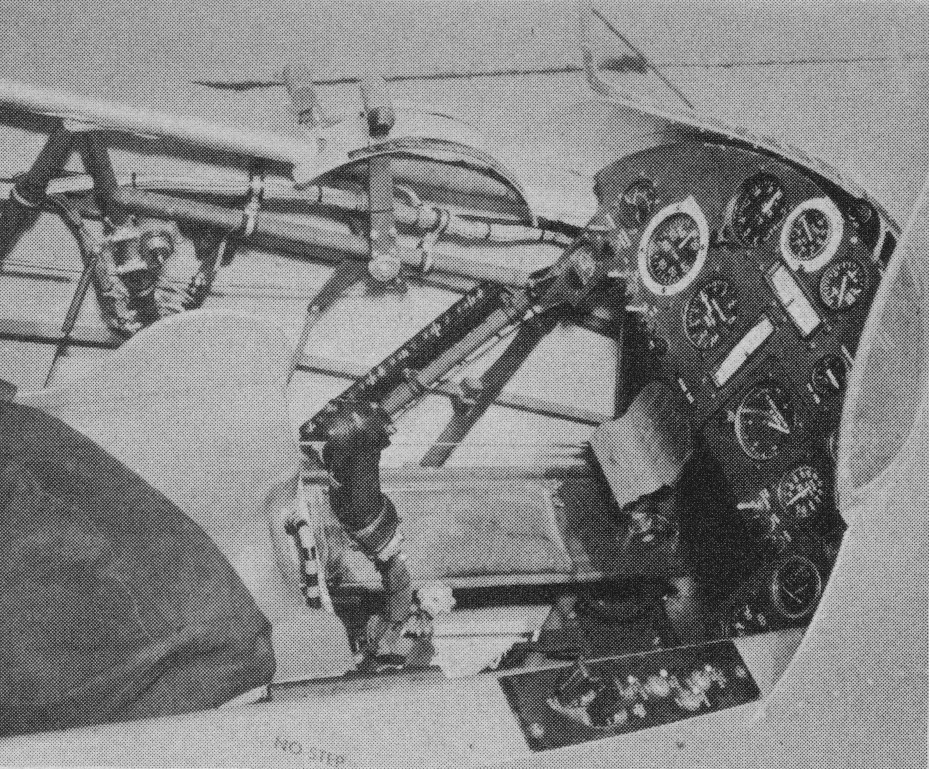
Conventional stick and rudder pedals controls actuate rudder, elevator, variable-incidence T-tailplane, and spoilers in the upper wing forward of the flaps, these replace the usual ailerons. Large wing tip end-plates provide structural support for the flaps and confine the slipstream.
Gas turbine tailpipe nozzles deflect Jetstream at right angles to eliminate forward thrust. Pitch and yaw control is achieved by shielding one side of the nozzle. For roll control ailerons actuate prop pitch control differentially when flaps are extended.
After a complete rebuild, the VZ 3 was returned to NASA in 1961 and pilots Fred Drinkwater and Bob Innis began a programme to investigate its low speed handling characteristics. Several modifications were made at this time, since when the VZ 3 has been contributing valuable data for the development of other VTOL aeroplanes.
Engine: 1 x 785 shp Lycoming T53-L-1 Props: 2 x Hartzell 3-bladed wood Span: 23 ft 5 in Length: 27 ft 8 in Height: 10 ft 8 in Gross weight: 2925 lb
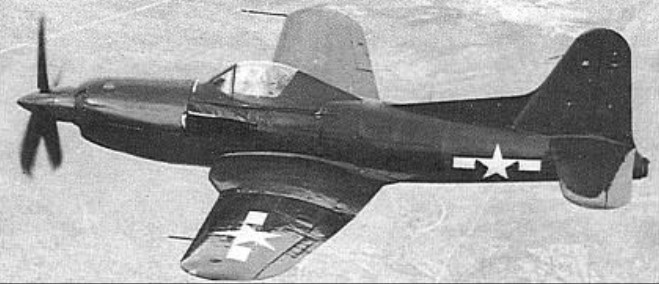
A major modification of the FR-1 Fireball, the Model 29 resulted from a Bureau of Aeronautics requirement for a single-seat fighter combining a turboprop with a turbojet. Assigned the designation XF2R-1 and later to become known unofficially as the “Dark Shark”, the single prototype utilised the fifteenth FR-1 production airframe and retained that fighter’s J31-GE-3 turbojet, mated with a General Electric XT31-GE-2 turboprop developing 1,700hp plus 227kg of residual thrust.
Although lacking the wing folding and the catapult and arrester gear standard on the FR-1, the XF2R-1 weighed 473kg more than its predecessor when it flew for the first time in November 1946. The XT31 drove a propeller with four square-tipped hollow-steel blades which could be fully feathered or reversed to zero blade angle extremely rapidly, the drag of the flatter blade angle serving as an effective air brake for landing. By comparison with the FR-1, the vertical tail surfaces of the XF2R-1 were enlarged to compensate for the lengthening forward to accommodate the turboprop, but the airframe of the later fighter was similar in most other respects. The XF2R-1 underwent extensive testing at Muroc Dry Lake, but no further development was undertaken.
Max take-off weight: 4990 kg / 11001 lb Wingspan: 12.80 m / 42 ft 0 in Length: 10.97 m / 36 ft 0 in Height: 4.27 m / 14 ft 0 in Wing area: 28.33 sq.m / 304.94 sq ft Max. speed: 800 km/h / 497 mph Ceiling: 11920 m / 39100 ft
Development of the RTAF-5 turboprop advanced trainer and forward air control aircraft was temporarily suspended until the Fantrainer-wing manufacturing programme was complete. The RTAF-5 is similar in general layout to the OV-10 Bronco, but is powered by a single Allison 250-B17C turboprop mounted on the rear of the fuselage in pusher configuration. Four underwing hardpoints are fitted for light stores. The prototype flew on October 5, 1984, with a fixed landing gear. A retraction mechanism and other systems were due to be installed during 1985.
RTAF-5 Engine: 1 x Allison 250 turboprop, 313 kW Span: 9.6 m Length: 10 m Wing area: 15.7 sq.m Empty wt: 1645 kg MTOW: 2154 kg Warload: 225 kg Max speed: 213+ kph Initial ROC: 91 m / min T/O run (to 15m): 700 m Ldg run (from 15m): 915 m Fuel internal: 219 lt
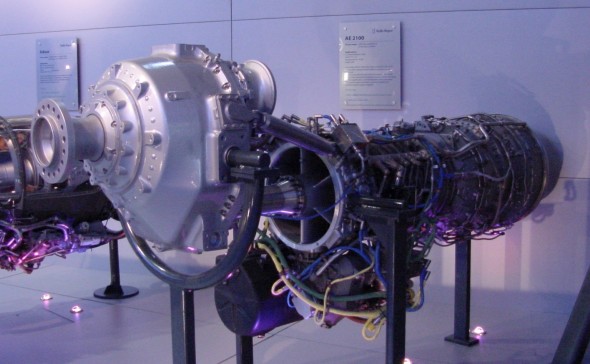
The Rolls-Royce AE 2100 is a turboprop developed by Allison Engine Company, now part of Rolls-Royce North America. A derivative of the Allison AE 1107C-Liberty (Rolls-Royce T406) turboshaft engine, the AE 2100 shares the same high-pressure core as that engine, as does the Rolls-Royce AE 3007. The engine is a two-shaft design, and was the first to use dual FADECs (full authority digital engine control) to control both engine and propeller. There are two versions of the engine: the civil AE2100A, and the AE2100D3 military variant.
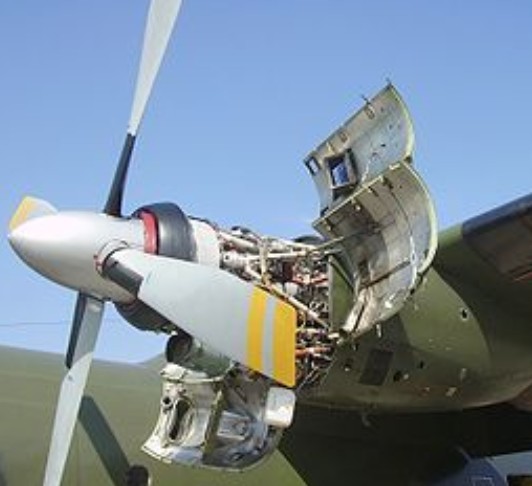
The engine uses new six-bladed Dowty propellers for use on the 50-seat Saab 2000 and the Lockheed C-130J Hercules military transport. Each engine develops 4,591 shaft horsepower.
Applications:
AE2100A Saab 2000 Indonesian Aerospace N-250 – Prototype only
AE2100D2A Alenia C-27J Spartan
AE2100J ShinMaywa US-2
AE2100D3 Lockheed Martin C-130J Super Hercules Lockheed P-3 Orion (test-bed)
Specifications: AE 2100D2 Type: Turboprop Length: 118 in (3.0 m) Diameter: 28.7 in (0.73 m) Dry weight: 1,727 lb (783 kg) Compressor: 14-stage axial Turbine: 2-stage HP, 2-stage PT Maximum power output: 4,637 shp (3,458 kW) Overall pressure ratio: 16.6:1 Power-to-weight ratio: 2.7 shp/lb (4.53 kW/kg)
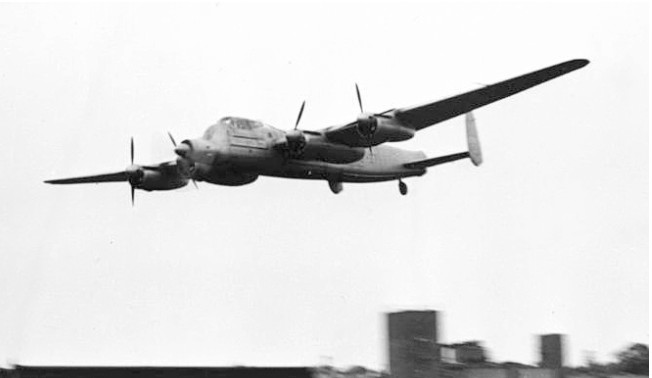
The Rolls-Royce RB.109 Tyne is a twin-shaft turboprop engine first run in April 1955. It was first test flown during 1956 in the nose of a modified Avro Lincoln. Following company naming convention for gas turbine engines this turboprop design was named after the River Tyne.
The Tyne was developed primarily for the four-engined Vickers Vanguard airliner, the prototype first flying on 20 January 1959 equipped with four Tyne Mk.506 of 4,985 e.s.h.p. Production deliveries of the engine were made from mid-1959 onwards to power the 43 Vanguards delivered to British European Airways and Trans-Canada Airlines.
The engine was further developed with greater power and used in the later twin-engined Dassault-Breguet Atlantique long-range reconnaissance aircraft; also in the Canadair CL-44 and Transport Allianz Transall transport aircraft.
A single stage HP turbine drives the 9-stage HP compressor. A 3 stage LP turbine drives the 6-stage LP compressor and, through a reduction gearbox, the propeller. The combustor is cannular.
The Mark 515 Tyne had a nominal takeoff power output of 5,730 hp (4,273 kW) equivalent power, flat rated to ISA+16.8C.
Rolls-Royce Tyne testbed Avro Lincoln demonstrating at Farnborough 1956 on just the nose Tyne, the 4 Merlins being shut down
Variants: RTy.1 4,370 hp (3,259 kW) fitted to Vickers Type 951 Vanguard and Vickers Merchantman. RTy.11 5,064 hp (3,776 kW) for Vickers Type 952 Vanguard RTy.12 4,616 hp (3,442 kW) for Canadair CL-44 RTy.12 5,399 hp (4,026 kW) for Short Belfast. RTy.20 Mk 21 5,667 hp (4,226 kW) for Breguet 1150 Atlantic and Breguet ATL2 Atlantique RTy.20 Mk 22 5,670 hp (4,228 kW) for Transall C-160 RTy.20 4,860 hp (3,624 kW) for Aeritalia G.222T RTy.20 6,035 hp (4,500 kW) for Transall C-160 and Breguet ATL2 Atlantique RTy.22 projected military use engine rated at 7,075 hp (5,276 kW) equivalent RTy.32 projected military use engine rated at 8,400 hp (6,264 kW) equivalent Mk.101 (RTy.12) Mk.506 Mk.512 Mk.515 Mk.515-101W Mk 801 Mk 45 RM1A Marinised ship powerplant RM1C Essentially similar to the RM1A RM3C Essentially similar to the RM1A
Applications Aeritalia G.222 Avro Lincoln Breguet Atlantic Canadair CL-44 Conroy Skymonster Short Belfast Transall C-160 Vickers Vanguard
The marine version, the Rolls-Royce Tyne RM1A, RM1C and RM3C remained in service as the cruise gas turbines in Royal Navy Type 42 destroyers and Type 22 frigates until the retirement of the 4 Batch 3 Type 22 frigates (2011) and the last remaining Type 42 Destroyer (2013).
Specifications: Tyne RTy.20 Mk 21 Type: Twin-spool turboprop Length: 108.724 in (2,762 mm) Diameter: 55.12 in (1,400 mm) Dry weight: 2,391 lb (1,085 kg) Compressor: Axial, 6-stage LP, 9-stage HP Combustors: 10 cannular flame tubes Turbine: 3-stage LP, single-stage HP Fuel type: Avtur Oil system: pressure spray/splash with dry sump using DERD 2487 spec. oil Maximum power output: 6,100 hp (4,549 kW) equivalent power Overall pressure ratio: 13.5:1 Turbine inlet temperature: 800 °C (1,470 °F) Specific fuel consumption: 0.485 lb/hp/hr (0.298 kg/kW/hr) for take-off Power-to-weight ratio: 2.55 hp/lb (4.194 kW/kg)
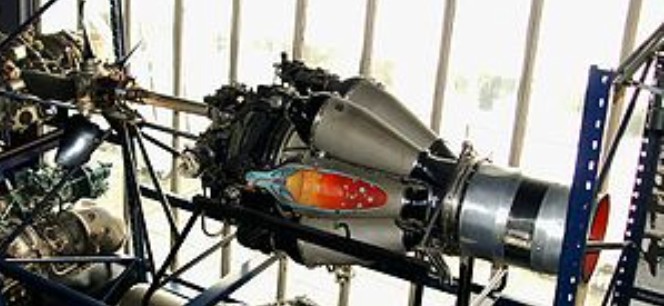
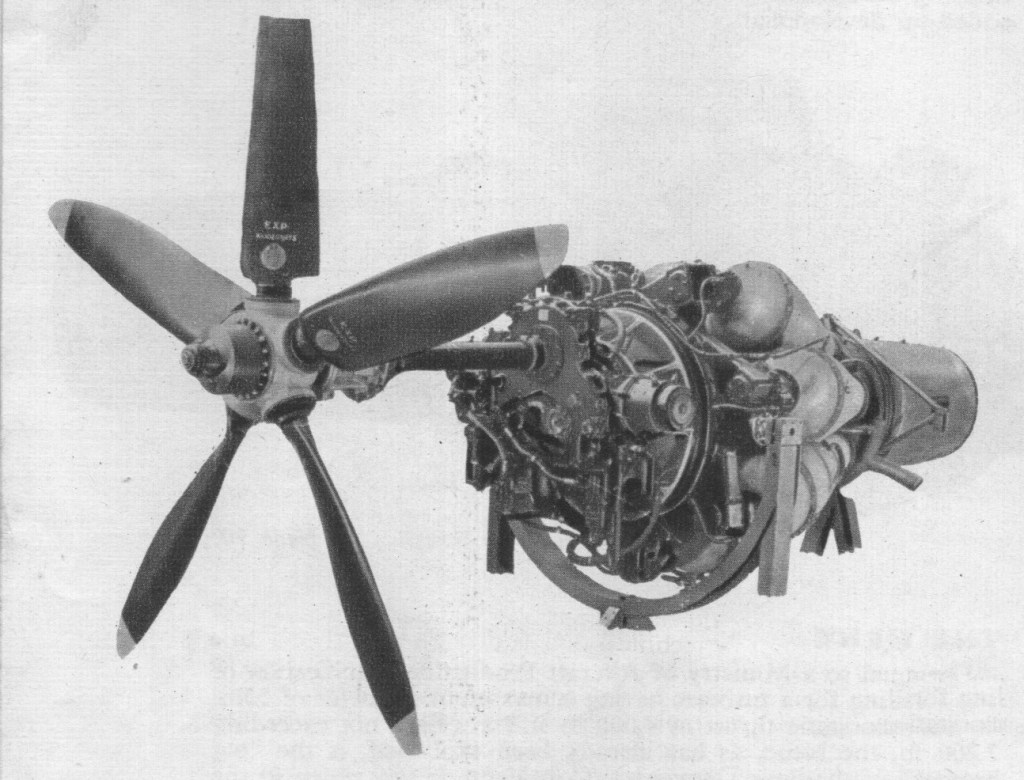
The Trent was based on a concept provided by Sir Frank Whittle and was essentially a Derwent Mark II turbojet engine with an additional turbine stage driving a reduction gearbox (designed by A A Rubbra) connected to a five-bladed Rotol propeller. Experimental work with the Trent (RB.50) actually dated back to May 1944, when a WelIand was equipped with a spur-type reduction gear and tested for shaft horsepower. First run in June 1944, the Trent ran for 633 hours on test before being installed in a Gloster Meteor (Trent Meteor) jet fighter which flew for the first time on 20 September 1945 at the start of a programme comprising 298 hours of flight tests.
The Rolls-Royce RB.50 Trent was the first Rolls-Royce turboprop engine.
Trent Type: Turboprop Dry weight: 1,000lb turbine unit, reduction gear 250lb, propeller 250lb, total engine/propeller weight 1,500lb Compressor: 1-stage double-sided centrifugal compressor Combustors: 10 x can combustion chambers Turbine: Single-stage axial Fuel type: Kerosene (R.D.E.F./F/KER) Oil system: pressure feed, dry sump with scavenge, cooling and filtration, oil grade 150 S.U. secs (32 cs) (Intavia 7106) at 38 °C (100 °F) Maximum power output: 750 shp, with 1,250 lb (570 kg) residual thrust
This turboprop achieved renown as the power unit of the Vickers Viscount, it has also been flown on a limited scale in the Avro Athena and Boulton Paul Balliol advanced trainers.
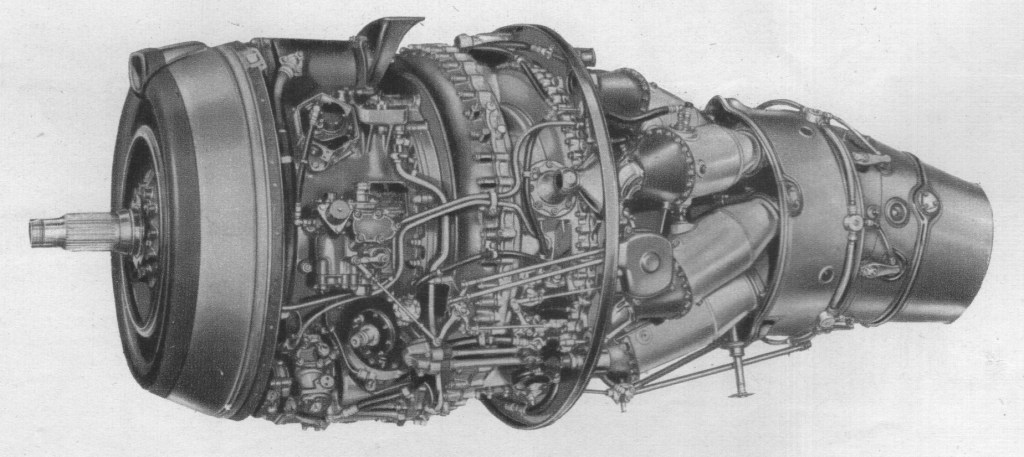
The Dart is characterized by a two-stage centrifugal compressor, handling about 20 lb of air per second, and a two-stage turbine. Steel guide vanes direct the air between the 19 rotor blades, from which it is impelled at high speed. After passing through a diffuser the flow is directed through curved passages, formed by the compressor casings and inter-stage guide vanes, into the second rotor.
The two stages of the turbine are locked together on a common shaft and the blades of the high and low pressure, stages have “fir tree” roots. Both discs are cooled on their front and rear faces, and a steel-strip seal prevents gas leakage between the stages. There are seven combustion chambers.
Dart final checks at Derby
Under tropical conditions lost take-off power is restored by water/methanol injection.
The Dart RDa.6 was in production for Viscounts, and has a new reduction gear and other refinements, making possible a maximum rating of 1,500 h.p. The RDa.5 was completely new, and designed for even greater powers. It is scheduled to power the Viscount 800 Series.
Dart 505 Diameter, 37.9in Length, 95.1in Dry weight, 1,030 lb Max. power, 1,400 s.h.p. plus 365 lb thrust Equivalent shaft horsepower, 1,515 at 14,500 r.p.m Specific fuel consumption, 0.83 lb/hr/e.s.h.p.




 All Aero