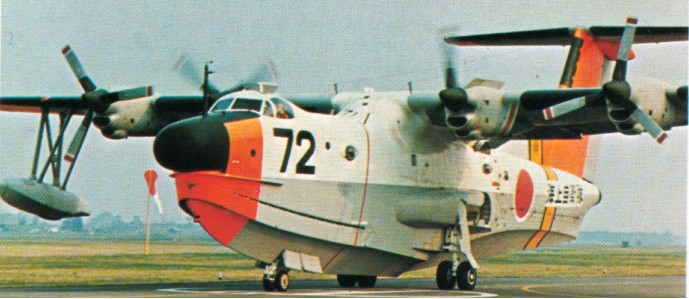
After January 1966, directed attention was put into a new marine aircraft. A Grumman Albatross was rebuilt as a dynamically similar flying model for a projected very large STOL ASW flying-boat for the Japanese Maritime Self Defense Force. The type was developed as the four-turboprop PS-1, but later as the US-1 amphibious search-and-rescue aircraft.
The Shinn Meiwa PS 1, a four turboprop STOL amphibian with an auxiliary engine driving a boundary -layer control pump, has a speed range from 295 knots maximum to a 40 knot stall. PS 1s carry search radar, sonobuoys, MAD and ECM equipment to aid in the search for submarines, and against which they can deploy anti submarine bombs, homing torpedoes, and rockets for surface attack.
Designed for long-range ASW, the four-turboprop PS-1 flying boat first flew in October 1967, entered service in 1973, and was followed by the US-1 amphibious variant in October 1974.
The first prototype PS-1 was converted later as waterbombing test vehicle.
Production of the PS-¬1 was completed with the 23rd aircraft in 1979. The seventh and subsequent US-1s are fitted with uprated T-64 IHI-10J turboprops and are designated US-lAs. Earlier aircraft are being progressively retrofitted with these engines.
The JMSDF intended to purchase one US-1A SAR amphibian every two years, the next funding was being sought in FY1988.
PS-1 Engines: 4 x T64-IHI-10 turboprop, 3060 shp Wing span: 108 ft 8.75 in (33.14 m) Max speed 340 mph (547 km/h) Crew: 10
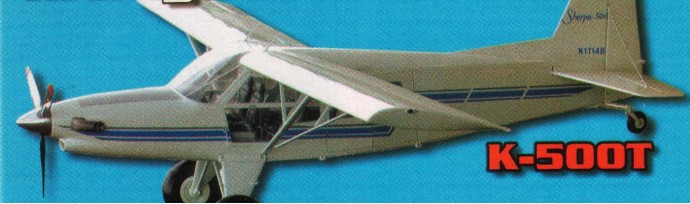
The Sherpa K-650T 8 place is turbine powered and capable of operating on wheels, skis, or floats.
I don’t like it. For me the worst aircraft of all bush planes. The plane is hard to land correctly and difficult to control. I regret the purchase. ry.ma@gmx.net
Engine: Honeywell TPE331-5, 840 hp Optional engine: Honeywell TPE331-10, 1000 hp Prop: 116 in 3-blade Wingspan: 47 ft 4 in Wing chord: 6 ft 8 in Aspect ratio: 7.1 Length: 34 ft 1 in Height: 9 ft 9 in Empty weight: 3500 lb MTOW: 6500 lb Max wing loading: 20.63 lb/sq.ft Max power loading: 8.66 lb/hp Fuel capacity: 346 USG Tailplane span: 18 ft 3 in Wheel track: 8 ft 10 in Prop ground clearance 3 pt: 3 ft 1 in Prop ground clearance level: 1 ft 7 in Cabin door height: 3 ft 7 in Cargo door width: 5 ft 1 in Baggage door height; 1 ft 8 in Baggage door width: 2 ft 6 in Cruise 18,000 ft: 188 mph Econ cruise 18,000 ft: 174 mph Stall clean: 58 mph Stall flaps down: 34 mph ROC SL: 1400 fpm Service ceiling: 25,000 ft TO run gross: 336 ft Landing run gross; 240 ft Range max cruise (42USG/hr) + res: 1256 sm Range econ cruise (36USG/hr) + res: 1500 sm Cabin volume: 220 cu.ft Baggage volume: 7.5 cu.ft Useful load: 3000 lb Wing area: 315 sq.ft Aileron area – total: 26.4 sq.ft Spoileron area – total: 4.6 sq.ft Flap area: 67.9 sq.ft Fin area: 32.6 sq.ft Rudder area: 15.7 sq.ft Horiz. Stab. Area: 77.6 sq.ft Elevator area: 36.8 sq.ft Seats: 8 Tires: 29x11x10 (35in opt.)
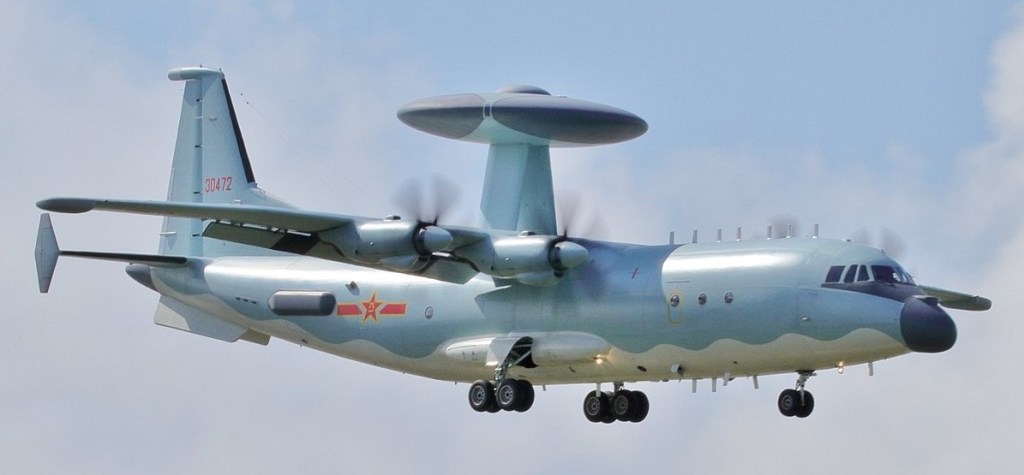
The KJ-200 (Chinese: 空警-200; pinyin: Kōngjǐng Liǎngbǎi; literally: “Airwarn-200”) NATO reporting name: Moth or Y-8 Balance Beam system, is an Airborne early warning and control (AEW&C) program developed by Shaanxi Aircraft Corporation. (KJ is from the first characters of the Pinyin spelling of 空警, (Kōng Jǐng), short for 空中预警 (Kōng Zhōng Yù Jǐng), which means Airborne Early Warning).
The key component of this aircraft is an AESA radar system, visually similar to the Saab Erieye system, mounted on struts above the rear fuselage, as well as ventral sensor domes. The platform of this aircraft is based on the Shaanxi Y-8F-600 and it has been reported that Pratt & Whitney Canada PW150B turboprops and Honeywell avionics have been incorporated.
The general designer of the KJ-200 is Ouyang Shaoxiu (欧阳绍修), the same general designer of the Y-8. According to Ouyang the KJ-200 has been significantly modified (around 80%) from the original Y-8. including the adoption of a glass cockpit.
The project experienced a major setback in 2006, when a KJ-200 crashed into a mountain in Guangde County while undergoing tests.
During the National Day of the People’s Republic of China military parade 1 October 2009, a KJ-200 took the role as a lead aircraft.
In February 2017 a US Navy Lockheed P-3 Orion and a KJ-200 inadvertently came close to each other over the South China Sea. The aircraft were within 1,000 feet (305 meters) of each other.
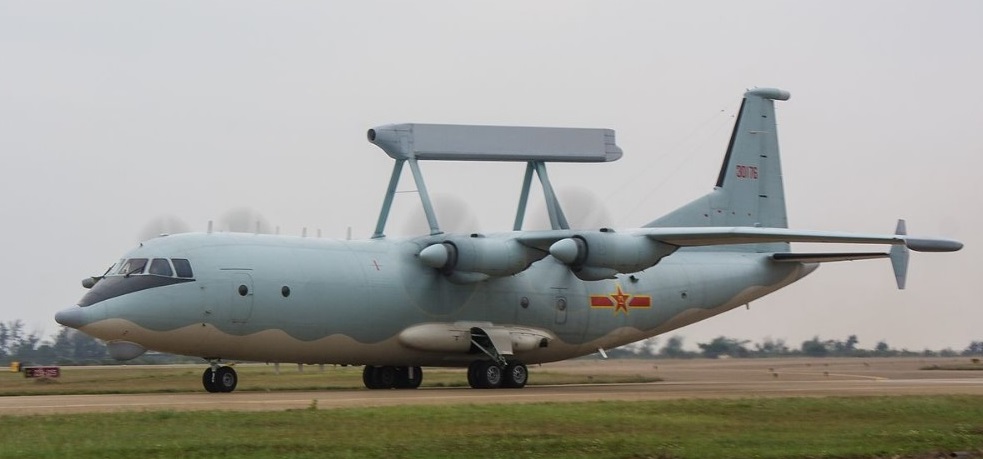
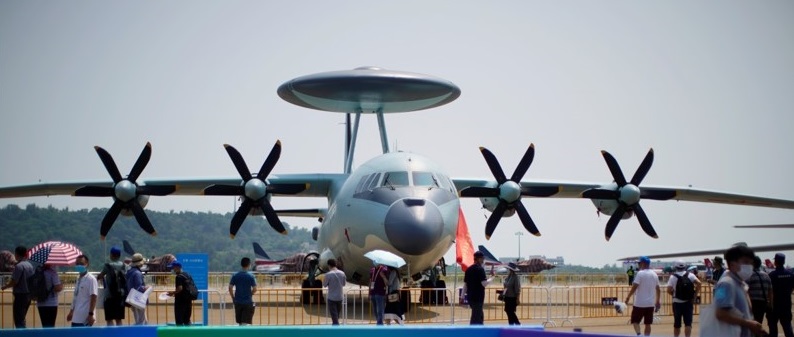
The Shaanxi KJ-500 (Chinese: 空警-500; pinyin: Kōngjǐng Wǔbǎi; literally: “Air Warning 500”) is a third-generation airborne early warning and control (AEW&C) aircraft used by the Chinese People’s Liberation Army Air Force. It was built by Shaanxi Aircraft Corporation, and is based on the Y-9 airframe.
China started the development of the KJ-500, its third AEW&C, in the late 2000s. The KJ-500 was required to have good detection capability, good identification ability, and quick responsiveness. The KJ-500 was also required to be the core force of the information combat system, its equipped technology has four major characteristics, which are networking, multi-functionality, high-integration, and lightweight.
The aircraft carries a fixed dorsal radome containing three AESA radar arrays for 360-degree coverage, and is said to be more efficient than the two-planar ‘balance beam’ array design used on the earlier KJ-200. Production of older AEW&C types reportedly ceased production in 2018 in response to the KJ-500 reaching full operational capability.
The KJ-500 is the base variant with the KJ-500A improved variant with an aerial refuelling probe debuted at the Zhuhai Airshow 2022.
Max speed: 550 km/h Max range: 5700 km Max endurance: 12 h Max takeoff weight: 77 tons Range against fighter sized targets: 470 km
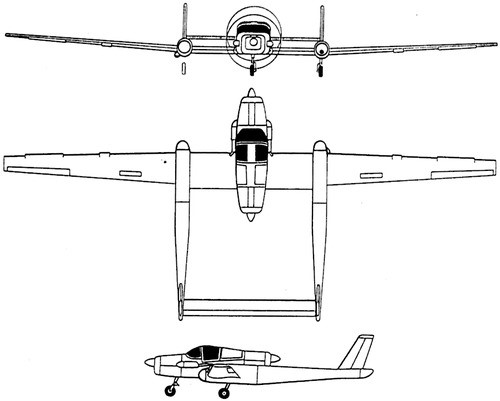
In the mid-1990s the Coast Guard decided that the RG-8 aircraft would be more useful if their capabilities were improved to include night operations by the addition of more mission sensor equipment. Discussions with Schweizer Aircraft resulted in a plan to upgrade two RG-8As and build one new aircraft to provide a total of three.
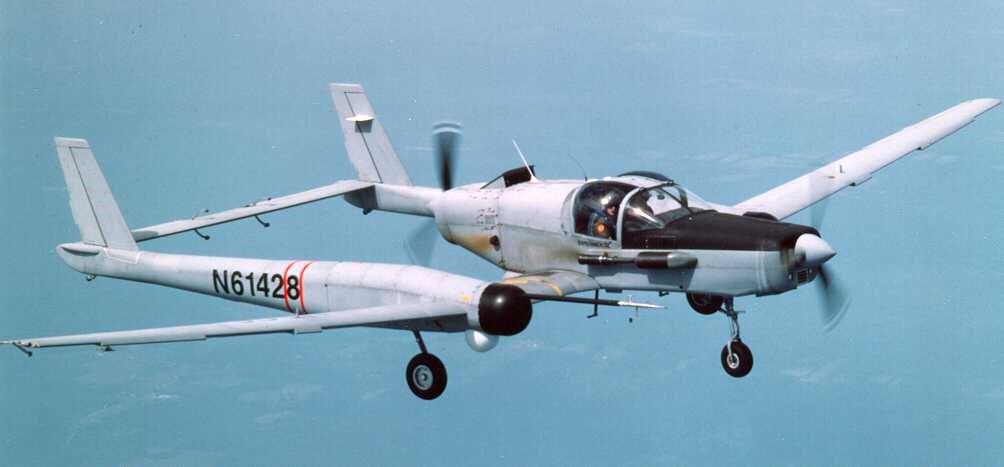
The RU-38 was intended to fulfill both the low altitude, quiet, over water/hostile terrain reconnaissance role and also the high altitude standoff surveillance role. Based on the Schweizer SGM 2-37 motor glider, a total of five RU-38s were produced between 1995 and 2005.
In converting to the new RU-38A configuration, the conventional RG-8A airframe was greatly modified by: Removing the single 235 hp (175 kW) Lycoming O-540-B powerplant Installing two Teledyne Continental Motors GIO-550A engines with a 3:2 gear reduction to 2267 operating rpm. The engines are mounted one in the nose and the other in the rear of the fuselage. Enlarging the crew compartment Improving the engine mufflers Increasing the wingspan from 56.5 ft (17.22m) to 84.13 ft (25.65 m) Changing the single tail fin to a twin-boom configuration with two fins Greatly enlarged sensor bays Improved noise signature reduction Tricycle landing gear replacing the conventional landing gear
The resulting aircraft bears little resemblance to the original TG-8. Installation of the twin-boom pods permits the carriage of more sensors. The left-hand pod houses an AN/APN-215(V) color multi-function X-band sea search radar with mapping capabilities. The right-hand pod houses the AN/AAQ-15 forward looking infrared (FLIR) and Low-Light TV enhanced vision systems.
Schweizer RU-38A
For navigation the RU-38A originally carried both OMEGA and GPS receivers, although the Omega has since been removed with that system’s withdrawal from service in 1997. The aircraft also has HF, VHF and UHF radios for voice and encrypted voice communications, plus direction finding. The crew may also use night vision goggles.
The aircraft has no flaps and instead retains the top and bottom surface divebrakes of its sailplane ancestors.
The RU-38A is designed to transit to its operational area with both engines operating. Once in the surveillance area the rear engine would normally be shut down and the aircraft operated in “quiet surveillance mode”. The second engine would be available for use in an emergency and for return to base at faster speed.
The first Coast Guard RG-8A was returned to Schweizer for conversion to RU-38A status on 24 January 1994. The initial plan called for the conversion of two RG-8As and then fabrication of one new RU-38A.
The first flight of the converted aircraft took place on 31 May 1995. The second USCG RG-8A aircraft that was earmarked for RU-38A upgrade crashed near Puerto Rico in 1996. As a result, the program was reduced to provide only two RU-38As to the USCG. The loss of the RG-8A delayed the program for many months and it was not completed until May 1997.
The first RU-38 was tested by the Air Force 445th Flight Test Squadron at Edwards AFB on behalf of the Coast Guard, starting in July 1998. The airplane flew some 100 test flights during the four-month program.
By September 1999 the two converted RU-38As had been delivered to the Coast Guard in Miami, Florida for operational employment. The RU-38As were flown in drug interdiction missions over the Gulf of Mexico and the Caribbean Sea, but they were reportedly grounded during 2000, due to problems with the aircraft meeting mission requirements or serviceability.
The company further improved the aircraft by replacing the two piston engines with two Rolls Royce Allison 250-B17F turboprop engines which allowed raising the gross weight to 7200 lbs (3265 kg). The new aircraft carries the military designation of RU-38B.
The RU-38B has 140 cubic feet (4.0 cu m) of payload space with a payload weight of 800 lbs (363 kg) available. The payload bays all have large access doors and are located both in the tailbooms and also behind the pilot and co-pilot seats in the fuselage. The latter space can also accommodate a third crew member, if required. Using pallet-mounted sensor packages the aircraft can be quickly changed from one mission to another.
The RU-38B is able to achieve quiet operation while loitering by using a propeller speed as low as 1000 rpm. This is possible because the sailplane-derived wing is efficient and flight at low airspeed can be sustained with low power. Exhaust from the front engine is routed overwing, reducing the noise footprint.
Two RU-38Bs were delivered to the US Department of Justice, one in 2004 and one in 2005.
The aircraft remains in production by Sikorsky Aircraft after acquiring Schweizer and was still being actively marketed by Schweizer in 2011. Neither the RU-38A or B was certified by the Federal Aviation Administration. Instead all aircraft operate as experimental aircraft in the Research and Development category.
RU-38 is the US military designation for the aircraft, indicating Utility, Reconnaissance. The Schweizer company model number is Schweizer SA 2-38A Condor and, in its three-seat configuration, Schweizer SA 3-38A Condor
RU-38A Maximum take-off weight: 5300 lb (2404 kg) Number built: 2
RU-38B Engines: 2 × Rolls Royce Allison 250-B17F Props: Constant Speed, Full Feather Wingspan: 84.13 ft (25.64 m) Wing area: 334.2 ft2 (31.05 m2) Airfoil: Wortmann Fx 61-163 Length: 35.1 ft (10.7 m) Empty weight: 4265 lb (1934 kg) Useful load: 2935 lb (1331 kg) Loaded weight: 7200 lb (3265 kg) Max. takeoff weight: 7200 lb (3265 kg) Maximum speed: 168 knots (312 km/h) Cruise speed: 83 knots (mission speed) (155 km/h) Stall speed: 62 knots with divebrakes closed (116 km/h) Never exceed speed: 168 knots (312 km/h) Service ceiling: 30,000 ft (9144 m) Wing loading: 21.5 lb/ft2 (105.1 kg/m2) Crew: two in side-by-side or three, with two pilots side-by-side and one sensor operator in the rear Number built: 3
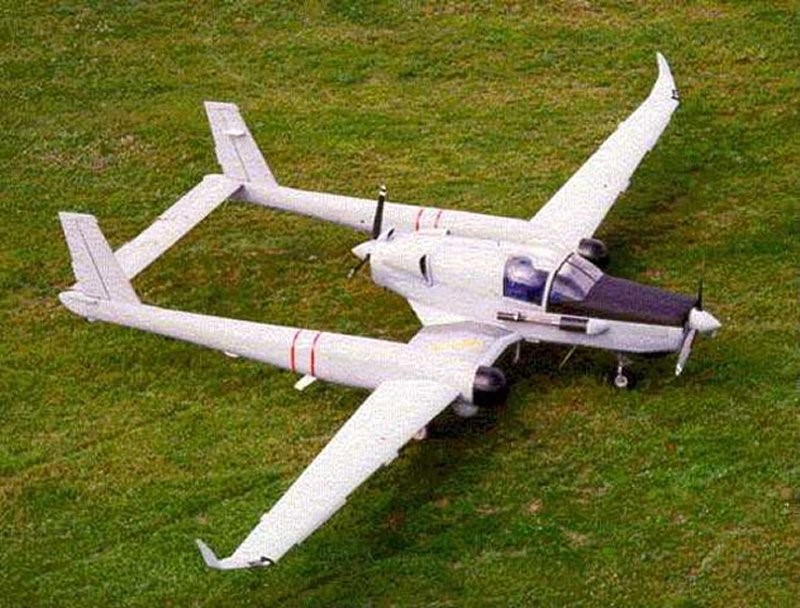
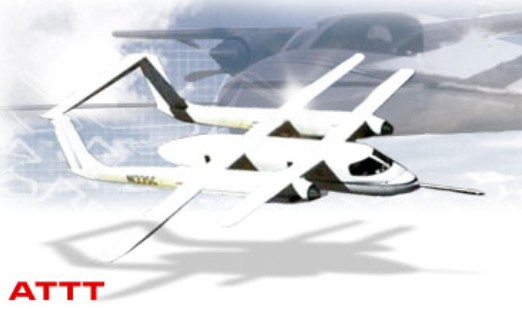
The Model 133-4.62 Advanced Technology Tactical Transport (ATTT) proof-of-concept demonstrator is a 62% scaled version of an airplane designed to challenging STOL and long range requirements. The ATTT was developed and test flown by Scaled Composites, Inc. under contract to DARPA. The initial flight test program consisted of 51 flights with the original cruciform tail configuration, measuring and refining performance, stability and control, and handling qualities. The results of the fabrication and test program were presented in a comprehensive report to DARPA .
In an effort to improve the aft loading capability of the aircraft and to correct aerodynamic deficiencies discovered during the test program, the ATTT aircraft was modified with a twin-boom tail whose general configuration was similar to that of the Rockwell OV-10 Bronco. This modified configuration is shown in the accompanying photograph. Pratt and Whitney of Canada PT6A-135A turboprop engines were attached to the twin booms in a tractor configuration. A simple fully mechanical flight control system was installed, with full control available from both seats. The Scaled-designed landing gear is actuated using electric motors.
The M-133 demonstrator used a unique flap system to enable its STOL performance. The high lift configuration consists of eight Fowler-type flaps, each of 43% chord. The flap system was designed to allow the initial takeoff roll to be performed with the flaps extended, but at low deflections to minimize takeoff drag. As rotation speed was neared, the flaps were quickly rotated to the maximum lift position via a separate pilot action. The ATTT was a key program for Scaled. It demonstrated our ability to perform a challenging aerodynamic and structural design, and to build, test, and deliver what amounted to two different manned research airplanes, including all design and flight test data, to DARPA for less than 3 million dollars, including all recurring and nonrecurring costs.
The Scaled ATTT (also seen as AT3) was flown in two different configurations. First as Model 133-3-62 with a conventional tail section with cruciform tailplanes. First flight 29 December 1987. Later in the test programme small endplates were added to the horizontal tail. During 1989 it few again as Model 133-4-62 with the twin tail booms. Engines were two 850hp P&WC PT6AS-135A end registration was N133SC.
In original form wingspan was 53.208ft, length 44.854ft and height 14.075ft. Internally the project was referred to as SMUT (Special Mission Utility Transport). It was an approx. 62% scale technology demonstrator for a planned ATTT -Advanced Technology Tactical Transport and some money may have come from DARPA – Defence Advanced Research Projects Agency.
The ATTT is in storage at the Air Force Flight Test Center Museum, at Edwards Air Force Base.
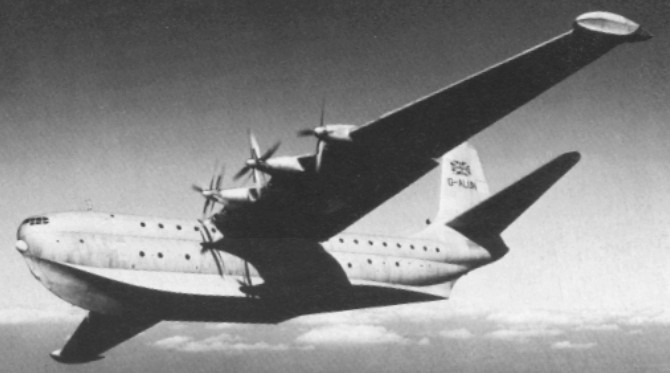
The Saunders Roe Princess was intended as a flagship for British Overseas Airways Corporation; weighed 152 tonnes (150 tons) and was to have carried 105 passengers in its two deck, pressurized hull. The three prototypes were, ordered in May 1946, were intended for non-stop transatlantic service. The Princess was powered by ten Bristol Proteus turboprop engines. Eight of the engines coupled in pairs driving contra-rotating propellers. The flight deck crew consisted of two pilots, two flight engineers, a radio operator and a navigator. Two decks carried 105 passengers in first and tourist class. By the time the first example flew, years behind schedule, on 22 August 1952 the programme cost had nearly quadrupled to £11,000,000.
Meanwhile BOAC had given up flying boat operations. Instead, the boats were to be completed as long-range military transports for the RAF, but the lack of a suitable powerplant brought even these optimistic hopes to an end. Larger than the Martin Mars and heavier than the Bristol Brabazon I, the Princess prototype was flown for the first time on 22 August 1952 and spanned 66.90m with its wingtip floats retracted, weighed 156,492kg on take-off. It could attain a maximum speed of 579km/h on the power of its 10 2386kW Bristol Proteus 600 turboprop engines.
Development problems with the gearboxes of the inboard engines contributed to the decision to end development. No one wanted the Princess or her two sisterships which had been completed at Saunders -Roe’s Isle of Wight factory, and the three Princesses sat cocooned at Calshot for 15 years before the cutters’ torches finally destroyed them. The second and third Princesses did not fly.
Saunders-Roe SR.45 Princess Engines: 10 x Bristol Proteus 2 turboprop, 3780hp Span: 210 ft 6 in / 66.90 m Length: 148 ft / 45.11 m Height: 17.37 m / 57 ft 0 in Max take-off weight: 156500 kg / 345025 lb Max. speed: 612 km/h / 380 mph Cruise speed: 579 km/h / 360 mph Range: 8484 km / 5272 miles Pax cap: 105 Crew: 6


 All Aero