S-251 Engine: 1 x Turbomeca Astazou II, 560 hp Wingspan w/tip tanks: 37 ft Length: 29.52 ft Empty weight: 1948 lb MTOW: 3968 lb Range: 1240 mi at 280 mph with 5 pax Range at 19,700 ft: 1466 mi Service ceiling: 36,000 ft ROC: 2652 fpm TO run: 678 ft TO to 50ft: 1345 ft
S-2510 Engine: 1 x Turbomeca Astazou X turboprop, 496kW Max. speed: 436 km/h / 271 mph
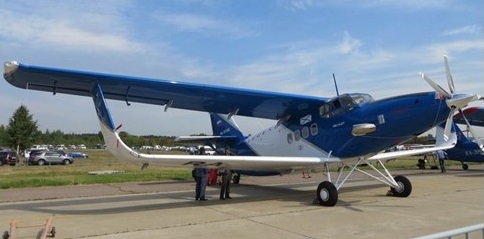
TVS-2-DT RA-2519G at MAKS, Zhukovsky, Moscow, Russia, August 26, 2015
Another organization working on a “better” An-2 is SibNIA (Siberian Aeronautical Research Institute) in Novosibirsk, Russia. In this version, the An-2MS (An-2MC in Russian) and later usually referred to as the TVS-2MS), the radial engine was replaced by a 1,100 hp Honeywell TPE331-12UHR turbine, driving a five-bladed Hartzell propeller. The first An-2MS/TVS-2MS was first flown on September 5, 2011 and by 2015 well over fifteen examples had been delivered by SibNIA and Rusaviaprom JSC, all built, from existing An-2 airframes retaining the An-2 wings and tail feathers.
SibNIA went a step further and also developed an upgraded An-2 with an entirely new composite construction high-lift, high-aspect-ratio wing. This new wing was first tested on an An-2MS which flew as a high wing monoplane. The aircraft, designated TVS-2-DT, first flew in December 2014 and had the TPE331 engine and old style tail. It then received curved wingtips on the upper wing and a new lower wing with wingtips acting as interconnecting struts. In this guise it flew on June 10, 2015, initially also with the old tail, but this was soon replaced by a new design larger and squared vertical tail as shown in the photo.
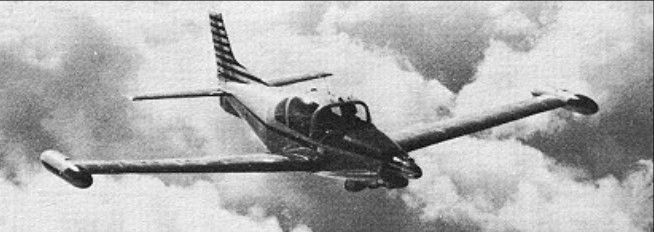
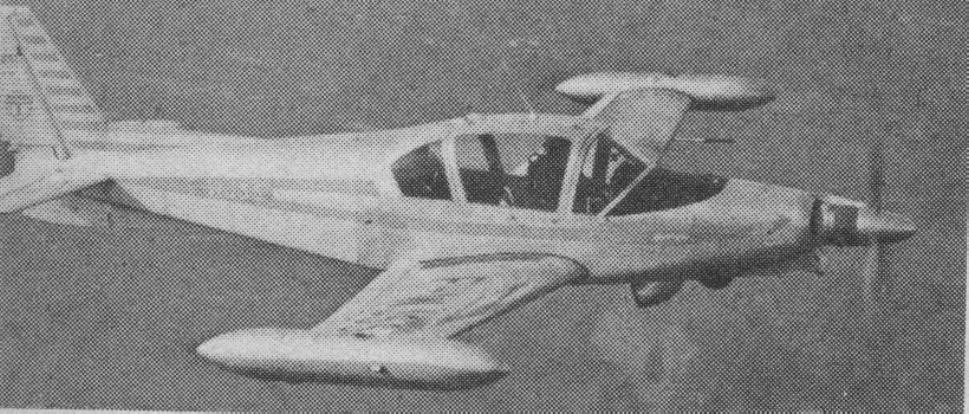
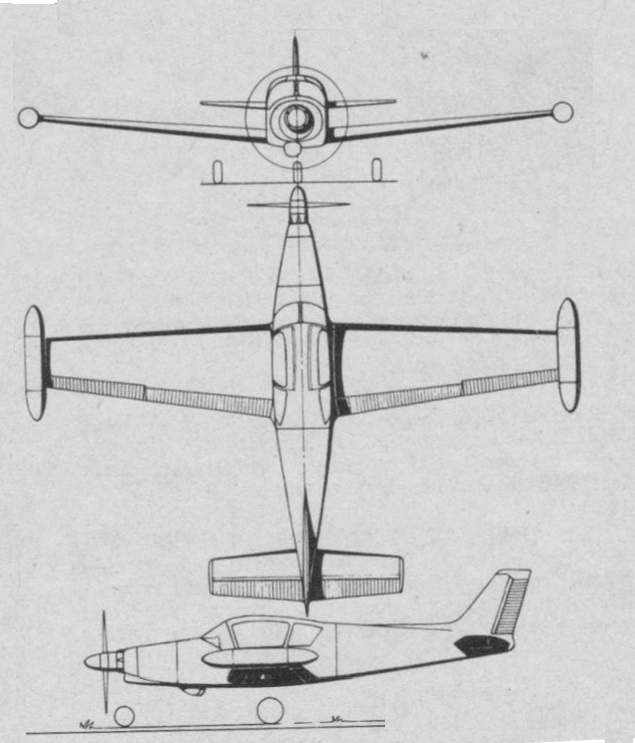
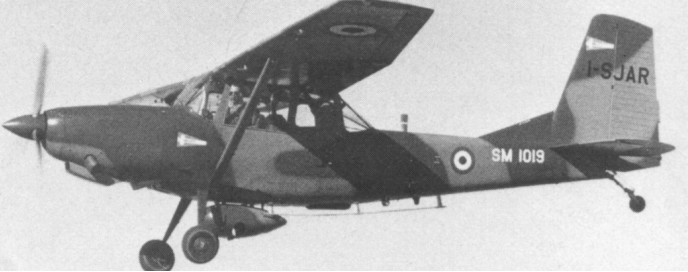
The Cessna O-1 provided the basis for the Italian development of a turboprop version. A two-seat STOL light monoplane powered by a 298kW Allison 250-B17 turboprop engine, the prototype first flew on 24 May 1969.
The SM 1019 was evaluated by the Italian Army Light Aviation, which ordered 80 SM.1019E1s, under the designation AL-2. Optional armament or equipment is carried on two underwing hardpoints.
Engine: Allison 250-B15G, 317 shp Wingspan: 10.97 m / 36 ft 0 in Max. speed: 280 km/h / 174 mph
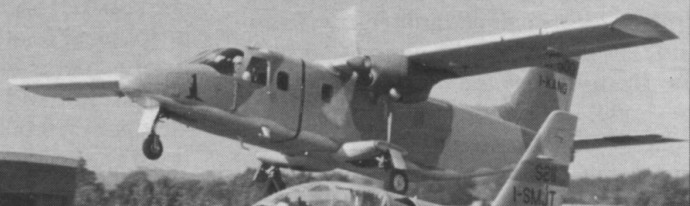
The prototype SF600TP Cangaru (Kangaroo) general utility transport was built by General Avia and made its first flight on 30 December 1978. Production examples entered service in an air taxi role on 8 April 1988.
A choice of fixed or retractable undercarriage versions was available, the engines being 450 shp (335 kW) Allison 250-B17F turboprops.
Projected military versions of the twin-turboprop SF.600TP Canguro include a swing-tail cargo transport, an electronic warfare aircraft, and a maritime surveillance variant with an undernose 360o -scan Bendix RDR-1400 search radar. Two underwing and two underfuselage hardpoints are provided.
The basic utility version can be equipped with 12 inward facing seats for paradropping, four stretchers for medevac, or Zeiss type cameras for photographic reconnaissance, and can also be used for target or glider towing.
In 1990 the PADC in the Philippines started assembling S 211s, followed by SF 260 TPWs and SF 600 Canguro in agreement with SIAI Marchetti of Italy.
The SF.600 Canguro was taken over by VulcanAir.
SF.600TP Engines: 2 x Allison 250-B17C turboprops, 450 shp (335 kW) Max take-off weight: 3300 kg / 7275 lb Wingspan: 15 m / 49 ft 3 in Length: 12.15 m / 40 ft 10 in Height: 4.6 m / 15 ft 1 in Max. speed: 305 km/h / 190 mph Ceiling: 7300 m / 23950 ft Range: 1580 km / 982 miles
The four-seat twin-turboprop Condor was designed and developed to the prototype stage by General Avia for military duties such as multiengine and weapons training, maritime surveillance, SAR, anti-tank, and ground attack.
Following the first flight in May 1983, SIAI-Marchetti has been responsible for flight testing the F.20TP Condor aircraft, which can be fitted with two stores pylons under each wing. Low-priority development continued for some time.
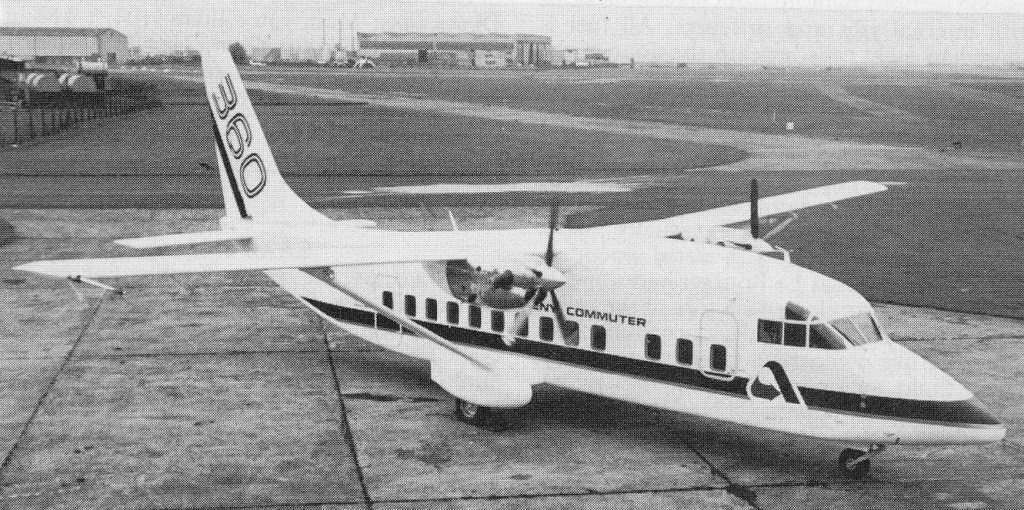
The 360 is a growth development of the 330 with more power, and a three foot stretch ahead of the wing and a redesigned rear fuselage and tail surfaces. An extra six seats (in two rows) were accommodated by stretching the cabin and deleting the 330’s rear loading ramp, and the tail arrangement was changed to a conventional single fin.
The prototype 360 flew on 1 June 1981 and the type entered service in December 1982. First introduced with Pratt & Whitney Canada PT6A-45R engines, the Shorts 360-300 version has 1,424 shp (1062 kW) PT6A-67R turboprops with six-bladed propellers and other refinements to produce about 18 per cent more thrust at take-off.
164 examples were sold up until 1991.
SD3.60 Engines: 2 x P&W PT6-65AR, 1403 shp Props: Hartzell 5-blade, 111-in Seats: 36 Length: 70.9 ft Height: 23.7 ft Wingspan: 74.7 ft Wing area: 453 sq.ft Wing aspect ratio: 12.3 Maximum ramp weight: 25,800 lb Maximum takeoff weight: 25,700 lb Standard empty weight: 16,600 lb Maximum useful load: 9200 lb Maximum landing weight: 25,400 lb Wing loading: 56.7 lbs/sq.ft Power loading: 9.7 lbs/hp Maximum usable fuel: 3840 lb Best rate of climb: 1010 fpm Service ceiling: 20,000 ft Maximum speed: 211 kt Normal cruise @ 7,000ft: 160 kt Fuel flow @ normal cruise: 975 pph Endurance at normal cruise: 3.4 hr Stalling speed clean: 94 kt Stalling speed gear/flaps down: 78 kt Turbulent-air penetration speed: 158 kt
Short 360-300 Engines: 2 x Pratt & Whitney PT6A-67R turboprops, 1062kW / 1,424 shp Prop: 6 blade Max take-off weight: 12290 kg / 27095 lb Wingspan: 22.8 m / 75 ft 10 in Length: 21.58 m / 71 ft 10 in Height: 7.27 m / 24 ft 10 in Wing area: 42.18 sq.m / 454.02 sq ft Cruise speed: 400 km/h / 249 mph Range w/max.payload: 745 km / 463 miles
The prototype of the Shorts SD3-30 30-passenger unpressurized commuter airliner; later redesignated Shorts 330, was derived from the smaller Skyvan, with a fuselage stretched to accommodate 30 passengers while retaining the Skyvan’s twin tail fin, but including a semi-retractable undercarriage.
The Short SD3-30 prototype (G-BSBH), a 30-passenger airliner powered by twin turboprop engines, was flown for the first time at Belfast, Northern Ireland on 22 August 1974, and the first entered service with the Canadian airline Time Air on 24 August 1976, although the first order had been placed by Command Airways of Pouglikeepsie, New York.
Versions available included the standard 330-200, the Sherpa civil freighter, and the 330-UTT utility tactical transport.
The USAF operated 18 twin-turboprop Sherpa/330-UTT from Zweibrucken in West Germany, providing a distribution service for high-priority spares in Europe. Designated C-23A, the aircraft were ordered in March 1984 to fulfil the European Distribution System Aircraft (EDSA) requirement. Two Sherpas were delivered in November 1984, and the remaining 16 by the end of 1985.
The C-23A is a freighter version of the Shorts 330-200, retaining many features of the civilian model including the forward freight door. An hydraulically operated rear cargo door/ramp is incorporated in the Sherpa, thus allowing through loading. Up to seven C08 or four LD3 cargo containers or two half-ton vehicles can be accommodated, and utility passenger operations may also be undertaken. The C-23A first flew on August 6, 1984, and is powered by two 893kW Pratt & Whitney Canada PYT6A-45R turboprops.
Designated C-23B, the first of 10 Shorts Super Sherpas for the US Army National Guard made its first flight in 1990. The aircraft are similar to the 18 C-23A Sherpas used by the US Air Force, but have more powerful Pratt & Whitney Canada PT6A-65AR turboprops, strengthened wings, five-bladed propellers and air-operable rear freight doors for supply dropping.
Lacking the rear loading ramp of the Sherpa, the Shorts 330-UTT (Utility Tactical Trans¬port) can carry a maximum payload of 3,630kg. Typical loads include 33 troops, 30 paratroops, or 15 stretchers. Range with 30 fully armed troops is greater than 1,100km. Two inward opening rear side doors are provided for para¬dropping. Customers for the 330-UTT include the Royal Thai Army and Royal Thai Police.
Nearly 100 had been delivered by 1990, and a total of 141 Short 330s were built before production ended in 1992.
SD3-30 Engines: 2 x P&WAC PT6A-45, 1120 hp Seats: 33 Wing loading: 48.6 lb/sq.ft Pwr loading: 9.8 lb/hp Max TO wt: 22,000 lb Operating wt: 14,230 lb Equipped useful load: 7770 lb Payload max fuel: 3930 lb Range max fuel/cruise: 690 nm/3.5 hr Range max fuel / range: 785 nm/ 5.5 hr Service ceiling: 18,500 ft Max cruise: 190 kt Max range cruise: 144 kt Vmc: 77 kt Stall: 73-89 kt 1.3 Vso: 95 kt ROC: 1130 fpm SE ROC: 210 fpm @ 101 kt SE Service ceiling: 9500 ft Min field length: 3650 ft Fuel cap: 3840 lb
SD3.30 Engines: 2 x P&W PT6A-45A, 1156 shp Props: Hartzell 5-blade, 111-in Seats: 30 Length: 58 ft Height: 16.2 ft Wingspan: 78.6 ft Wing area: 453 sq.ft Wing aspect ratio: 12.3 Maximum ramp weight: 22,500 lb Maximum takeoff weight: 22,400 lb Standard empty weight: 14,700 lb Maximum useful load: 7800 lb Zero-fuel weight: 21,140 lb Maximum landing weight: 22,100 lb Wing loading: 49.5 lbs/sq.ft Power loading: 9.7 lbs/hp Maximum usable fuel: 3840 lb Best rate of climb: 1070 fpm Certificated ceiling: 19,000 ft Maximum single-engine rate of climb: 210 fpm @ 105 kt Single-engine climb gradient: 120 ft/nm Single-engine ceiling: 6750 ft Maximum speed: 204 kt Normal cruise @ 10,000ft: 197 kt Fuel flow @ normal cruise: 890 pph Endurance at normal cruise: 3.9 hr Stalling speed clean: 89 kt Stalling speed gear/flaps down: 74 kt Turbulent-air penetration speed: 157 kt
330/UTT Engine: 2 x P&WAC PT6A turboprop Installed pwr: 1785 kW Span: 22.8 m Length: 17.7 m Wing area: 42.1 sq.m Empty wt: 6445 kg MTOW: 11,160 kg Payload: 3630 kg Cruise speed: 372 kph Initial ROC: 360 m / min Ceiling: 6100 m T/O run: 415 m Ldg run: 235 m Fuel internal: 2546 lt Range/payload: 1390 km with 2330 kg Capacity: 33 pax
C-23A Sherpa Engine: 2 x P&WAC PT6A Installed pwr: 1785 kW Span: 22.8 m Length: 17.7 m Wing area: 42.1 sq.m MTOW: 10,390 kg Payload: 3175 kg Cruise speed: 350 kph Initial ROC: 360 m / min Ceiling: 6100 m T/O run (to 15m): 1036 m Ldg run (from 15m): 1225 m Fuel internal: 2032 lt Range/payload: 1240 km with 2270 kg Capacity: 33 pax
C-23A Engines: 2 x Pratt Whitney PT6A-45R turboprops, 900kW Max take-off weight: 10390 kg / 22906 lb Loaded weight: 6680 kg / 14727 lb Payload: 3175kg / 7000 lb Wingspan: 22.76 m / 75 ft 8 in Length: 17.69 m / 58 ft 0 in Height: 4.95 m / 16 ft 3 in Wing area: 42.1 sq.m / 453.16 sq ft Cruise speed: 352 km/h / 219 mph Ceiling: 6000 m / 19700 ft Range w/max.payload: 370-1240 km / 230 – 771 miles Crew: 3
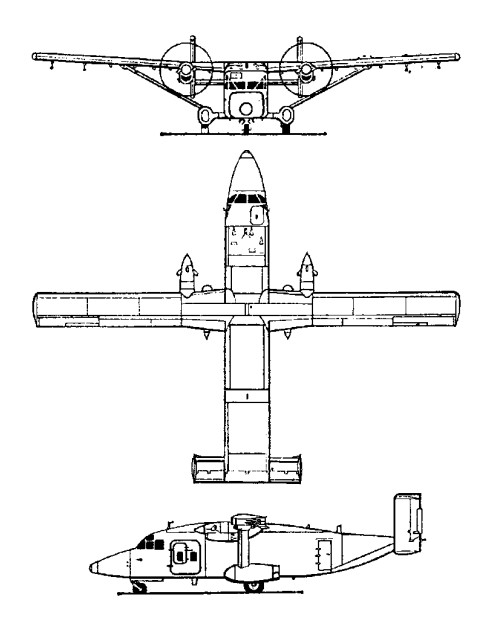
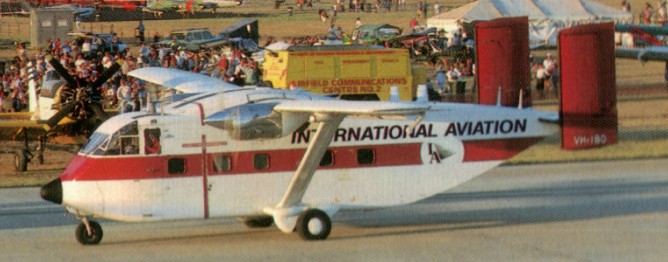
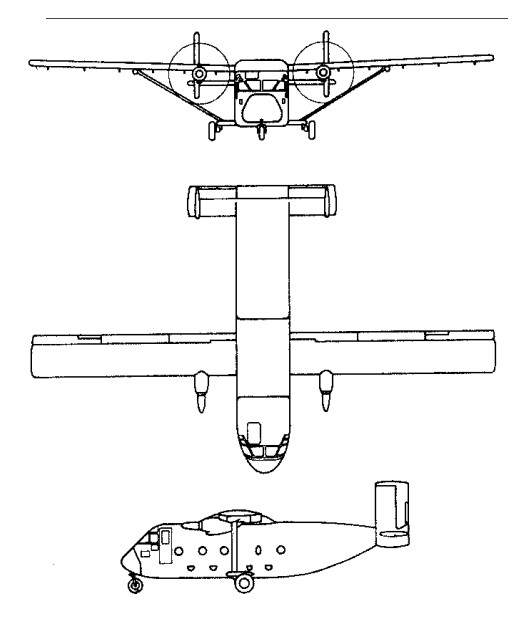
The Skyvan had its origins in the Miles Aerovan, the concept of which was taken on by Short in a radically overhauled design. It was designed to carry an 11 ton payload over 200 miles at 160 m.p.h, with an all up weight of 8,600 lb.
Two prototypes were built at Belfast during 1960 with two 390 bhp Continental GTS IO 520s. It was decided that turboprop power was required, so the prototype and early production (Series 2) examples were ultimately fitted with Astazou II turboprops.
The Short Skyvan (G ASCN), re engined with Turbomeca Astazou turboprops, flew for the first time with its new power plants on October 2, 1963. With Dennis Taylor at the controls the Skyvan was in the air for twenty five minutes on its first flight.
These engines were not ideal for hot-and-high conditions or American customers, so the Series 3 was upgraded to the specified Garrett type.
The Skyliner was a dedicated passenger-carrying version.
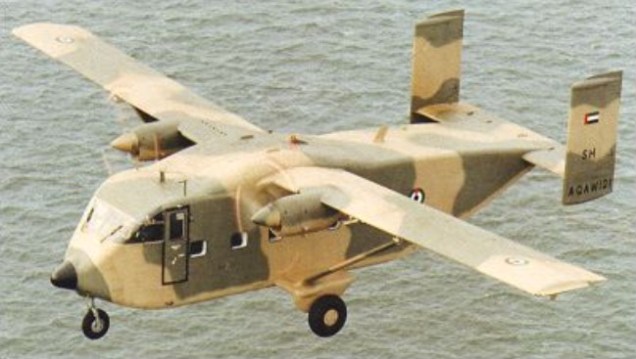
The military version of the twin-turboprop Skyvan is the Skyvan 3M-200, which is cleared to an increased maximum take-off weight of 6,804kg for military operations. Powered by two 533kW Garrett TPE331 engines, the prototype Skyvan 3M first flew early in 1970. Troop transport, paradropping, assault transport, SAR, and medevac are among the capabilities of the Skyvan. The Skyvans of the Sultan of Oman’s Air Force have Racal ASR 360 airborne surveillance radars for maritime patrol and SAR duties.
The sole example of the Skyvan sold to the Sharjah Amiri Air Wing was delivered in 1986. It was also the last Skyvan built.
In all, 149 Skyvans were built and sold to commercial freight/passenger ‘bush’ operators and military/paramilitary operators up until 1986.
SC-7 Engines: 2 x Garrett TPE 331-2-201A, 715 shp / 533kW Props: Hartzell 3-blade, 102-in Seats: 19 Length: 40 ft Height: 15 ft Wingspan: 64.8 ft Wing area: 373 sq.ft Wing aspect ratio: 11 Maximum ramp weight: 12,500 lb Maximum takeoff weight: 12,500 lb Standard empty weight: 7100 lb Maximum useful load: 5400 lb Equipped useful load: 3900 lb Maximum landing weight: 12,500 lb Wing loading: 33.5 lbs/sq.ft Power loading: 8.7 lbs/hp Fuel cap: 2320/3105 lb Payload max fuel: 795 lb Range max fuel/cruise: 770nm/4.5hr Range max fuel /range: 849nm/5.9hr Best rate of climb: 1640 fpm Service ceiling: 22,100 ft Maximum single-engine rate of climb: 450 fpm @ 92 kt Single-engine ceiling: 12,500 ft Maximum speed: 176 kt Normal cruise @ 10,000ft: 169 kt Fuel flow @ normal cruise: 482 pph Endurance at normal cruise: 6 hr Max range cruise: 145 kt Vmc: 67 kt Stalling speed clean: 74 kt Stalling speed gear/flaps down: 55 kt Turbulent-air penetration speed: 140 kt Min field length: 1580 ft 1.3 Vso: 78 kt
Skyvan Series 3 Engines: 2 x Garrett TPE331-201 turbo-prop, Max take-off weight: 5670 kg / 12500 lb Empty weight: 3500 kg / 7716 lb Wingspan: 19.79 m / 65 ft 11 in Length: 12.22 m / 40 ft 1 in Height: 4.6 m / 15 ft 1 in Wing area: 34.65 sq.m / 372.97 sq ft Cruise speed: 325 km/h / 202 mph Ceiling: 6860 m / 22500 ft Range w/max.fuel: 1117 km / 694 miles Range w/max.payload: 450 km / 280 miles Crew: 2 Passengers: 19
Skyvan 3M-200 Engine: 2 x Garrett TPE331 Installed pwr: 1060 kW Span: 19.8 m Length: 12.2 m Wing area: 35.1 sq.m Empty wt: 3768 kg MTOW: 6800 kg Payload: 2360 kg Cruise speed: 308 kph Initial ROC: 470 m / min Ceiling: 6700 m T/O run: 290 m Ldg run: 210 m Fuel internal: 1330 (+440) lt Range/payload: 1075 km with 4000 kg Capacity: 20 pax
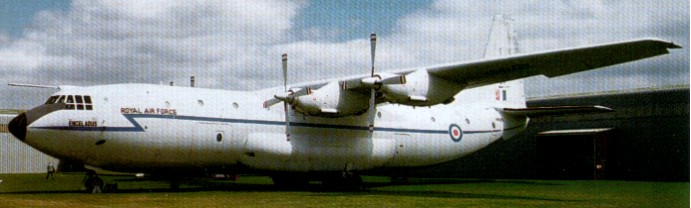
The Shorts Belfast was originally built for the RAF in the 1960s and although the manufacturer initiated a civil certification programme, of which approximately 65% was completed, this was cancelled due to apparent lack of interest displayed by commercial carriers at that time. The development of the Belfast was initially based upon that of the Bristol Britannia the design was for some time dubbed the Britannic, and the RAF finalised a contract for 10 of the type to serve in the strategic, heavy airlift role.
The aircraft eventually utilised only some of the Britannia’s basic wing structure. It was specifically designed for the carriage of heavy freight, including the largest types of guns, vehicles, guided missiles and other loads and had ‘beaver-tail’ rear loading doors capable of permitting the unhindered passage of any load that the fuselage could contain. As a troop transport it could carry 200 men, and was often used to carry helicopters overseas.
Following a development which spanned four years, the first Belfast made its maiden flight on 5 January 1964 and deliveries to the RAF commenced on 20 January 1966, when the first C.Mk l was handed over to No 53 Squadron at Brize Norton.
As a result of defence cuts at the end of 1976, the RAF phased out Belfast operations and, on 23 March 1977, Eurolatin Aviation concluded the purchase of the aircraft. At this stage in their career the Belfasts had flown 23 million nm without incident, averaging 8,000 flying hr/airframe. Of the original 10 aircraft, four were scrapped, one was destined for display with the RAF Museum and TAC HeavyLift had access to the other five.
On obtaining the aircraft, the airline completed an investigation to ascertain the outsanding conditions for Civil Aviation Authority (CAA) approval and following the go ahead decision for certification, they enrolled the aid of Marshalls of Cambridge to provide the design and flight test support for the Belfasts under the organisation’s existing CAA approvals. An independent engineering base at Southend airport was set up to carry out modifications required by the programme and to organise the management, identification, certifying and transport of spares for the fleet.
The Belfast civil certification programme involved a cost of over £4 million and included 120hr of flight testing; 20,000man/hr of design; 25,000man/hr of aircraft engineering; a complete assessment of all aircraft systems; civil certification of the Rolls Royce Tyne engine; production of civil maintenance schedules, flight operating and technical manuals; and design, manufacture and installation of modifications to the radio station, navigation equipment and the aircraft’s compulsory ‘black boxes’, cockpit voice recorder and flight data recorder. Additional tasks were the removal of both the Belfast’s RAF automatic landing system (the type became the first military transport in the World cleared for ‘hands¬off’ autolanding in fully operational conditions), and in flight refuelling equipment.
The dimensions and specifications of the Belfast are impressive and its hold has a volume of 11,000 cu.ft with a cross section minimum of 12ftx 12ft. It is capable of carrying up to 34 tons of freight although at this weight its range is a very limiting 700 800nm, and it has a cruising speed approaching 330mph.
Several aircraft operated with civil Heavylift Cargo Airlines at Stansted in Britain.
Short Belfast C 1 Engines: 4 x Rolls Royce Tyne RTy 12 Mk 101 turboprops, 5,730eshp / 4273kW Length: 136ft 5in / 41.58 m Height: 47ft / 14.33 m Wing span: 158ft 10in / 48.4 m Wing area: 2464.956 sq.ft / 229.0 sq.m Max take off weight: 230050 lb / 104330.0 kg Weight empty: 127023.4 lb / 57607.0 kg Cruise with max payload: 275kts (510km/hr) Service ceiling: 30003 ft / 9145 m Cruising altitude: 23950 ft / 7300 m Range w/max.fuel: 10200 km / 6338 miles Range w/max.payload: 2000 km / 1243 miles Max hold width: 16ft 1in Max payload: 75,000 lb (34,000kg) Capacity: 200 troops Crew: 4-5
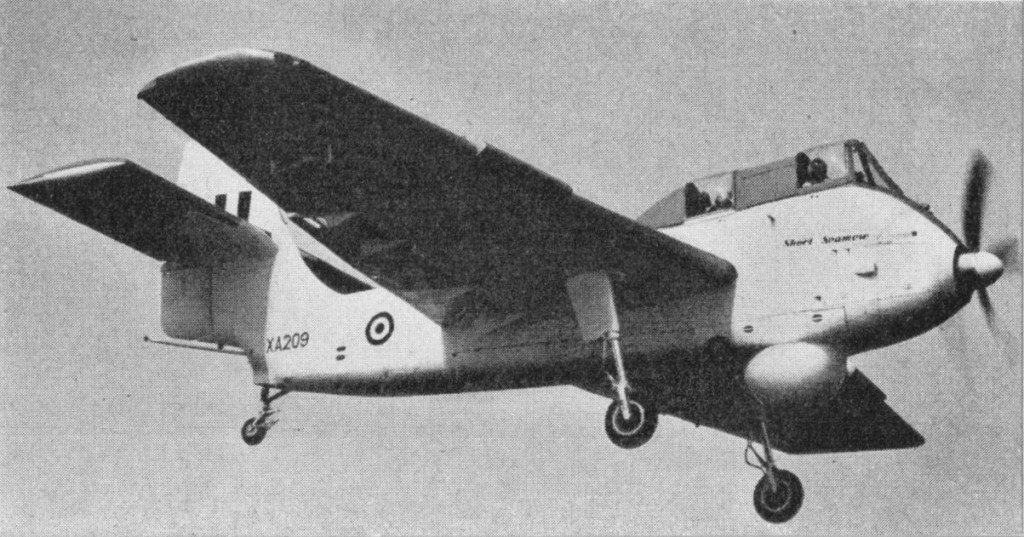
The Seamew was conceived as a cheap, rugged anti-submarine aircraft able to operate from small carriers used by the UK and some other allied nations. To this end it was built with a fixed landing gear and a strong structure. The fixed undercarriage legs could be jettisoned in the event of a ditching at sea. The need to house a large search radar under the belly led to the adoption of a tailwheel undercarriage layout. Despite this, the prototype was badly damaged on its first landing, although it was repaired in time for the Farnborough Air Show.
The Mamba powered anti submarine Short Seamew with 1,590 s.h.p. underwent intensive development with two prototypes. The higher lift characteristics at slow speeds for operation from escort type carriers have been improved by the installation of fixed slats at the mid span of each wing, while the slat under the inner tailplane leading edge was replaced by a vented fillet. The Seamew can power fold its wings and extended them.
In handling terms the Seamew was described as having some ‘vicious tendencies’. It was capable of aerobatics, but the chief test pilot seemed to be the only one able to wring the full manoeuvrability out of the Seamew – until he stalled the prototype Mk.2 during a display and was killed.
Production began for RAF Coastal Command and the Royal Navy, but the RAF order was cancelled in 1956 and the Navy’s was a victim of the defence cuts of the following year. The Mk 2 was a version for Coastal Command with larger wheels and manual wing folding. It was cancelled after rwo were completed.
Short SB-6 Seamew AS1
S.B.6 Seamew Engine: 1 x 1780hp Armstrong Siddeley Mamba turboprop Max take-off weight: 6804 kg / 15000 lb Wingspan: 16.75 m / 55 ft 11 in Length: 12.50 m / 41 ft 0 in Max. speed: 378 km/h / 235 mph Crew: 2







 All Aero